A fleet vehicle that fails to start costs more than the repair — it costs a missed delivery, a stranded driver, and a compliance gap if the breakdown happens during a regulated run. Cold cranking amp (CCA) degradation, corroded battery cables, and failing alternators are the leading causes of no-start failures in commercial fleets, yet most go undetected until roadside failure. Sign Up Free to track battery health, CCA test results, and electrical inspection findings per vehicle in Oxmaint — with automatic replacement alerts before failure occurs. Battery replacement and electrical system inspections need to be scheduled, recorded, and acted on — not left to driver observation. Book a Demo to see how Oxmaint embeds battery and electrical checks into every PM cycle across your fleet.
Required Battery and Electrical Inspection — Frequency Matrix
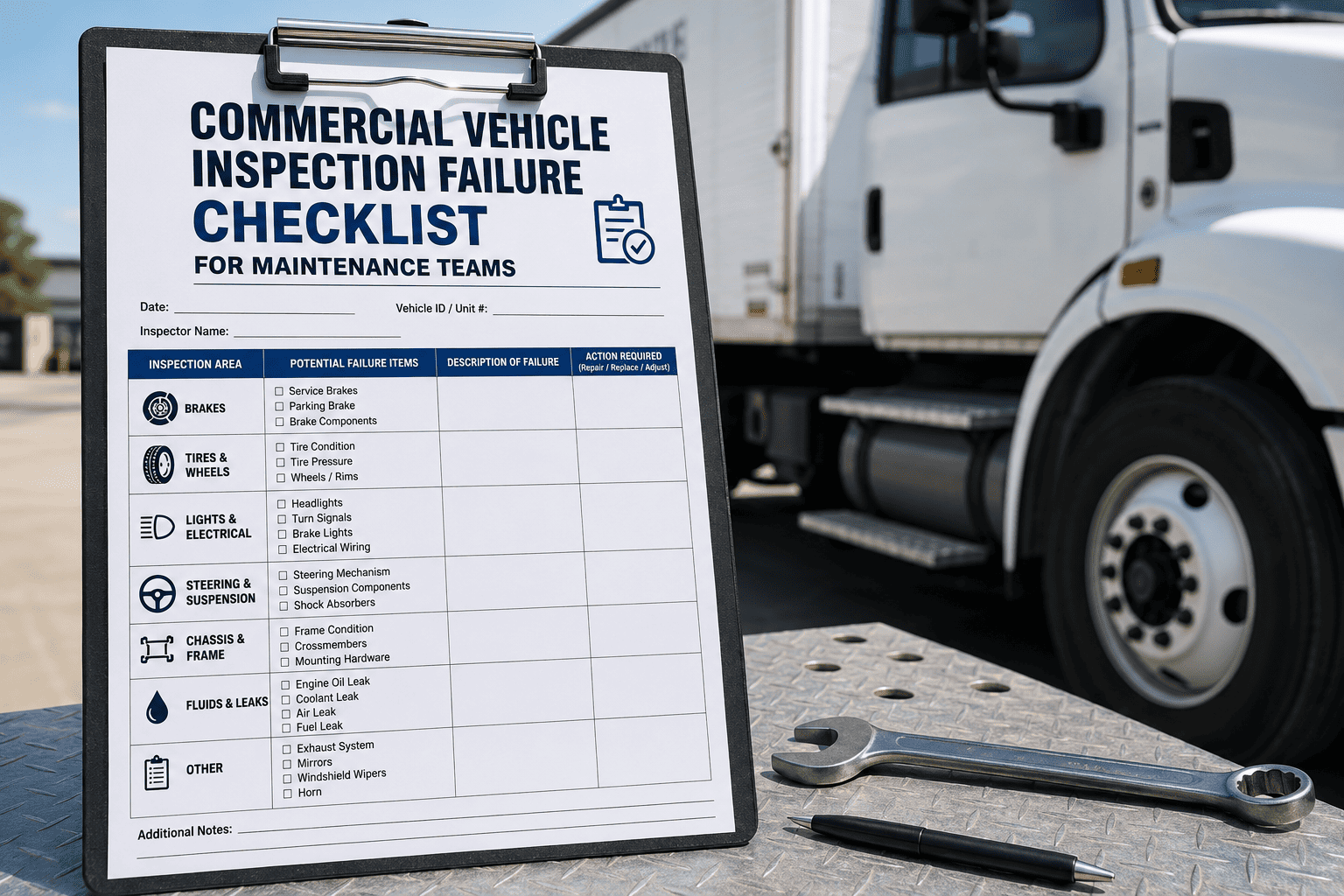
Fleet battery and electrical system inspections must follow a structured frequency — monthly driver checks alone will not catch CCA degradation, failing alternators, or corroded terminals before they cause a no-start. The matrix below shows which items require monthly, quarterly, and annual attention, and which findings are immediate removal-from-service conditions. Sign Up Free to manage battery inspection schedules per vehicle in Oxmaint.
Technology Supporting Fleet Battery Compliance
Battery failures are the most preventable no-start cause in fleet operations — and the least tracked. CCA test results, installation dates, and cable condition findings disappear into paper logs or are never recorded at all. Three technology layers make battery compliance automatic and exception-driven. Book a Demo to see how Oxmaint connects battery tracking to your PM workflow.
1. Battery Condition and CCA Load Test Checklist
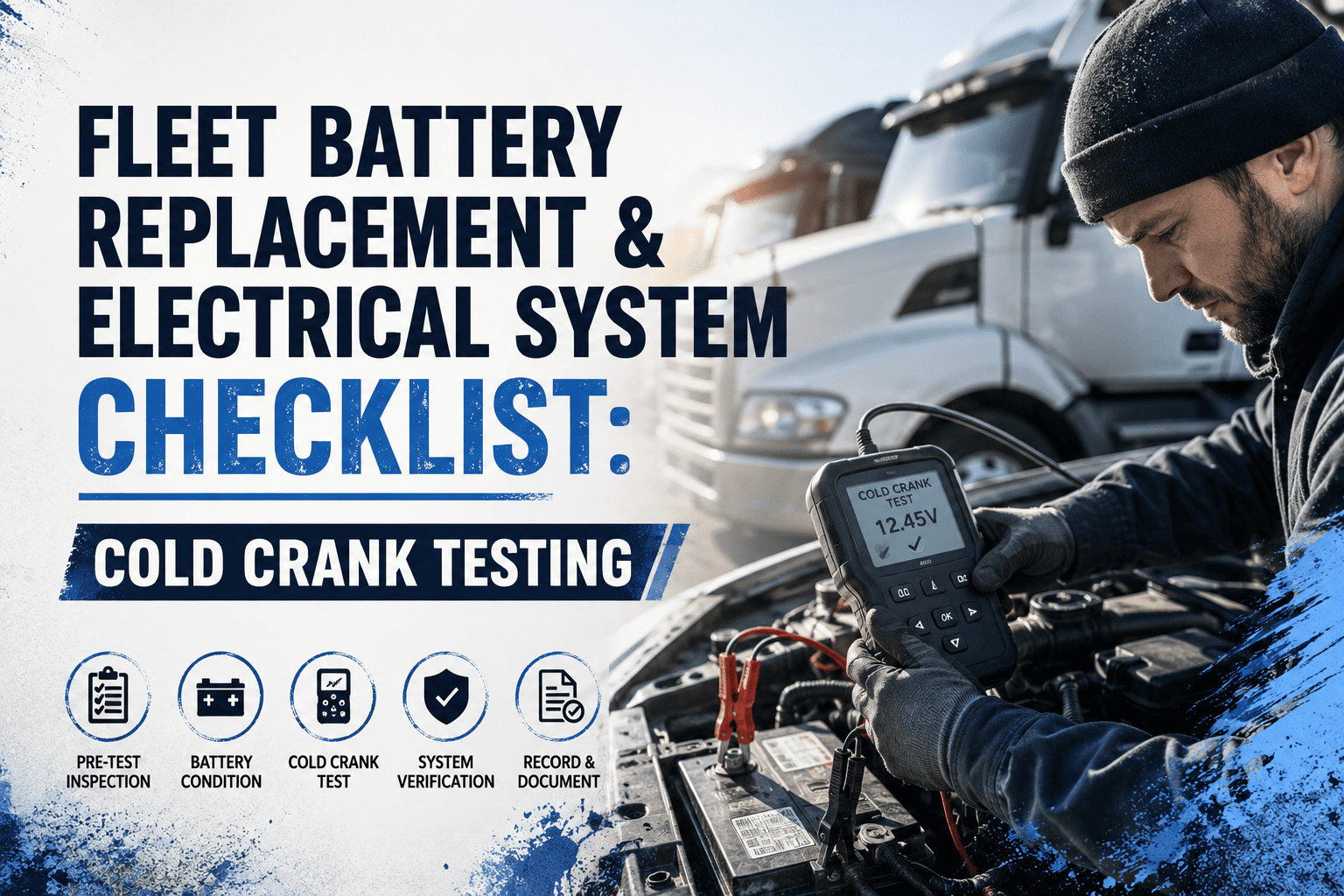
A battery that starts the vehicle on a warm day may fail completely when ambient temperatures drop — because CCA capacity degrades gradually and is invisible until a load is applied. A full CCA load test at annual service, combined with monthly terminal checks, is the minimum standard for commercial fleet battery compliance. Sign Up Free to record battery load test results and replacement dates per vehicle in Oxmaint.
CCA load test — measured output vs rated specification
Apply a calibrated load tester at 50% of rated CCA for 15 seconds — a battery delivering less than 75% of rated CCA under load requires immediate replacement. Record the result and date in the vehicle's battery register. Replace — below 75% CCA
Open circuit voltage — rested voltage before load test
Measure rested voltage after 2 hours off charge — below 12.4V indicates a partially discharged or degraded battery. A battery that will not hold rested voltage above 12.4V is a replacement candidate regardless of age. Defect — below 12.4V rested
Battery case — cracks, swelling, and electrolyte leakage
Any crack, case deformation, or electrolyte staining on the battery tray is an immediate removal condition — a leaking battery will corrode the tray, cables, and surrounding components rapidly. Remove — cracked or leaking case
Battery age — installation date vs fleet replacement policy
Verify installation date against the fleet's battery replacement policy — most commercial vehicle batteries reach end-of-reliable-life at 3–5 years regardless of tested condition. Schedule proactive replacement before the threshold, not after a failure. Defect — past replacement threshold
Battery hold-down — bracket secure and clamp undamaged
A battery that can move in its tray will vibrate, accelerating internal plate damage and reducing CCA capacity. Verify the hold-down clamp is torqued correctly and the tray is undamaged and free of corrosion. Defect — loose or missing hold-down
Battery rating — CCA and RC rating matches vehicle specification
Verify the installed battery's CCA rating meets or exceeds the OEM minimum for the vehicle — an undersized replacement is a compliance gap and a no-start risk in cold operating conditions. Replace — below OEM CCA spec
2. Battery Terminal and Cable Inspection Checklist
Corroded terminals and degraded battery cables cause more electrical system failures than bad batteries — because resistance in the cable path prevents the full CCA from reaching the starter even when the battery tests healthy. Terminal and cable inspection must be part of every PM service event. Book a Demo to see how Oxmaint tracks cable condition findings per vehicle across your fleet.
Positive and negative terminal posts — corrosion and connection
Remove both terminal clamps and inspect for white or blue oxide corrosion on the post — clean with a terminal brush and baking soda solution, then coat with anti-corrosion gel before reinstalling. Retorque clamps to spec. Defect — visible corrosion buildup
Battery cables — insulation condition and routing
Inspect the full length of both battery cables for cracks, abrasion through the insulation, heat damage, or chafing against chassis components. Any exposed conductor is a short-circuit risk and an immediate replacement condition. Replace — exposed conductor
Cable end connectors — cracks, corrosion inside the crimp
Internal corrosion inside the cable crimp or connector body adds resistance that a visual terminal check will not detect — replace any cable end connector with visible oxidation inside the crimp or terminal pocket. Defect — corroded crimp connection
Ground straps — chassis, engine block, and body
Locate all ground strap attachment points and verify each strap is intact, free of corrosion, and securely fastened — a high-resistance ground path causes more electrical faults than a positive cable fault in most commercial vehicles. Defect — corroded or loose ground
Voltage drop test — positive and negative cable under starter load
With a voltmeter across the positive cable under starter load, any reading above 0.5V indicates excessive resistance in the cable or connections — identify and replace the high-resistance section before the battery is condemned unnecessarily. Defect — above 0.5V drop
3. Charging System and Alternator Verification Checklist
A battery that fails load test may be the victim, not the cause — a failing alternator that undercharges the battery will discharge every replacement installed until the root cause is corrected. Alternator output and charging system verification must accompany every battery replacement and every annual electrical inspection. Sign Up Free to log alternator test results and charging system findings in Oxmaint per vehicle.
Alternator output voltage — at idle and at 2000 RPM under load
Charging voltage must read 13.8–14.5V at both idle and 2000 RPM with all accessories on — a reading below 13.5V indicates an undercharging alternator that will drain the battery progressively until a no-start failure occurs. Replace — below 13.5V under load
Alternator ripple voltage — diode condition check
AC ripple above 0.5V on the DC charging line indicates a failed alternator diode — this will cause erratic electrical system behavior and progressively discharge the battery even when the alternator output voltage reads within range. Defect — ripple above 0.5V AC
Alternator belt — tension, condition, and pulley alignment
A slipping or cracked alternator belt causes intermittent undercharging — check tension to spec, inspect for glazing or cracks across the belt width, and verify pulley alignment is within 1mm across the drive system. Defect — cracked or slipping belt
Starter current draw — amperage within OEM specification
Measure starter current draw during cranking — excessive draw (above OEM spec) indicates a failing starter motor that is overtaxing the battery during each start cycle, accelerating CCA degradation and increasing no-start risk. Defect — above rated draw
Parasitic draw — current drain with all circuits off
With the vehicle off and all accessories disconnected, parasitic draw must be below 50mA for most commercial vehicles — a draw above this level will discharge a healthy battery over a weekend and cause Monday morning no-start events. Defect — above 50mA parasitic draw
Alternator mounting — bracket secure and vibration-free
Inspect the alternator mounting bracket for cracks and verify all mounting bolts are torqued to spec — a loose alternator will wear its own bearing prematurely and introduce belt misalignment that causes charging system dropout. Defect — loose or cracked mount
Oxmaint embeds battery load test scheduling, CCA result recording, and alternator test reminders directly into each vehicle's PM checklist — so every electrical inspection item is completed and recorded at the correct interval without manual tracking by the compliance team. Book a Demo to see Oxmaint's fleet electrical compliance workflow.
Frequently Asked Questions
The most common questions from fleet maintenance and compliance teams about battery replacement intervals, CCA testing, and electrical system inspection requirements for commercial vehicles.
Annually at minimum for most commercial vehicles — and quarterly for vehicles operating in extreme cold climates or high-demand electrical applications. Load test results should be recorded per vehicle with the date and technician ID.
A battery delivering less than 75% of its rated CCA under a calibrated load test should be replaced — even if it is still starting the vehicle. Batteries between 75–85% of rated CCA should be flagged for monitoring at the next PM interval.
Yes — if the cables or terminals have high resistance, the battery's full CCA cannot reach the starter. Always perform a voltage drop test on the positive and negative cable paths before condemning a battery that passes a load test.
13.8–14.5V at the battery terminals with the engine running and accessories on. Below 13.5V indicates undercharging; above 14.8V indicates overcharging — both conditions accelerate battery degradation.
Oxmaint tracks installation date, CCA rating, and last test result per vehicle — generating 30-day advance replacement alerts and work orders automatically when a battery reaches its age or test-result threshold, without manual calendar management.
Below 50mA with all circuits off and the vehicle fully powered down. Higher parasitic draw requires circuit-by-circuit diagnosis to identify the source — common causes include stuck relays, aftermarket accessories, and faulty BCM modules.