A fleet vehicle accident is a multi-dimensional event — it is simultaneously a safety incident, an insurance claim, a repair project, and a fleet availability problem. Most fleet operations handle these four dimensions through separate processes managed by different people: safety officers, insurance coordinators, workshop supervisors, and fleet managers. The result is a workflow that exists only in people's heads and email threads, producing inconsistent documentation, delayed repair authorisations, missed subrogation opportunities, and return-to-service times that are 40–60% longer than they need to be. A structured accident repair workflow, managed through a CMMS from incident report to return-to-service sign-off, closes every one of these gaps. OxMaint's AI Predictive Maintenance and work order platform gives fleet safety and maintenance teams the connected workflow to handle accident repairs professionally, consistently, and on time.
Safety & Repairs · Fleet Management Comparison Guide
Fleet Accident Repair Workflow: From Incident to Return-to-Service
A side-by-side comparison of ad-hoc vs. structured CMMS-driven accident repair workflows — and the return-to-service time, cost, and compliance outcomes each produces.
40–60%
Longer return-to-service time with ad-hoc vs. structured repair workflows
3x
Higher documentation completeness with CMMS-managed incident records
25%
Reduction in total repair cost with structured authorisation and vendor control
The Accident Repair Workflow: 6 Stages Compared
From the moment an incident is reported to the moment the repaired vehicle returns to active fleet status, there are six distinct stages in the accident repair workflow. Each stage presents opportunities for delay, documentation failure, or cost overrun. Here is how an ad-hoc workflow compares to a CMMS-structured process at each stage.
Stage 1
Incident Reporting
Ad-Hoc Workflow
Driver fills out a paper form or sends an email. Photos are taken on a personal phone and may or may not be shared. Incident details are inconsistent — different information captured by different drivers. Form sits in an inbox until someone processes it. No automatic notification to fleet manager, safety officer, or insurance coordinator.
Result: Incomplete incident records, delayed notifications, inconsistent photo documentation
CMMS-Structured Workflow
Driver completes a standardised digital incident form on mobile — required fields enforce complete data capture. Photos, GPS location, time-stamp, and third-party details attach directly to the incident record. Automatic notifications sent immediately to fleet manager, safety officer, and insurance coordinator. Incident record is immutable and timestamped.
Result: Complete, timestamped incident record ready for insurance submission within minutes
Stage 2
Initial Damage Assessment
Ad-Hoc Workflow
Vehicle arrives at workshop. Technician does a visual walk-around. Damage notes are written on a paper worksheet or verbally communicated to the workshop supervisor. No formal scope of repair document. Estimate may be done informally before authorization, or repair begins before the full damage picture is known — leading to supplement estimates and extended timelines.
Result: Scope creep, supplement estimates, and delayed insurance authorisation
CMMS-Structured Workflow
Digital damage assessment checklist captures all damage with photos tied to specific vehicle zones. Assessment generates a structured scope-of-repair document with estimated costs before any work begins. This document becomes the basis for insurance pre-authorisation — one submission, all documentation in place. Any supplement repairs discovered during repair are captured through a change order process with timestamped approval.
Result: Faster insurance pre-authorisation, fewer supplements, controlled repair scope
Stage 3
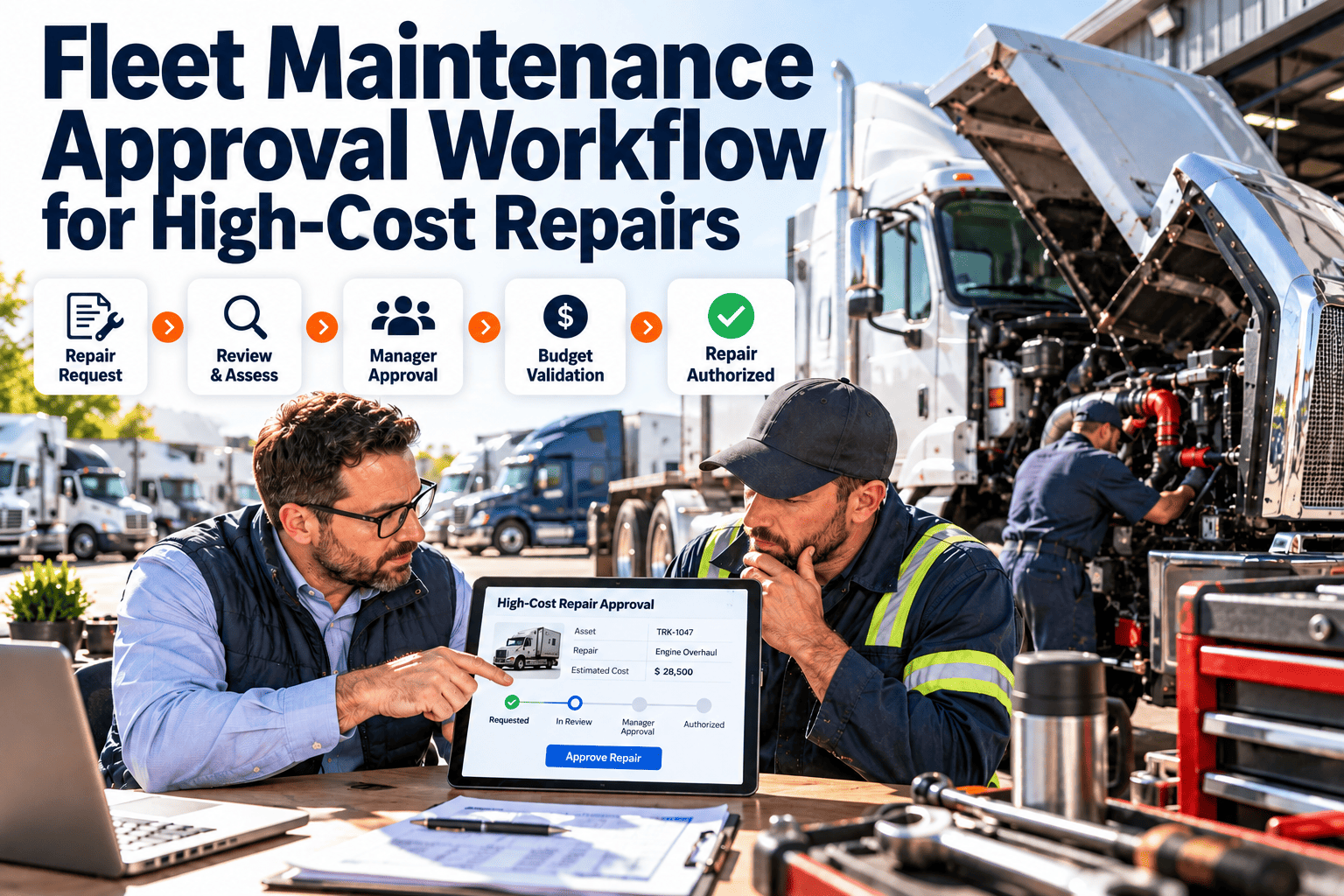
Repair Authorization
Ad-Hoc Workflow
Authorisation is a sequence of phone calls and emails between workshop supervisor, fleet manager, and insurance adjuster. Each party works from different information. Authorisation delays of 3–7 days are common. Vehicle sits unrepaired while parties communicate. Cost thresholds for in-house vs. outsource decisions are informal and inconsistent.
Result: 3–7 day authorisation delay, vehicle idle, inconsistent spend approval
CMMS-Structured Workflow
Repair scope document is routed for approval through a defined workflow with configured thresholds — repairs below a set cost level auto-approve; above threshold triggers fleet manager review; above a second threshold triggers senior management sign-off. All approvals are timestamped in the work order. Insurance adjuster has direct access to the incident record and damage documentation, reducing adjuster call-backs and delays.
Result: Sub-24-hour authorisation for standard repairs, clear audit trail
Stage 4
Repair Execution and Parts Management
Ad-Hoc Workflow
Parts are ordered verbally or via phone when needed. No pre-ordering based on damage assessment. Workshop waits for parts after repair begins. Labour time is not tracked against the job. Total repair cost is only known when the invoice arrives. No visibility into repair progress for fleet manager — status updates require calling the workshop.
Result: Parts delays extend repair time, cost unknown until completion
CMMS-Structured Workflow
Damage assessment generates a parts list immediately. Parts are ordered before the vehicle enters the active repair bay — they arrive ready for the job. Labour is tracked against the work order in real time. Fleet manager sees live repair progress on the dashboard. Running cost vs. estimate is visible throughout, enabling mid-repair decisions if scope changes. ETA for return to service is calculable from the start.
Result: Faster repair cycle, cost visibility throughout, predictable return-to-service date
Stage 5
Quality Check and Return-to-Service
Ad-Hoc Workflow
Technician advises workshop supervisor the job is done. Supervisor does a walk-around. Vehicle is released. No structured sign-off checklist. No formal documentation that quality standards were met. If a subsequent issue emerges, there is no record of the condition at time of return to service to support a warranty or warranty-back claim.
Result: No quality documentation, rework risk, warranty gaps
CMMS-Structured Workflow
Repair completion triggers a structured return-to-service checklist — QC sign-off by a designated inspector captures condition, test results (where applicable), and as-repaired photos. Sign-off is timestamped and attached to the vehicle's CMMS record. Fleet manager receives a return-to-service notification. If the same repair location shows a defect within a warranty period, the CMMS record provides clear evidence of condition at time of return.
Result: Documented quality standard, warranty protection, automatic fleet manager notification
Stage 6
Post-Repair Analysis and Insurance Recovery
Ad-Hoc Workflow
Total repair cost is recorded somewhere — maybe in an accounts spreadsheet, maybe in an email thread. Insurance recovery is pursued if someone remembers to follow up. Third-party recovery (subrogation) is often missed because the documentation to support a claim isn't assembled. Accident patterns across the fleet are invisible because there is no aggregate data.
Result: Missed recovery opportunities, no fleet-level accident trend data
CMMS-Structured Workflow
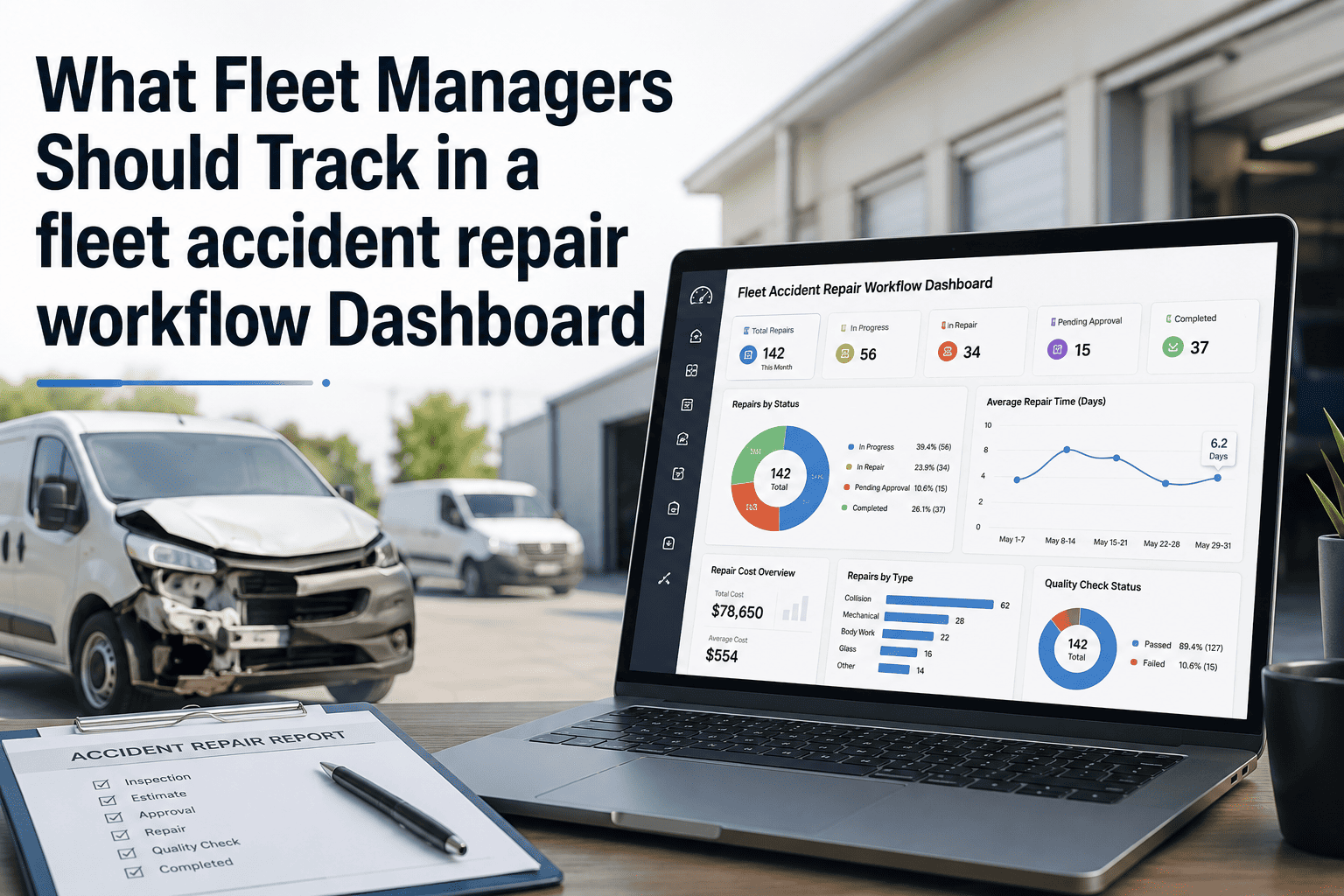
Closed work order generates a complete cost record: parts, labour, and vendor costs. Insurance recovery status is tracked within the work order. Third-party liability cases are flagged at incident reporting stage and tracked through to recovery close. Fleet-level accident reporting surfaces vehicles with repeated incidents, high-risk routes or times, and patterns that inform driver training and risk management programs.
Result: Systematic insurance recovery, fleet risk intelligence, subrogation support
OxMaint's work order and incident management platform connects all six stages of the accident repair workflow — from mobile incident reporting to post-repair insurance tracking. Start a free trial or book a 30-minute demo to see the complete accident repair workflow.
Return-to-Service Time: Ad-Hoc vs. Structured Workflow
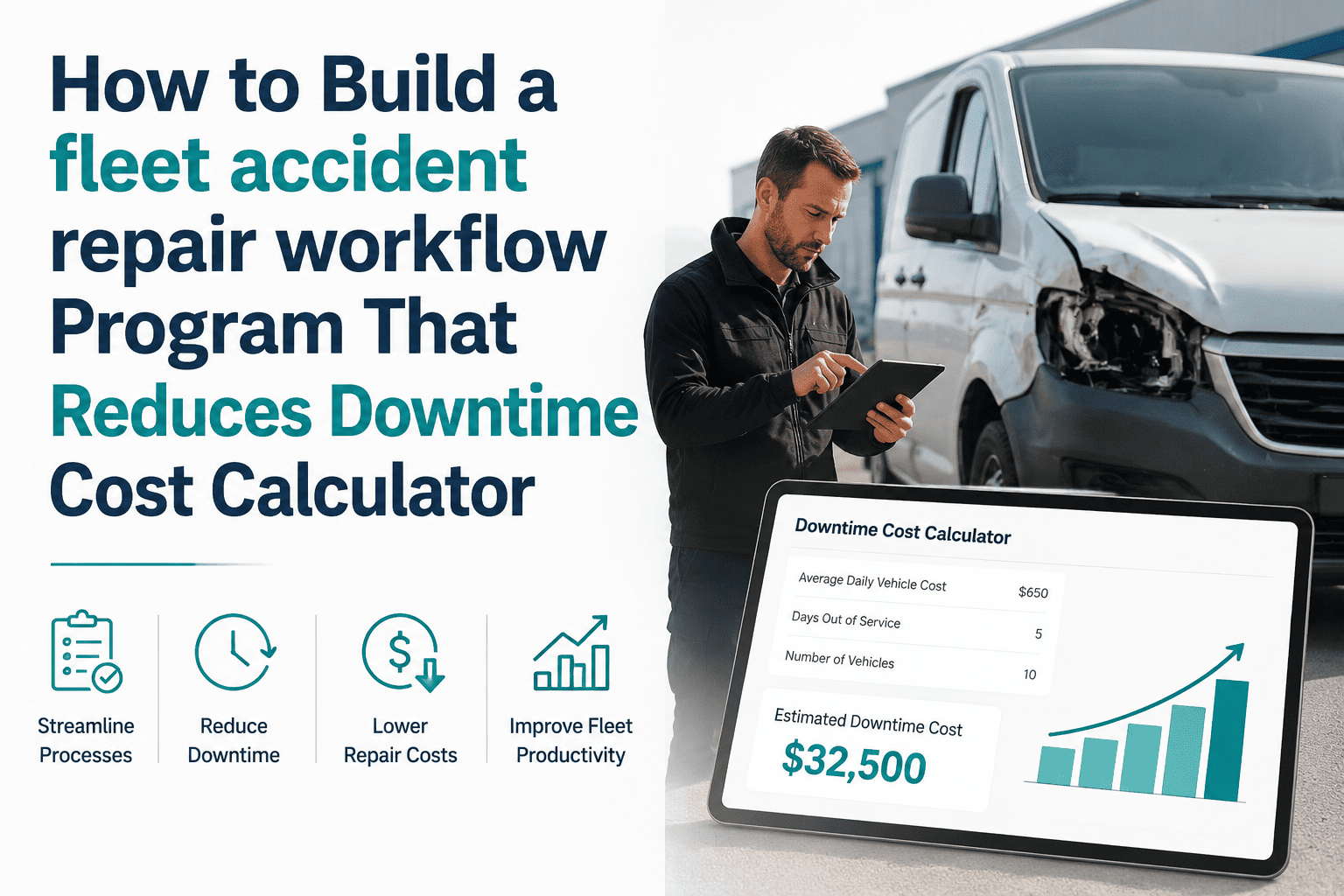
Return-to-service time is the metric that quantifies workflow efficiency most directly. Here is a typical timeline comparison for a standard bodywork and structural repair on a fleet vehicle — a real-world scenario tracked across multiple fleet operators.
Ad-Hoc Workflow Timeline
Day 1Incident reported — email sent, paper form completed
Day 2–3Vehicle delivered to workshop, damage assessed informally
Day 3–6Authorisation phone calls and email chain with insurer
Day 6–8Parts ordered — some arrive, some delayed
Day 8–12Repair begins with available parts, pauses waiting for others
Day 13–15Repair complete, informal sign-off, vehicle returned
Average: 14–16 days out of service
CMMS-Structured Workflow Timeline
Day 1Incident reported digitally — complete record, instant notifications
Day 1–2Digital damage assessment generates scope and parts list
Day 2Auto-approval for standard repairs; parts ordered immediately
Day 3–4Parts arrive (pre-ordered from assessment), repair begins
Day 4–7Repair completed with live progress tracking
Day 7–8Structured QC sign-off, return-to-service notification
Average: 7–9 days out of service
Frequently Asked Questions
What information should be captured in a fleet accident incident report?
A complete fleet incident report should capture: date, time, and GPS location of incident; vehicle ID and driver details; third-party information (if applicable); damage description for each vehicle zone; photos of all damage areas; witness statements; police report reference if applicable; and the driver's account of events. OxMaint's digital incident form enforces all required fields, ensuring complete documentation every time.
See OxMaint's incident reporting workflow.
How does a structured accident repair workflow help with insurance claims?
Insurance adjusters work faster when they receive complete, organised documentation. A CMMS-structured workflow provides timestamped incident records, photo documentation by damage zone, structured repair cost breakdowns, and a clear audit trail from incident to repair completion — all in a format that supports fast adjuster processing. Structured documentation also supports third-party liability recovery (subrogation) in at-fault third-party incidents, which ad-hoc processes routinely miss.
Can OxMaint track accident repair costs separately from routine maintenance costs for a vehicle?
Yes. OxMaint allows work orders to be classified by type — accident repair, scheduled PM, corrective maintenance, inspection, and others. This means accident repair costs are tracked separately from routine maintenance in cost reports, allowing fleet managers to see true total cost of ownership adjusted for accident history, and to identify vehicles or drivers with disproportionate accident cost contribution.
Book a demo to see cost classification reporting.
What is the typical ROI of improving accident repair workflow efficiency?
ROI comes from three sources: faster return to service (reducing replacement vehicle or rental costs during repair), improved insurance recovery rates (better documentation drives higher and faster settlements), and reduced total repair cost through pre-authorised vendor rates and controlled scope of repair. For a fleet with 10+ accident events per year, ROI from workflow improvement typically exceeds implementation cost within the first 6–9 months.
Safety & Repairs · OxMaint
Cut Accident Repair Cycle Time in Half — With a Workflow That Actually Works
OxMaint connects incident reporting, damage assessment, repair authorisation, parts management, QC sign-off, and insurance recovery into a single structured workflow — giving your fleet and safety teams a process that reduces return-to-service time and protects your insurance recovery.