A fleet maintenance approval workflow for high-cost repairs defines who must approve a major repair, how quickly, and with what evidence before work begins. Without it, a failed engine or transmission quote gets passed around by email while the vehicle sits idle and the route is covered by a rental. Approvals either move too slowly or get skipped entirely, and both outcomes cost money. A clear workflow ties the estimate, the vehicle history, and the decision to one record, which is the approach teams build with Oxmaint maintenance management software.
Fleet Maintenance Approval Workflow for High-Cost Repairs
Approve major repairs faster, with better evidence and clear accountability, so vehicles return to service without uncontrolled spend.
Why high-cost repairs stall or slip through
High cost, high urgency
Vehicle is critical to routes. Delay is expensive, so approvals need a fast lane with clear authority.
High cost, low urgency
Time exists to compare quotes, review history, and test the repair-versus-replace question.
Low cost, high urgency
Pre-approved limits let technicians act immediately without waiting for a manager.
Low cost, low urgency
Batch these into planned work and avoid spending approval effort on small items.
- Estimates arrive by phone or email and are never attached to the work order.
- Approvers cannot see prior repairs on the same vehicle, so they decide blind.
- Verbal approvals leave no audit trail when invoices differ from quotes.
- Vehicles wait because nobody owns the next step.
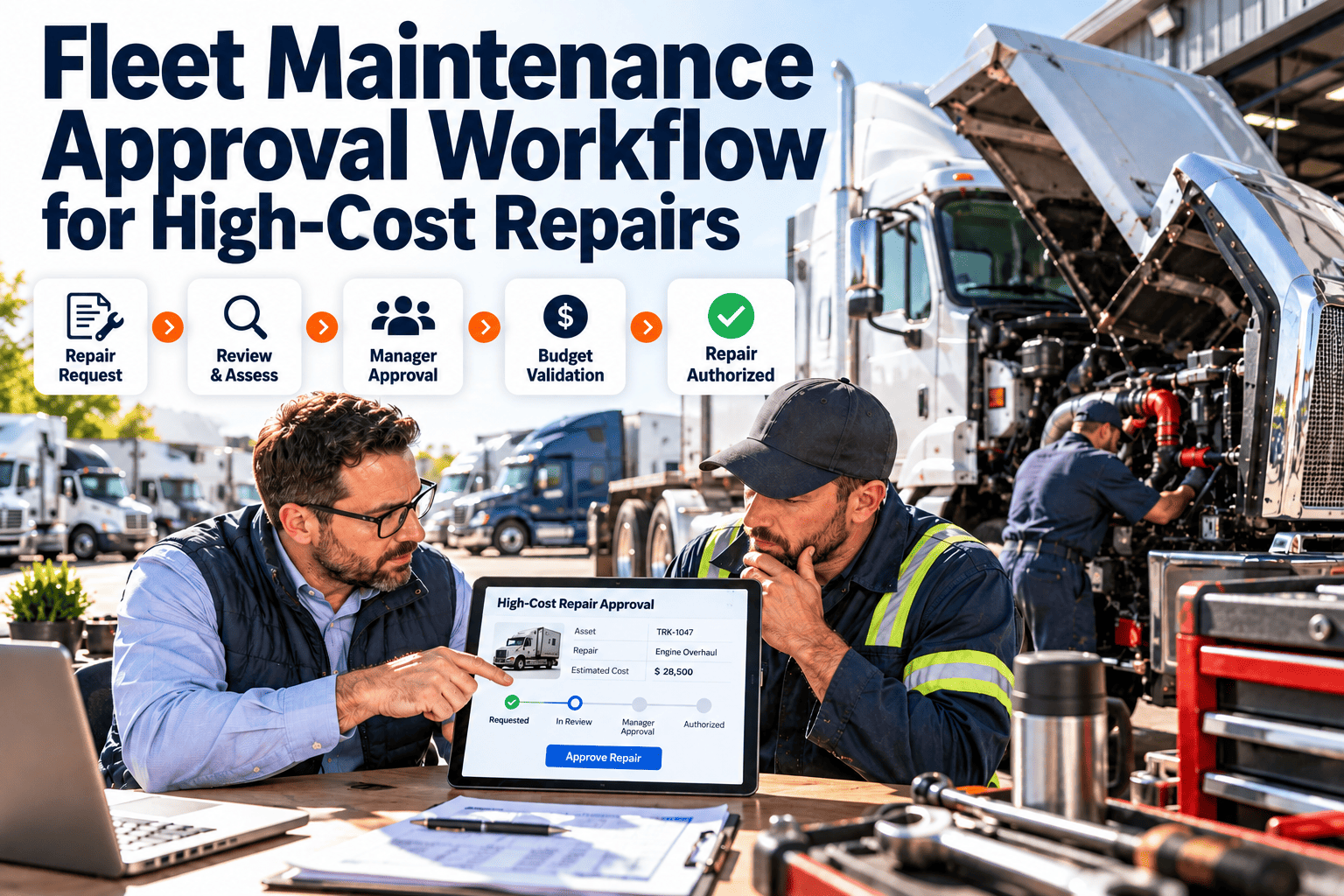
The approval workflow, stage by stage
Diagnose and document
Technician records the complaint, root cause, photos, and meter reading on the work order.
Build the estimate
Parts, labor hours, and outside vendor quotes are listed against the work order.
Classify the repair
The estimated total places the repair in a cost tier that decides who must approve.
Route for review
The approver receives the estimate, vehicle history, and a target response time.
Decide and record
Approve, reject, or request changes, with the name, date, and reason stored on the record.
Execute and compare
Repair proceeds, and the final invoice is checked against the approved estimate.
Close and learn
Record the fix, the variance, and any warranty claim, then use the data in future reviews.
Approval tiers and what each one needs
Thresholds below are examples of structure only. Set dollar limits to match your fleet size, vehicle value, and risk tolerance.
| Tier | Trigger | Approver | Evidence required | Response target |
|---|---|---|---|---|
| Tier 1 | Estimate within shop limit | Shop supervisor | Diagnosis and parts list | Same shift |
| Tier 2 | Estimate above shop limit | Fleet manager | Estimate, photos, repair history | Within one business day |
| Tier 3 | Major component or near replacement value | Fleet manager and finance | Lifetime cost, age, utilization, replacement quote | Within agreed review window |
| Emergency | Safety-critical or stranded vehicle | On-call approver | Short note, full review after the fact | Immediate |
Stop approving big repairs by email
Keep the estimate, history, and decision on one work order so approvals are fast, visible, and auditable.
Repair or replace: what approvers should see
Evidence that favors repair
- Few prior failures on the same system.
- Vehicle age and mileage within planned life.
- Repair cost well below replacement cost.
- Warranty or goodwill coverage possible.
Evidence that favors replacement
- Repeat failures across several systems.
- Rising cost per mile over recent periods.
- Repair cost close to the vehicle's current value.
- Long downtime already recorded this year.
None of this works without a complete maintenance history tied to the vehicle, which is why the approval step and the asset record belong together.
The evidence packet every approver should receive
Before and after a structured approval process
Controls that protect spend without slowing the shop
Pre-approved limits
Let supervisors approve routine repairs below a defined amount so small jobs never queue.
Variance thresholds
Require a new approval when the final cost exceeds the approved estimate by a set percentage.
Duplicate repair checks
Flag the same complaint on the same vehicle within a short window for warranty or rework review.
Vendor comparison
Request more than one quote for large outside jobs and record why a vendor was chosen.
KPIs to measure approval performance
How Oxmaint supports the approval process
Work orders
Hold the diagnosis, estimate, notes, status, and attachments for each major repair.
Asset history
Show prior repairs and cost trends so approvers decide with full context.
Inventory and parts
Track parts used and on hand to keep estimates realistic.
Reporting
Review cycle times, downtime, and spend by vehicle, vendor, and repair type.
Frequently asked questions
What counts as a high-cost repair?
Each fleet sets its own dollar limit based on vehicle value and budget, then tiers approvals above it.
Who should approve major repairs?
Usually a fleet manager, with finance added for repair-or-replace decisions near replacement value.
How do we avoid delays on urgent repairs?
Use an emergency path with an on-call approver and a full review after the vehicle is safe.
Can approval records support audits?
Yes, storing decisions with the work order gives a clear trail, and you can book a demo to see it.
How do we start?
Define your tiers, then create an account and route your next major repair through it.
Make every major repair a documented decision
Give approvers the evidence they need and give your shop a clear path to yes, so vehicles return to service sooner.