Fleet downtime from accident-related repairs is one of the most controllable — and most poorly controlled — costs in fleet operations. Unlike mechanical breakdowns, which require predictive systems to prevent, accident repair downtime is largely a workflow problem: the vehicle is physically repairable, but the time from incident to return-to-service is extended by authorisation delays, parts procurement gaps, unclear vendor selection, and missing documentation. Building a structured accident repair workflow program doesn't require expensive technology or a large team — it requires defined processes, clear decision rules, and a system that connects every stakeholder in the repair cycle. Use the calculator below to estimate your current downtime cost exposure and see how OxMaint's work order management platform builds that structure into your fleet operations.
Cost Calculator · Fleet Accident Repair Workflow
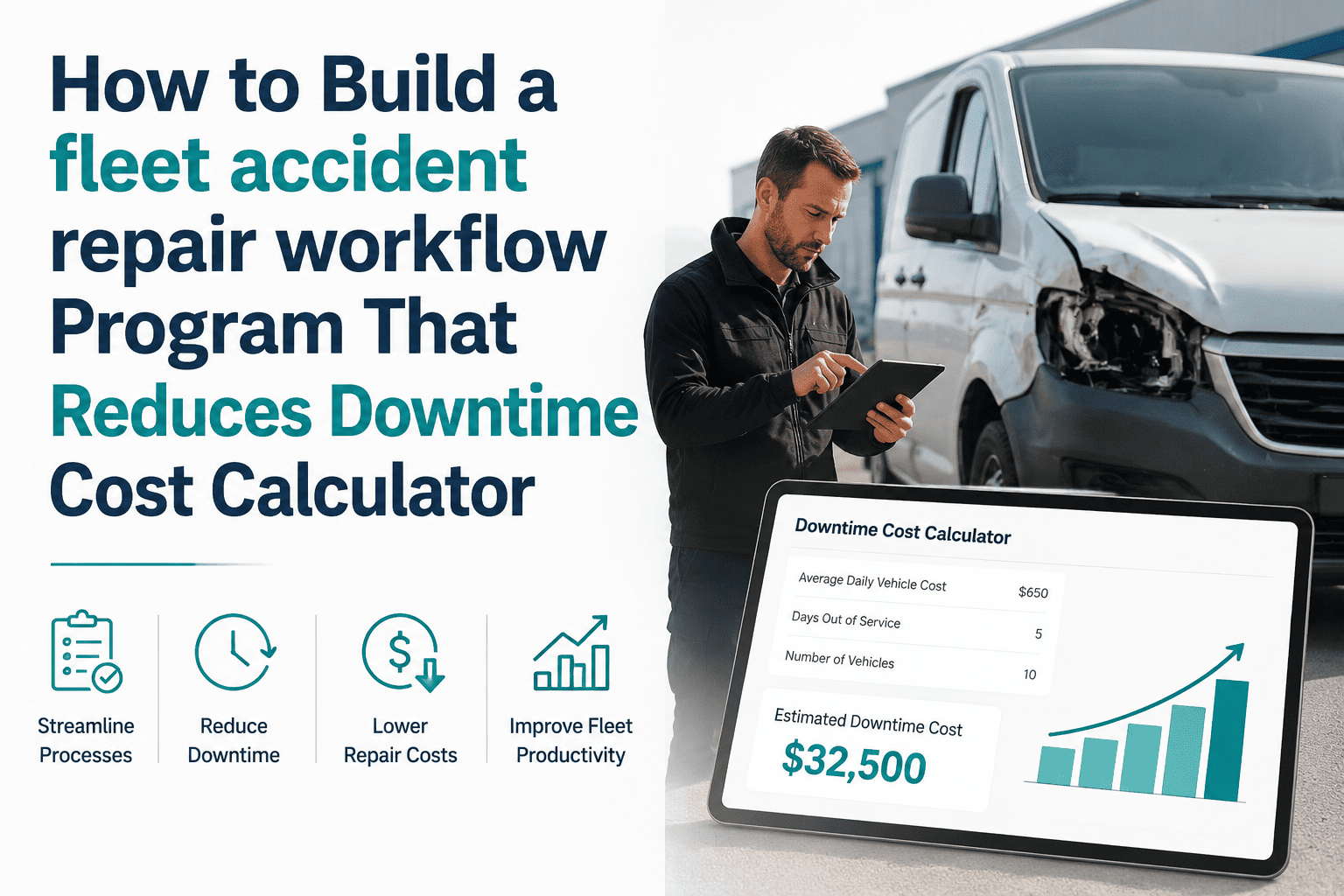
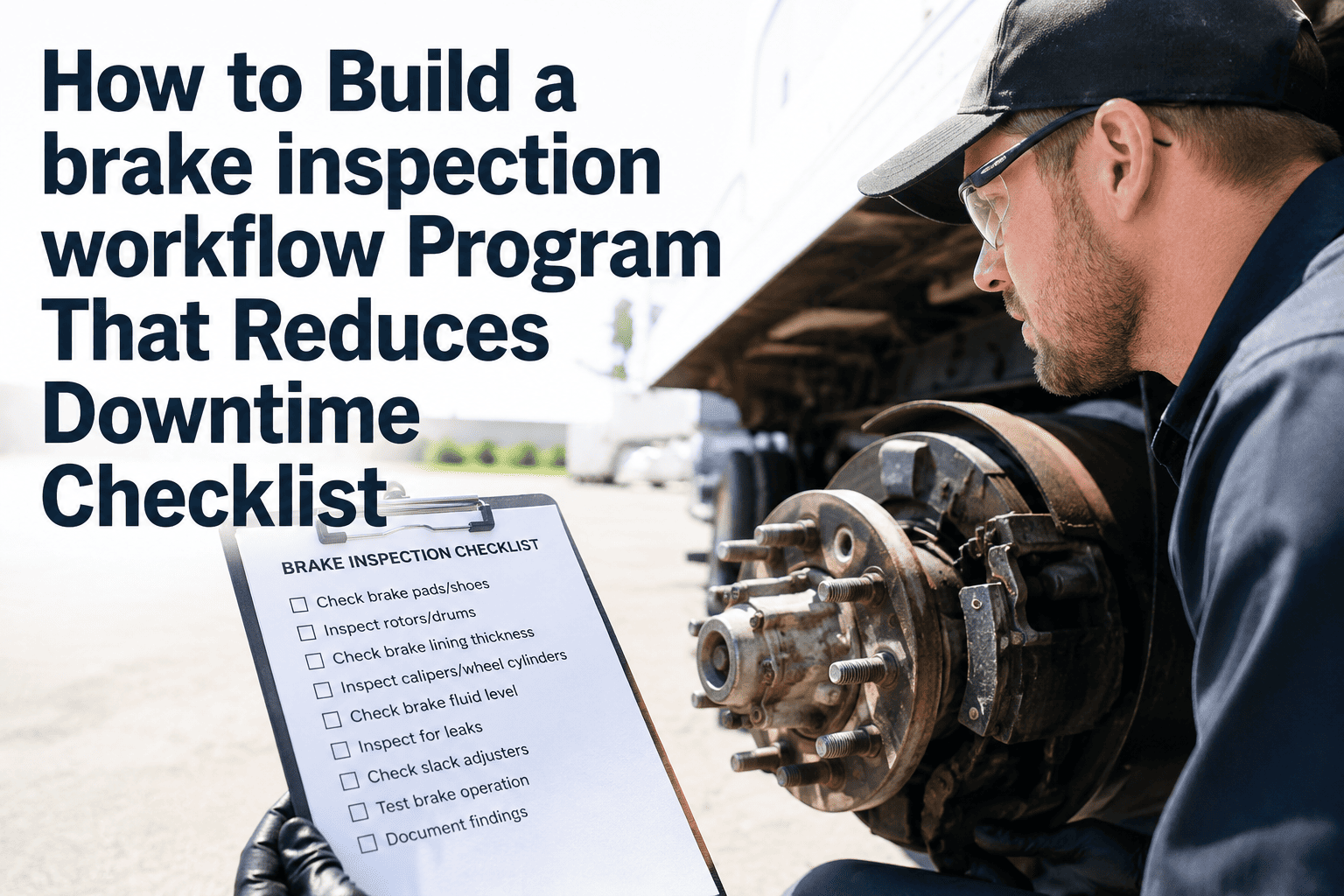
How to Build a Fleet Accident Repair Workflow Program That Reduces Downtime
A step-by-step guide to designing a structured accident repair workflow — with a cost calculator to quantify how much uncontrolled repair processes are costing your fleet right now.
Downtime Cost Calculator: What Are Accident Repairs Costing Your Fleet?
Before building the workflow, understand the cost. Enter your fleet's accident data to calculate your current annual downtime cost exposure from accident-related vehicle-out-of-service time.
Your Fleet's Accident Downtime Cost Analysis
Current Annual Downtime Cost
$0
Estimated Cost with Structured Workflow (8 days avg)
$0
Annual Savings Potential
$0
Benchmark: structured accident repair workflows reduce average days out of service from 12–16 days to 7–9 days. Savings calculation assumes achieving an 8-day average.
The 5-Component Fleet Accident Repair Workflow Program
A complete accident repair workflow program has five components. Each one addresses a specific source of delay and cost overrun in the repair cycle. Together, they convert a chaotic, people-dependent process into a repeatable, documented workflow that produces consistent return-to-service times regardless of which supervisor or workshop handles the repair.
Component 1
Standardised Incident Capture
Every accident starts with a complete incident record — not a partial one. Build a digital incident form that drivers complete on their mobile device within 30 minutes of an incident. Required fields enforce complete data capture: vehicle ID, driver, time, location, damage description by zone, photos, and third-party details. The form should auto-notify fleet manager, safety officer, and insurance coordinator simultaneously — eliminating the "who told who" communication gap that delays the first 24–48 hours of every repair cycle.
Downtime reduction: 1–2 days saved on authorisation prep
Component 2
Pre-Authorised Damage Assessment Protocol
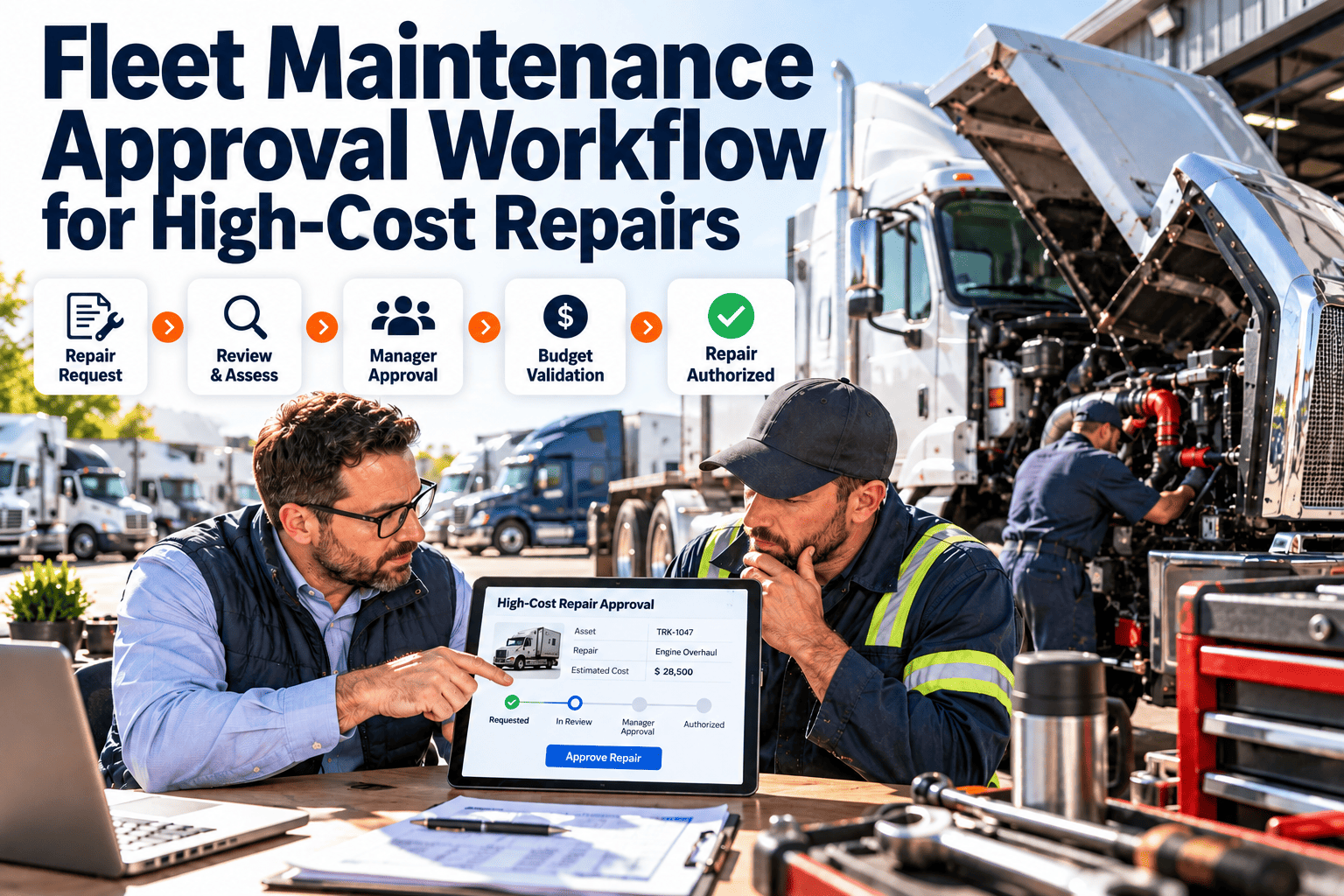
Define who performs damage assessment (internal QC tech, preferred body shop, or independent assessor), what format the assessment takes, and what cost thresholds trigger different approval paths. Low-cost repairs should auto-approve via CMMS workflow — requiring a fleet manager's manual review for a $600 bumper repair burns 12–24 hours without adding value. Set approval thresholds in advance: below $X auto-approve; above $X to fleet manager; above $Y to senior management. Document this in the system, not in an email to whoever is on duty.
Downtime reduction: 2–4 days saved on authorisation cycle
Component 3
Preferred Repairer Network with Pre-Negotiated Rates
Ad-hoc vendor selection is one of the largest drivers of accident repair cost overrun. Build a preferred repairer panel with pre-negotiated labour rates, parts pricing agreements, and repair time commitments. Tier the panel by repair type — minor bodywork, structural, mechanical, glass — and by geography for multi-location fleets. Assigning repairs to the preferred panel eliminates quote shopping delays and ensures rate predictability. Repairer performance (repair time vs. commitment, rework rate, invoice accuracy) should be tracked in CMMS to inform panel review decisions annually.
Cost reduction: 15–25% lower repair cost vs. ad-hoc vendor selection
Component 4
Repair Tracking and Parts Coordination
Once a repair is authorised, the CMMS work order becomes the live tracking document. Parts ordered, parts arrived, repair stage, estimated completion, and actual completion are all updated in real time. The fleet manager sees status without calling the workshop. If a parts delay is identified at day 3, the fleet manager can decide whether to source the part differently or transfer a replacement vehicle to the site — decisions that require live information, not a phone update every other morning. ETA accuracy improves when progress is tracked daily against a committed timeline.
Downtime reduction: 1–3 days saved through proactive parts management
Component 5
Return-to-Service QC and Insurance Tracking
Close the repair with a structured quality check and a formal return-to-service sign-off that attaches to the vehicle's permanent record. The sign-off protects against warranty disputes if the same area develops a fault within a short period. Simultaneously, the closed work order triggers insurance cost reconciliation — actual repair cost vs. estimate, recovery amount from insurer, and any third-party recovery status. Tracking recovery status to completion is where most ad-hoc processes fall apart; the CMMS workflow keeps it visible until money is recovered or the case is formally closed.
Financial recovery: Improved insurance recovery and subrogation capture
OxMaint's work order and fleet management platform provides the digital infrastructure for all five components of a structured accident repair workflow. Start a free trial or book a 30-minute demo to walk through the accident repair workflow setup for your fleet.
Implementation Roadmap: Building Your Program in 90 Days
A structured accident repair workflow program can be implemented without disrupting day-to-day operations. This 90-day roadmap prioritises quick wins in the first 30 days while building durable process infrastructure over the full period.
Days 1–30
Foundation: Documentation and Process Design
Audit current accident repair process — map each step, identify average time at each stage, quantify current return-to-service time
Design standardised digital incident form — required fields, photo protocol, notification routing
Define authorisation thresholds for repair cost levels — document in writing, not verbal agreement
Configure CMMS incident and accident repair work order templates
Train drivers and supervisors on digital incident reporting — run a mock incident exercise
Days 31–60
Vendor and Insurance Integration
Identify and approach preferred repairer candidates — issue RFQ with rate and turnaround commitment requirements
Negotiate and document preferred repairer agreements — at least two vendors per key geography
Brief insurance broker on new workflow documentation standards — confirm what documentation format they require for fast adjudication
Set up insurance tracking in CMMS — incident to claim to recovery close workflow
Go live with digital incident reporting and new authorisation workflow for all new accidents
Days 61–90
Performance Tracking and Optimisation
Review first 30 days of structured workflow — measure actual return-to-service time vs. previous average
Identify remaining delay points — where is the process still producing gaps?
Implement QC sign-off and return-to-service checklist if not done in Phase 1
Run first monthly accident repair performance report from CMMS — time, cost, recovery, repairer performance
Identify high-incident vehicles or drivers for targeted risk management intervention
Frequently Asked Questions
What is the biggest driver of long accident repair return-to-service times?
Authorisation delays are the single biggest avoidable driver. When the approval path for a repair is informal — phone calls, email chains, waiting for the right person to be available — even straightforward repairs can sit unauthorised for 3–5 days. Defining clear approval thresholds in advance and routing them through a CMMS workflow eliminates this gap. Parts delays are the second biggest driver, which is solved by ordering from the damage assessment, not after repair begins.
See how OxMaint automates approval routing.
How many preferred repairers should a fleet operator maintain on their panel?
For a fleet of 20–50 vehicles operating in a single region, two to three preferred body repairers and one preferred mechanical repairer is typically sufficient. Larger or more dispersed fleets need panel coverage by geography. The key is that the panel size is manageable enough to build meaningful relationships and track performance — a panel of 15 vendors with no performance data provides no advantage over open-market selection.
Can fleet accident data help reduce future incidents, not just manage current ones?
Absolutely — and this is one of the most underused benefits of structured accident recording. Aggregate incident data reveals patterns: vehicle types with higher incident rates, specific routes or times with elevated risk, drivers with recurring incidents, and cost-per-incident trends over time. These patterns inform targeted driver training, route risk reviews, and fleet renewal decisions that progressively reduce incident frequency — not just repair cycle time.
Book a demo to see OxMaint's fleet safety analytics.
How does OxMaint handle accident repair workflows for fleets with mixed in-house and outsourced repair?
OxMaint supports both internal work orders (assigned to in-house technicians) and external purchase orders (assigned to preferred repairer vendors) within the same workflow. A repair that starts as an in-house assessment and is then outsourced to a preferred repairer transitions seamlessly within the same work order record — so the complete cost and timeline is visible in one place, regardless of which entity does the physical repair.
Safety & Repairs · OxMaint
Build the Accident Repair Workflow That Cuts Your Return-to-Service Time in Half
OxMaint gives fleet operators the digital infrastructure to standardise incident capture, automate repair authorisation, track parts and repair progress in real time, and close the insurance recovery loop — turning a chaotic process into a competitive advantage.