Fleet Benchmarking: How Top Performers Compare on Cost, Uptime, and Safety Metrics
By Alex Jordan on March 28, 2026
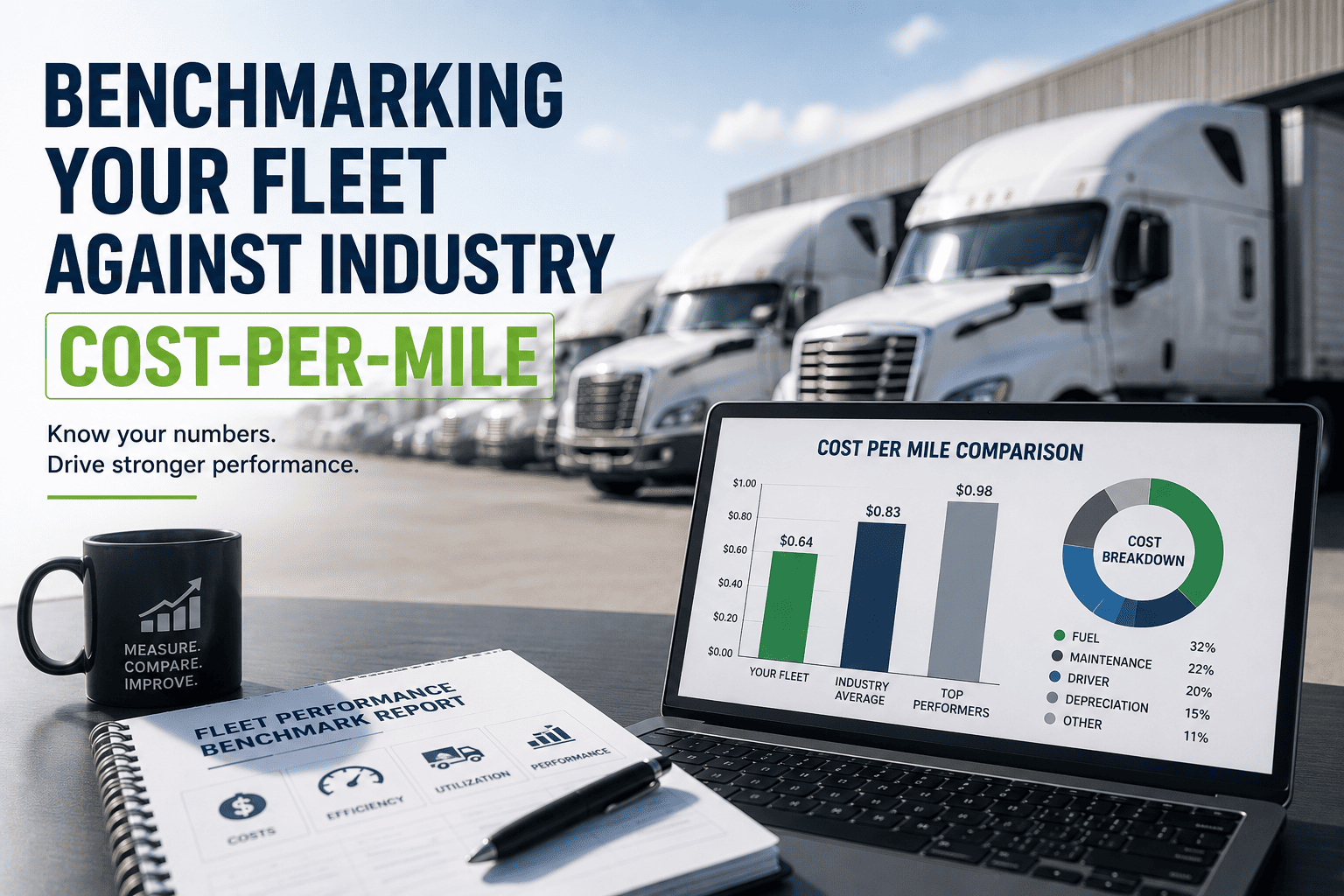
Top-performing fleets don't guess — they benchmark. They know their cost per mile is $0.54, their uptime is 96.2%, and their PM compliance sits at 94% because they measure these numbers quarterly and compare them against industry data. The gap between a top-quartile fleet and an average fleet is not talent or equipment — it is data discipline. Fleets in the top 25% spend 34% less on maintenance, suffer 68% fewer unplanned breakdowns, and record safety incident rates less than a third of the industry average. OxMaint's fleet analytics dashboard generates every benchmark metric automatically from your work order and telematics data — so you know exactly where you stand and which gaps to close first.
Fleet Operations · Blog · 2026
Fleet Benchmarking: How Top Performers Compare on Cost, Uptime, and Safety Metrics
Compare your fleet against top-quartile performers across cost per mile, uptime %, PM compliance, fuel economy, and safety — using 2026 industry benchmark data to identify and close your highest-value performance gaps.
34%Lower maintenance spend in top-quartile vs. average fleets
$0.54Cost per mile — top 25% commercial fleet benchmark (2026)
96%Uptime achieved by top-performing fleets vs. 89% industry average
3×Lower safety incident rate — top quartile vs. bottom quartile fleets
Where Does Your Fleet Actually Stand? — The 7-KPI Benchmark Map
Most fleet operators believe they are performing near industry average — but fewer than one in three can prove it with data. The 2026 fleet benchmark landscape shows a dramatic spread between top performers and the bottom quartile across every key metric. Understanding where your fleet sits in each zone — Poor, Industry Average, or Top Performer — is the first step to building a targeted improvement plan. The band chart below shows the performance threshold for each of the seven metrics that define fleet operational excellence. OxMaint calculates all seven metrics automatically from your existing CMMS work orders and telematics data.
Fleet Performance Scoring: Which Tier Is Your Fleet In?
Fleet performance doesn't break down into "good" or "bad" — it maps to five measurable performance tiers that each carry different financial and operational implications. A fleet in the World-Class tier operates with 96%+ uptime, PM compliance above 92%, and safety incidents below 0.6 per million miles. Every tier below carries compounding cost penalties — the jump from Industry Average to Bottom Quartile typically adds $2,800–$4,400 per vehicle per year in preventable maintenance and downtime costs. Knowing your tier per metric directs your investment to the highest-return gaps, not the most visible ones. OxMaint's analytics dashboard scores your fleet per metric and shows the specific interventions that move each tier upward.
Fleet Performance Scoring Framework — 5 Tiers
Assess your fleet against each tier quarterly — one tier improvement = $2,800–$4,400 per vehicle recovered annually
Focus: Immediate CMMS deployment. Every week without PM scheduling costs $350–$600 per vehicle.
Technology That Moves the Benchmark: OBD, Digital Twin, AI Camera, and SAP
Top-performing fleets don't achieve their benchmark positions through manual discipline alone — they use a connected technology stack that makes benchmark-level performance the automatic outcome of daily operations. OBD-II and J1939 telematics feeds provide the real-time vehicle data that powers predictive maintenance and accurate CPM tracking. AI Digital Twin models forecast component failure per vehicle, enabling parts pre-ordering before any symptom appears. AI Camera Vision reduces safety incidents by catching driver behavior and mechanical issues simultaneously. SAP and ERP integrations close the loop between CMMS work orders and enterprise financial reporting — making benchmark metrics visible at board level, not just in the maintenance office. PLC integrations from depot equipment extend the same data discipline to fixed plant assets.
OBD-II / J1939
CPM improvement
−18%
Uptime gained
+12%
PM compliance lift
+19%
Real-time engine and fault data powers predictive PM — moving fleets from average to high-performer tier on CPM and uptime within 6 months.
McKinsey IoT / Deloitte predictive maintenance fleet data 2025
AI Camera Vision
Safety incident reduction
−31%
DVIR accuracy
94%
Detection lead time
88%
Cabin and exterior cameras reduce safety benchmark from industry average to top-tier within one insurance policy year through documented coaching.
Fleet AI vision deployment benchmarks · US/EU 2025
SAP / ERP Integration
PM automation rate
96%
Cost reporting accuracy
94%
Procurement savings
−22%
CMMS-to-SAP integration makes fleet benchmark metrics visible at CFO level — connecting operational performance to financial planning automatically.
SAP fleet maintenance integration case studies · 2024–2025
Industry Vertical Benchmarks: What Top Performers Look Like in Your Sector
Fleet benchmarks vary significantly by industry vertical — a top-performing long-haul carrier and a top-performing urban delivery fleet operate at completely different CPM targets, uptime requirements, and PM structures. Applying the wrong benchmark to your operation produces misleading gap analysis: an 8.0 MPG fuel economy reading is exceptional for a construction fleet and poor for a highway tractor. The accordion below shows sector-specific benchmarks for four major commercial fleet verticals, based on 2026 ATA, NPTC, and Fleetio industry data. OxMaint's benchmarking module allows fleet directors to select their vertical and compare automatically against the correct peer group.
Long-Haul / OTR Trucking
Class 7–8 · 100K+ mi/yr
Cost per MileTop: <$0.48 | Industry Avg: $0.62 | Gap to close: $0.14/mi
Uptime %Top: >96% | Industry Avg: 91% | Every 1% = 3.65 revenue days/yr per truck
Out-of-Service RateTop: <1.8% | Industry Avg: 4.2% | OBD engine-hour monitoring reduces OOS by 48%
Tyre Cost / Vehicle / YrTop: <$2,100 | Avg: $3,600 | Off-road surface tracking and rotation discipline key
Municipal / Government Fleet
Mixed fleet · Compliance-driven
Uptime %Top: >94% | Industry Avg: 88% | Emergency vehicle uptime is non-negotiable — safety risk if <90%
Fleet Age vs. BudgetTop performers: avg fleet age <7 yrs | Avg: 9.2 yrs | Lifecycle cost tracking drives replacement timing
Compliance (DVIR/DOT)Top: 99%+ | Industry Avg: 86% | Audit-ready records protect against liability exposure
SafetyTop: <0.8 per 1M mi | Avg: 1.9 | Public liability exposure makes safety benchmark critical
"
We had no idea where we ranked until we pulled our OxMaint reports and mapped them to the 2026 benchmarks. Our uptime was 86% — solidly in the "Below Average" tier. Within nine months of targeted PM improvements, we hit 93% uptime. That single metric improvement saved us $280,000 in a fleet of 42 vehicles.
VP of Fleet Operations — Regional distribution company, 42 vehicles, Texas, USA
Know Your Benchmark Score — Across All 7 KPIs — In Minutes
OxMaint generates your fleet's benchmark score automatically from your existing CMMS data. See exactly which tier you're in, what the gap to top-quartile is, and which interventions move you there. Free to start.
How to Run Your First Fleet Benchmarking Program — 5 Steps
Fleet benchmarking is not a one-time report — it is a quarterly operating discipline that turns performance data into prioritised action. Most fleet directors who attempt benchmarking without a CMMS produce one-time snapshots that are out of date before they are presented. The correct approach uses CMMS data as the continuous source of truth and maps it automatically to industry benchmarks — so every quarter produces an updated gap analysis without manual calculation. OxMaint automates the data collection and benchmark comparison steps, reducing the benchmarking cycle from a week of spreadsheet work to a one-click report.
1
Audit Your Current KPI Baseline
Pull CMMS reports for the last 12 months. Calculate each of the 7 core KPIs: CPM, uptime %, PM compliance rate, maintenance cost per vehicle, fuel economy, safety incidents per million miles, and DVIR completion rate. If you can't calculate all 7 from your current system, that is the first gap to fix.
Step 1
2
Map Each KPI to the Industry Benchmark Tier
Using the 2026 Fleetio, ATA, and NPTC benchmark data, place each of your 7 KPIs into one of the five performance tiers. Use your industry vertical's benchmarks, not the cross-industry average — a construction fleet and a last-mile delivery fleet have fundamentally different cost profiles.
Step 2
3
Quantify the Revenue Gap per Metric
For each metric below top-quartile, calculate the annual cost of the gap: a 5% uptime gap on a 40-vehicle fleet at $180/hr operational cost = $1.26M annually. Prioritise interventions by revenue impact, not by ease of implementation — the biggest gap is the first investment.
Step 3
4
Deploy Targeted Interventions per Gap
Match each gap to its intervention: PM compliance gap → CMMS automated scheduling; CPM gap → route optimisation + PM interval calibration; safety gap → AI camera + driver coaching program; uptime gap → predictive maintenance + parts advance procurement. One intervention per metric, measured independently.
Step 4
5
Re-Benchmark Quarterly — Track Tier Movement
Run the benchmark comparison every quarter. Track tier movement per metric — a fleet moving from "Industry Average" to "High Performer" on PM compliance in one quarter typically recovers $1,800–$2,400 per vehicle in preventable repair costs. Benchmark progress, not just activity.
Step 5
34%
Lower maintenance spend — top-quartile vs. average fleet (2026 Fleetio data)
The gap compounds: top-quartile fleets also pay lower insurance premiums and have higher asset residual values.
$0.54
Cost per mile — top-quartile benchmark for Class 6–8 commercial fleets in 2026
Every $0.01 CPM improvement on a 40-vehicle / 80K mi/yr fleet = $32,000 annual saving compounded.
96%
Uptime achieved by top-performing fleets — vs. 89% industry average across all sectors
Each 1% uptime gain on a 40-vehicle fleet at $180/hr operational value = $252,000 annual revenue recovered.
Q1
Typical payback on CMMS deployment — first tier improvement covers platform cost within 90 days
PM compliance improvement alone — from 72% to 85% — generates $1,800–$2,400 per vehicle in Year 1.
Frequently Asked Questions
What data do I need to start fleet benchmarking?
You need 12 months of work order data (repair costs, PM completion dates, downtime hours) and mileage records per vehicle. OxMaint pulls all 7 KPIs automatically from your existing records — no manual calculation required.
How often should we run fleet benchmarking?
Quarterly is the minimum — it gives enough time for interventions to show measurable impact before the next review. Monthly tracking for high-priority metrics (uptime, CPM) and quarterly full benchmarking across all 7 KPIs is the top-performer standard.
Which benchmark metric has the highest ROI for most fleets?
PM compliance rate. A 15% compliance improvement (e.g., 70% → 85%) typically delivers $1,800–$2,400 per vehicle per year in prevented breakdown costs — with no capital investment beyond CMMS deployment.
Does fleet size affect which benchmarks apply?
Fleet size affects benchmark targets for maintenance cost/vehicle (larger fleets gain procurement volume discounts) but CPM, uptime, PM compliance, and safety metrics are size-independent — the top-quartile thresholds apply equally to 15-vehicle and 500-vehicle fleets.
Know Your Tier. Close the Gap. Keep Score.
OxMaint generates your full 7-KPI benchmark report automatically — free to start, no hardware required.



.png)