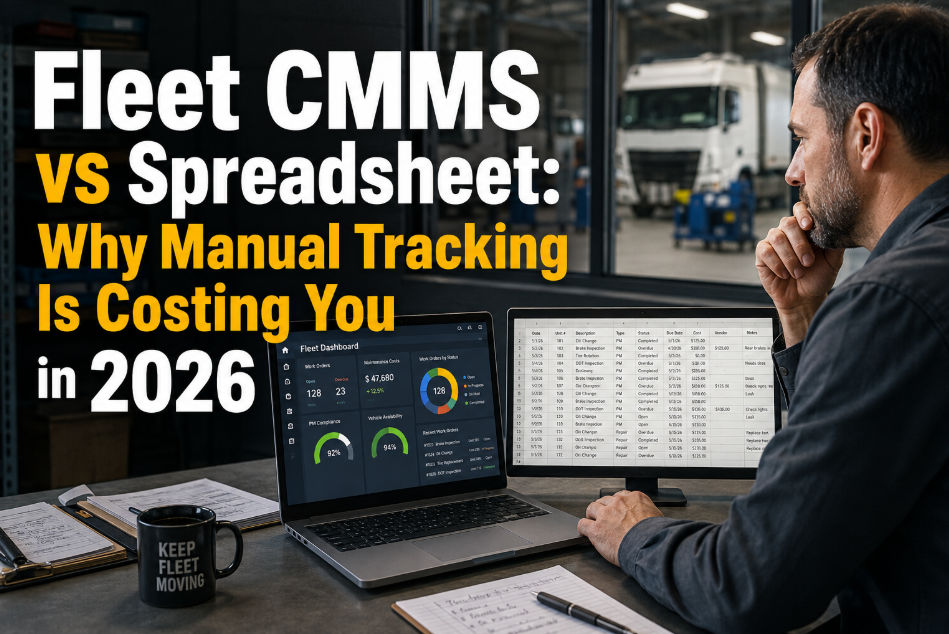
The spreadsheet-managed fleet is not a cost-saving strategy — it is a slow accumulation of invisible risk. Every preventive maintenance interval tracked in a shared Excel file is one missed update away from a blown PM. Every compliance record stored across email threads and folder structures is one hard drive failure or staff departure away from being unrecoverable. Every vehicle cost calculation done manually is one formula error away from a capital decision made on bad data. In 2026, fleet managers running manual tracking systems are not just dealing with operational inefficiency — they are absorbing the compounding cost of missed PMs, undetected compliance gaps, and the staff time consumed by data entry that a CMMS eliminates entirely. Industry data consistently shows that fleets switching from spreadsheet management to CMMS reduce unplanned maintenance costs by 18–25% within the first year, driven primarily by PM compliance improvement and earlier defect detection. If your fleet is still managed in Excel, the question is not whether a CMMS would save money — the question is how much you have already lost this year to a system that was not designed to manage fleet maintenance operations. Start a free trial and compare the difference directly, or book a demo and let us show you exactly where your spreadsheet-managed fleet is losing money right now.
Fleet CMMS vs Spreadsheet: Why Manual Tracking Is Costing You in 2026
Missed PMs, compliance gaps, and untracked costs are the real price of spreadsheet fleet management. This analysis shows the hidden cost of manual tracking — and the measurable ROI of switching to a CMMS built for fleet operations.
The Hidden Cost of a Spreadsheet Is Not the Spreadsheet — It Is Everything the Spreadsheet Cannot Do
Fleet spreadsheets do not send automated PM reminders when vehicles miss an interval. They do not lock a vehicle from dispatch when a critical defect is reported. They do not calculate cost per mile per vehicle, flag compliance documentation gaps, or generate a DOT audit trail in 60 seconds. These missing capabilities are not feature gaps — they are real costs absorbed daily by every fleet manager still running maintenance on manual tracking systems. Oxmaint replaces every spreadsheet limitation with an automated, audit-ready workflow that saves time, prevents failures, and protects the organization. Start a free trial or book a demo to see the full platform difference for your fleet size.
Eight Ways Spreadsheet Fleet Management Costs You Money Right Now
Each of these failure modes is quantifiable, recurring, and preventable. They are not edge cases or worst-case scenarios — they are the routine operational cost of a system that was built for financial data, not for fleet maintenance workflow management.
Fleet CMMS vs Spreadsheet: Full Feature Comparison
Where the CMMS ROI Comes From — Quantified for a 50-Vehicle Fleet
What Oxmaint Replaces — Feature by Feature
Oxmaint is built specifically for fleet operations with mobile-first technician workflows, automated PM scheduling, and compliance documentation built into every work order. Fleet managers who want to see the full platform against their current spreadsheet workflow can start a free trial or book a demo and walk through a live demonstration configured for their fleet size.
Measured Outcomes — Fleets That Switched from Spreadsheet to Oxmaint
Frequently Asked Questions
How long does it take to migrate a spreadsheet-managed fleet to a CMMS like Oxmaint?+
What is the minimum fleet size where a CMMS like Oxmaint delivers measurable ROI over spreadsheets?+
Can we run the CMMS and our existing spreadsheets in parallel during the transition?+
How does Oxmaint handle fleets with multiple vehicle types and different PM requirements across vehicle classes?+
Your Fleet Deserves a System Built for Fleet Management — Not a Repurposed Financial Tool
Spreadsheets were designed to manage financial data. Fleet maintenance operations require automated PM scheduling, mobile work order management, defect-to-closure tracking, compliance documentation, and real-time cost analytics — capabilities that spreadsheets structurally cannot deliver. Every month a spreadsheet-managed fleet continues without CMMS is another month of absorbed PM gaps, compliance exposure, and administrative cost that a platform built for fleet operations eliminates from day one. No long implementation. No per-user fees. First automated PM work orders in the same week you start your trial.