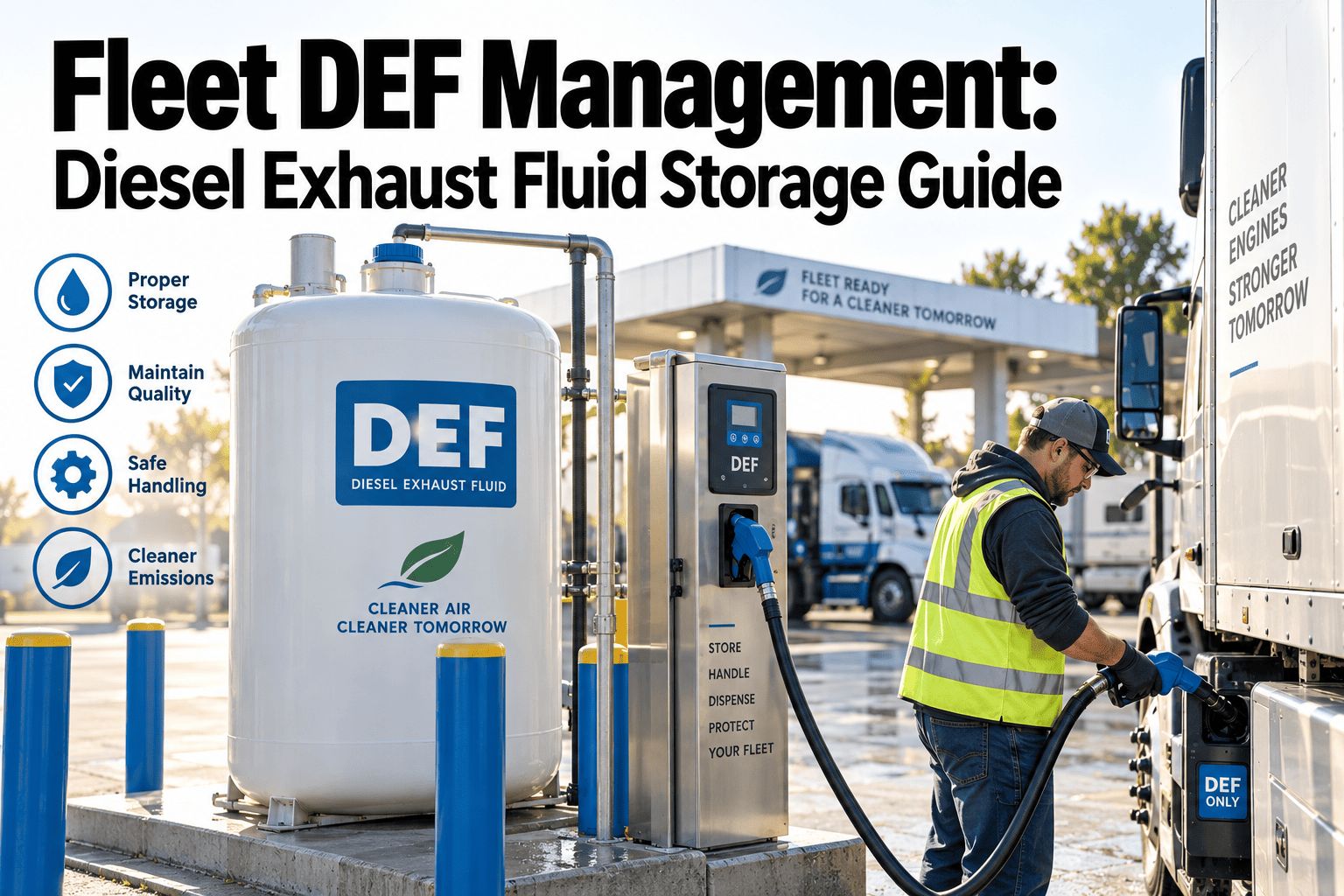
A regional beverage distributor running 65 Class 8 trucks learned how fast diesel exhaust fluid can shut down a route the hard way: a delivery truck derated to 5 mph on a Tuesday morning because the DEF tank had been quietly running on contaminated fluid from a tote that sat outside through a heat wave. The driver didn't notice anything wrong until the dash warning escalated from a light to a countdown, and by the time the truck limped back to the yard, the route was three hours behind and a customer delivery window was missed. Diesel exhaust fluid is simple chemistry — 32.5 percent urea in deionized water — but the consequences of getting storage, quality, or consumption tracking wrong are anything but simple, and most DEF-related downtime is entirely preventable with the right tracking in place.
Every diesel engine built since 2010 uses selective catalytic reduction to meet EPA NOx emission standards under the federal 2010 heavy-duty diesel rule, which means every one of those trucks depends on a continuous, correctly dosed supply of on-spec DEF injected into the exhaust stream. When the SCR system detects a quality fault, contamination, or an empty tank, federal emissions regulations require the engine to progressively limit performance — first a dashboard warning, then a speed limitation, and finally a full stop at the next key cycle if the condition isn't corrected. This is not a manufacturer's aggressive policy choice; it is a regulatory requirement built into every SCR-equipped engine, which is exactly why DEF management deserves the same operational discipline fleets apply to fuel.
The DEF Inducement Escalation — What Happens When Quality or Supply Fails
Storage Temperature — The Single Biggest Driver of DEF Shelf Life
ISO 22241 defines DEF quality tolerances precisely, and storage temperature is the variable that degrades a properly mixed batch faster than anything else. Heat accelerates the breakdown of urea into ammonia and biuret, both of which push the solution out of spec and, if injected into an SCR system, can damage the catalyst rather than protect it.
| Storage Condition | Temperature Range | Expected Shelf Life | Operational Note |
|---|---|---|---|
| Optimal Storage | Below roughly 77°F, shaded | 18–24 months | Ideal for bulk tanks and long-term inventory |
| Standard Storage | 23–77°F, sealed container | 12–18 months | Typical warehouse or covered yard storage |
| Elevated Heat Exposure | Sustained above 86°F | Roughly 12 months, decreasing further with sustained heat | Common failure point for totes left outdoors in summer |
| Vehicle-Tank Storage | Ambient, unshaded | Not recommended beyond 6 months | Periodic concentration testing required if held longer |
| Cold Exposure | Below 12°F | No degradation — freezing is reversible | SCR system heating restores fluid on startup, no quality loss |
Contamination — The Failure Mode That Doesn't Announce Itself
Unlike a stockout, which every driver notices, contamination can sit undetected in a tank for weeks. The concentration drifts out of the 32.5 percent (±1.5 percent) tolerance, the SCR sensor eventually flags it, and by then the fluid may have already been dosed into the exhaust stream at the wrong ratio for an extended period.
Bulk Tank vs. Packaged DEF — Choosing the Right Supply Model
Fleet size and duty cycle determine whether bulk storage or packaged containers make more operational sense, and the two models carry very different tracking requirements.
Cold-Weather DEF Operations — What Actually Needs Attention
Freezing gets more attention than it deserves, since a frozen tank thaws on its own during normal operation without any quality loss. The real cold-weather risks sit elsewhere in the system.
DEF Consumption Tracking — Turning a Reactive Refill Into a Planned One
DEF consumption scales with fuel burn, typically running 2 to 5 percent of diesel volume, but that ratio climbs under sustained high-load or high-idle conditions common in refrigerated transport, construction, and stop-and-go delivery routes. A fleet that tracks DEF only when a driver reports the dash warning is, by definition, always reacting one step behind the actual consumption curve.
Testing DEF Quality Without Sending Every Sample to a Lab
A full ISO 22241 laboratory panel is the definitive test, but most fleets cannot justify lab testing every tote and tank on a routine basis. A tiered approach catches the majority of quality problems without that overhead.
Documenting the result of every check — not just the failures — is what turns DEF quality control into evidence rather than assumption. A refractometer reading logged against the receiving date and lot number gives a fleet a defensible record if an SCR failure is ever disputed with an OEM, a supplier, or an insurer, in the same way an oil analysis report backs up a lubrication claim.
Where DEF Tracking Fits Into Fleet Maintenance Software
DEF is easy to treat as a consumable that lives outside the maintenance system entirely — something purchased in bulk and topped off informally between PM services. That separation is exactly what creates blind spots: a maintenance platform that already tracks fuel, mileage, and PM triggers per vehicle is the natural place to also track DEF consumption rate, tank level, and lot expiration, because the same vehicle telemetry that flags an overdue oil change can flag a DEF dosing rate trending upward before a sensor fault sets in.
Linking DEF inventory to work order generation closes the more expensive gap: instead of a driver discovering an empty bulk tank at the yard on a Monday morning, a threshold-triggered purchase order or fill task appears on the schedule days ahead of the shortfall. For fleets running mixed engine platforms, tracking DEF quality alongside oil analysis and coolant condition in one asset record also makes it far easier to spot a developing SCR problem that shows up as rising DEF consumption before it shows up as a dashboard fault code.
Multi-site fleets gain an additional benefit from this consolidation: visibility across every yard means a bulk tank running low at one location can be cross-checked against nearby inventory before an emergency same-day delivery gets scheduled at a premium price just to avoid a stockout. That same consolidated view also supports supplier accountability — when every delivery, lot number, and refractometer reading is logged against the vehicle and location it served, a fleet has the documentation needed to push back on a supplier if repeated quality issues keep tracing back to one delivery route, one storage location, or one particular batch of totes purchased from a single vendor.
Frequently Asked Questions
Every Derated Truck Started as a Storage Tote Nobody Was Watching.
OxMaint tracks DEF inventory, storage exposure, and consumption per vehicle so a shortage or quality drift shows up as a scheduled task — not a driver stranded on the shoulder.