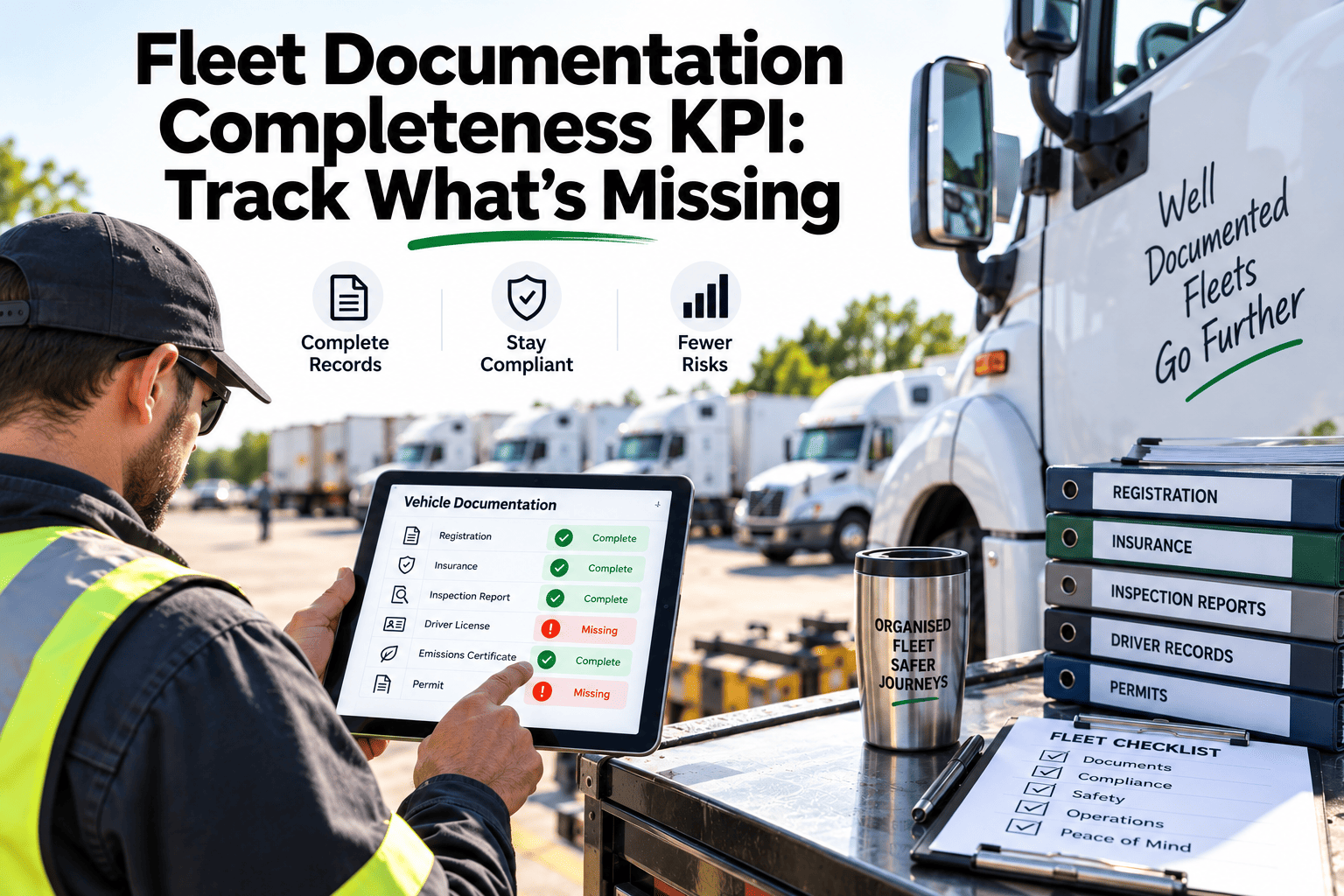
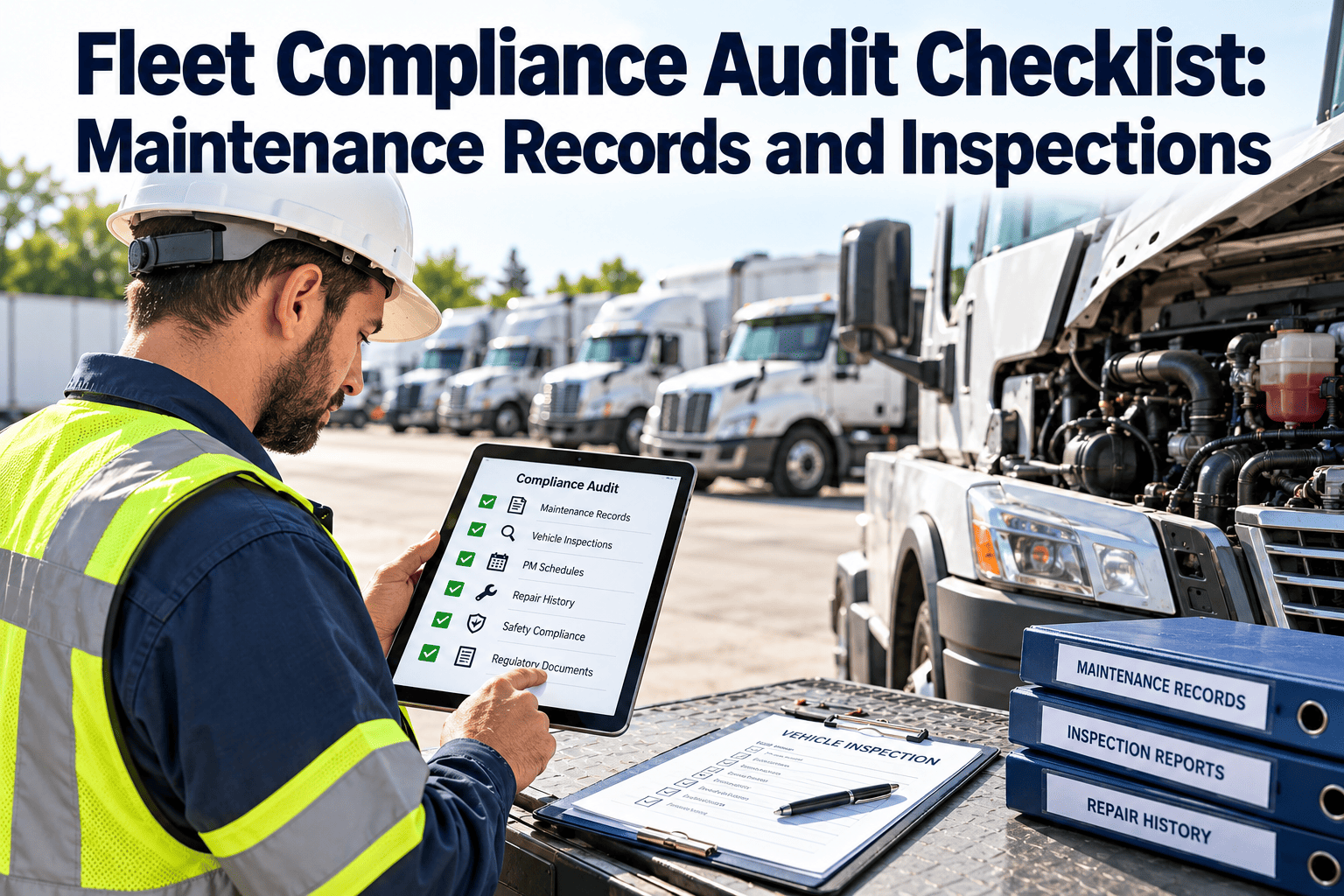
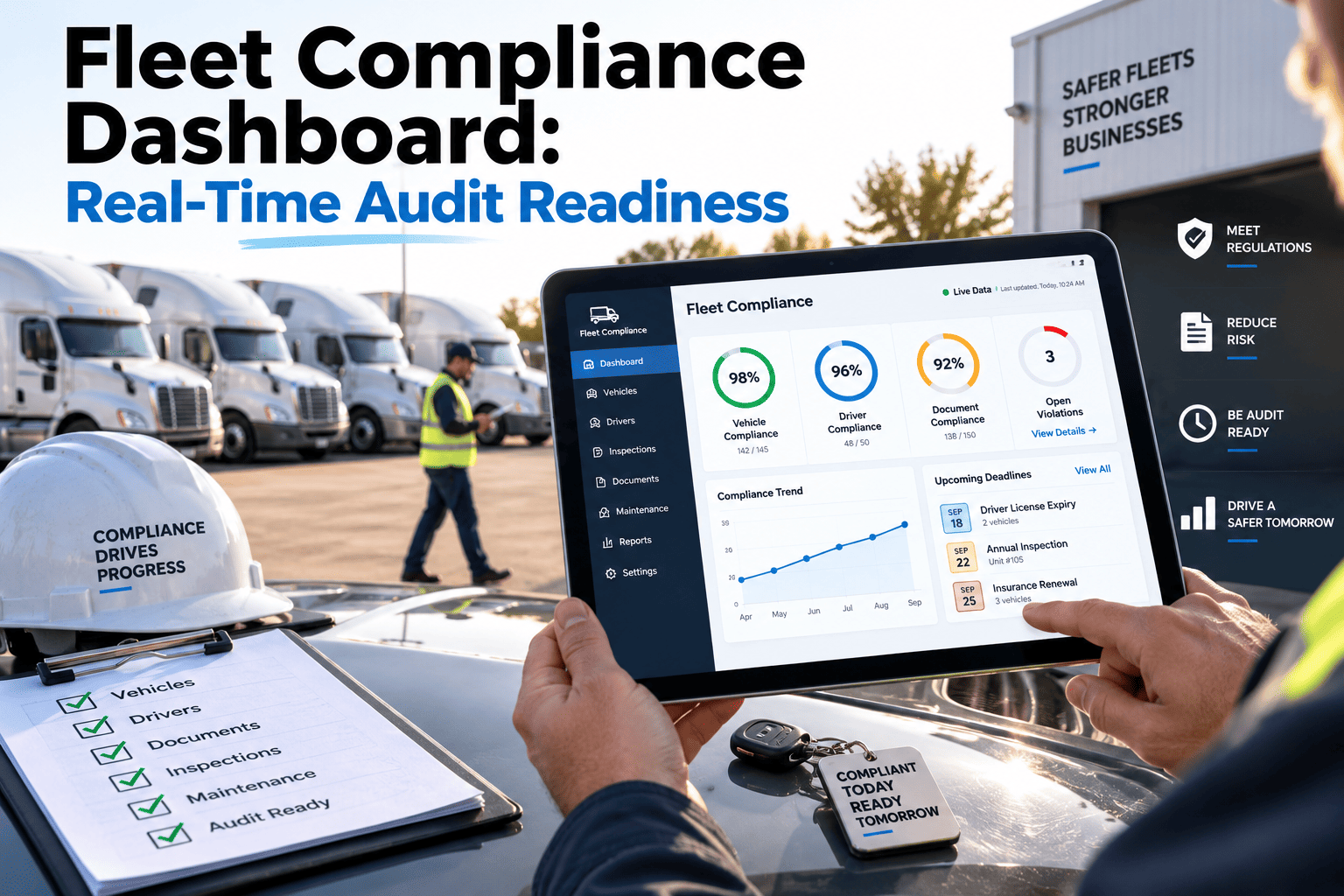
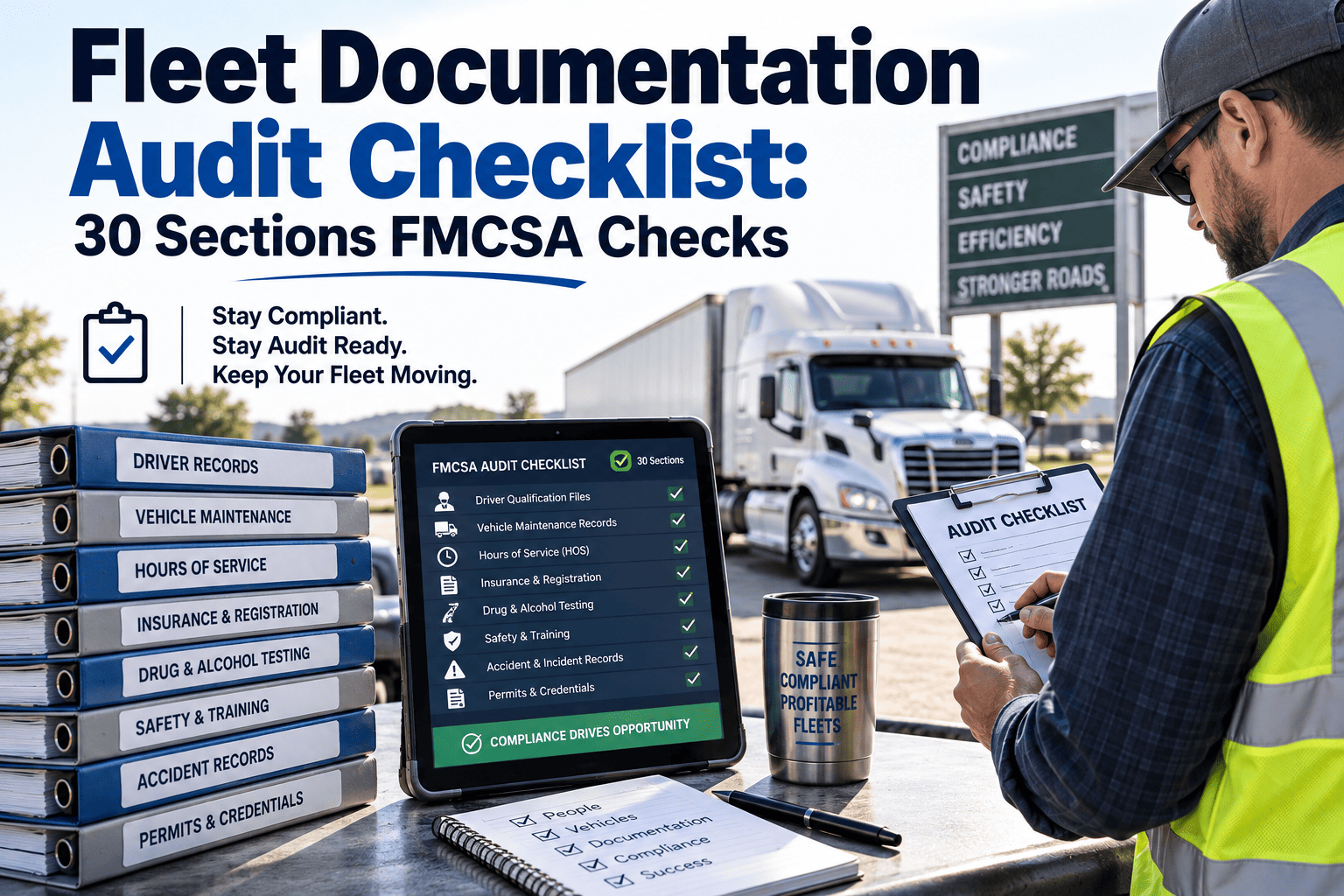
Most fleets do not fail an FMCSA compliance review because a truck was unsafe. They fail because a record that existed somewhere could not be produced, dated, or signed when an investigator asked for it in the fifteen minutes they allow. A documentation completeness KPI turns that risk from a surprise into a number you check every week, long before an auditor ever opens a file start a free trial.
Fleet Compliance · Documentation Metrics
You Can't Fix What You Don't Measure. Score Your Fleet's Documentation Completeness Before an Auditor Does.
A single completeness percentage, tracked by driver and by vehicle, that tells you exactly which records are missing — before they become findings on a compliance review.
Why "We Think We're Compliant" Isn't a Metric
Ask most safety managers whether their driver qualification files and maintenance records are complete, and the honest answer is usually "probably." That answer does not survive an FMCSA compliance review, where investigators work through a fixed set of document categories and treat every missing, expired, or unsigned record as its own separate violation — regardless of whether the underlying equipment or driver was actually unsafe.
30–40%
of driver qualification files show at least one gap the first time a fleet reviews them closely
7%
of carriers complete a full FMCSA review with zero documentation findings
$16K+
maximum civil penalty per documentation violation, independent of any safety outcome
15 min
typical window an investigator allows to produce a requested record
The gap between "probably fine" and a verified percentage is exactly where a documentation completeness KPI earns its place on a weekly dashboard. Instead of a feeling, it produces a number: the share of required records that exist, are current, and are correctly signed, across every driver file and every vehicle file in the fleet.
What the Completeness KPI Actually Measures
This is deliberately stricter than a simple document count. A medical certificate that is scanned and filed but expired three months ago is not a complete record — it is a finding waiting to happen. The KPI only credits a record when it would survive an auditor's direct question about it.
Six Record Categories the Score Should Cover
01
Driver qualification files — application, CDL and endorsements, medical certificate, motor vehicle record, road test or equivalent
02
Hours of service records — ELD data completeness, unassigned driving time resolved, supporting documents retained
03
Drug and alcohol testing — pre-employment result on file, random pool participation logged, Clearinghouse query completed
04
Vehicle maintenance records — annual inspection certificate, DVIR defect resolution, PM completion history
05
Accident register entries — every reportable accident logged with the required detail within the retention window
06
Signature and timestamp integrity — every record attributable to a specific individual with a verifiable date
Reading the Score: What the Bands Actually Mean
A single fleet-wide percentage hides too much. A 92% score can mean every driver is nearly complete, or it can mean twelve drivers are perfect and three have almost nothing on file. The score is only useful when it is read by band, not by average.
OxMaint · Documentation Completeness Dashboard
See Your Fleet's Completeness Score, Category by Category, Before the Audit Notice Arrives
OxMaint scores every driver file and every vehicle file automatically, and shows exactly which record is missing, expired, or unsigned.
Where Completeness Gaps Actually Form
Documentation gaps rarely come from carelessness. They come from records that pass through several hands and several systems before they land in a file — and every hand-off is a place a record can stall, get misfiled, or simply never arrive.
The Path a Record Takes — and Where It Breaks
Source
Event Occurs
A medical exam is completed, a DVIR defect is repaired, an annual inspection is performed — the record is created outside the fleet's own system, often on paper or at a third-party facility.
→
Transfer
Record Changes Hands
The document travels from clinic, vendor, or technician back to the office — by email, fax, or a driver's glovebox — with no tracking of whether it actually arrived.
→
Filing
Manual Entry
Someone files the record into the correct driver or vehicle folder, on the correct date, without a system flagging whether that record was even expected.
→
Expiry
Silent Aging
A completed record ages past its validity window — a medical certificate, an annual inspection — with nothing prompting renewal until the file is pulled for audit.
A completeness KPI checks the destination — but a dashboard that also flags stalled hand-offs and approaching expirations catches the gap before it becomes a missing record.
Tracking the KPI by Hand vs a Live Dashboard
Building the KPI Into a Weekly Routine
A completeness score that only gets checked once a year is barely better than not measuring at all. The fleets that stay consistently audit-ready treat the score as a standing weekly item, not an annual scramble.
Monday — Review the Score
Pull the fleet-wide percentage and the list of drivers or vehicles below the 90% band.
Assign Gaps
Route each missing record to the person who can actually close it — dispatch, HR, or the shop.
Track Expirations 30 Days Out
Renew medical certificates and inspection certifications before they lapse, not after.
Re-Score Before Month End
Confirm the fleet-wide score moved in the right direction before the next reporting cycle.
A Gap That Starts Small Rarely Stays Small
Documentation gaps almost never appear all at once. A fleet usually starts with one driver whose medical certificate renewal slips past the office because the paper copy sat in a truck for two weeks before anyone filed it. That single gap does not trigger an audit on its own — but it sets a pattern that repeats, quietly, across the file cabinet.
One slipped renewal rarely triggers a finding by itself — it is the unfixed process behind it that eventually does.
Six months later, the same fleet pulls files ahead of a new contract bid and discovers that four other drivers have the same slipped renewal, because the underlying process — paper certificate, manual filing, no expiration alert — was never actually fixed after the first gap was caught. The completeness score would have shown this the first week, not the sixth month, because it checks every file against every required category continuously rather than waiting for someone to notice.
A score checked weekly catches a gap while it is still one file. A score checked yearly catches it as a pattern.
This is the practical argument for treating completeness as a KPI rather than a periodic clean-up project. A score that only gets checked before a known audit catches the gaps that happened to surface by then — not the ones quietly accumulating in files nobody had a reason to open. A score checked weekly catches the pattern in week one, while it is still a single file and not a systemic finding.
Common Pushback — and Why It Doesn't Hold Up
Safety managers who have not yet adopted a completeness KPI often raise the same handful of objections. Most of them come from picturing the score as more work rather than as a replacement for the manual checking they are already doing inconsistently.
01
"We already know our files are in good shape." Most fleets that say this have never actually scored every file against every required category — they are describing a general impression, not a measured result.
02
"This just adds another report to check." A live score that flags gaps automatically replaces the manual file-by-file review that most fleets already do sporadically, rather than adding to it.
03
"Our records are spread across vendors and we can't unify them." The score does not require replacing existing vendor relationships — it requires a system that pulls status from each of them into one view.
04
"We'll fix it before the next audit." Audits rarely arrive on a predictable schedule, and the gap between "we'll fix it" and an actual clean-up rarely closes on its own without a standing number to track against.
What Changes Once the Score Is Visible Every Week
The value of a completeness KPI is not the number itself — it is what a visible, recurring number changes about how a safety team behaves. Once a score exists on a dashboard, three things tend to shift inside a fleet's operations without any other process change.
Gaps Get Owners
A missing record stops being "somewhere on the to-do list" and becomes a specific line item assigned to a specific person with a specific file it belongs to.
Renewals Move Earlier
Teams start renewing medical certificates and inspection documents before the expiration date drags the score down, instead of after the record has already lapsed.
Vendor Hand-offs Get Scrutiny
When a category consistently drags the score down, the pattern usually points to one weak hand-off — a clinic, a TPA, a paper form — rather than a training problem.
Audit Prep Shrinks to Minutes
Because the fleet already knows its score at any given moment, an audit notice does not trigger a scramble — it triggers a export of a number that was already current.
Scoring by Category, Not Just Overall
A fleet-wide completeness percentage is a useful headline number, but the category breakdown underneath it is where the actual corrective work happens. Two fleets can post the same 92% overall score for entirely different reasons — one because a handful of drivers are missing isolated documents, the other because one entire category, like previous employer inquiries, is systematically weak across the whole roster.
The same overall score can hide two very different problems — the category breakdown is what tells them apart.
Breaking the score down by category turns a vague sense of "we're mostly fine" into a specific, assignable problem. If drug and alcohol testing documentation consistently scores lower than every other category, that points at a specific process — likely the hand-off between the testing vendor and the file — rather than a general lack of diligence across the safety team.
DQF
Driver qualification files typically show the widest spread between fleets — some run near 100%, others carry gaps in nearly a third of files
D&A
Drug and alcohol testing records often lag because they depend on a third-party TPA transmitting results back into the fleet's own file promptly
MX
Maintenance records tend to score well once DVIR defect resolution is tracked digitally, since paper DVIRs are the most common source of gaps
This category-level view is also what makes the weekly routine sustainable. Instead of reviewing every file every week, a safety manager can watch which category is trending down and target that hand-off directly, which is a far smaller task than a full file-by-file audit repeated on a weekly cadence.
Frequently Asked Questions
What completeness score should a fleet aim for?
Treat anything below 98% as an active worklist, not a passing grade. FMCSA investigators cite individual missing records, not fleet averages, so a single incomplete driver file is still a finding even inside a strong overall score.
Does an expired document count as present or missing?
Expired. A completeness KPI should only credit a record that would hold up if an investigator checked its date, which means expired medical certificates or inspection certifications should score as incomplete until renewed.
Can OxMaint calculate this score automatically?
Yes — OxMaint checks every driver and vehicle file against the required record categories continuously, showing a live completeness percentage and a filtered list of exactly what is missing.
Start a free trial to see your fleet's current score.
How is this different from a general compliance dashboard?
A completeness KPI is narrower by design — it measures whether required records exist, are current, and are correctly signed, rather than broader safety performance metrics like CSA scores or inspection pass rates.
Who should own the weekly completeness review?
Most fleets assign it to the safety manager or compliance officer, but the underlying tasks — a medical exam, a repair sign-off — sit with dispatch, HR, and the shop, so the routine needs to route gaps to whoever can close them.
Stop Guessing Whether Your Files Are Complete. Score Them.
Live completeness scoring across driver files, vehicle files, and every required record category.