-compliance-checklist.png)
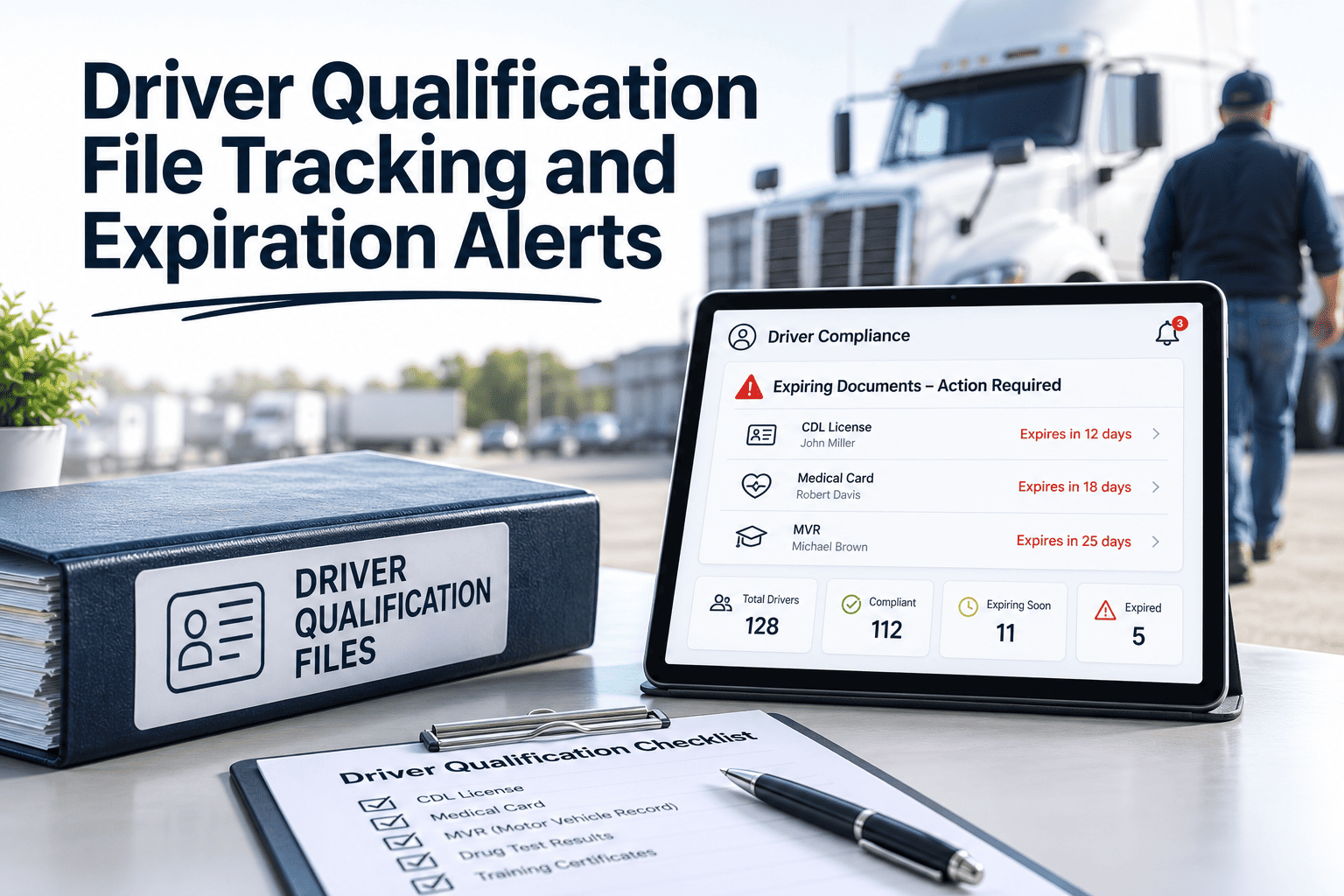
The Driver Qualification File is the most audited document category in FMCSA compliance reviews — and the most commonly found deficient. Every commercial driver must have a complete, current DQF maintained at the carrier before their first dispatch, and every element must remain current for as long as the driver is employed. A DQF with a single expired medical certificate or a missing safety performance history request is a complete DQF deficiency — FMCSA does not give partial credit for partially complete files. Oxmaint's DQF management module tracks every required element per driver, sends automated expiry alerts 30 days in advance, and stores all records in a centralised platform retrievable in seconds during any compliance review.
DQF Required Elements — At-a-Glance Status Board
Every element below is mandatory under 49 CFR Part 391. The status board shows what each element requires, which regulation governs it, its retention period, and the action triggered when it expires. Use this as a pre-audit self-check — any element showing a gap requires immediate action before an investigator arrives.
How Technology Is Modernising DQF Management
A paper-based DQF system works until your driver count exceeds 20 — at which point manual expiry tracking, missing document follow-ups, and audit preparation become a full-time compliance job. Four technologies are turning DQF management from reactive firefighting into a proactive, automated programme that stays ahead of every expiry date across every driver in the fleet. Oxmaint automates DQF compliance tracking for fleets of all sizes.
1. Pre-Employment DQF — Required Before First Dispatch
Every element in this section must be completed and documented before a driver operates any CMV for the carrier. There is no grace period, no temporary authority to drive while documents are pending. A single missing pre-employment element places the carrier in violation from the moment the driver first moves a vehicle. Oxmaint's DQF onboarding checklist enforces every pre-employment requirement before dispatching a new driver.
Employment application — FMCSA format, signed, 10-year history
The application must cover a 10-year employment history for all positions — not just CMV driving positions. All gaps in employment must be explained. The application must be signed and dated by the driver. An application that lists "see résumé" instead of completing the required fields is not a complete application and does not satisfy §391.21. Violation — missing/unsigned
Pre-employment MVR — from every state licensed in past 3 years
Obtain MVR from every state where the driver held a licence in the preceding 3 years — not just the current state. A driver who held licences in two states requires two pre-employment MVRs. Document the review outcome — a carrier that obtains the MVR but does not document its review has an incomplete DQF under §391.23. Violation — incomplete state coverage
Medical Examiner's Certificate — FMCSA National Registry examiner
The medical examination must be performed by an examiner listed on the FMCSA National Registry of Certified Medical Examiners. Verify the examiner's registry status on the FMCSA website — an examination by an unregistered examiner is invalid regardless of the driver's physical fitness. Record the examiner's NPI number in the DQF. Violation — unregistered examiner
Road test certificate — completed for each vehicle class operated
§391.31 requires a road test for the vehicle type the driver will operate. A driver who passes a road test in a straight truck but will operate combination vehicles requires a separate road test or must have a valid CDL with the appropriate class. The road test certificate must be signed by the examiner. CDL used as equivalent must be explicitly documented. Violation — wrong vehicle class
Pre-employment drug test — negative result from DOT-certified laboratory
The pre-employment drug test must be conducted under DOT 49 CFR Part 40 chain-of-custody protocols at a SAMHSA-certified laboratory. The test must be a 5-panel DOT test. An employer-collected urine specimen, a rapid test, or a non-DOT panel does not satisfy §382.301 — the result is invalid regardless of outcome. Violation — non-DOT protocol
FMCSA Clearinghouse — full query before first dispatch
A full clearinghouse query must be conducted and a response received before the driver's first dispatch — not within 30 days, not pending. The driver must provide electronic consent through the clearinghouse portal. Store the query result and consent confirmation in the DQF. A carrier that dispatches before the query response is received is in violation. Violation — dispatched before query
Safety performance history — written requests to all prior CMV employers
Send written requests for safety performance information to every employer for whom the driver operated a CMV in the preceding 3 years. Document every request sent and every response received. If a former employer does not respond within 30 days, document the follow-up attempt. The absence of a response does not excuse the carrier from documenting the inquiry effort under §391.23. Violation — no documented request
AI Document Scanning tip: Oxmaint's document scanner reads uploaded medical certificates and CDL copies on mobile — extracting expiry dates automatically and setting 30-day, 14-day, and 7-day alerts for every driver in the fleet without a single manual entry. See Oxmaint's automated DQF expiry tracking in action.
2. Ongoing DQF Maintenance — Annual Requirements
The DQF does not become complete at hire and stay complete — several elements require annual renewal, and failure to perform and document these renewals converts a previously complete file into a deficient one. Annual DQF maintenance must be managed as a per-driver scheduled event, not as a fleet-wide annual exercise performed on the same date for all drivers. Oxmaint tracks each driver's individual annual review due dates — no more missed renewals.
Annual MVR review — conducted and documented within 12 months
The annual MVR review must be obtained and reviewed within the preceding 12 months — measured from the driver's hire date anniversary, not a calendar year. The review must be documented: who reviewed it, when, and what action was taken based on the review outcome. A carrier that obtains the MVR but has no record of review completion has a deficient DQF under §391.25. Violation — no review documentation
Annual review of driving record — violations, accidents, convictions
§391.25 requires a written annual review of each driver's accident record, traffic conviction history, and compliance with FMCSA regulations. The review must be signed by the person conducting it. An annual MVR without a documented review narrative does not satisfy §391.25 — obtaining the record and reviewing it are two separate requirements with separate documentation. Violation — no signed review
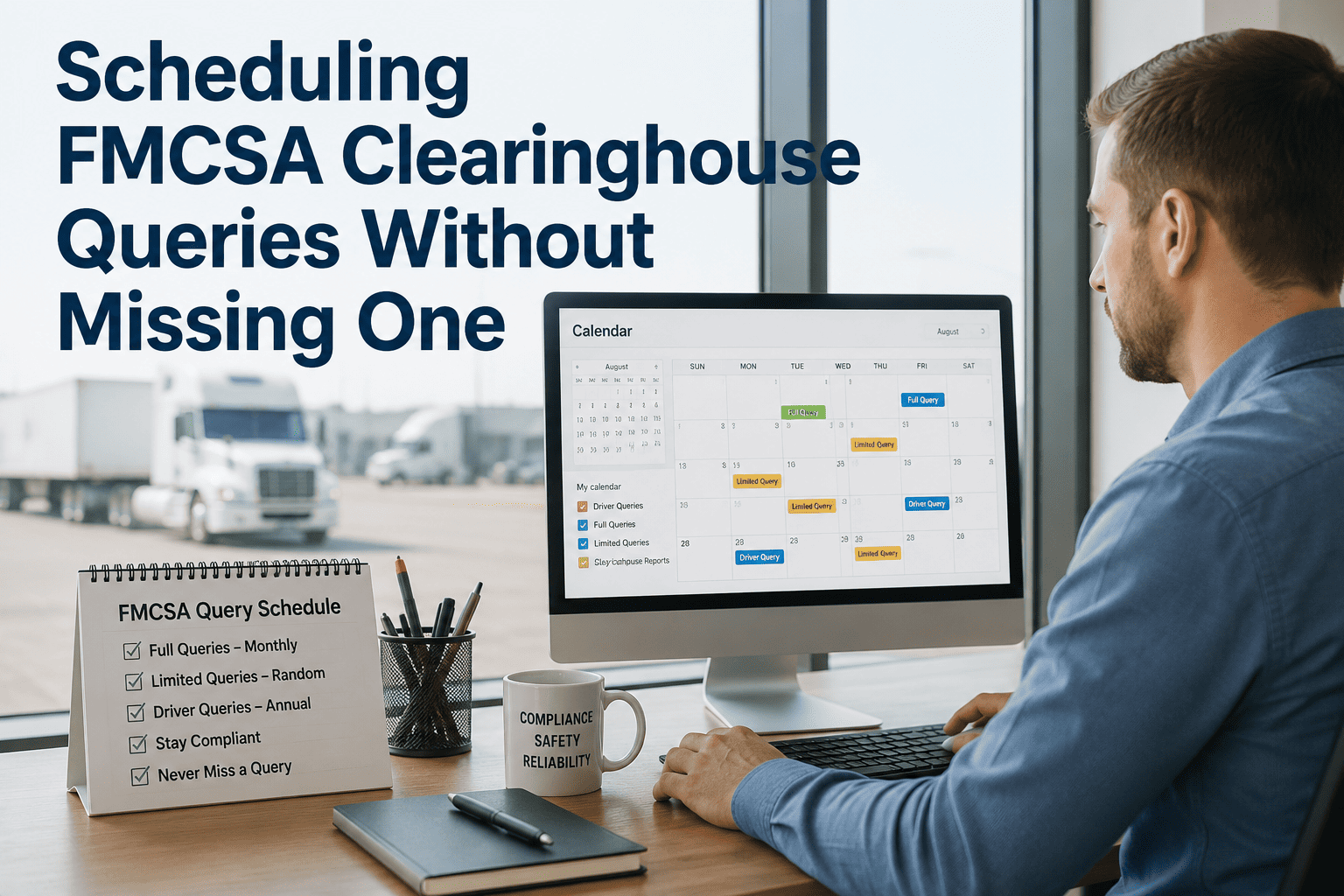
Clearinghouse limited query — within preceding 12 months
Every active CMV driver must have a limited clearinghouse query conducted within the preceding 12 months under §382.701(b). Unlike the full pre-employment query, the limited annual query requires driver consent renewed annually. Track query due dates per driver — a fleet annual query on a single date misses drivers hired at different points in the year. Violation — annual query overdue
Medical certificate — monitor expiry and renew before expiration
Track each driver's medical certificate expiry date individually — certificates expire at different dates depending on the examiner's assessment and the driver's health conditions. A driver whose certificate expires on a Tuesday does not have a grace period until Monday. The day after expiry, the driver is operating without a valid medical certificate under §391.41. Violation — expired certificate
CDL copy — update on renewal and endorsement changes
Update the DQF with a current CDL copy at every renewal. Verify the endorsement list matches the vehicles and loads the driver is currently operating — a driver who began hauling tankers after their last CDL renewal may not have a tanker endorsement on the copy in the DQF. Review endorsements at every annual driving record review. Deficiency — outdated copy
3. Accident, Violation, and Remedial Action Records
Accident and violation records are not optional additions to the DQF — they are required documentation that proves the carrier's safety management programme is functioning. A carrier with zero documented accidents in three years of operation is not automatically compliant; it is suspicious. FMCSA investigators look for evidence that the carrier identified, investigated, and responded to safety events — not just that none occurred.
Accident register — all DOT-recordable accidents for preceding 3 years
Maintain an accident register per §390.15 covering all accidents meeting the DOT recordable threshold (fatality, injury requiring medical treatment beyond first aid, or vehicle towed from scene). The register must include date, location, driver, vehicle, fatalities, injuries, and hazmat release. Retention: 3 years. A missing accident register is cited independently from DQF deficiencies. Violation — no register maintained
Post-accident drug and alcohol test records — retained in DQF
Post-accident drug and alcohol tests required under §382.303 must be completed within the specified time windows — blood alcohol within 8 hours, urine drug test within 32 hours. Retain all test results, collection documentation, and the accident report that triggered the test in the driver's DQF. A positive post-accident test result triggers clearinghouse reporting requirements within 3 business days. Violation — missed test window
Traffic conviction and serious violation documentation
Document all traffic convictions and serious traffic violations reported by drivers under §383.31. Drivers must report convictions to the carrier within 30 days and to their licensing state within 30 days. Carriers must document that the report was received and reviewed. A driver who fails to report a conviction puts the carrier in violation when the conviction appears on the next MVR pull. Deficiency — unreported conviction
Remedial training and return-to-duty documentation
If a driver is returned to duty following a positive drug or alcohol test, retain all return-to-duty documentation in the DQF — SAP evaluation, prescribed treatment, return-to-duty test result, and follow-up testing schedule. Incomplete return-to-duty documentation is treated as no return-to-duty process having occurred, placing the carrier in violation for operating a driver without completing the required programme. Violation — incomplete RTD docs
Digital Twin tip: Each driver's Oxmaint digital twin flags accident register entries, post-accident test deadlines, and clearinghouse reporting windows automatically — ensuring no post-accident requirement is missed in the hours immediately following an incident when operational pressure is highest. Book a demo to see automated post-accident DQF workflow in Oxmaint.
Before Oxmaint, our DQF compliance was a spreadsheet and a shared drive. We had 12 drivers with expired medical certificates that nobody had tracked — we only found out during a compliance review. After deploying Oxmaint's DQF module, every expiry date is tracked per driver and we get alerts 30 days out. We've had zero DQF deficiencies in our last two compliance reviews.
DQF Compliance Programme — Key Metrics
DQF deficiencies are the single most cited documentation violation in FMCSA compliance reviews — more common than ELD, maintenance, or insurance violations combined.
Automated expiry alerts 30 days before any DQF element lapses give compliance teams sufficient time to schedule medical exams, obtain MVRs, and run clearinghouse queries before violations occur.
11 separate DQF elements required under 49 CFR Part 391 — each with its own documentation standard, retention period, and renewal trigger that must be individually tracked per driver.
DQFs must be retained and auditable for 3 full years after a driver leaves — meaning every carrier is always carrying active DQF obligations for former drivers, not just current ones.
Frequently Asked Questions
The most common questions from compliance officers and HR teams about Driver Qualification File requirements, FMCSA standards, and DQF audit preparation.
Yes. Every driver who operates a CMV under the carrier's DOT number must have a complete DQF maintained by that carrier — regardless of employment type. For leased owner-operators, the motor carrier is responsible for maintaining or obtaining the DQF under §391.63. A lease arrangement does not transfer DQF responsibility to the driver or the leasing company.
Document the original request, the date sent, and a follow-up attempt made after 30 days without response. The carrier must retain evidence of the inquiry attempt regardless of whether a response is received. The absence of a response does not create a DQF violation — the failure to send the request and document the attempt does. FMCSA requires the effort, not the outcome.
3 years after the termination date under §391.51. The full file — application, all MVR records, medical certificates, road test, annual reviews, clearinghouse query results, and accident/violation history — must be retained and retrievable for the full 3-year period. The 3-year clock starts from the driver's last day of service, not the date the termination was processed administratively.
Yes. FMCSA accepts electronic DQF records provided the system prevents unauthorised modification, maintains an audit trail of changes, and produces legible records on demand. The system must be immediately accessible during a compliance review — cloud-based platforms like Oxmaint satisfy this requirement; systems requiring IT support to retrieve records may not meet the "readily available" standard.
A DOT-recordable accident: fatality — always test; injury where any person receives medical treatment away from the scene — test unless driver can be completely discounted as a contributing factor; vehicle towed from scene — test unless the driver can be completely discounted. The carrier's safety manager makes the determination. Document the decision either way — failure to test when required and failure to justify not testing are both violations.
Oxmaint tracks every DQF element expiry date per driver — medical certificates, CDL renewals, MVR review due dates, and clearinghouse query anniversaries — sending automated alerts at 30, 14, and 7 days before expiry. A compliance dashboard shows the DQF status of every driver in the fleet in a single view, with expired and expiring elements flagged in priority order for immediate action.