A fleet that runs from one yard is manageable with a whiteboard and a good lead technician. A fleet spread across several depots, branches, or regions is a different problem. Each location develops its own inspection habits, service intervals, parts shelves, and record keeping. Over time the same truck can receive very different care depending on where it is parked. This guide explains how multi-location fleet teams can bring those locations onto one maintenance standard, and how a maintenance-first CMMS supports that work.
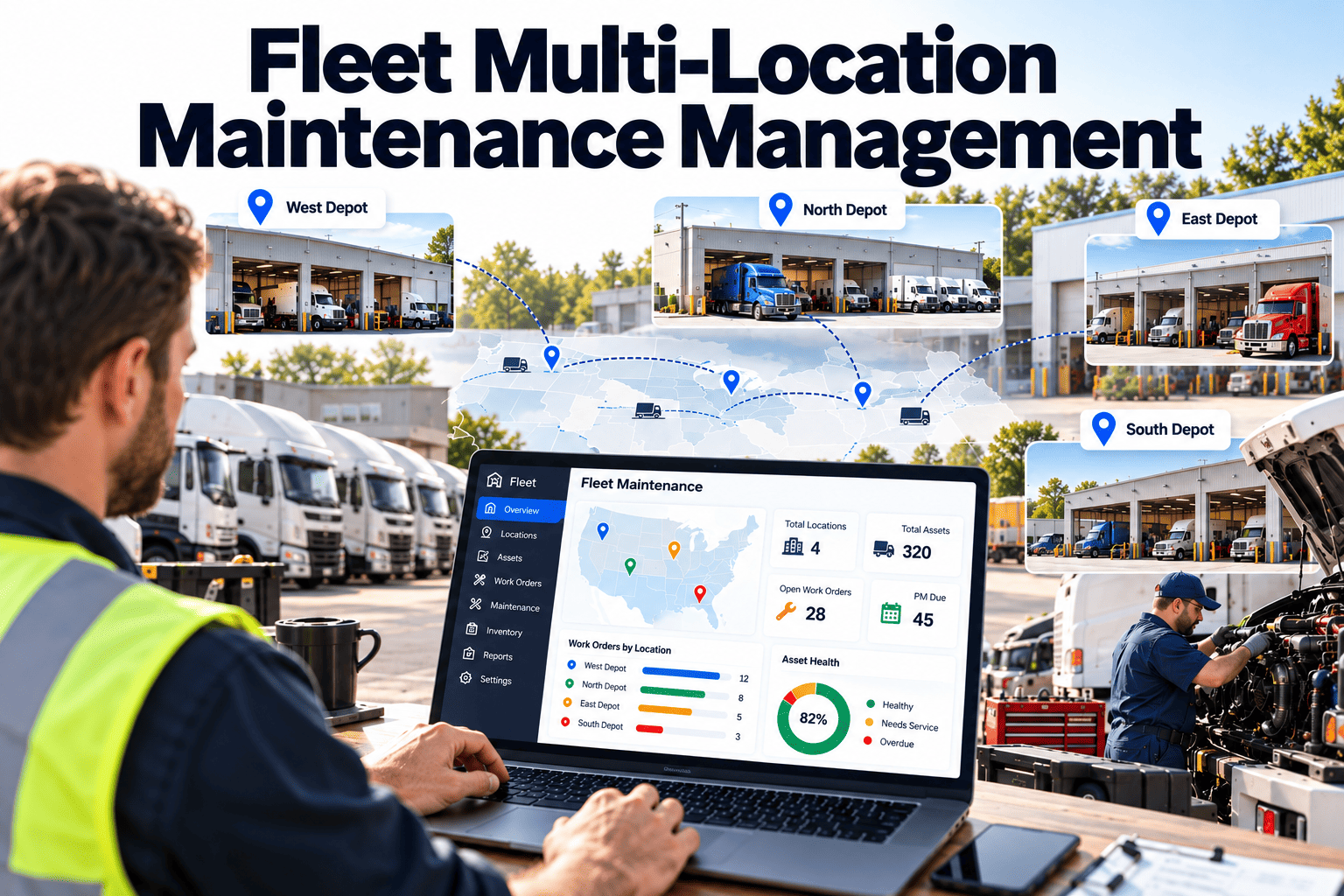
Fleet Multi-Location Maintenance Management: One Standard, Every Depot
Stop running five depots as five separate maintenance programs. Put inspections, preventive maintenance, work orders, parts, and compliance records on a single system your whole fleet can follow.
What Goes Wrong When Every Location Maintains Its Own Way
Multi-location fleets rarely fail because of one big mistake. They drift. Small local differences add up until head office cannot trust the numbers it is looking at.
One depot uses paper checklists, another uses photos in a chat group, and a third skips low-severity defects entirely.
Identical vehicles get oil, brake, and tire service at different intervals because each shop trusts its own experience.
Technicians describe the same fault in different words, so repeat failures cannot be grouped or analyzed fleet-wide.
One location holds surplus filters while another delays a repair waiting on the same part.
When a vehicle transfers between depots, its service history often does not travel with it.
Root Causes Behind Multi-Location Maintenance Inconsistency
Fixing symptoms at each depot does not last. The causes sit in how the fleet is organized.
- 1Local autonomy without a shared baseline. Depot managers are rewarded for keeping vehicles on the road, so they build their own routines. Without a corporate standard, every routine is defensible and none is comparable.
- 2Disconnected tools. Spreadsheets, paper job cards, email, and separate shop systems mean no one sees the whole fleet in one view.
- 3Mixed vehicle types and ages. Tractors, trailers, vans, and specialty units each need different schedules, and acquisitions often bring in assets with unknown history.
- 4Staff turnover. Knowledge held in a senior technician's memory leaves when that person does.
- 5No common definition of done. A work order closed at one depot may mean a verified repair, while at another it only means the vehicle left the bay.
Operational Impact: Where the Cost Shows Up
The effects are felt in uptime, safety exposure, and budget. This matrix helps teams decide which problems to tackle first.
| Gap | Likelihood across locations | Consequence if ignored | Priority |
|---|---|---|---|
| Missed or inconsistent pre-trip and post-trip inspections | High | Defects reach the road; audit findings | Fix first |
| PM intervals that differ for identical vehicles | High | Uneven wear, premature component failure | Fix first |
| Repeat repairs not linked to prior work orders | Medium | Same fault repaid several times | Fix next |
| Parts stranded at the wrong location | Medium | Longer downtime, emergency purchasing | Fix next |
| Service history lost on vehicle transfers | Medium | Weak resale documentation, blind spots | Fix next |
| Inconsistent fault and failure coding | High | Reports that cannot be compared | Fix with rollout |
See Every Depot's Maintenance in One View
Start with your own vehicles and locations, or walk through your multi-depot setup with our team.
A Standard Maintenance Workflow Every Location Can Follow
Standardization does not mean ignoring local conditions. It means every depot moves a vehicle through the same stages.
Compliance Does Not Stop at the Depot Gate
For U.S. motor carriers, the Federal Motor Carrier Safety Regulations in Part 396 set expectations for inspection, repair, and maintenance. Carriers in other regions face comparable national rules.
| Requirement area | What records should show | Multi-location risk |
|---|---|---|
| Systematic inspection, repair, and maintenance (49 CFR 396.3) | Vehicle identification, service performed, and dates, kept in a retrievable form | Records held at the depot that did the work, not where the audit happens |
| Driver vehicle inspection reports (396.11) | Reported defects and certification that repairs were completed or not needed | Reports lost or filed inconsistently between shifts and sites |
| Annual inspection (396.17) | Evidence of a qualifying inspection within the required period | Due dates tracked locally and missed during transfers |
| Inspector and brake inspector qualifications | Proof that staff are qualified for the work they sign off | Qualification files kept at a single site |
- Confirm the exact rules that apply to your operation and jurisdiction with your compliance lead.
- Keep records retrievable by vehicle, not by depot.
- Use one defect-to-repair trail so an auditor can follow any item from report to closure.
KPIs That Make Locations Comparable
You can only compare depots when they measure the same things the same way. Start with a short list and define each one in writing.
Parts and Inventory Across Locations
Parts control is where multi-location fleets often lose the most time.
Before: Local Shelves
- Each shop reorders by feel
- No visibility of stock at other depots
- Emergency purchases at retail prices
- Obsolete parts sit unnoticed
After: Shared Visibility
- Reorder points based on usage history
- Technicians can see which site holds a part
- Parts linked to PM schedules in advance
- Usage tied to work orders and vehicles
Technology Trends Shaping Multi-Location Fleet Maintenance
Three developments are changing how distributed fleets schedule and prioritize work.
Telematics and fault codes
Engine diagnostic codes and odometer or engine-hour data can trigger service by actual usage rather than a calendar guess.
Mobile-first shop work
Technicians and drivers capture inspections, photos, and labor at the vehicle, which removes retyping and delays.
Condition-based decisions
Repeat fault history and inspection trends help teams move selected components from fixed intervals to condition-based service.
How Oxmaint Supports Multi-Location Fleet Maintenance
Oxmaint is a maintenance management platform. These are the capabilities most relevant to a multi-depot fleet.
| Fleet need | Oxmaint capability |
|---|---|
| Consistent service schedules | Preventive maintenance templates applied to vehicle groups at every location |
| Defect capture and follow-up | Mobile inspections that generate work orders |
| Single vehicle history | Asset records holding work orders, parts, and costs that follow the vehicle |
| Shop coordination | Work order assignment, priority, and scheduling |
| Parts availability | Inventory tracking linked to work orders |
| Management visibility | Dashboards and reports by location, vehicle class, or asset |
| Audit readiness | Retrievable inspection and maintenance records |
Rollout Checklist for Standardizing Across Depots
Roll out in stages rather than switching every location at once.
- Build one asset register. Combine every vehicle and trailer, with unit number, type, location, and known history.
- Group vehicles into classes. Assign one PM schedule per class, reviewed by senior technicians from several depots.
- Adopt one inspection form per class. Keep it short enough that drivers will complete it.
- Define failure codes. Use a short shared list so reports can be compared.
- Pilot at one or two depots. Choose a location with a willing manager and fix the process before expanding.
- Train by role. Drivers, technicians, planners, and managers each need different instruction.
- Review KPIs monthly. Compare locations and adjust intervals using actual history.
Frequently Asked Questions
How do I standardize PM when depots run different vehicle mixes?
Group vehicles by class and duty cycle, then set one schedule per class. Allow documented local exceptions only where conditions justify them.
Can a CMMS replace our telematics system?
No. Telematics supplies usage and fault data, while the CMMS turns it into scheduled work. You can book a demo to discuss your setup.
What should we measure first?
Start with PM compliance, inspection completion, and downtime per vehicle. They are simple to define and quickly show differences between locations.
How do we handle vehicles transferred between depots?
Keep history on the vehicle record rather than the location, so service dates, open defects, and costs move with the unit.
Where do we begin?
Load your vehicles and one pilot depot, then sign up and test a common inspection and PM schedule before wider rollout.
Bring Every Location Under One Maintenance Standard
Give drivers, technicians, and managers one workflow, and give leadership one trusted view of fleet maintenance.