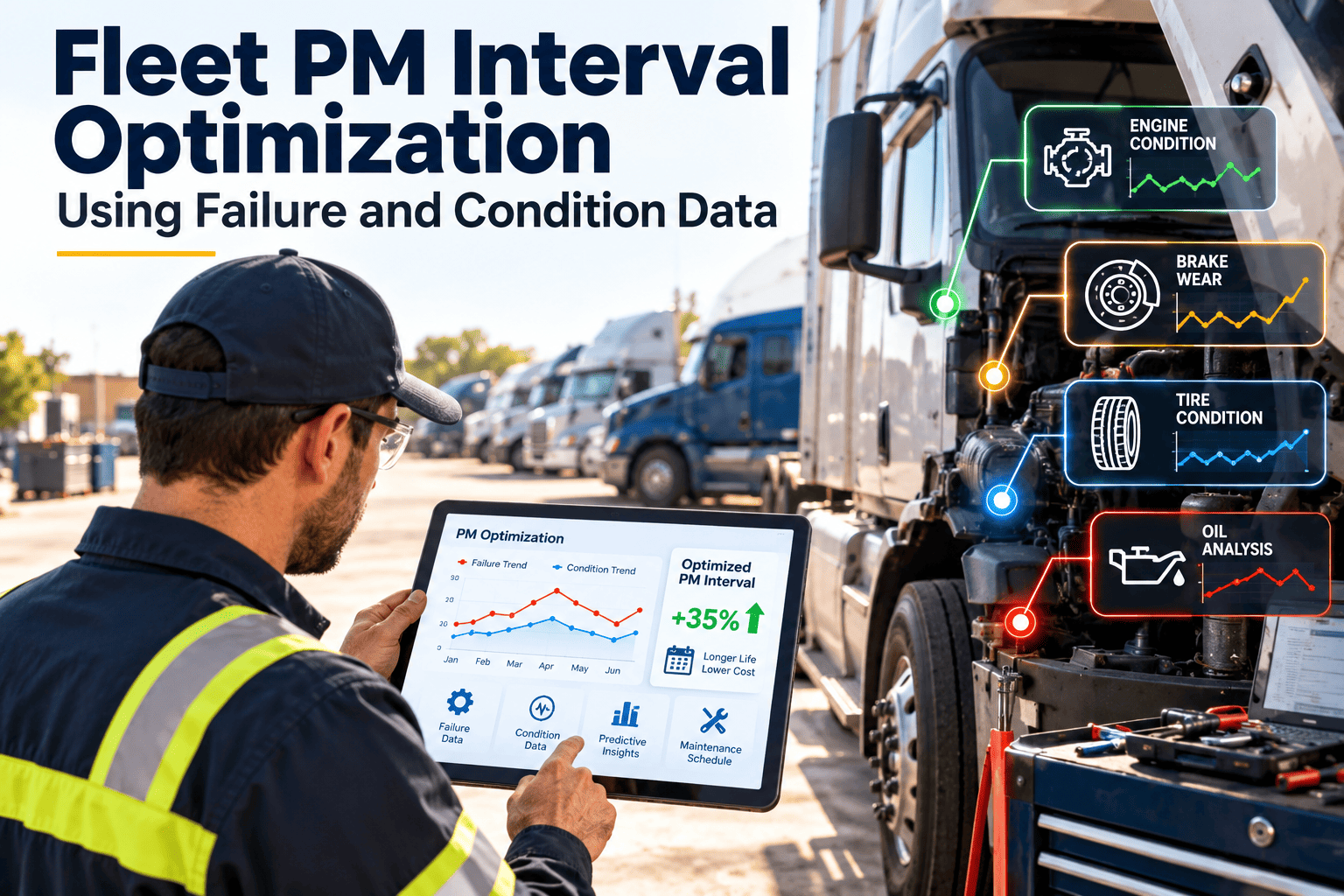
Fleet PM interval optimization is where most preventive maintenance programs quietly lose money, not because they skip service, but because they schedule it against the wrong number. A fixed mileage interval treats a long-haul truck running smooth interstate miles the same as a delivery van doing two hundred stop-starts a day in city traffic, even though the two vehicles wear at completely different rates. One gets pulled in for service while its components still have life left, burning labor and parts for no operational gain. The other runs past its real wear point while still showing as "within schedule" on paper, right up until something fails on the road. Usage-based scheduling closes that gap by triggering service from actual mileage, engine hours, and duty cycle data instead of a calendar guess, and fleets that make the switch typically find both problems were happening at once, on the very same fleet, under the very same fixed schedule.
Fleet Maintenance · PM Scheduling · 2026
Fleet PM Interval Optimization: The Usage-Based Guide
A fixed-mileage schedule cannot tell the difference between a highway truck and a stop-start delivery van. Usage-based PM intervals can — and the gap between the two approaches is bigger than most maintenance budgets assume.
20-30%
Cut in unnecessary service visits once intervals track real usage
15-25%
Reduction in total per-vehicle maintenance spend annually
40-50%
Fewer reactive breakdown repairs under CMMS-driven PM compliance
$8,000
Typical repair cost that follows one skipped, wrongly-timed oil change
One Schedule, Two Very Different Trucks
Picture two vehicles on the same fixed 10,000-mile PM schedule. Both get pulled in on the same interval. Both get the same checklist. Only one of them actually needed it.
Vehicle A — Highway Route
Duty cycleSteady interstate miles
Wear patternLow, consistent
Result on fixed scheduleServiced too early
Vehicle B — Urban Delivery
Duty cycle200+ daily stop-starts
Wear patternHigh, accelerated
Result on fixed scheduleServiced too late
Same mileage number. Same checklist. Opposite problem. This is what a fixed interval hides — and what usage-based scheduling is built to catch.
Where Your Fleet Is Losing Money Right Now
Every fleet running fixed intervals sits somewhere on two overlapping problems: over-servicing vehicles that did not need it, and under-servicing vehicles that badly did. Both numbers are almost always non-zero, and both are measurable the moment you start comparing PM visits against actual defects found.
Over-Servicing Rate
Share of annual PM visits that come back with no defects found — labor and parts spent on components that still had service life left.
Under-Servicing Gap
Share of unplanned breakdowns that happened on components still marked "within schedule" at the time they failed.
See Your Fleet's Real Over-Servicing Rate
OxMaint compares every PM visit against actual defects found and flags exactly which vehicles are being serviced too early, too late, or right on time.
How Usage-Based PM Scheduling Actually Works
Switching from a fixed calendar to usage-based intervals is not a rip-and-replace project. It is a five-step data loop that most fleets can start running within a single billing cycle, using data most vehicles are already generating.
1
Capture Real Usage
Pull odometer, engine hours, and duty cycle data automatically from telematics instead of relying on manual logs.
2
Set Per-Asset Baselines
Group vehicles by actual wear pattern — route type, load, terrain — instead of one blanket interval for the whole fleet.
3
Trigger Work Orders on Real Thresholds
Let mileage, hours, or condition signals generate the PM work order automatically — not a date on a spreadsheet.
4
Compare Visits Against Defects Found
Track which PM visits find real issues and which come back clean, and use that ratio to keep tightening the interval.
5
Review and Adjust Per Vehicle Class
Revisit intervals quarterly as duty cycles shift, so the schedule keeps tracking real usage instead of drifting back to a fixed default.
Fixed Interval vs. Usage-Based — Side by Side
The difference between the two approaches is easiest to see laid out metric by metric, across the same fleet, over the same twelve months.
Fixed-Mileage Schedule vs. Usage-Based Scheduling — Annual Comparison
Ranges reflect commonly reported outcomes for fleets shifting from fixed-calendar PM to telematics-driven, usage-based scheduling.
What a CMMS Adds That a Spreadsheet Cannot
Usage-based scheduling depends on data arriving automatically and being compared against results consistently — two things a spreadsheet or a paper checklist were never built to do at fleet scale. A CMMS closes that loop without adding work for your maintenance team.
Automatic Usage Capture
Odometer and engine hour data flow in from telematics, removing manual entry and the errors that come with it.
Per-Asset PM History
Every service event tied to its exact usage baseline, so the next interval starts from verified real-world data.
Interval Optimization Analytics
Defects-found ratios surface which vehicle classes are over-serviced and which are running past their real wear point.
Fleet-Wide Cost Visibility
Cost per mile and cost per vehicle update automatically with every closed work order — no spreadsheet reconciliation.
Frequently Asked Questions
What counts as "usage" beyond mileage?
Engine hours, idle time, load weight, and duty cycle all count. Engine hours matter especially for vehicles that idle heavily or run auxiliary equipment, where mileage alone understates real wear.
How do I find my fleet's current over-servicing rate?
Does usage-based scheduling replace preventive maintenance entirely?
No. It keeps the same PM structure but changes what triggers each task — real usage data instead of a fixed date or mileage number applied to every vehicle equally.
How long does it take to see results after switching?
Most fleets see measurable shifts in unnecessary visits and reactive repairs within the first two to three PM cycles, as intervals tighten around actual defect data per vehicle class.
Do I need new hardware to start usage-based PM?
Stop Scheduling PM Off a Guess
OxMaint turns odometer, engine hour, and duty cycle data into per-vehicle PM intervals — cutting unnecessary visits, catching high-wear vehicles before they fail, and giving you a defect-rate number instead of a fixed calendar guess. Free to start. No hardware required.