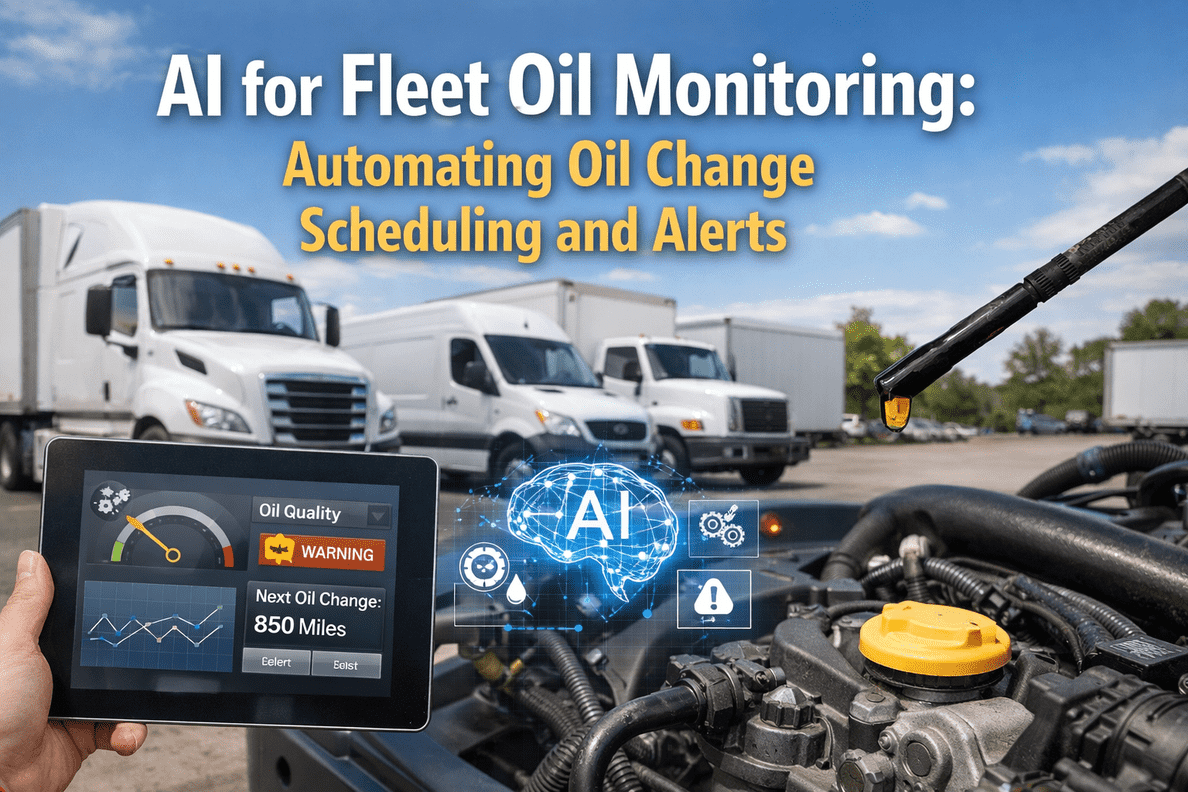
A national trucking fleet in Ohio was changing oil on every vehicle every 15,000 miles — a blanket interval set five years ago by a maintenance manager who no longer worked there. Nobody had questioned it since. When an independent oil analysis programme was introduced, the results were striking: 60% of oil samples still had 30% or more useful life remaining at the change point, while 12% of samples showed early wear metal contamination that should have triggered an earlier change. The fleet was simultaneously wasting money on premature changes and missing early warning signs of developing engine problems — both caused by the same root failure: treating every vehicle, every route, and every operating condition as identical. Modern fleet oil change interval optimisation uses AI-driven oil condition analysis, telematics data, and engine load monitoring to determine precisely when each vehicle's oil actually needs changing — not when the calendar says it should. The result is fewer unnecessary changes, fewer missed critical changes, lower oil costs, and longer engine life. Sign in to OxMaint to activate AI oil change interval optimisation for your fleet, or book a demo to see how OxMaint's condition-based oil scheduling reduces oil costs while protecting every engine in your operation.
Fleet Oil Change Optimization · AI Oil Analysis · Extended Drain Intervals · OxMaint
Stop Changing Oil on a Calendar. Start Changing It When the Data Says To. AI Oil Interval Optimization Cuts Oil Costs by Up to 30% While Protecting Every Engine in Your Fleet.
OxMaint AI fleet oil management combines oil condition monitoring, engine telematics, duty cycle analysis, and manufacturer data to generate the optimal drain interval for every individual vehicle — eliminating premature changes that waste money and missed changes that damage engines.
30%
average fleet oil cost reduction when condition-based oil scheduling replaces fixed-interval calendar changes
60%
of fleet oil changes performed at fixed intervals are premature — oil still has usable life remaining at the change point
$180
average oil and labour cost per heavy-duty fleet vehicle oil change — multiplied across 50, 100, or 500 vehicles with every unnecessary early change
2–4×
engine life extension achieved by fleets using condition-based oil management vs. generic fixed-interval programmes
Fixed oil change intervals are a legacy of an era when fleet managers had no way to know what was actually happening inside an engine between service visits. A 15,000-mile change interval made sense when the only alternative was guessing — but when AI can monitor oil degradation in real time, cross-reference engine load and operating temperature, and flag the exact vehicle-specific point at which oil life drops below the safe threshold, the fixed interval becomes an expensive approximation that costs money when it's too frequent and costs engines when it's too infrequent. OxMaint's AI oil interval optimisation gives fleet managers the data to stop approximating and start making individual decisions for every vehicle in the fleet — decisions grounded in actual oil condition, not calendar assumptions.
Six Reasons Fixed Oil Change Intervals Are Costing Your Fleet More Than They Save
Every Vehicle Gets the Same Interval
A highway truck running steady 65 mph loads degrades oil far more slowly than a city delivery van with constant stop-start operation, idling, and short cold-start cycles. Applying one interval to both means the highway truck gets changed too often and the city van may not get changed often enough when conditions are severe.
Seasonal and Climate Variation Ignored
Oil degrades faster in extreme heat and in severe cold-start conditions. A fleet operating in Texas summer heat, UAE desert temperatures, or Canadian winter cold requires different intervals than the temperate climate the manufacturer's recommendation was based on — yet fixed intervals rarely account for geographic or seasonal variation.
No Early Warning of Engine Problems
Elevated iron, copper, or aluminium particles in oil are early indicators of bearing wear, cylinder liner degradation, or coolant contamination — signs that appear weeks before a failure event. Fixed-interval programmes without oil analysis miss these signals entirely, allowing developing engine damage to compound undetected between service visits.
Premature Changes Waste Budget
Oil that still has 30–40% useful life remaining when changed is money poured down the drain — literally. A 500-vehicle fleet performing 10% premature changes at $180 per service wastes $90,000 per oil change cycle. Over a year, that's a significant maintenance budget line that could fund preventive work on genuinely degraded systems.
OEM Intervals Are Averages, Not Optima
Manufacturer-recommended intervals are set for average conditions and average duty cycles to be conservative enough for the worst-case operator. If your fleet operates in milder conditions than the OEM assumed, you may be able to safely extend intervals by 20–40% — but without data, you're guessing, and guessing conservatively costs money.
No Cross-Fleet Learning
When one vehicle develops an oil-related engine issue, there's no system to determine if other vehicles of the same make, model, or route type share the same risk profile. Each vehicle's oil history is isolated — valuable patterns that could protect the rest of the fleet remain invisible without AI cross-fleet analysis.
How OxMaint AI Oil Interval Optimisation Works — Three Data Layers
01
Oil Condition Monitoring — Real-Time and Sampled Analysis
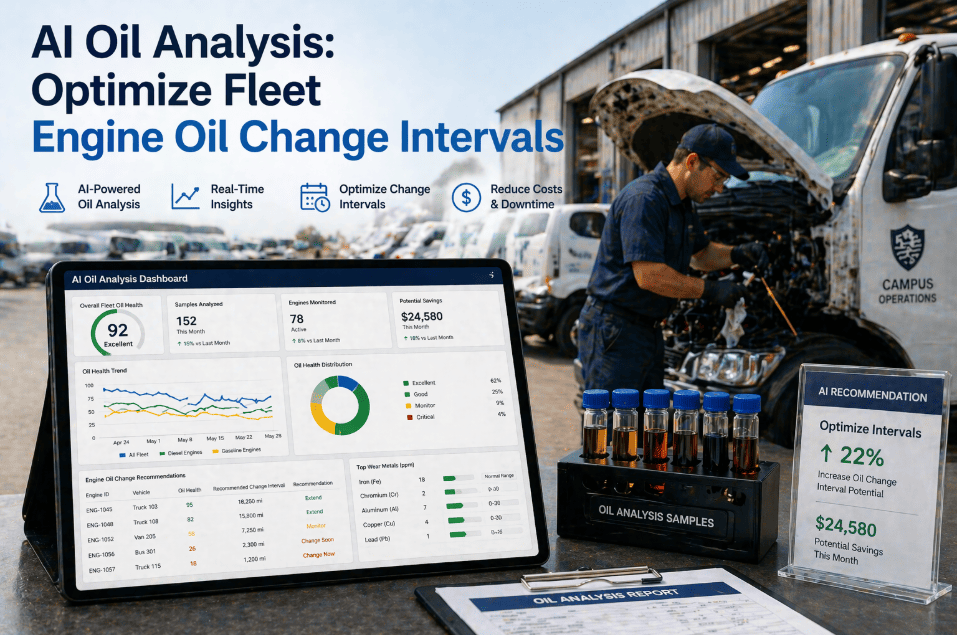
OxMaint integrates with onboard oil life monitoring systems (OLM) present in most modern fleet vehicles and combines that data with periodic oil sample analysis from third-party laboratories. OLM data tracks engine temperature cycles, load factors, idle time, and operating hours to calculate a real-time oil life percentage. Lab sample results add direct measurement of viscosity breakdown, total base number (TBN) depletion, contaminant levels, and wear metal concentrations — the full oil condition picture that OLM alone cannot provide.
02
Duty Cycle and Environmental Analysis
OxMaint AI pulls telematics data — idle percentage, average load, stop frequency, operating temperature range, and route type — to classify each vehicle's duty cycle and adjust the oil degradation model accordingly. A vehicle averaging 40% idle time in urban delivery gets a compressed interval model. A highway line-haul vehicle with steady-state load gets an extended model. Geographic data adjusts for ambient temperature ranges specific to operating regions — critical for fleets in high-heat markets like the UAE, Middle East, or Southern US.
03
AI Interval Recommendation and Scheduling
OxMaint AI combines oil condition data, duty cycle analysis, lab results, and fleet-wide wear pattern learning to generate an optimal next change point for each individual vehicle — expressed as mileage, hours, or calendar date, whichever comes first. The recommendation is scheduled as a preventive maintenance work order in OxMaint with automated technician assignment, parts pre-ordering, and reminder escalation — so the optimal interval actually gets executed, not just calculated.
OxMaint AI · Fleet Oil Change Optimization
Individual Oil Intervals for Every Vehicle. Based on Actual Oil Condition. Scheduled Automatically. Your Fleet's Oil Programme Optimised in Days, Not Months.
OxMaint replaces the fleet-wide fixed interval with condition-based individual scheduling — cutting oil costs, extending drain intervals safely, and catching engine problems before they compound.
OxMaint Oil Management Features — What Fleet Managers Get
Real-Time Oil Life Percentage Dashboard
OxMaint displays current oil life percentage for every vehicle in the fleet — colour-coded from green (healthy) to amber (schedule soon) to red (change required). Supervisors see at a glance which vehicles need oil service this week vs. which have 8,000+ miles remaining, eliminating the daily manual check of service schedules.
Oil Sample Lab Integration and Wear Metal Trending
OxMaint imports oil analysis laboratory results directly from major fleet oil analysis providers — tracking iron, copper, lead, chromium, and sodium trends across consecutive samples per vehicle. AI trend analysis identifies which vehicles show progressive wear metal increase before the level reaches the critical threshold.
Duty Cycle Classification per Vehicle
OxMaint automatically classifies each vehicle's duty cycle from telematics — highway, mixed, urban, severe — and applies the appropriate oil degradation model. Vehicles reclassified due to route changes automatically get updated interval recommendations within one data sync cycle, without manual adjustment.
Automated PM Work Order Scheduling
When a vehicle's AI-calculated change point approaches, OxMaint automatically creates a preventive maintenance work order — assigned to the correct technician, with the oil type and filter spec pre-populated, and reminder notifications to the fleet manager at 500 miles and 100 miles remaining. Zero manual scheduling required.
Oil Cost and Savings Reporting
OxMaint tracks actual oil change costs per vehicle and compares them against the projected cost under the previous fixed-interval programme — quantifying savings per vehicle, per asset class, and fleet-wide. Monthly and quarterly savings reports give fleet managers the evidence to justify the condition-based programme to ownership or board-level stakeholders.
Cross-Fleet Anomaly Detection and Alerts
OxMaint AI monitors oil consumption patterns across the fleet and flags vehicles consuming significantly more oil than similar vehicles in similar conditions — an early indicator of developing ring, seal, or valve guide wear that may not yet be reflected in external symptoms but is measurable in the oil data before engine damage becomes costly.
Oil Management by Fleet Type — Which Operations Benefit Most
Long-Haul Heavy Freight
Highway trucking fleets operating steady-state loads at consistent temperatures are prime candidates for safely extended drain intervals — often 20–35% beyond OEM recommendations when oil analysis confirms oil condition remains well within specification. The per-change savings at $180–$350 per heavy-duty oil change add up rapidly across a large fleet.
Urban Delivery and Service Fleets
Stop-start urban delivery vehicles with high idle fractions and frequent cold starts degrade oil faster than highway equivalents — meaning their fixed intervals may actually be too long, not too short. AI duty cycle analysis identifies these vehicles for compressed intervals, catching early wear before it accelerates during the harsh urban operating cycle.
Construction and Off-Road Equipment
Construction and mining equipment operating in high-dust, high-heat, and variable-load conditions requires oil analysis programmes that monitor contamination levels alongside degradation — dust ingestion increases wear metal loading faster than engine heat alone, and AI analysis of combined contamination and degradation data drives the optimal change decision.
Fixed Interval vs. OxMaint AI Condition-Based — What Changes
Fixed Interval Programme
Same interval for every vehicle regardless of duty cycle
60% of changes premature — oil life remaining wasted
No early warning of developing engine wear
No seasonal or geographic adjustment
Manual scheduling — changes missed when vehicles are unavailable
No cross-fleet learning from oil trend data
Oil cost invisible — no per-vehicle tracking
VS
OxMaint AI Condition-Based
Individual interval per vehicle based on actual condition
Oil changed when needed — up to 30% fewer total changes
Wear metal trending catches engine issues weeks early
Duty cycle and climate adjustments built in automatically
Automated PM work orders — no missed services
AI fleet-wide pattern learning improves recommendations over time
Per-vehicle savings tracked and reported monthly
Outcomes — Fleets Using OxMaint AI Oil Interval Management
28%
average reduction in total annual oil change count at fleets switching from fixed to OxMaint condition-based scheduling — without any increase in engine warranty claims
$142K
average annual oil programme savings at a 200-vehicle mixed fleet on OxMaint AI scheduling vs. prior fixed-interval programme
14 engines
average number of early engine wear events caught by oil analysis wear metal trending at fleets in their first year on OxMaint — before symptoms appeared externally
That Ohio fleet was wasting $90,000 per oil change cycle — and missing early engine wear warnings at the same time. Two problems. One root cause. No visibility into actual oil condition. OxMaint fixes both.
Individual condition-based intervals. Real-time oil life monitoring. Wear metal trending. Automated PM scheduling. OxMaint makes your oil programme accurate for every vehicle, not just average for all of them.
We had 180 trucks all on the same 15,000-mile oil change interval. After 90 days on OxMaint, our highway trucks were averaging 19,800 miles between changes with clean oil analysis results, while our city delivery trucks flagged for earlier changes based on high idle data. In the first year we did 22% fewer total oil changes, saved $94,000 in oil and labour, and caught three engines with elevated copper readings before they developed actual bearing issues. That's the value of knowing what's actually in the oil, not just how many miles it's been.
— Director of Fleet Maintenance, Regional Carrier · 180 Trucks · US Midwest · OxMaint user since 2023
Frequently Asked Questions — Fleet Oil Change Interval Optimisation
How does OxMaint determine the optimal oil change interval for each individual vehicle?
OxMaint combines three data sources: real-time onboard oil life monitor (OLM) data via telematics integration, periodic oil sample laboratory results imported from analysis providers, and duty cycle data from GPS and engine telematics. AI models combine all three to generate an individual change recommendation for each vehicle that reflects its actual operating conditions.
Sign in to OxMaint to activate oil interval optimisation for your fleet.
Will extending oil change intervals void manufacturer warranties?
Extended drain intervals are acceptable under most manufacturer warranties when supported by documented oil analysis results demonstrating oil condition remains within specification. OxMaint maintains the full oil analysis history and change record needed to satisfy warranty documentation requirements — consult your specific OEM warranty terms before extending beyond the published interval.
How does OxMaint handle fleets operating in extreme climate conditions like Middle East or desert environments?
OxMaint adjusts oil degradation models based on ambient temperature range data from GPS location — vehicles operating in high-heat environments (UAE, Saudi Arabia, Texas summer) receive compressed degradation models that account for accelerated thermal breakdown. Oil analysis sampling frequency is also increased for high-heat operations.
Book a demo to see climate-adjusted oil interval management for your operating region.
Which oil analysis laboratories does OxMaint integrate with for fleet sample results?
OxMaint integrates with major fleet oil analysis providers including Polaris Laboratories, Analysts Inc., Blackstone Laboratories, Shell LubeAnalyst, and Castrol ON — receiving results via API or structured data import. Manual entry is also supported for labs not on the integration list, with the same trend analysis and wear metal alerting applied to all result data.
How quickly can a fleet transition from fixed-interval to condition-based oil scheduling in OxMaint?
Most fleets are fully transitioned to condition-based oil scheduling within 30–60 days of OxMaint deployment — the time needed to import vehicle history, establish baseline oil sample results for each vehicle class, and configure duty cycle classifications. Fleet managers can run fixed and condition-based programmes in parallel during the transition to validate condition-based recommendations before fully switching over.
Your Fleet Has Been Changing Oil on a Calendar for Years. OxMaint Changes It Based on the Oil. 30% Lower Costs. Longer Engines. Zero Guessing.
AI oil condition monitoring. Individual vehicle intervals. Lab result integration. Automated PM scheduling. Wear metal trend alerts. OxMaint makes every oil change decision in your fleet a data-driven one — not a calendar one.