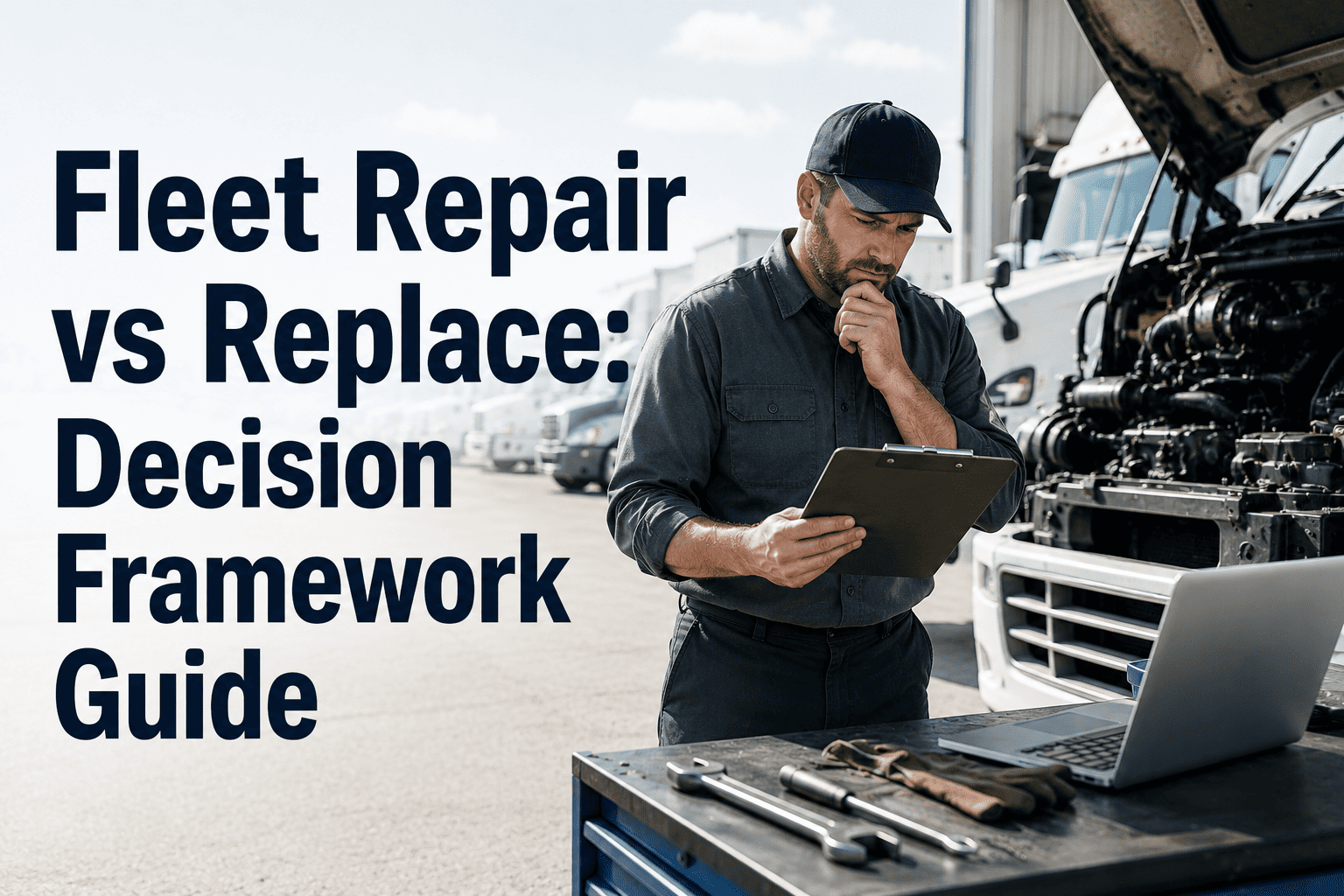
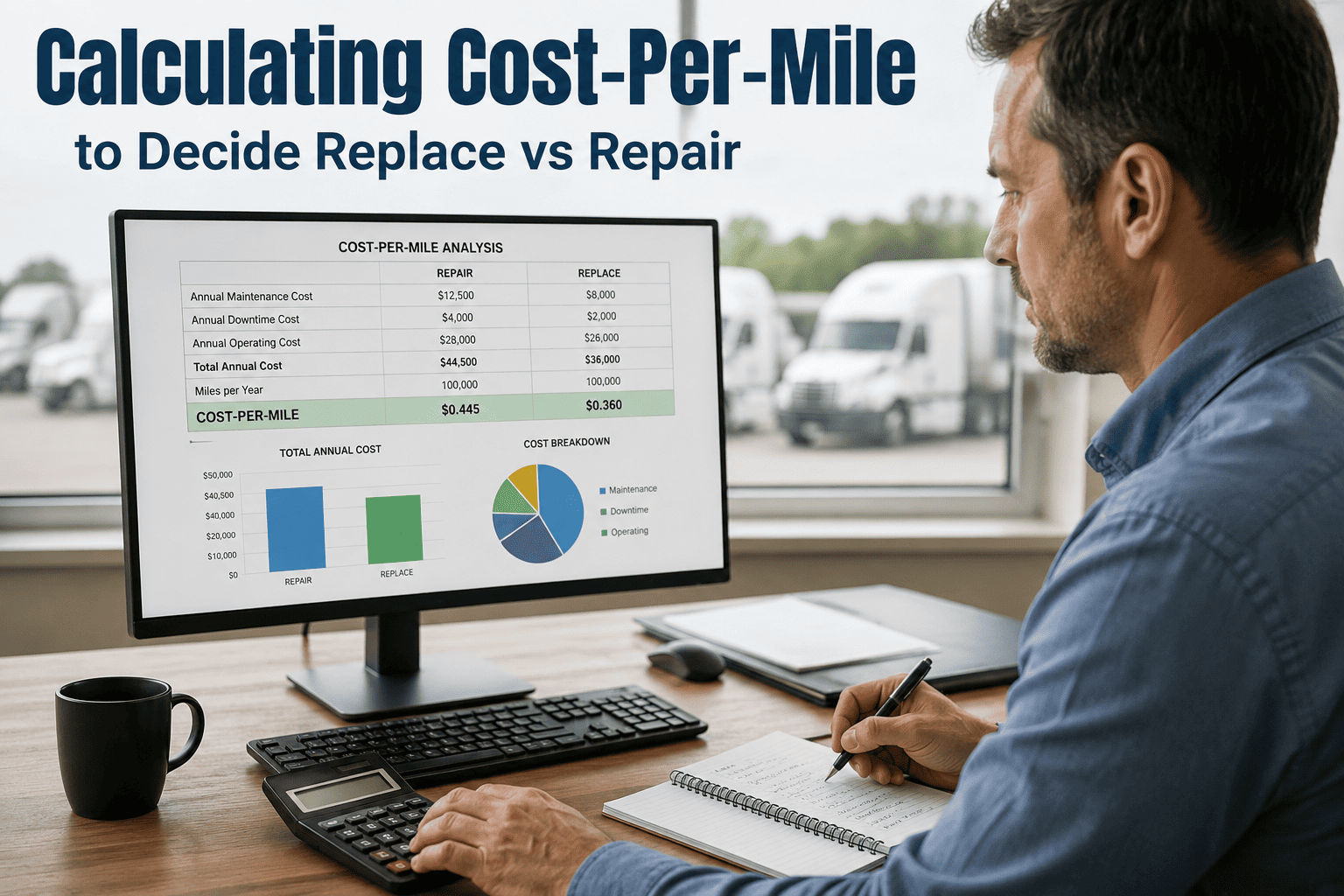
Fleet Repair vs Replace: Data-Driven Decision Framework
By Jack Miller on April 8, 2026
A regional trucking company in Ohio kept repairing a 2016 Class 8 tractor for 14 months past its economic replacement point — spending $34,000 in cumulative repairs on a truck with a trade-in value of $18,000. Nobody made a wrong decision. Nobody ignored the data. The data simply didn't exist in a form that enabled a decision. Each repair was approved individually, each one seemed reasonable in isolation, and nobody was tracking the total cost of ownership trajectory that was screaming "replace" from month nine onward. Fleet managers across the US face this every day — not a shortage of information, but a shortage of information assembled into a decision. OxMaint's repair vs replace engine builds that decision automatically, combining maintenance history, remaining useful life models, and current market values into a single recommendation with the numbers behind it. Book a demo to see your fleet's replacement queue today.
Stop Repairing Vehicles Past Their Economic Replacement Point
AI cost modeling, RUL prediction, and TCO analysis — one platform, one decision
Wasted in repairs on a single truck past its economic replacement point — a real Ohio fleet, 14 months of avoidable spend
67%
Of US fleet managers report keeping vehicles beyond their optimal replacement point due to lack of real-time TCO data — NPTC survey
23%
Average reduction in per-vehicle maintenance spend when replacement decisions are driven by AI cost modeling vs calendar-only policies
The 6 Data Points That Drive Every Repair vs Replace Decision
Every repair vs replace decision comes down to six numbers. The problem is that most fleets have these numbers scattered across three systems and a spreadsheet that's two months out of date. OxMaint assembles all six automatically for every vehicle in your fleet — updated in real time as maintenance events occur.
1
Total Cost of Ownership (TCO)
Most underused metric in fleet management
Cumulative acquisition, fuel, insurance, maintenance, downtime, and disposal costs per mile. A vehicle with low repair invoices but poor fuel economy and high downtime often has the worst TCO in the fleet. OxMaint calculates this automatically from IFTA, maintenance records, and telematics.
2
Remaining Useful Life (RUL)
AI-predicted from maintenance frequency, mileage trajectory, and failure history
OxMaint's AI models predict the probability of major system failure (engine, transmission, driveline) within the next 6, 12, and 24 months — giving fleet managers a forward-looking decision window rather than a reactive repair event.
3
Repair Cost Acceleration Rate
The signal most fleets miss until it's too late
Annual repair spend that is increasing faster than 15–20% year-over-year is the clearest leading indicator that a vehicle is approaching economic end of life. OxMaint plots this trend line automatically and flags vehicles crossing the threshold.
4
Market Residual Value
The asset value you're eroding with every deferred repair
Every month a vehicle runs past its optimal disposal window, its market value declines while its repair probability increases. OxMaint integrates with market valuation data to show current trade-in value alongside projected 6-month and 12-month depreciation curves.
5
Downtime Cost per Vehicle
The hidden cost that makes the repair invoice look cheap
A $2,500 repair that takes a revenue-generating truck off the road for 4 days at $800/day contribution margin has a real cost of $5,700 — not $2,500. OxMaint calculates downtime cost using your configured vehicle revenue rate and tracks cumulative downtime per asset.
6
Replacement Cost Differential
The comparison the decision actually requires
OxMaint calculates the projected 24-month cost of continuing to operate and repair the current vehicle against the 24-month cost of replacement — factoring in current incentives, fuel efficiency improvement, and reduced maintenance probability on a newer chassis.
Repair vs Replace — OxMaint AI
Every Vehicle. Every Decision. Every Number — Automatically.
OxMaint assembles all six decision variables for every vehicle in your fleet and delivers a replacement recommendation — with the financial model behind it.
How OxMaint Builds the Repair vs Replace Decision — Step by Step
The repair vs replace engine runs continuously in the background — every work order completed, every fuel transaction recorded, and every telematics event processed updates each vehicle's decision score. The model surfaces vehicles approaching replacement thresholds before they become emergency decisions made under pressure.
Continuous
Data Aggregation
OxMaint pulls maintenance history, fuel data, telematics, downtime events, and parts costs into a unified vehicle cost record — updated with every transaction
Daily
TCO Calculation
Total cost of ownership recalculated per vehicle per day — acquisition amortization, fuel, maintenance, insurance, and downtime cost per mile updated automatically
Weekly
RUL Model Refresh
AI Remaining Useful Life model re-runs on each vehicle using updated maintenance frequency, mileage rate, and system health indicators — probability of major failure recalculated
On Trigger
Threshold Alert
When TCO exceeds replacement cost differential or RUL drops below configured threshold — fleet manager receives a replacement recommendation with full financial model attached
On Request
Capital Plan Export
Fleet replacement queue exported as a capital plan — vehicles ranked by replacement urgency with projected 12-month and 24-month spend if retained vs replaced — CFO-ready format
Ongoing
Decision Audit Trail
Every repair approval and replacement decision is logged with the data that supported it — protecting fleet managers and documenting asset lifecycle decisions for ownership review
Repair vs Replace by Vehicle Type — What the Thresholds Look Like in Practice
Different vehicle types have different economic replacement points. A Class 8 OTR tractor has a different cost structure than a last-mile delivery van or a service pickup. OxMaint configures replacement thresholds by vehicle class — not a single fleet-wide rule that doesn't fit anyone well.
Vehicle Type
Replace Signal
Annual Repair Threshold
Typical RUL Trigger
Key TCO Driver
Class 8 OTR Tractor
Repair cost >40% of trade-in value/yr
$18,000–$28,000/yr
600K–800K miles
Downtime cost per day
Medium Duty Box Truck
Repair cost >35% of trade-in value/yr
$8,000–$14,000/yr
200K–300K miles
Fuel cost per mile
Last-Mile Delivery Van
Repair cost >30% of trade-in value/yr
$4,500–$8,000/yr
150K–200K miles
Stop count reliability
Service / Utility Pickup
Repair cost >25% of trade-in value/yr
$3,500–$6,500/yr
120K–175K miles
Tech productivity loss
Refrigerated Trailer
Reefer unit + frame repair combined
$12,000–$20,000/yr
15–20 years / 1M miles
Cargo spoilage risk
Construction / Off-Road
Component cost > replacement premium
$22,000–$45,000/yr
10K–15K engine hours
Project delay liability
Cost of Repair vs Replace — By Fleet Size
The financial impact of running an undisciplined replacement policy scales directly with fleet size. The numbers below represent real fleet data — showing what fleets typically spend keeping vehicles past their replacement point versus what a structured OxMaint-driven policy recovers.
Small Fleet
10–50 vehicles
Avg annual overspend (reactive policy)
$38,000–$95,000
OxMaint annual licence
$3,600–$7,200
Vehicles past replacement point
3–8 typical
Time to first replacement recommendation
14 days
Expected 1st-year savings
$28,000–$72,000
Mid-Size Fleet
50–250 vehicles
Avg annual overspend (reactive policy)
$95,000–$380,000
OxMaint annual licence
$7,200–$18,000
Vehicles past replacement point
12–35 typical
Time to first replacement recommendation
14 days
Expected 1st-year savings
$70,000–$290,000
Large Fleet
250+ vehicles
Avg annual overspend (reactive policy)
$380,000–$1.2M+
OxMaint annual licence
$18,000–$48,000
Vehicles past replacement point
35–90+ typical
Time to first replacement recommendation
14 days
Expected 1st-year savings
$280,000–$900,000+
We had 14 trucks that were costing us over $22,000 a year each in repairs and downtime. Our controller thought we couldn't afford to replace them. OxMaint showed us the 24-month cost of keeping them vs replacing — on four of those trucks, replacement paid back in under 8 months. We replaced nine in the first cycle. Maintenance spend dropped $340,000 in year one.
— VP of Fleet Operations, 180-vehicle LTL carrier, Tennessee, OxMaint user since 2022
Technology Stack Behind the Decision Engine
OxMaint's repair vs replace engine pulls from four technology layers — each adding a data dimension that makes the replacement decision more accurate and more defensible. Connect your existing fleet technology stack through OxMaint — no rip-and-replace required.
AI Digital Twin
Each vehicle has a living digital twin in OxMaint — accumulating maintenance history, mileage, failure events, and cost data. The twin runs forward-looking degradation models that predict major system failure probability 6–24 months ahead.
OBD / Telematics Integration
OBD-II and telematics data feeds OxMaint in real time — engine fault codes, idle time, hard braking events, and mileage all update TCO calculations automatically. Supports Samsara, Verizon Connect, Geotab, and all major US providers.
SAP / ERP Integration
Replacement recommendations from OxMaint trigger capital procurement workflows in SAP automatically — purchase approvals, vendor quotes, and disposal orders initiated from the same recommendation that identified the replacement need.
AI Camera Vision
AI camera inspection at pre-trip and post-trip captures visible wear, body damage, and fluid leak indicators — feeding condition data into the replacement model that pure cost data would miss. Documented condition supports trade-in valuation negotiations.
Frequently Asked Questions
How quickly does OxMaint produce repair vs replace recommendations after onboarding?
Most fleets receive their first replacement recommendations within 14 days of loading historical maintenance data. If your fleet has 2+ years of work order history, the model runs immediately on import — no waiting period for data accumulation.
Can OxMaint generate a capital plan report for CFO or ownership review?
Yes — OxMaint exports a replacement queue ranked by urgency, showing projected 12-month and 24-month cost of retaining each vehicle versus replacing it. The report includes the financial model behind each recommendation and is formatted for executive review.
Does OxMaint integrate with our existing telematics provider?
OxMaint integrates with all major US telematics platforms including Samsara, Geotab, Verizon Connect, Fleet Complete, and Motive. OBD-II data, GPS mileage, fault codes, and idle time all feed the TCO model automatically — no manual data entry required.
What if we have mixed vehicle types — trucks, vans, and trailers?
OxMaint configures replacement thresholds by vehicle class. Class 8 tractors, medium duty trucks, vans, trailers, and off-road equipment each have their own economic replacement parameters — the model doesn't apply a one-size-fits-all rule that fits nobody.
How does OxMaint handle the downtime cost variable — our trucks earn different daily rates?
You configure a daily contribution margin or revenue rate per vehicle type in OxMaint. The model applies your actual rate to downtime hours — so a premium temperature-controlled route vehicle shows its true downtime cost, not an average that undervalues it.
Fleet Repair vs Replace — OxMaint AI
Know Which Vehicles to Replace Before They Cost You More to Keep.