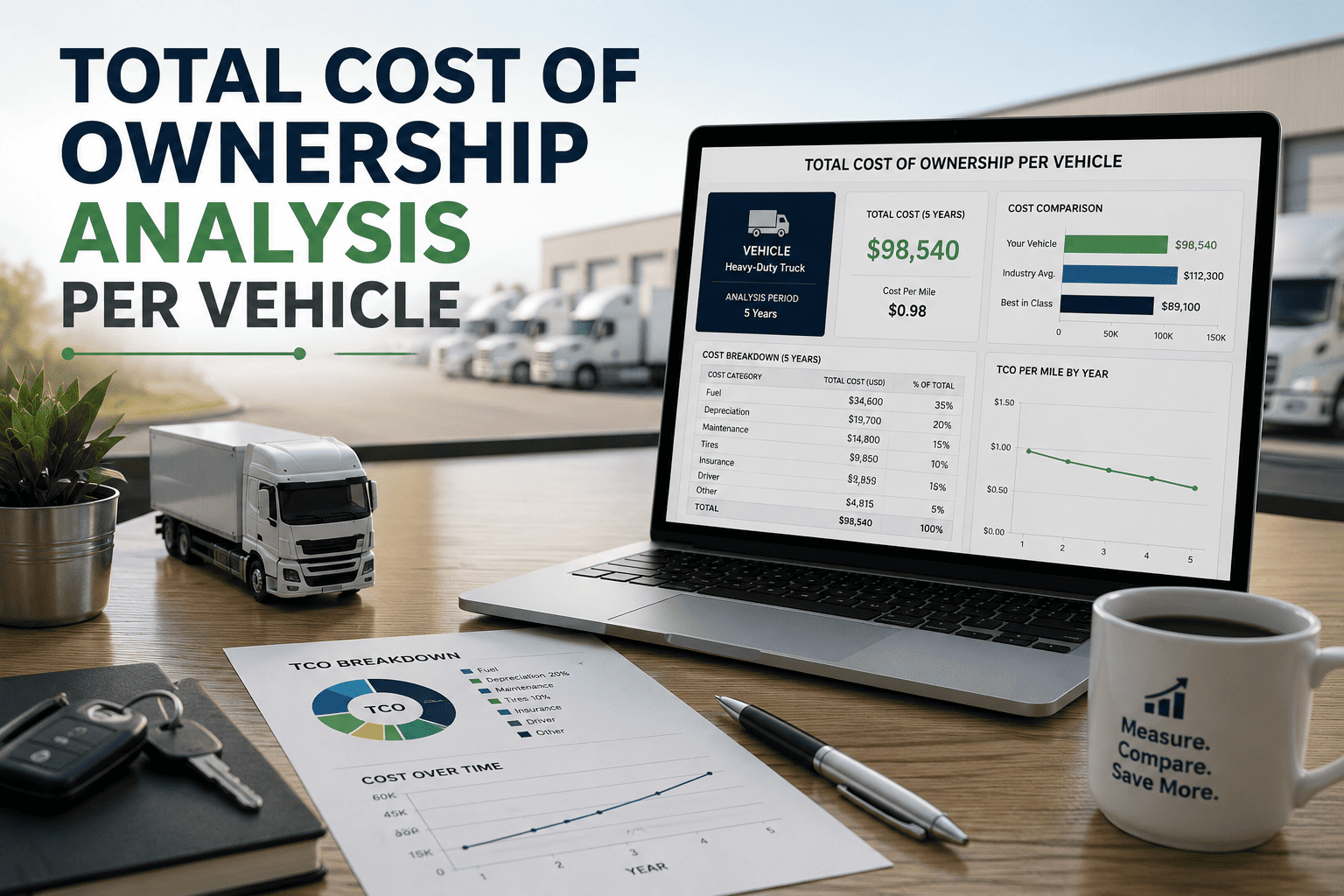
Most fleet managers know their fuel costs. Fewer know their maintenance costs per vehicle. Almost none can tell you the true total cost of ownership across the full lifecycle of each asset — and that gap is where replacement decisions go wrong, budgets miss reality, and CFOs lose confidence in fleet operations. A vehicle that looks cheap on acquisition often becomes the most expensive asset in your fleet when you factor in maintenance escalation, downtime, depreciation curves, and residual value decline. This lifecycle cost analysis template gives fleet managers and finance teams the framework to calculate true TCO, compare vehicles on a level playing field, and make replacement decisions based on data instead of intuition. The spreadsheet does the math — but if you want continuous lifecycle tracking that updates automatically as maintenance events occur, Oxmaint's fleet CMMS calculates TCO in real time and flags vehicles crossing your replacement thresholds before they become money pits. Download the template to start your analysis, or book a demo to see lifecycle analytics in action.
Fleet Vehicle Lifecycle Cost Analysis Template: Excel Spreadsheet
Calculate total cost of ownership, depreciation, maintenance trends, fuel costs, and optimal replacement timing for every vehicle in your fleet. Built for fleet managers and finance teams.
Download the TCO Calculator or Track Continuously
Use the Excel template for point-in-time lifecycle analysis. For continuous TCO tracking that updates automatically with every work order and fuel purchase, Oxmaint calculates cost per mile and replacement timing in real time.
What This Lifecycle Cost Analysis Template Calculates
True total cost of ownership includes every expense from acquisition to disposal. This template captures all cost categories and calculates the metrics that drive replacement decisions and budget planning.
Purchase price, taxes, registration, delivery fees, and initial outfitting costs. Establishes the capital baseline for depreciation calculations and ROI analysis. Includes financing cost allocation if applicable.
Straight-line and declining balance depreciation calculations. Book value tracking by year. Comparison to market residual values. Identifies optimal sale timing based on depreciation curves.
PM costs, repair costs, parts, labor, and external vendor expenses tracked by year. Calculates maintenance cost per mile and identifies vehicles with escalating maintenance trends.
Annual fuel consumption, cost per gallon trends, and miles per gallon tracking. Calculates fuel cost per mile and identifies vehicles with declining fuel efficiency requiring attention.
Out-of-service days tracked with estimated productivity impact. Calculates the hidden cost of unreliable vehicles that spreadsheets typically miss. Links downtime to specific repair events.
All-in cost per mile calculated by vehicle and by fleet average. The single most important metric for comparing vehicles regardless of age, type, or usage pattern. Updated as data is entered.
TCO Components: Where Your Fleet Money Actually Goes
The purchase price is just the beginning. For most commercial vehicles, acquisition represents only 38% of lifetime cost. Understanding where the other 62% goes is essential for lifecycle planning and replacement decisions. This template breaks down every cost category.
Purchase price minus residual value equals true ownership cost. Depreciation is fastest in years 1-3, slows in years 4-6, then accelerates again as vehicles age past optimal life.
Second largest cost category for most fleets. Fuel efficiency degrades 8-12% over vehicle life. Tracking MPG trends by vehicle identifies candidates for replacement or repair.
Planned PM plus unplanned repairs. Maintenance costs are predictable in years 1-5, then escalate non-linearly. Vehicles past optimal life cost 3.2x more to maintain per mile.
Fixed costs that accumulate regardless of usage. Insurance premiums, annual registration, licensing, and allocated fleet management overhead. Often overlooked in simple TCO calculations.
The Replacement Timing Decision: Data Points That Matter
The optimal replacement point is where the cost of keeping a vehicle exceeds the cost of replacing it. This template calculates the key indicators that identify when a vehicle crosses that threshold. Fleets that replace at the right time save an average of $8,400 per vehicle compared to those who hold too long or replace too early. Want automated replacement alerts? Oxmaint flags vehicles crossing your thresholds automatically — book a demo or start a free trial to see it in action.
When monthly maintenance costs approach or exceed half the monthly depreciation value, the vehicle is consuming capital that could fund a replacement. This ratio is the primary trigger for replacement analysis.
Vehicles with cost per mile significantly above fleet average drag down overall fleet efficiency. A 40% premium indicates systemic issues that will continue to escalate.
Vehicles with more than 15 out-of-service days annually are creating productivity gaps and forcing backup vehicle usage. The hidden cost of downtime often exceeds visible repair costs.
Resale values decline sharply at certain mileage and age milestones (typically 100K miles and 7 years). Selling before these thresholds captures significantly more residual value.
The spreadsheet gives you a snapshot. Oxmaint gives you continuous lifecycle tracking that updates with every work order, every fuel purchase, and every inspection. Replacement candidates are flagged automatically. Budget forecasts update in real time. CFOs get the data they need without waiting for quarterly analysis.
Template Calculation Formulas
The Excel template includes these pre-built formulas. Enter your data and the calculations update automatically.
| Metric | Formula | What It Tells You |
|---|---|---|
| Total Cost of Ownership | Acquisition + Fuel + Maintenance + Insurance + Registration - Residual Value | Complete lifetime cost of the vehicle from purchase to disposal |
| Cost Per Mile | TCO / Total Miles Driven | Normalizes cost comparison across vehicles with different usage patterns |
| Annual Depreciation | (Acquisition Cost - Residual Value) / Expected Life Years | Capital consumed per year; basis for replacement timing decisions |
| Maintenance Ratio | Annual Maintenance Cost / Annual Depreciation | When this exceeds 0.5, vehicle is approaching replacement threshold |
| Downtime Cost | Out-of-Service Days x Daily Productivity Value | Hidden cost of unreliability that justifies earlier replacement |
| Break-Even Mileage | (Acquisition - Residual) / (New Vehicle CPM - Current Vehicle CPM) | Miles at which replacing with new vehicle becomes cost-neutral |
Frequently Asked Questions
How do I estimate residual value for vehicles in my fleet?
What is a good target for cost per mile?
How often should I update lifecycle cost data?
Should I include financing costs in TCO calculations?
Make Data-Driven Replacement Decisions
Holding vehicles too long costs $8,400 per vehicle on average. Replacing too early wastes capital. The lifecycle cost analysis template gives you the framework to find the optimal replacement point for every vehicle. Download it today, or upgrade to Oxmaint for continuous TCO tracking that updates automatically and flags replacement candidates before they become money pits.