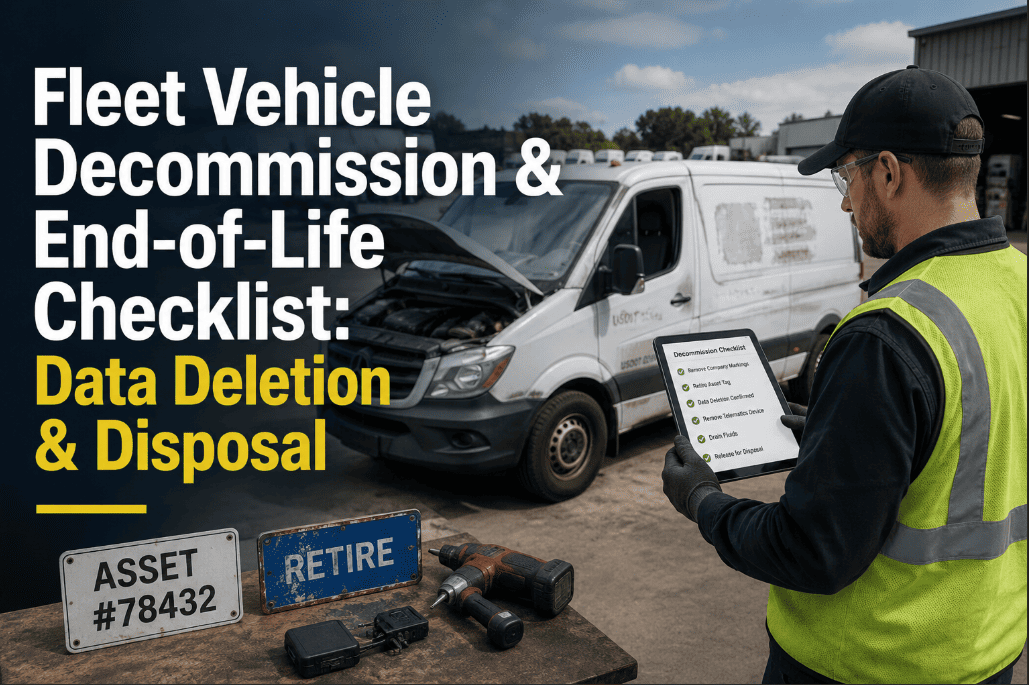
A fleet vehicle that is removed from service without a structured decommission process does not simply leave the fleet — it leaves with telematics data containing driver behaviour records, GPS location history, and route logs that may contain sensitive client delivery information; it leaves with a VIN that is still registered to the company in the state database; and it leaves with a GPS unit that is now tracking a vehicle owned by a remarketing buyer who did not consent to being monitored. Fleet vehicle decommissioning is not an administrative afterthought — it is a data security event, a regulatory compliance action, and an environmental obligation that carries liability from the moment the keys are handed over until every system has been formally closed. This checklist gives your fleet managers, operations, and compliance teams a complete end-of-life framework covering data deletion, GPS removal, asset de-registration, environmental fluid disposal, and remarketing documentation — structured so every decommission is traceable in your OxMaint compliance tracking platform with timestamped records that prove every vehicle was decommissioned correctly, not just parked and forgotten.
Fleet Vehicle Decommission & End-of-Life Checklist: Data Deletion & Disposal
A step-by-step fleet vehicle decommission framework covering data deletion, GPS and telematics removal, asset de-registration, environmental fluid disposal, title transfer, and remarketing documentation — built for fleet operations where an incomplete decommission creates a data breach, a registration liability, or an environmental violation.
Data Deletion & In-Cab System Wipe
A fleet vehicle's in-cab systems contain far more identifiable data than most fleet managers recognise: the navigation system holds 90 days of trip history, home and office addresses, and frequently visited locations; the Bluetooth pairing list contains the personal phone IDs of every driver who connected since the last reset; and the telematics unit holds driver behaviour profiles, HOS records, and delivery location data that are subject to data protection regulation in every jurisdiction where the fleet operates. Data deletion is not optional — it is a legal obligation under GDPR, CCPA, and equivalent state-level privacy laws.
GPS & Telematics Device Removal
A GPS unit left in a vehicle that has been sold to a remarketing buyer is not a minor oversight — it is a device that continues to transmit the new owner's location data to the fleet operator's telematics platform without the new owner's knowledge or consent. In jurisdictions with active privacy enforcement, this constitutes illegal surveillance. In fleet operations with OBD-II plug-in units, the device may also drain the new owner's battery and generate false vehicle health data in the fleet system — both of which have downstream consequences that arrive as complaints, not as line items on a decommission checklist.
A vehicle decommissioned without a complete record trail is a liability that stays on the fleet's books indefinitely. OxMaint creates a permanent decommission record for every vehicle — data deletion confirmation, GPS removal log, registration cancellation date, and disposal certificate — so your fleet closes every vehicle cleanly and can prove it on demand.
Asset De-Registration & Insurance Cancellation
A vehicle registration that remains in the fleet company's name after the vehicle is sold to a remarketing buyer means that every toll charge, red-light camera fine, parking violation, and overweight citation incurred by the new owner arrives at the fleet company's address until the registration is formally transferred. Fleet operations that decommission high volumes of vehicles without a systematic de-registration process routinely discover months of accumulated traffic fines from vehicles they no longer own — along with the administrative cost of contesting each one.
Environmental Fluid & Hazardous Material Disposal
A fleet vehicle being decommissioned for salvage contains hazardous materials that are subject to EPA Resource Conservation and Recovery Act (RCRA) regulations regardless of the vehicle's condition. Engine oil, coolant, brake fluid, transmission fluid, battery acid, air conditioning refrigerant, and catalytic converter materials all have specific disposal requirements — and a salvage yard or remarketing agent that accepts a vehicle without proper documentation that these materials were handled correctly does not absolve the original fleet owner of generator liability under RCRA.
Fleet Branding & Livery Removal
A vehicle sold to a remarketing buyer with the fleet company's livery still applied is a vehicle that continues to represent the company's brand in public — without the company's control over how it is operated, maintained, or used. A decommissioned vehicle still carrying a fleet logo that is involved in a traffic incident, observed in a location inconsistent with the company's values, or used for a purpose that conflicts with the company's public commitments creates a reputational risk that is entirely preventable through systematic livery removal before transfer.
Mechanical Condition Documentation & Remarketing Preparation
A vehicle entered into remarketing without an accurate condition report leaves the fleet exposed to post-sale disputes about undisclosed defects. A condition report completed at the time of decommission — with odometer reading, tyre tread depth, paint condition grade, and open recalls documented — creates a contemporaneous record of the vehicle's state at the time of transfer that is far more defensible than a buyer's claim made weeks after the sale. Accurate condition documentation also enables the fleet to achieve maximum remarketing value by presenting the vehicle's condition transparently.
Decommission Documentation & Compliance Closure
A fleet vehicle decommission that cannot be reconstructed from a single file — with the data deletion certificate, GPS removal log, registration cancellation confirmation, refrigerant recovery certificate, title transfer document, and buyer details all linked to the vehicle's asset record — is a decommission that will take weeks to defend if the vehicle is later involved in an incident, a data breach claim, or an environmental enforcement action. Complete decommission documentation is the difference between a closed file and an open liability.
Six Metrics That Prove Your Fleet Decommission Programme Is Fully Compliant
| Metric | How to Measure | Target | Frequency |
|---|---|---|---|
| Data Deletion Completion Rate | Vehicles with confirmed data deletion / Total decommissioned | 100% | Per decommission |
| GPS Removal Compliance | Vehicles with GPS removed before transfer / Total decommissioned | 100% | Per decommission |
| Registration Cancellation Lead Time | Days from vehicle transfer to registration cancellation | Same day | Per decommission |
| Environmental Disposal Compliance | Vehicles with refrigerant recovery cert / Total scrapped | 100% | Per decommission |
| Insurance Cancellation Speed | Days from vehicle transfer to policy removal | Same day | Per decommission |
| Decommission Record Completeness | Vehicles with all 7 categories confirmed / Total decommissioned | 100% | Quarterly audit |
Frequently Asked Questions
What data protection laws apply to fleet vehicle telematics data at decommission?
In the United States, the California Consumer Privacy Act (CCPA) and its successor CPRA apply to telematics data that can be linked to identifiable individuals, including drivers. In the EU and UK, GDPR applies. Both frameworks treat GPS location history, driver behaviour records, and HOS logs as personal data that must be deleted or anonymised when the processing purpose ends — which for a decommissioned vehicle is at the point of transfer. Failure to delete this data before vehicle sale constitutes a data transfer without consent and creates regulatory exposure in both jurisdictions. OxMaint captures data deletion confirmation as a mandatory step in the decommission workflow.
What is the EPA requirement for air conditioning refrigerant recovery in fleet vehicles?
EPA Section 608 of the Clean Air Act prohibits the intentional release (venting) of refrigerants from mobile air conditioning systems. Before a vehicle is scrapped, crushed, or sold for salvage, the refrigerant must be recovered using an EPA-certified recovery machine by an EPA Section 608 certified technician. The recovered refrigerant is then either reclaimed for reuse or destroyed. Civil penalties for refrigerant venting can reach $44,539 per day per violation under 40 CFR Part 82. The certification and recovery records must be retained by the fleet operator as the vehicle generator. See how OxMaint tracks refrigerant recovery certification as a mandatory decommission gate.
How long must fleet decommission records be retained?
Retention periods vary by record type: FMCSA requires HOS records to be retained for 6 months; EPA hazardous waste manifests must be retained for 3 years under RCRA; vehicle title transfer records should be retained for the statute of limitations period in the relevant state (typically 3–6 years); and financial records related to vehicle disposal and depreciation should be retained for 7 years for tax audit purposes. The safest approach is to retain the complete decommission file for 7 years, as this covers all regulatory and tax requirements simultaneously.
What happens if a fleet vehicle's registration is not cancelled after sale?
If the registration remains in the fleet company's name after the vehicle is transferred, all traffic violations, toll charges, parking fines, and regulatory citations generated by the new owner will be mailed to the fleet company's registered address. The fleet company is then responsible for contesting each violation and proving it no longer owns the vehicle — a process that requires providing the title transfer documentation to each issuing authority individually. Some states also continue to assess annual registration renewal fees until the registration is formally cancelled or transferred. Proactive same-day cancellation or transfer eliminates this exposure entirely.
Does a fleet company have liability for a sold vehicle that is later involved in an accident?
If the title has been properly transferred and the registration has been cancelled or transferred to the new owner, the fleet company's liability exposure is generally extinguished at the point of transfer. However, if the title has not been transferred, the fleet company may be named as a defendant in any civil claim arising from the vehicle's subsequent operation, on the basis that it was the registered owner at the time of the incident. Additionally, if a safety defect known to the fleet at the time of sale (such as an open recall or documented brake deficiency) caused or contributed to the incident and was not disclosed, the fleet may face product liability or fraudulent concealment claims. OxMaint captures all known defects at decommission and links them to the signed condition report provided to the buyer.
Every Vehicle Decommissioned. Every Data Point Deleted. Every Record Closed.
OxMaint converts your fleet vehicle decommission process into a structured digital workflow with data deletion confirmation, GPS removal logs, disposal certificates, and a complete audit trail — so every vehicle exits your fleet cleanly and every decommission is defensible on demand.