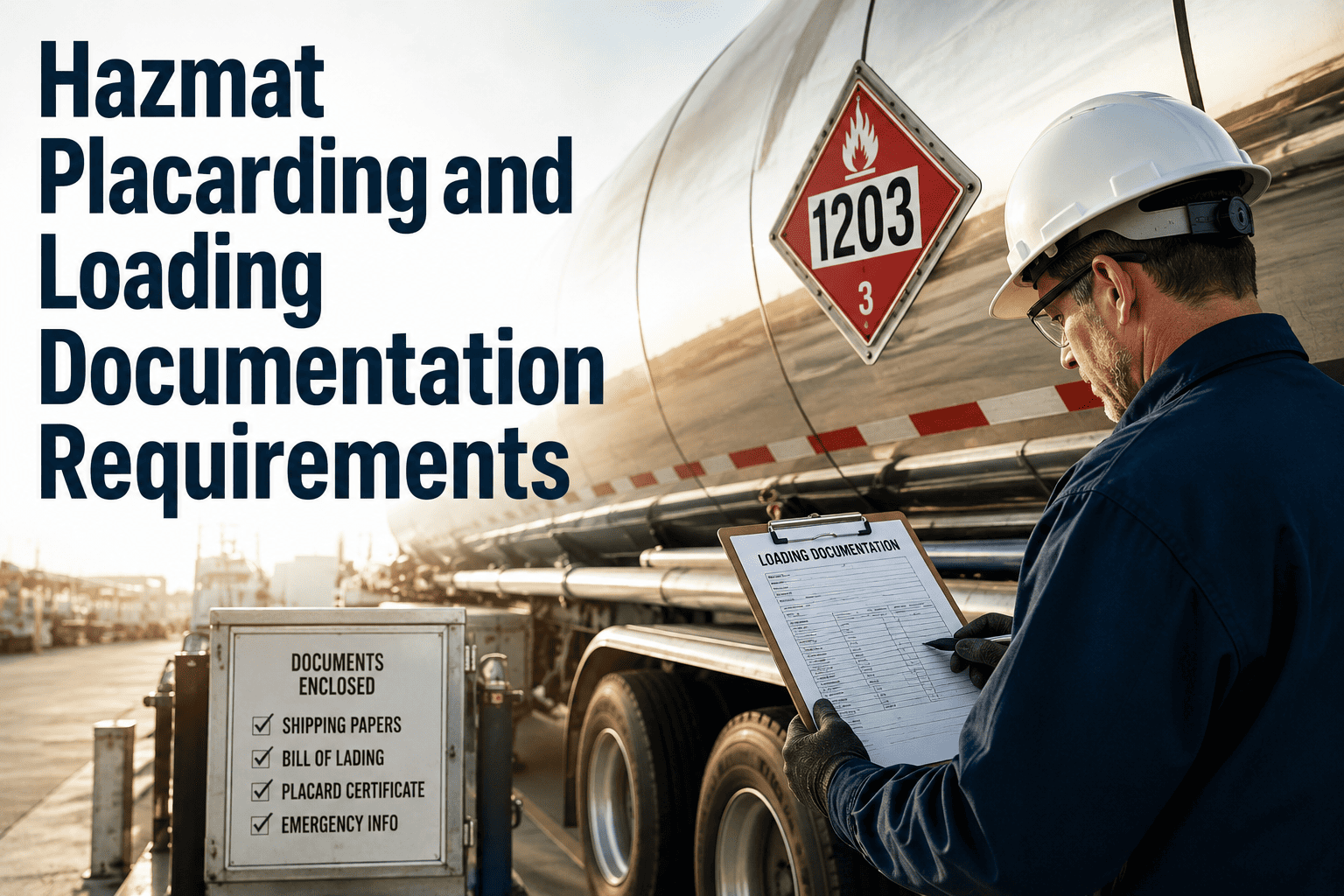
Hazmat placarding and loading documentation requirements under 49 CFR Parts 171–180 add a demanding layer of compliance on top of standard commercial vehicle rules — and violations carry fines up to $89,678 per incident, with knowing violations reaching $209,247. For any fleet hazmat compliance program, even occasional placarded loads require a hazmat safety permit, driver endorsements, function-specific training, UN-spec packaging, four-sided placarding, shipping papers, and strict segregation. This fleet hazmat guide for 2026 breaks down each requirement and shows how a CMMS-integrated compliance module turns audit-intensive paperwork into automated, audit-ready records. Ready to eliminate compliance gaps? Start Free Trial and see how OxMaint keeps every hazmat document, endorsement, and placard checklist in one system.
Fleet Hazmat Guide 2026
One hazmat violation can cost more than a truck. Is your fleet ready for 2026 enforcement?
FMCSA hazmat enforcement runs on a separate, higher-penalty track than standard vehicle violations. Every placarded load demands documented proof — endorsements, training, shipping papers, and placarding checklists — retained and retrievable on demand.
8-Point Hazmat Compliance Checklist
What every hazmat fleet must verify before, during, and after every placarded load
Fleet hazmat compliance under 49 CFR Parts 171–180 hinges on eight interlocking requirements. Missing any one of them — from a lapsed training record to a missing placard on the trailer's rear — triggers enforcement on a dedicated hazmat track with fines 5–10× higher than standard commercial vehicle violations.
Hazmat Safety Permit
Required under 49 CFR 385.403 when hauling specified quantities of certain hazardous materials. Carriers operating without an active permit face out-of-service orders and maximum-tier fines.
CDL Hazmat Endorsement (H)
Every driver operating a placarded vehicle must hold an H endorsement on their CDL, backed by a current TSA security threat assessment. Endorsement renewals must be tracked per driver, not per fleet.
Function-Specific Training (3-Year Cycle)
Every employee who handles, loads, or prepares hazmat documentation needs function-specific training refreshed every three years under 49 CFR 172.704. Records of completion must be retained.
UN Specification Packaging
Packaging must meet 49 CFR 173 standards with correct UN specification marks. Using non-spec or expired packaging for a regulated material is an automatic critical violation.
Four-Sided Placarding
Placards must be displayed on all four sides of the vehicle per 49 CFR 172.504 when required, with orange panels or UN identification numbers visible and legible. A missing or obscured placard is a standalone violation.
Shipping Papers & Retention
49 CFR 172.200 requires proper shipping name, hazard class, ID number, packing group, and total quantity. Carriers must retain shipping papers for at least 1 year — 3 years for hazardous waste manifests.
Emergency Response Information
Immediate-access emergency response data per 49 CFR 172.602 must be in the cab with the driver — not buried in a filing cabinet. Inspectors ask for it before anything else.
Segregation & Compatibility
49 CFR 177.848 prohibits loading incompatible hazardous materials together. Segregation tables must be consulted and documented per load, not assumed from past shipments.
Penalty Reality Check
Hazmat violation fines vs. standard commercial vehicle fines
Hazmat enforcement operates on a fundamentally different penalty scale than standard roadside violations. A single missing shipping paper or obscured placard can trigger a fine larger than the revenue from the entire load — and knowing violations escalate to criminal-tier civil penalties.
| Violation Type | Standard CV Fine Range | Hazmat Fine Range | Retention / Record Burden |
|---|---|---|---|
| Missing vehicle inspection record | $1,000 – $5,000 | — | Driver file, 1 year |
| Missing / incorrect shipping paper | — | $5,000 – $89,678 | Carrier file, 1–3 years |
| Placard missing or illegible | — | $5,000 – $50,000+ | Per-load checklist |
| Driver without H endorsement | $2,500 – $10,000 | $10,000 – $89,678 | Endorsement + TSA assessment |
| Lapsed hazmat training (3-year) | — | $5,000 – $25,000 per employee | Training records, 3-year cycle |
| Knowing violation (any category) | — | Up to $209,247 | Criminal-tier civil exposure |
Real-World Scenario
What a hazmat documentation audit looks like — and what it costs when records are missing
Consider a 45-truck regional fleet hauling Class 3 flammable liquids and Class 8 corrosives on alternating routes. During a compliance review, FMCSA auditors request shipping papers for 120 loads from the prior 11 months, current H endorsements and TSA assessments for 22 drivers, function-specific training completion dates for all hazmat-handling employees, and placarding checklists proving four-side placement per load.
If the fleet manages these records across spreadsheets, driver cabinets, and a paper dispatch log, assembling that audit packet takes 60–80 labor hours. Missing or incomplete records trigger per-violation fines: 6 lapsed training records at $12,000 each, 2 missing shipping papers at $18,500 each, and 1 undocumented placard failure at $25,000. Total exposure for a single review: $132,000+ — before knowing-violation multipliers apply.
The same fleet running OxMaint's compliance module pulls the entire audit packet in under 10 minutes: every shipping paper, endorsement expiration, training completion, and placard checklist is indexed, time-stamped, and retention-tagged. The cost of the software is a fraction of a single violation fine.
How OxMaint Helps
How OxMaint turns hazmat compliance from manual risk into automated audit-readiness
OxMaint's dedicated compliance module tracks every hazmat requirement — driver endorsements, placarding checklists, shipping papers, and training records — under retention rules enforced by the system, not remembered by a dispatcher. The result: zero missing documents at audit, automatic expiration alerts, and a single source of truth across the fleet.
Endorsement & Training Expiration Tracking
OxMaint tracks H endorsement renewals, TSA assessment dates, and 3-year function-specific training cycles per employee — with automated alerts 90, 60, and 30 days before expiration. Fleets eliminate lapsed-training fines without manual calendar checks.
CMMS-Integrated Shipping Paper Generation
Generate 49 CFR 172.200-compliant shipping papers directly from dispatch — proper shipping name, hazard class, ID number, packing group, and total quantity auto-populated from the asset and material registry. Retention rules (1 year general, 3 years hazardous waste) are enforced automatically.
Per-Load Placarding Checklists
Drivers complete a digital four-side placard verification checklist on the OxMaint mobile app before departure — front, rear, left, right, plus UN number panels. Each checklist is GPS-stamped, time-stamped, and permanently archived to the load record.
Emergency Response Data Per Material
OxMaint attaches 49 CFR 172.602 emergency response information to each material in the registry, making it instantly accessible to drivers in-cab and to dispatch in real time. No more digging through binders during a roadside inspection or incident.
See OxMaint on your hazmat operations — book a 30-min demo
Walk through a live hazmat compliance workflow: endorsement tracking, shipping paper generation, placard checklists, and audit-packet export. Bring your toughest compliance question.
FAQ
Hazmat placarding, loading, and documentation — your top questions answered
When is a hazmat safety permit required for a fleet?
A hazmat safety permit is required under 49 CFR 385.403 when a carrier hauls specified quantities of certain hazardous materials, including highway route-controlled quantities of radioactive materials, more than 55 lb of certain explosives, or bulk shipments of hazardous materials requiring placarding. Fleets hauling even occasional qualifying loads must hold an active permit before dispatch. OxMaint's compliance module flags permit-required materials automatically at the dispatch stage — book a demo to see it in action.
How often must hazmat training be refreshed for fleet employees?
Function-specific hazmat training must be refreshed every 3 years under 49 CFR 172.704 for every employee who handles, prepares, or transports hazardous materials. This includes drivers, loaders, dispatchers preparing shipping papers, and warehouse staff selecting packaging. Training completion records must be retained and produced during audits, and OxMaint automates the 3-year cycle with expiration alerts.
How long must hazmat shipping papers be retained by the carrier?
Carriers must retain hazmat shipping papers for at least 1 year after the shipment under 49 CFR 172.201. For hazardous waste shipments, the retention period extends to 3 years. Records must be accessible for inspection and include the proper shipping name, hazard class, ID number, packing group, and total quantity — OxMaint enforces these retention rules automatically.
What are the four-sided placarding requirements for hazmat vehicles?
Under 49 CFR 172.504, placards must be displayed on all four sides of the vehicle — front, rear, and both sides — when required for the material being transported. Orange panels or UN identification numbers must also be displayed as applicable. Placards must be visible, legible, and not obscured by damage, dirt, or cargo. A missing placard on any single side is a standalone violation.
What is the maximum fine for a hazmat placarding or documentation violation?
The maximum civil penalty for a hazmat violation is $89,678 per violation, and knowing violations can reach $209,247 per violation. These fines apply per instance — a single load with multiple violations (missing placard, incorrect shipping paper, lapsed training) can stack into six-figure exposure. Using a CMMS like OxMaint to automate documentation and placard checklists is the most cost-effective way to eliminate that risk — Start Free Trial to see how.
Stop risking six-figure hazmat fines on manual paperwork
OxMaint automates endorsement tracking, shipping paper generation, placard checklists, and training records — all retention-tagged and audit-ready. See it on your operations in 30 minutes.
Free 14-day trial · No credit card