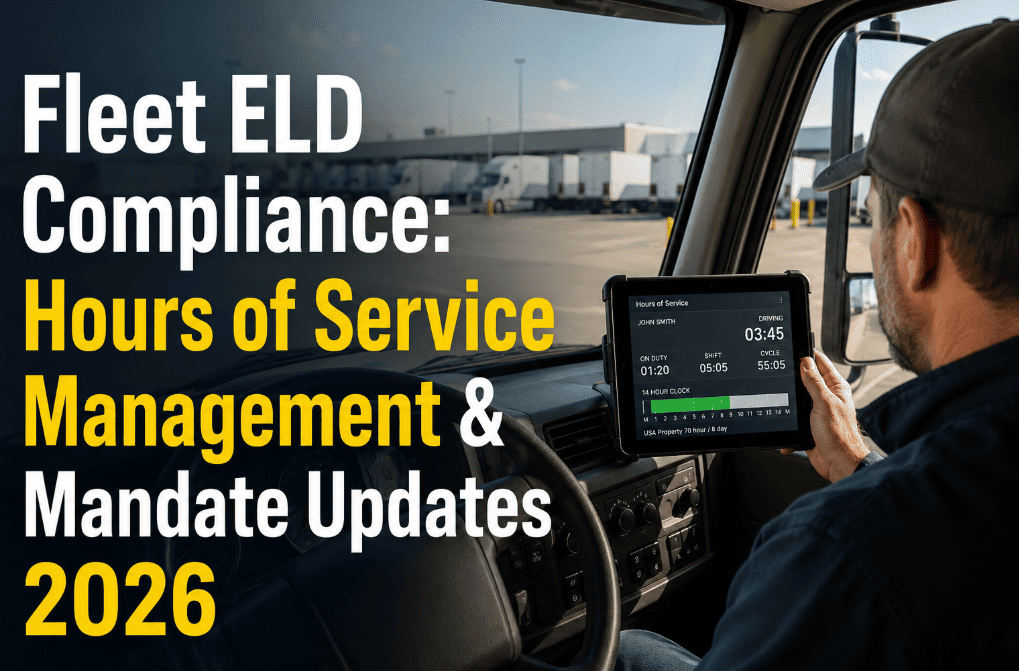
The FMCSA's Electronic Logging Device mandate has been fully enforced since 2019, but 2026 brings updated Hours of Service rule interpretations, expanded exemption categories, and heightened enforcement scrutiny at weigh stations and roadside inspections across all 50 states. Fleets that treat ELD compliance as a device problem rather than a data management problem consistently accumulate HOS violations that cost an average of $16,000 per citation in fines, out-of-service orders, and CSA score damage. Oxmaint integrates with leading ELD platforms to connect driver HOS data directly to vehicle maintenance records — giving fleet managers a single operational view of compliance status, vehicle health, and driver availability. If your fleet's ELD program needs a stronger operational backbone, start a free trial or book a demo to see the integration in action.
Fleet ELD Compliance: Hours of Service Management and Mandate Updates 2026
Updated FMCSA rules, expanded exemptions, and tighter roadside enforcement make 2026 the most consequential ELD compliance year since the original mandate. Here is how fleet managers stay ahead of violations, manage exceptions, and connect HOS data to vehicle maintenance.
ELD Compliance Is Not Just a Driver Problem — It Is a Fleet Operations Problem
When a vehicle is pulled out of service at a weigh station due to an HOS violation, the problem is not just the driver's log. It is the dispatch decision that put that driver on that route, the maintenance schedule that did not flag the vehicle for its next PM before the long haul, and the operations system that had no visibility into the combined picture. Oxmaint connects vehicle maintenance status to ELD-reported utilization — giving fleet managers the operational data to prevent the dispatch decisions that create compliance exposure. Start a free trial or book a demo to see how ELD and CMMS data connect in a single dashboard.
Key FMCSA ELD and HOS Changes Affecting Fleets in 2026
The core ELD mandate structure remains intact in 2026, but FMCSA has clarified and updated several HOS provisions that directly affect how fleets manage driver scheduling, exception documentation, and inspection readiness. Each change below requires a corresponding update to your fleet's ELD policies and dispatcher training.
Drivers operating within 150 air miles of their reporting location and returning within 14 hours are exempt from ELD requirements. The 2026 update clarifies that "air miles" — not road miles — is the measurement standard, expanding practical eligibility for regional delivery and construction fleets. Documentation of reporting location must be maintained in dispatch records, not just driver logs.
The adverse driving conditions exception — allowing 2 additional hours of drive time when conditions encountered after departure make completion of the run in normal HOS impossible — now requires digital notation in the ELD log at the time of invocation. Verbal documentation after the fact is no longer accepted during enforcement review. Fleet management systems must capture the exception trigger, time, and location in real time.
FMCSA's 2026 guidance clarifies that the 8/2 and 7/3 split sleeper berth options are both permissible without either period counting against the 14-hour driving window. Fleet scheduling systems must correctly account for split rest periods when calculating remaining available drive time — a calculation that multiple ELD platforms handle inconsistently and that is a frequent source of enforcement citations.
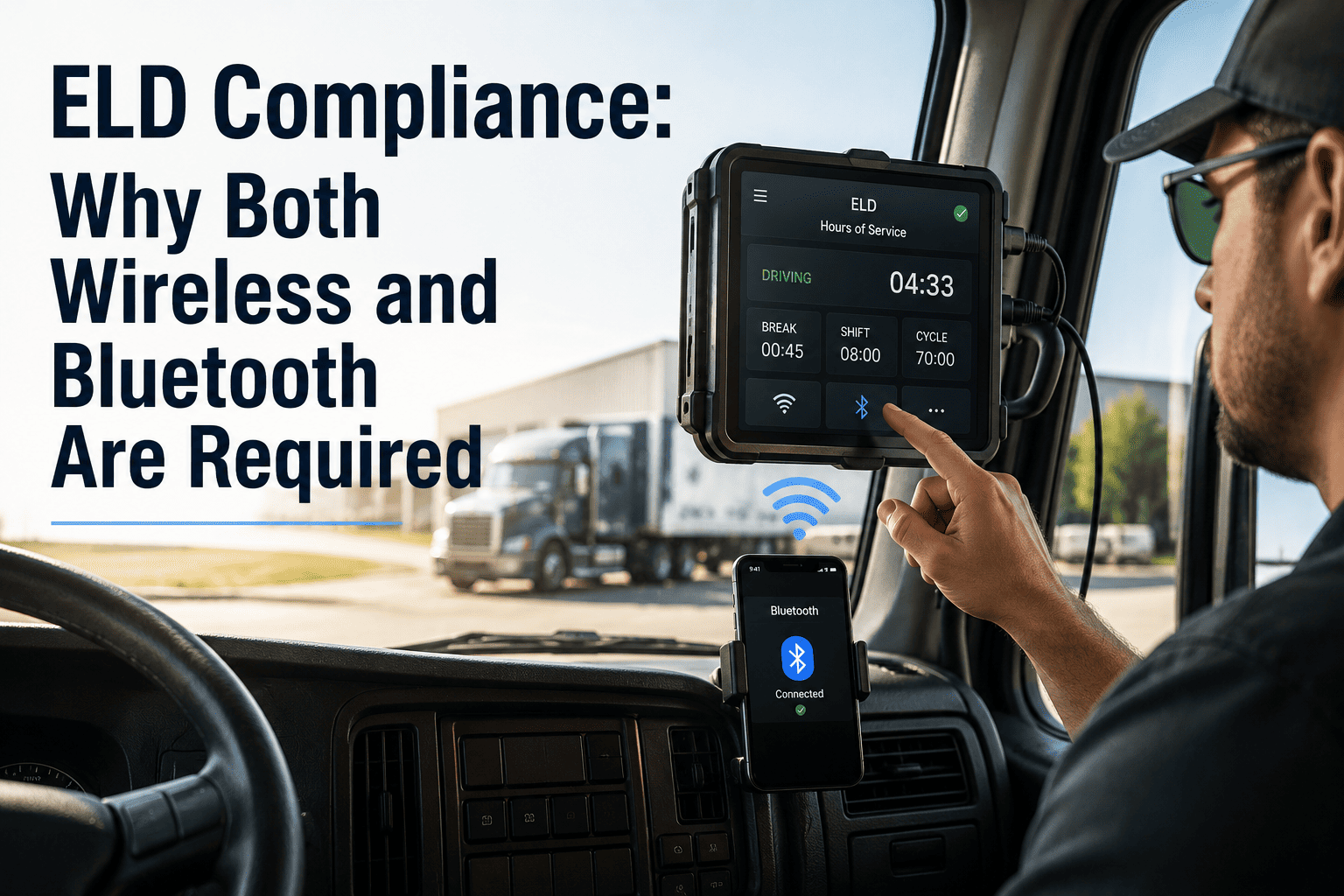
The Commercial Vehicle Safety Alliance's 2026 inspection focus includes ELD data transfer capability — specifically whether drivers can transfer logs via both telematics and USB/Bluetooth methods within 60 seconds of inspector request. Fleets where drivers cannot demonstrate both transfer methods face automatic citation regardless of HOS log compliance. Driver training on data transfer procedures is now a compliance requirement, not optional.
2026 FMCSA Hours of Service Rules: Property-Carrying CMV Reference
| HOS Rule | Limit | Reset Requirement | Exception Available | Oxmaint Tracking |
|---|---|---|---|---|
| 11-Hour Driving Limit | 11 hours driving after 10 consecutive hours off | 10 consecutive hours off duty | Adverse driving +2 hrs | ELD integration via API |
| 14-Hour Window | 14-hour on-duty window after coming on duty | 10 consecutive hours off duty | Short-haul, adverse conditions | Dispatch alert at 12-hr mark |
| 30-Minute Break | Required after 8 cumulative hours of driving | 30 min off-duty or sleeper berth | Short-haul exception exempt | ELD auto-flagged in log review |
| 60/70-Hour Limit | 60 hrs in 7 days or 70 hrs in 8 days on-duty | 34-hr restart (optional) | Ag commodity, oilfield exemptions | Weekly utilization dashboard |
| 34-Hour Restart | Resets 60/70-hr clock after 34 consecutive hrs off | Must include 1am–5am period twice | Used once per 168 hours | Reset tracking per driver record |
| Short-Haul Exception | 150 air-mile radius, return by hour 14 | No ELD required if conditions met | Cannot use with sleeper berth split | Exception eligibility flagged |
The 6 Most Costly ELD and HOS Violations Fleet Managers Face in 2026
ELD systems record all vehicle movement. Driving time that occurs without a logged-in driver — during fueling, yard moves, or pre-trip repositioning — accumulates as unassigned driving time. FMCSA inspectors treat uncorrected unassigned time as a log falsification indicator. Fleets must review and assign or annotate all unassigned events within 24 hours. Average fine: $4,200 per incident at enforcement.
When an ELD malfunctions, the driver must notify the carrier within 24 hours and revert to paper logs. The carrier must correct the malfunction or replace the device within 8 days. Fleets that do not have a documented ELD malfunction response protocol — or cannot produce the paper logs from the malfunction period — receive automatic citations during inspection regardless of actual HOS compliance.
ELD annotations — notes explaining duty status changes, exception invocations, and unassigned time — must be completed in the driver's original language and contain sufficient detail to explain the log entry. Vague annotations like "yard move" without location context or "exception used" without specifying the exception type are treated as incomplete records with fines of $1,100 to $3,300 per occurrence.
Personal conveyance — logging drive time as off-duty when driving for personal reasons — is one of the most frequently cited ELD violations in 2026 enforcement. Common misuse patterns include driving from a truck stop to a restaurant exceeding reasonable distance, or using personal conveyance to extend an otherwise expired 14-hour window. FMCSA issued 2025 guidance tightening what qualifies as an approved personal conveyance movement.
If a driver cannot transfer ELD data to an enforcement officer within 60 seconds using either the telematics or local transfer method, the inspection results in a form and manner violation. The most common causes are outdated ELD firmware, expired telematics subscriptions, and driver unfamiliarity with the local transfer procedure. Both transfer methods must be tested quarterly per CVSA guidance.
ELD logs must be supported by corroborating documents — fuel receipts, bills of lading, dispatch records, toll receipts — that confirm the log's accuracy. FMCSA requires carriers to retain supporting documents for 6 months. Inspectors cross-reference fuel receipts against GPS location data. Discrepancies of more than 75 miles are treated as potential log falsification and trigger Level 1 inspections.
How Oxmaint Connects ELD Data to Fleet Maintenance for Full Operational Visibility
ELD compliance and vehicle maintenance are not separate programs — they share the same asset: the vehicle. A truck with 85 hours logged on its engine this week is a truck that is due for an oil change based on hours, may have a driver pushing close to the 70-hour limit, and needs its next PM scheduled before it is assigned another 5-day route. Oxmaint connects these data points. Start a free trial or book a demo to see the ELD-CMMS integration configured for your fleet size.
ELD-reported engine hours sync to Oxmaint asset records — triggering PM work orders when a vehicle reaches oil change, filter, and inspection intervals based on actual hours driven, not calendar estimates. No manual odometer entry, no missed service intervals from odometer discrepancies.
The Oxmaint fleet dashboard shows each vehicle's HOS driver status — hours remaining, next reset time, exception status — alongside maintenance status: days to next PM, open work orders, warranty expiry. Dispatch decisions are made with full compliance and maintenance context visible simultaneously.
Every adverse driving, short-haul, and agricultural commodity exception invocation is logged as a compliance event attached to the driver record and the vehicle record. Exception frequency analysis identifies drivers and routes that consistently push exception limits — enabling route redesign before violations accumulate.
ELD malfunction events generate automatic work orders in Oxmaint with an 8-day compliance timer. The work order tracks replacement device procurement, installation, and verification — with escalation alerts to the fleet manager at day 5 if the malfunction is not yet resolved. Paper log requirement is documented as a compliance event in the vehicle record.
Quarterly data transfer capability tests — both telematics and local transfer — schedule as recurring PM tasks in Oxmaint, assigned to fleet supervisors. Pass/fail results attach to the vehicle and driver records. Before a roadside inspection, the driver's most recent transfer test result is visible in the vehicle's compliance history.
Fuel receipts, maintenance records, and dispatch documents attach to vehicle records in Oxmaint with date and location indexing. When a DOT auditor requests supporting documents for a specific driver and date range, the complete package — fuel receipts, work orders, inspection records — exports in under 10 minutes from the vehicle's digital record.
Disconnected ELD Management vs. Integrated Fleet Compliance Operations
What Integrated ELD-CMMS Management Delivers for Fleet Operations
Fleets with integrated HOS visibility in dispatch decisions eliminate the majority of preventable violations that occur when routes are assigned without driver hours visibility
Each prevented HOS citation eliminates fine cost, CSA score damage, insurance premium impact, and the operational disruption of an out-of-service order during a delivery run
vs. 3 days of manual record assembly — digital supporting document storage with date indexing makes any DOT audit request producible in minutes, not days
ELD-driven engine hour PM triggers replace calendar estimates — service intervals align with actual vehicle utilization and manufacturer specifications rather than assumed mileage accumulation
Frequently Asked Questions
Which ELD platforms does Oxmaint integrate with?+
How does Oxmaint handle vehicles exempt from the ELD mandate?+
What happens to HOS and ELD data in Oxmaint when a driver transfers to a different vehicle mid-week?+
Can Oxmaint generate the CSA BASICs score impact report for our fleet?+
Connect Your ELD Data to Your Fleet Maintenance Program in 2026
HOS violations, missed PM intervals, and DOT audit scrambles all trace back to the same root cause: ELD data and fleet maintenance data living in separate systems. Oxmaint closes that gap — engine hours trigger PM schedules, HOS status informs dispatch, and every compliance event is documented and searchable. No heavy implementation. First ELD integration active within days.


-compliance-eld-rules-and-fleet-management-best-practices.png)