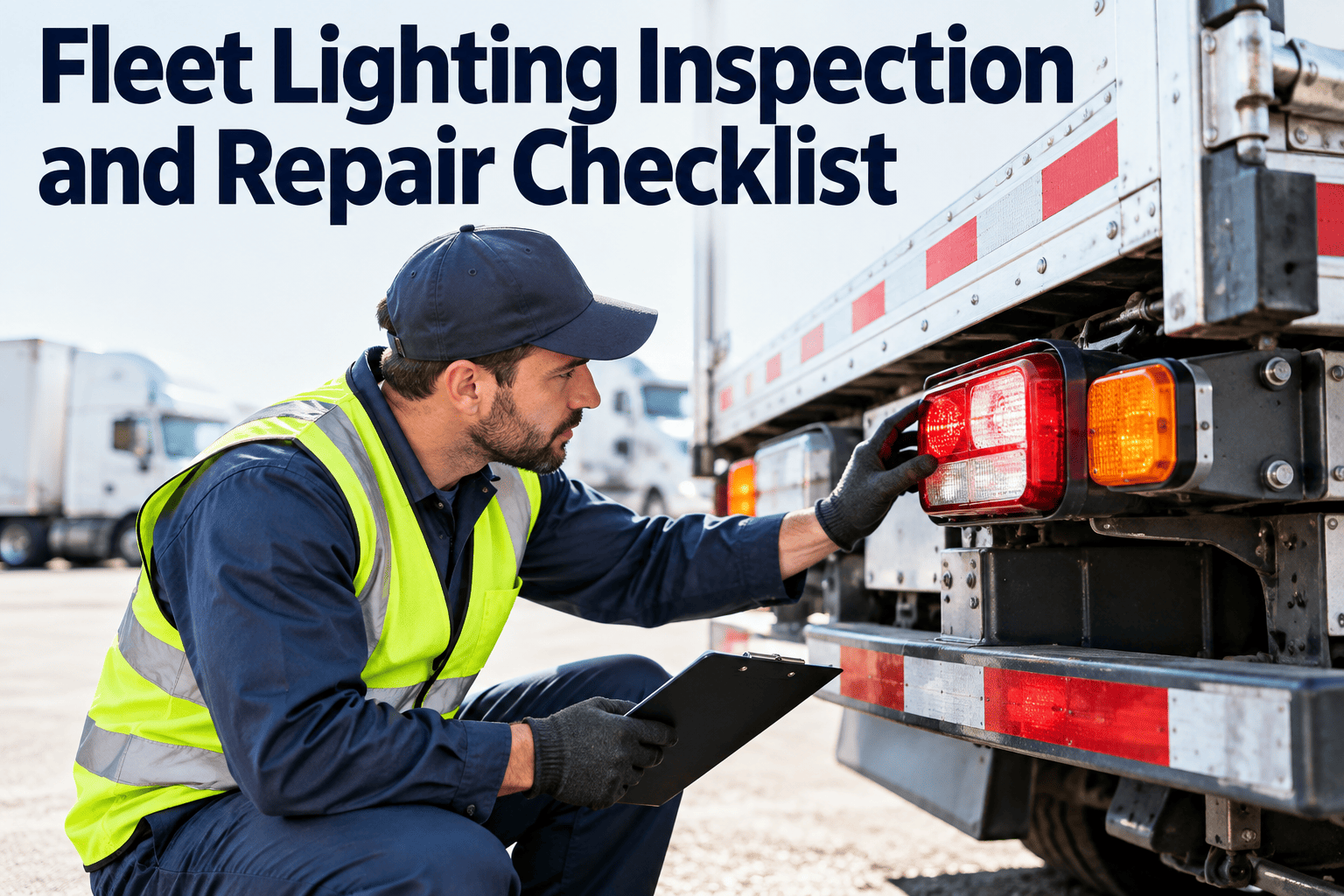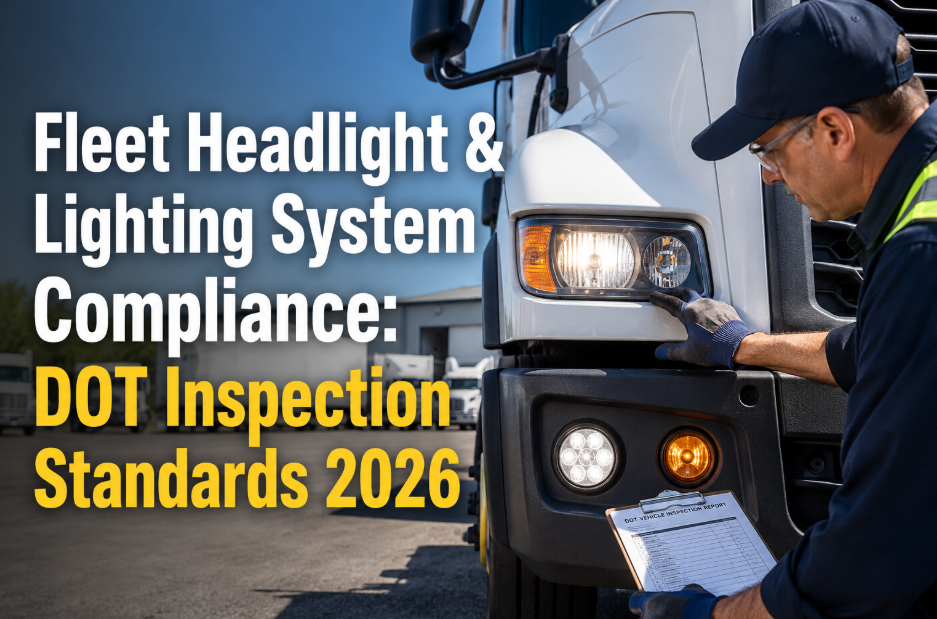
Lighting violations are the second most common citation category in DOT roadside inspections — accounting for 14.3% of all vehicle-related violations documented by FMCSA in 2024. A single non-functional marker light, a misaligned headlamp, or a cracked reflector can result in an out-of-service order that costs the fleet an average of $1,180 per event when you factor in driver downtime, towing, expedited repair, and delayed delivery penalties. Yet lighting system maintenance remains one of the most under-documented and inconsistently scheduled maintenance categories in commercial fleet operations. The reason is simple: lighting failures are individually inexpensive to fix but operationally catastrophic when they accumulate as CSA violations. This guide covers the complete 2026 DOT lighting compliance landscape — inspection standards, LED upgrade economics, alignment protocols, and how CMMS-automated lighting maintenance documentation eliminates the violation pattern that damages CSA scores and insurance rates. Fleets ready to automate lighting compliance tracking can start a free trial or book a demo to see how Oxmaint tracks every lamp, reflector, and marker light across your fleet.
Fleet Headlight and Lighting System Compliance: DOT Inspection Standards 2026
Lighting is the #2 DOT roadside citation category. Learn headlight alignment protocols, LED conversion ROI, marker light inspection schedules, and how CMMS automates the documentation that keeps your fleet compliant and your CSA scores clean.
A $4 Marker Light Bulb Should Never Cost Your Fleet $1,180
The economics of lighting violations are absurd — a burned-out clearance lamp costs $3.50 to replace in the shop and $1,180 when discovered at a roadside inspection. The problem is not repair difficulty or parts cost. The problem is that lighting checks are not systematically scheduled, documented, or tracked across the fleet. Oxmaint automates lighting inspection scheduling for every vehicle on every PM cycle — with digital checklists that require lamp-by-lamp sign-off before a vehicle returns to service. Want to see how automated lighting compliance works for your fleet size? Start a free trial or book a demo to map your fleet's lighting assets to automated inspection schedules.
FMVSS 108 and FMCSA Lighting Requirements for Commercial Vehicles
Commercial vehicle lighting compliance is governed by two regulatory layers: FMVSS 108 establishes the manufacturing standard for lamp type, placement, and performance, while FMCSA 49 CFR Part 393 Subpart B establishes the operational requirements that are enforced during roadside inspections. Both apply simultaneously to every vehicle in your fleet.
| Lighting Component | FMVSS 108 / 49 CFR Requirement | Common Violation | OOS Criteria |
|---|---|---|---|
| Headlamps (low/high beam) | Two required, white, properly aimed within 4" at 25 ft | Misalignment, reduced output, wrong color temperature | One headlamp inoperative = OOS at night |
| Tail lamps | Two required, red, visible 1,000 ft to rear | Burned out, cracked lens, moisture intrusion | Both inoperative = OOS |
| Stop lamps (brake lights) | Two required, red, activated by brake application | Inoperative, delayed activation, wrong color | Both inoperative = OOS |
| Turn signals (front/rear) | Two front amber, two rear amber or red, flash rate 60-120/min | Burned out, incorrect flash rate, wrong color | No operative signal on either side = OOS |
| Clearance/marker lamps | Front amber, rear red, on vehicles over 80" wide | Burned out, cracked lens, missing reflectors | 50%+ inoperative on one side = OOS |
| Reflectors and retroreflective tape | Red rear, amber side, conspicuity tape on trailers per FMVSS 108 | Faded, peeling, missing sections, wrong color placement | 50%+ missing conspicuity = OOS for trailers |
Six Most Common Fleet Lighting Violations and Their True Cost
FMCSA roadside inspection data reveals consistent patterns in lighting violations. These six categories account for 89% of all lighting-related citations — and every one of them is preventable with systematic pre-trip inspection enforcement and scheduled lighting PM cycles.
38% of all lighting violations. Clearance and marker lamps are the most frequently cited because vehicles typically carry 10-18 of them, they experience constant vibration, and drivers often do not walk the full vehicle during pre-trip. A single burned-out amber marker on a tractor-trailer is a citation. Three on the same side is an OOS event. Average replacement cost in shop: $6.20. Average cost at roadside: $1,180.
18% of lighting violations. FMVSS 108 requires headlamp aim within 4 inches of center at 25 feet. Vibration, suspension settling, and aftermarket bulb replacement without re-aiming all cause gradual misalignment. Misaligned headlamps reduce driver visibility by 30-40% and create oncoming glare that triggers complaints and inspection attention.
15% of lighting violations. DOT conspicuity tape (retroreflective sheeting) degrades over 3-5 years from UV exposure, road debris, and washing chemicals. Missing or degraded tape sections exceeding 50% of required coverage on any side trigger an OOS order. Tape replacement costs $85-$140 per trailer in the shop vs. $1,180+ at roadside inspection.
11% of lighting violations. Tail lamp and stop lamp failures are safety-critical — a vehicle with inoperative stop lamps at highway speed is an immediate rear-end collision risk. Moisture intrusion through cracked lenses is the primary failure mode, corroding sockets and accelerating bulb failure. Lens replacement with gasket: $22. Roadside event: $1,180+.
4% of lighting violations but disproportionately associated with accident liability. Turn signal failures include inoperative lamps, incorrect flash rates (outside 60-120 per minute), and cross-wired circuits that illuminate the wrong lamp. Wiring corrosion at trailer connections is the most common root cause — and the most frequently missed during pre-trip inspections.
3% of lighting violations. The most overlooked lamp on any commercial vehicle — mounted low on the rear of the trailer where it collects road spray, salt, and debris. License plate lamp failure is a guaranteed citation during any roadside inspection because it is one of the first items checked. Replacement cost: $8. The irony of a $1,180 event from an $8 bulb should end any debate about lighting PM value.
LED Lighting Upgrade Economics for Commercial Fleets
LED conversion is the single highest-ROI lighting investment a fleet can make — not because LEDs are better technology, but because they reduce the maintenance event frequency that drives lighting violation risk. The economics are clear and the payback period is measurable.
How Oxmaint Automates Fleet Lighting Compliance Documentation
Lighting compliance is a documentation problem disguised as a maintenance problem. The repairs are simple and inexpensive — the challenge is ensuring every lamp on every vehicle is checked on every cycle and every finding is documented. Oxmaint turns lighting inspections from ad-hoc visual checks into systematic, documented compliance events. Fleets ready to eliminate lighting violations from their CSA profile can start a free trial or book a demo to see the full lighting inspection workflow.
Register headlamps, tail lamps, markers, clearance lamps, turn signals, and reflectors per vehicle in Oxmaint. Each lighting component carries its type (LED/halogen), installation date, expected lifespan, and inspection history — enabling proactive replacement scheduling before failure occurs.
Pre-built inspection checklists matching 49 CFR Part 393 requirements — lamp-by-lamp verification with pass/fail recording, photo documentation for damaged lenses, and mandatory sign-off before the vehicle clears for dispatch. No lamp gets skipped because the checklist enforces completion.
Schedule headlamp alignment verification at 25,000-mile intervals or semi-annually — whichever comes first. Oxmaint generates the alignment work order automatically and tracks the measurement result against FMVSS 108 aim specifications, documenting compliance for audit review.
Track conspicuity tape installation date, last inspection result, and scheduled replacement date per trailer. Oxmaint flags trailers approaching tape replacement intervals — typically 5 years from installation — and generates work orders before degradation reaches the 50% OOS threshold.
Track every lighting-related roadside citation by vehicle, lamp type, and inspection location. Oxmaint identifies violation patterns — specific vehicles with repeat issues, specific lamp positions with higher failure rates — so you can target root causes rather than just replacing bulbs reactively.
Manage LED conversion as a fleet-wide project in Oxmaint — track which vehicles have been converted, which are scheduled, and measure the violation rate and maintenance cost difference between converted and unconverted vehicles to document LED ROI for budget justification.
Fleet Lighting Compliance ROI with CMMS-Managed Inspections
Fleets with CMMS-scheduled lighting inspections report 63% fewer lighting-related roadside citations within 12 months of implementation
Combined savings from proactive lamp replacement, reduced violations, avoided OOS events, and LED conversion maintenance reduction
Full fleet LED conversion achieves payback in 18 months through reduced replacement frequency, lower power draw, and fewer violation events
Every lighting check on every vehicle generates a complete digital record — no gaps, no missing sign-offs, fully audit-ready for DOT review
Frequently Asked Questions
Are LED conversions DOT-legal for all commercial vehicle lighting positions?+
How often should headlamp alignment be checked on commercial vehicles?+
Can Oxmaint track conspicuity tape condition separately from other lighting?+
What CSA BASIC category do lighting violations affect?+
Every Lamp on Every Vehicle Should Be Documented on Every PM Cycle
A $4 marker light bulb should never cost your fleet $1,180. A faded strip of conspicuity tape should never trigger an OOS order. A misaligned headlamp should never damage your CSA score. These are preventable events — preventable with systematic inspection scheduling, digital checklists that enforce lamp-by-lamp verification, and compliance documentation that is always current and always exportable. Oxmaint makes lighting compliance automatic, documented, and audit-ready. No implementation project. First lighting inspection work orders in week one.