An owner-operator running a 28-vehicle ready-mix concrete fleet in Texas changed engine oil on a strict 15,000-mile interval across every truck — a discipline most fleet managers would consider solid maintenance practice. What the schedule couldn't see was the contamination building in one Mack's crankcase from a hairline coolant intrusion in the head gasket. The oil looked fine at the last change. By the time the engine threw a fault code, the journal bearings had already begun scoring. The rebuild bill was $47,000 — for a repair that would have cost $900 in gasket work if caught through routine oil analysis 6,000 miles earlier. Interval-based oil changes protect against dirty oil; they don't protect against contamination, viscosity breakdown, or metal particle concentration. If your fleet is still on fixed drain intervals, start a free 30-day trial with Oxmaint to see what AI oil condition monitoring reveals about your engines, or book a demo with our team.
AI-Powered Predictive Maintenance / Oil Analysis / Engine Health
AI Oil Analysis: Stop Changing Oil on a Clock and Start Changing It on Condition
Fixed oil change intervals replace good oil and miss the contamination events that destroy engines. Oxmaint AI oil analysis monitors viscosity, wear metal concentration, contamination markers, and oxidation levels in real time — extending drain intervals safely and catching engine damage months before a fault code fires.
30%
fewer oil changes with AI condition-based intervals
$343K
documented annual savings for a 50-vehicle fleet
8:1
average ROI within the first 12 months of deployment
60–90 days
typical time to first prevented engine failure
Condition-Based Engine Care
Every Mile Your Engine Runs, Oxmaint AI Is Reading the Oil
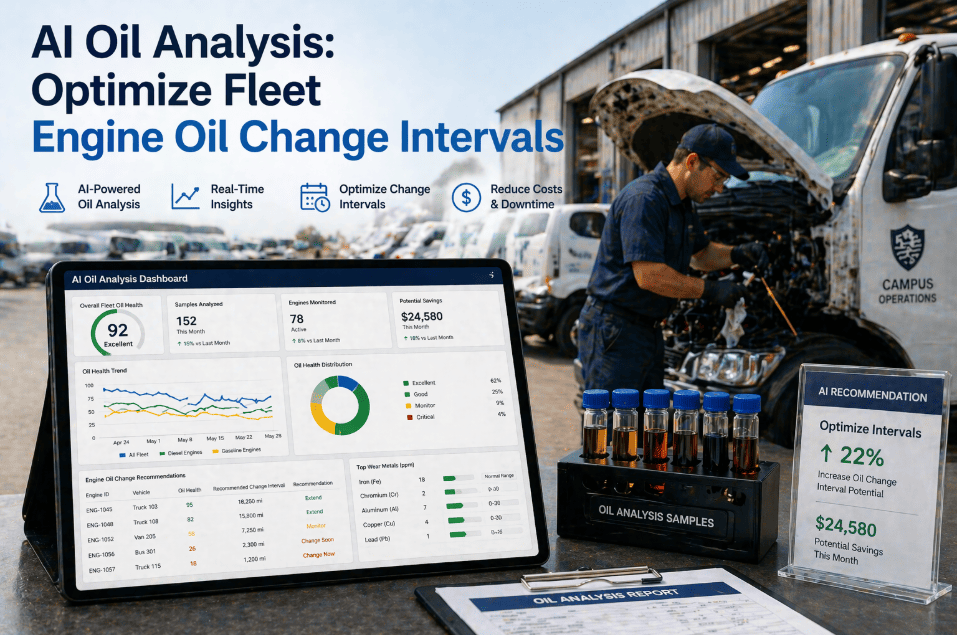
Oxmaint connects in-line oil condition sensors and lab analysis data to a predictive AI model that tracks viscosity, wear metals, contamination, and oxidation trends — generating work orders before damage occurs and extending drain intervals on the engines that can safely run longer.
What Is AI Fleet Oil Analysis — And Why Does It Beat Interval-Based Changes?
Traditional oil maintenance operates on a simple assumption: after X miles or Y days, oil degrades enough to warrant a change. This model protects against normal age-based degradation. It does nothing to detect the contamination events, coolant intrusions, fuel dilutions, and metal particle spikes that actually destroy fleet engines. AI oil analysis treats the lubricant as a diagnostic signal — a continuously readable record of what is happening inside the engine right now. Viscosity tells you about thermal breakdown. Wear metal concentration tells you about bearing and ring wear rates. Contamination markers tell you about gasket integrity and air filtration performance. Together, they build a picture of engine health that interval-based maintenance is structurally blind to. This is the shift from oil management to engine intelligence — start a free trial or book a demo to see the full diagnostic workflow.
The Four Oil Degradation Signals Oxmaint AI Monitors Continuously
V
Viscosity Index
Viscosity outside the operating band causes inadequate film strength or pumping losses. AI alerts when trending outside spec — not just after it crosses.
W
Wear Metal Concentration
Iron, copper, chromium, and lead concentrations in ppm reveal bearing, ring, and cylinder liner wear rates. Trending upward signals are caught weeks before engine damage becomes structural.
C
Contamination Level
Coolant glycol, water content, fuel dilution, and soot concentration. Any of these above threshold triggers a work order for root-cause investigation before the contaminant compounds into engine damage.
O
Oxidation and TAN
Total Acid Number (TAN) rise indicates oxidative breakdown and additive depletion. Tracking TAN trend rather than a single reading gives Oxmaint AI its predictive power for optimal drain timing.
Four Oil Analysis Failures That Cost Fleet Managers More Than They Realize
01
Contamination Events Hidden Until Engine Damage Is Done
Coolant intrusion, fuel dilution, and water ingress can compromise oil quality within hundreds of miles of a fault occurring. Fixed drain intervals may not trigger an oil change for weeks — long enough for the contaminant to score bearings, strip additive packages, and begin lacquering cylinder walls.
02
Good Oil Changed Too Early, Bad Oil Running Too Long
A fixed 15,000-mile interval changes oil at 15,000 miles whether that oil has 40% remaining life or has been running critically degraded since mile 9,000. Neither outcome is optimal. Fleets simultaneously waste money on premature changes and run degraded oil past safe operating limits on other units.
03
Wear Metal Trends Are Invisible Without Analysis
Iron concentration doubling over three consecutive samples is a clear early signal of ring or liner wear beginning — but only if you're tracking it. A one-time lab sample tells you the level today. AI trend analysis tells you the trajectory and flags the engine before the wear rate becomes irreversible.
04
Engine Failure Costs 5.5x More Than Early Intervention
The average fleet engine rebuild or replacement runs $47,000–$65,000. The average early-intervention repair triggered by oil analysis — gasket replacement, injector service, cooling system flush — costs $800–$3,500. The math for AI oil analysis pays out on the first prevented failure alone for any fleet running more than 20 vehicles.
How Oxmaint AI Oil Analysis Works Across Your Fleet
Oxmaint integrates in-line oil condition sensor data and periodic lab analysis results into a single AI model that tracks every engine across your fleet — setting dynamic drain intervals, alerting on contamination events, and generating investigative work orders when wear metal trends exceed their baseline. No more guessing whether an engine can run another 3,000 miles. Every drain decision is backed by actual oil condition data. Start a free trial today or book a demo to see the diagnostic dashboards live.
01
Real-Time Viscosity Monitoring
In-line viscosity sensors track oil grade integrity continuously. Viscosity thinning below the lower SAE specification limit triggers an alert — identifying fuel dilution or thermal breakdown before the engine is running on a dangerously thin film.
Fuel dilution detected in hours, not at the next change
02
Wear Metal Concentration Trending
Iron, copper, lead, chromium, and aluminum particles are tracked in parts-per-million against each engine's baseline. A doubling of iron concentration over two consecutive samples flags that engine for inspection — turning a $3,500 repair into a scheduled event rather than a $47,000 failure.
Bearing and ring wear detected weeks before catastrophic failure
03
Contamination Detection and Root-Cause Alerts
Glycol, water, fuel, and soot levels are monitored against defined thresholds. Any spike above baseline triggers a contamination work order with root-cause prompts — directing the tech to inspect the specific system most likely responsible (cooling, injection, air filtration) before the engine is cleared to run.
Contamination root cause identified before engine damage escalates
04
Dynamic Drain Interval Optimization
Instead of a fixed 15,000-mile interval across the fleet, Oxmaint assigns each engine a data-driven drain recommendation based on its actual oil condition. Engines running long highway hauls in clean conditions can safely extend to 20,000+ miles. Engines in severe-duty or contamination-risk applications drain earlier — no guesswork required.
30% fewer oil changes fleet-wide with verified safety
05
TAN and Oxidation Progression Tracking
Total Acid Number rise is tracked as a trend, not a threshold crossing. Oxmaint AI models the oxidation rate and predicts the remaining additive life, generating a drain recommendation window that accounts for both the current TAN level and its rate of change — giving the fleet team 1–3 weeks' lead time.
Additive life estimated to within a 500-mile window
06
Fleet-Wide Oil Health Dashboard
Every engine in the fleet ranked by oil condition score — from cleanest to most concerning — with each unit's viscosity, wear trend, contamination status, and days to recommended drain visible in a single view. The operations team sees exactly where the oil-related risk is sitting right now, across every unit.
Oil decisions for a 100-unit fleet made in under 5 minutes
Interval-Based Oil Changes vs. Oxmaint AI Oil Analysis
| Factor | Fixed Interval (Traditional) | Oxmaint AI Condition-Based | Fleet Outcome |
|---|
| Contamination detection | Not detected until next change — may be 6,000+ miles away | Detected within hours of contamination event | Engine damage prevented at root cause |
| Wear metal trending | Not tracked — single point lab samples at best | Continuous trend analysis with AI trajectory modeling | Bearing failure predicted weeks early |
| Drain interval accuracy | Same mileage for all engines regardless of duty cycle | Unique interval per engine based on actual condition | 30% reduction in total oil changes |
| Cost per avoided failure | No prediction — failure cost absorbed reactively | First prevented failure typically covers full-year cost | ROI within 60–90 days |
| Work order generation | Scheduled by calendar — technician initiates | Auto-generated when oil condition crosses threshold | Zero missed critical oil events |
| Engine lifespan impact | Reactive — extends life only through regular changes | Proactive — detects events that shorten life before damage | 20–40% engine lifespan extension |
What Fleets Are Saving With AI Oil Analysis
$292K
Net annual savings, 50-vehicle fleet
From prevented engine failures, extended drain intervals, reduced inspections, and eliminated emergency repairs
8:1
Average ROI within 12 months
Organizations deploying comprehensive AI predictive maintenance programs including oil analysis consistently report this return
30%
Reduction in total oil changes
Through condition-based drain intervals verified safe by AI — no guesswork, no risk to engine warranties
60–90 days
Typical time to first prevented failure
Most fleets identify a contamination event or wear metal spike within the first quarter that would have become an engine failure
Frequently Asked Questions
What does Oxmaint actually measure in engine oil — and how is it different from a lab test?+
Oxmaint combines in-line sensor data (viscosity, temperature, particulate count) with periodic lab analysis results (wear metals in ppm, TAN, fuel dilution, water content) in a single AI model. The key difference from a standalone lab test is trend analysis — Oxmaint doesn't just report today's number, it models the rate of change and predicts where each parameter will be in 1,000, 3,000, and 5,000 miles. A single elevated iron reading means something different from an iron reading that has doubled three consecutive samples.
Book a demo to see how trend analysis works across a full fleet.
How much can drain intervals realistically be extended without engine risk?+
The extension depends on engine type, duty cycle, and operating conditions — which is exactly why condition-based analysis beats fixed intervals. Highway-cycle diesel engines running fresh fuel and clean air filtration typically see 20–25% interval extension verified safe by oil condition data. Severe-duty or urban-cycle engines may drain earlier than the standard interval because their actual oil condition warrants it. Oxmaint generates the recommendation based on real data, not a universal assumption. A 50-vehicle fleet deploying this typically reduces total annual oil changes by 30%, saving both parts cost and shop labor.
Start a free trial to see how it calculates drain intervals for your specific fleet.
Does AI oil analysis work for diesel, gasoline, and alternative fuel engines?+
Yes. Oxmaint supports diesel (Class 6–8 commercial), light-duty petrol, CNG, and LNG fleet engines. The baseline parameters and threshold limits are engine-type specific — a CNG engine's normal wear metal profile differs from a diesel's, and Oxmaint's models account for this. EV fleets benefit from transmission and thermal fluid monitoring through the same platform. Mixed fleets with multiple powertrains are managed in one unified oil analysis dashboard.
How quickly does Oxmaint generate a work order when oil analysis finds a problem?+
For in-line sensor alerts (viscosity drop, contamination spike), the work order is generated within minutes of the threshold being crossed. For lab-based analysis alerts, the work order is generated when results are imported — the import is automated for supported lab formats. The work order includes the specific finding, the suspected root cause, the recommended inspection scope, and the priority level. Urgent contamination events escalate to the fleet manager and the assigned technician simultaneously via dashboard, mobile app, and email notification.
Engine Intelligence from Oxmaint
Your Oil Is Telling You Something. Oxmaint AI Makes Sure You Hear It.
Condition-based oil analysis, wear metal trending, contamination detection, and dynamic drain scheduling — unified in one platform. Stop spending $47,000 on engine failures that a $3,500 early repair would have prevented.
30%
Fewer oil changes with condition-based intervals
8:1
Average ROI within 12 months
60–90 days
To first prevented engine failure
$292K
Net annual savings, 50-vehicle fleet