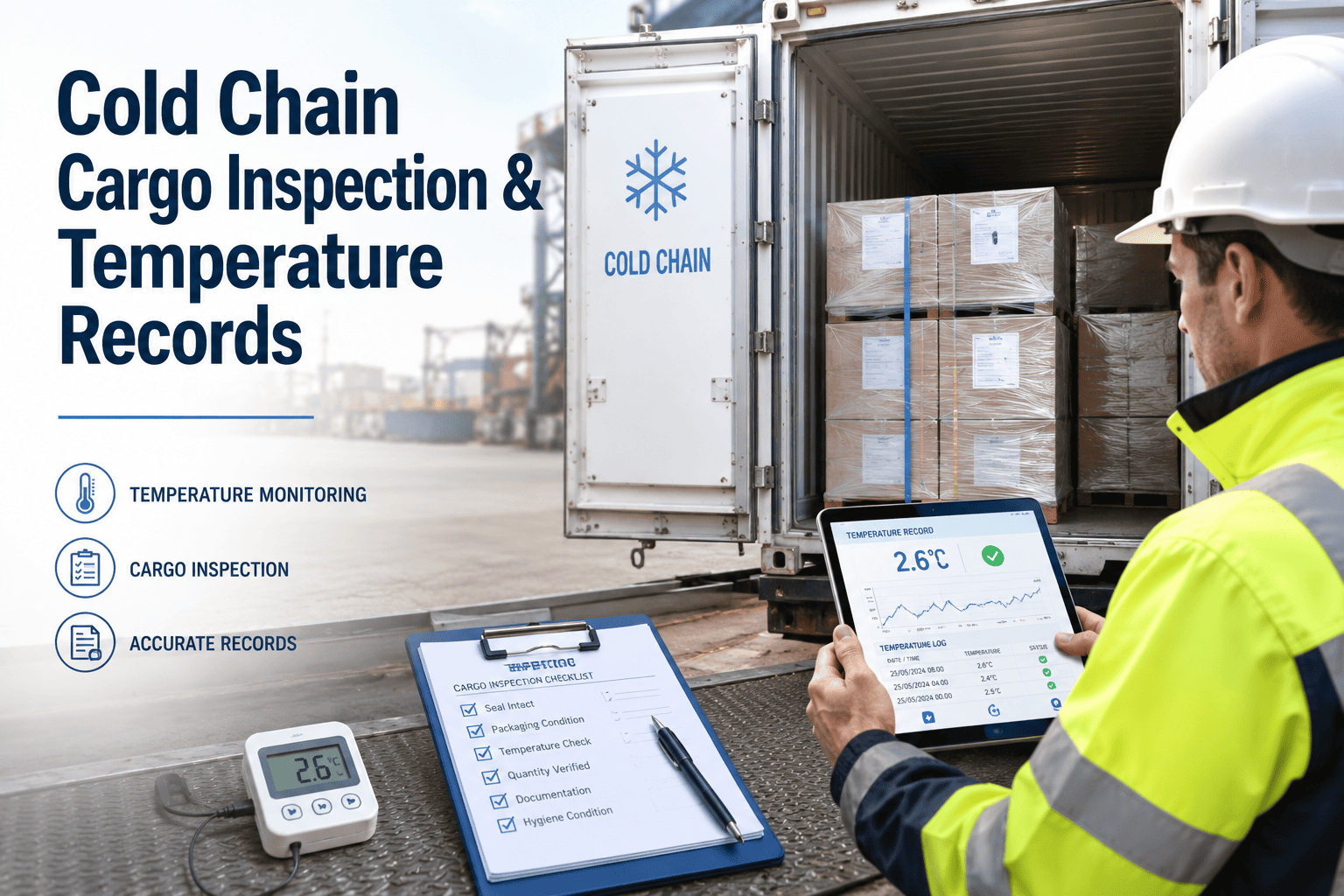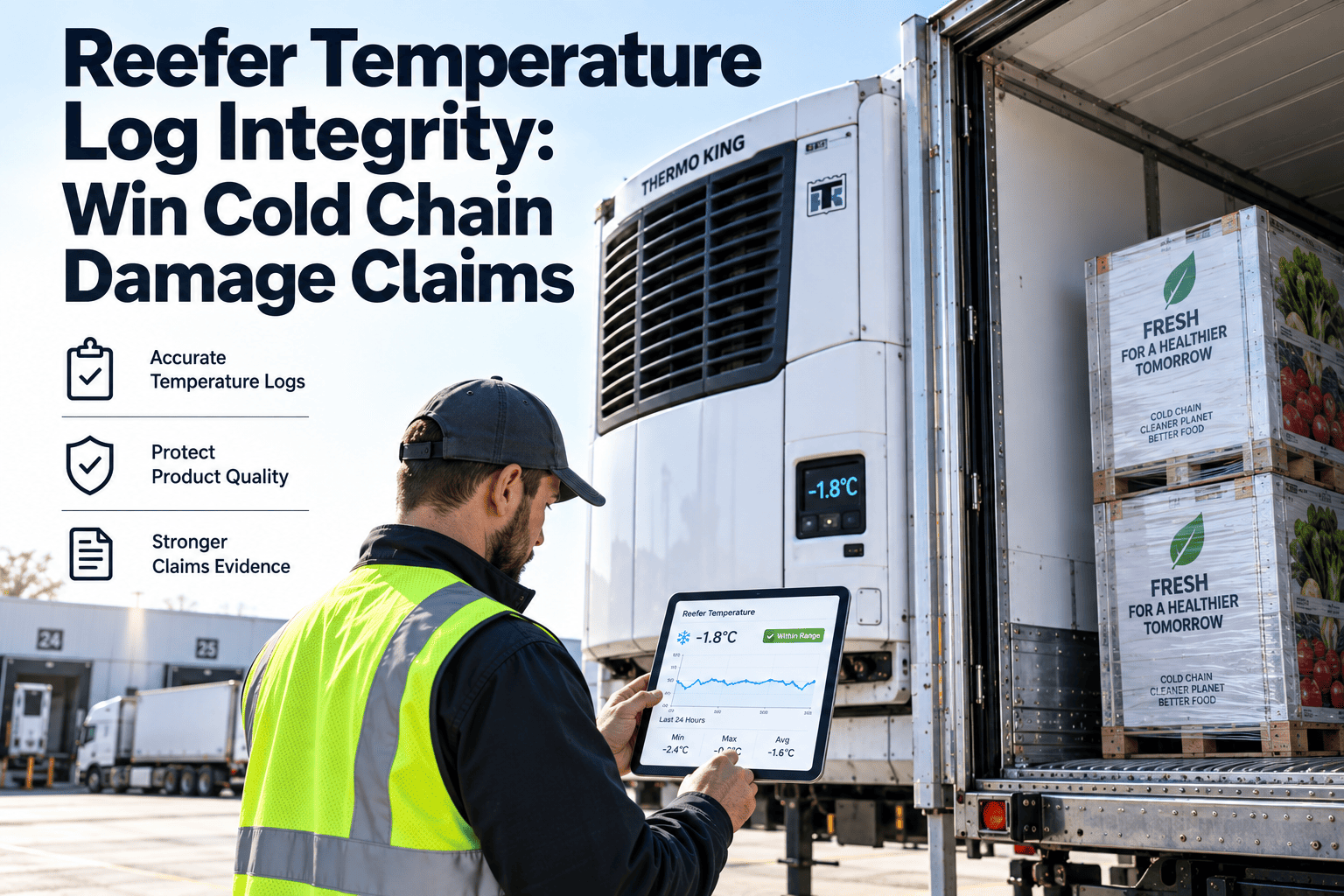
A cold chain claim rarely turns on whether the cargo actually spoiled. It turns on whether the carrier can produce a temperature record strong enough to withstand a P&I club's objections, a shipper's own logger data, and an adjuster looking for any gap in the chain of custody. A shipper-placed data logger alone is often not enough to win that argument.
Reefer Temperature Log Integrity: Winning Cold Chain Damage Claims
Refrigerated cargo claims are decided on the strength of the temperature record, not just the temperature itself. See where shipper-placed loggers fall short, how sensor placement and machine downloads build a defensible file, and how tamper-evident logging protects a carrier when a claim is filed.
Why A Shipper's Own Data Logger Carries Less Weight Than It Should
Placing a data logger in the trailer feels like insurance. It costs little and produces a clean temperature curve. But when a claim is actually filed, that curve is routinely challenged, and rarely because the logger was inaccurate.
A logger near a door, a vent, or the wall of the trailer reads a different temperature than the center of the load, and the defense will say so.
Without a documented handoff of the logger and its data, an adjuster can argue the record does not reliably represent that specific shipment.
A bare temperature line has none of the context, pre-trip status, power events, or airflow data that a full record provides.
A shipper logger standing alone, with no matching carrier record, is easy to characterize as one-sided evidence.
Every Reefer Load Needs A Record That Holds Up
Oxmaint logs pre-trip checks, temperature readings, and reefer inspections as scheduled work orders per trailer, building the corroborating carrier-side record that strengthens a claim file instead of leaving it resting on a single shipper logger.
What A Defensible Reefer Temperature Record Actually Contains
Modern refrigerated trailers carry an integral data logger tied to the reefer's own microprocessor, and it captures far more than a temperature line. Claims specialists list the microprocessor download first among the records assembled to defend a reefer claim, alongside pre-trip results and equipment handover paperwork.
Power on and off events, PTI results, alarms, temperature, and in some units humidity and airflow data pulled directly from the unit's controller.
Delivery and return air temperature recorded at set intervals, commonly every six hours, by the driver or a terminal inspector.
Confirms the unit, seals, drains, and setpoint were verified before the load was accepted, ruling out a pre-existing equipment fault.
Documents the handoff of the trailer between parties, closing the chain-of-custody gap that undermines a standalone logger reading.
Where A Logger Sits Determines Whether Its Data Holds Up
Sensor placement is one of the most common points of failure in cold chain documentation. A logger near a heat source, in a poorly ventilated corner, or isolated from the actual product will produce a reading that does not represent what the cargo experienced.
- Against a door or curtain
- Directly under a supply-air vent
- In an airflow shadow behind stacked pallets
- Near the reefer unit's own heat exhaust
- Centered within the product load
- Representative of length, width, and height gradients
- Documented and photographed at load time
- Serial number logged against the shipment reference
Protecting The Record From Being Challenged As Unreliable
A strong temperature curve can still be thrown out if the other side can show the record was editable, unlabeled, or disconnected from a specific truck and trip. Tamper-evident practice is what keeps a good reading from being dismissed on a technicality.
The Regulatory Backdrop Behind Cold Chain Documentation
Reefer compliance spans more than a single rulebook, and the right documentation standard depends on the cargo being hauled.
| Cargo Type | Governing Framework | Key Documentation |
|---|---|---|
| Food and perishables | FSMA, HACCP, or local equivalents | Continuous temperature log, corrective action records |
| Pharmaceuticals | Good Distribution Practice guidance | Validated temperature mapping, calibrated sensor records |
| International road freight | ATP agreement for perishable goods | Equipment certification, in-transit temperature record |
| Cross-border shipments | Customs and import requirements | Cold chain documentation alongside origin and phytosanitary certificates |
Build The Corroborating Record Automatically
Recurring pre-trip inspections, scheduled reefer PM, and logged excursion responses give every load a documented history that stands alongside the microprocessor download, not apart from it.
Most Cold Chain Breaks Happen Between Legs, Not During Them
The main transport leg is usually the best-controlled part of a refrigerated shipment. The vulnerable moments are the transfer points: time spent unshaded on a loading apron, hours waiting unplugged for a terminal power slot, and the gap between a chilled trailer and a chilled dock or store.
Unit, setpoint, seals, and drains verified before the load is accepted.
Exposure risk rises if the trailer sits unshaded or unplugged during staging.
Typically the most stable segment, monitored continuously by the reefer's own logger.
Power gaps during transload between trailers or containers are a common excursion point.
The handoff to the receiving dock, where a final temperature check closes the record.
Turning Reefer Documentation Into A Standard Workflow, Not A Scramble
Most reefer documentation gaps are not caused by missing equipment. They happen because inspections, logger checks, and excursion responses live in different notebooks, phones, and email threads across drivers and terminals.
Recurring pre-trip work orders capture unit status, setpoint, and seal condition before every reefer load.
Drivers record in-transit checks and flag excursions from a phone, timestamped and tied to the trailer and load.
Reefer PM, repairs, and calibration history stay attached to the specific trailer, ready to support a claim file.
Inspection and excursion records stay searchable and retained for the window a claim or audit might require.
Assembling The File Once An Excursion Or A Rejection Happens
When a receiver flags a temperature issue at delivery, the strength of the response depends on how quickly a complete file can be assembled, not on scrambling to reconstruct records after the fact. A consistent submission process turns a stressful call into a routine paperwork exercise.
Do this before the trailer is reused or repositioned, since the download reflects that specific trip.
Show the unit and setpoint were verified correct before the load was accepted.
Provide the periodic delivery and return air readings that corroborate the machine record.
Show what action was taken when an alarm fired, and when, to demonstrate active monitoring rather than a passive record.
Close the chain-of-custody gap by showing exactly who held the trailer and when, from origin to delivery.
Carriers that keep these five records attached to the shipment from the start, rather than reconstructing them after a rejection, consistently move through the claims process faster and settle disputes with less back-and-forth. The file either exists already or it does not, and there is rarely time to build it retroactively once cargo has already been rejected at the dock.
Sensor And Reefer Unit Failures Behind Bad Records
A perfect documentation process cannot compensate for a reefer unit or sensor that is quietly failing. Equipment condition and record quality are two sides of the same problem, and a maintenance gap on one shows up as a data gap on the other.
An uncalibrated probe can read within an acceptable range while the actual cargo temperature has already drifted outside it.
A worn seal lets ambient air infiltrate the trailer, producing localized temperature swings that a single sensor may miss entirely.
Blocked return air channels or overpacked pallets prevent even air circulation, creating hot spots the logger does not capture.
A brief power interruption during a terminal transfer can go unrecorded if the unit's data retention interval is too short.
Frequently Asked Questions
Why does a shipper-placed data logger sometimes lose a claim?+
How often should reefer temperature be checked in transit?+
What is the single most important record in a reefer claim file?
Where do most cold chain temperature excursions actually happen?+
How can a carrier standardize reefer documentation across drivers?+
Why Multi-Terminal Fleets Struggle Most With Reefer Documentation
A single-yard operation can rely on one dispatcher knowing every trailer's habits. That informal system breaks down the moment a fleet spans multiple terminals, each with its own drivers, loading procedures, and paper habits.
| Practice Area | Ad-Hoc Per-Terminal Handling | Standardized Fleet Practice |
|---|---|---|
| Pre-trip checks | Paper form, filed locally or not at all | Logged work order per trailer, per trip |
| Manual temperature checks | Left to driver habit | Scheduled reminder every six hours |
| Microprocessor downloads | Pulled only after a claim is filed | Downloaded and archived on a fixed cycle |
| Sensor placement | Not documented | Photographed and logged at load time |
| Claim file assembly | Reconstructed from scattered sources | One searchable record per shipment |
The gap between these two columns is usually not a technology gap. Most fleets already own the reefer units, the loggers, and the phones drivers carry. What is missing is a consistent workflow that runs the same way whether a load originates from the home terminal or a satellite yard three states away, and a place where all of that documentation lands automatically instead of depending on one careful driver remembering every step.
A Load-Level Checklist For Reefer Temperature Integrity
Reducing the reefer documentation problem to a per-load checklist makes the standard easy to apply consistently, whether the load originates at the home terminal or a satellite yard hundreds of miles away.
Stop Letting A Single Logger Carry Your Whole Claim
A defensible reefer record is built from pre-trip checks, six-hour logs, microprocessor downloads, and a documented chain of custody, not one shipper-placed device. Standardize that record at every yard before the next claim tests it.