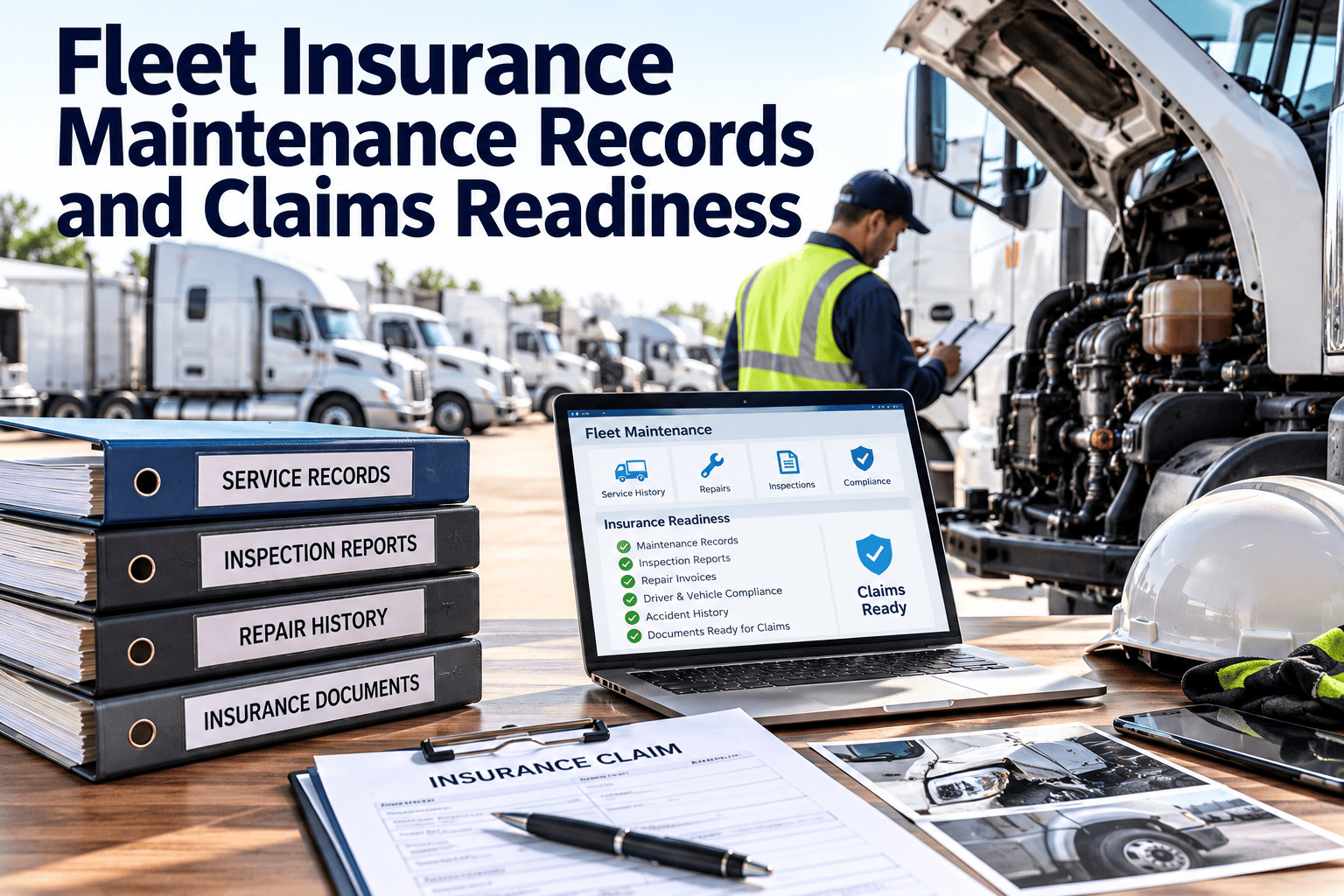
When a fleet vehicle is involved in an accident, the insurance adjuster's first question is rarely about the crash itself — it's about the vehicle's maintenance history. A brake system serviced on schedule and documented in detail can be the difference between a claim that settles cleanly and one where the fleet is found partly liable for a mechanical failure that a court decides should have been caught. Fleets that treat maintenance records as part of their risk management program, not just their repair paperwork, put themselves in a stronger position the moment a claim is filed, and many now build that discipline directly into fleet maintenance software rather than a filing cabinet.
The maintenance record you file today is the evidence an adjuster reads tomorrow
Insurance carriers and courts both look at documented maintenance history when an accident involves a mechanical factor — a worn tire, a failed brake line, a bald tread. A fleet with a complete, timestamped record has a defensible position. One without it does not.
A claim is rarely about the crash alone
Insurance carriers investigate causation, not just impact. If a vehicle's brakes, tires, or steering are implicated in an accident, the carrier and any opposing counsel will request the maintenance history for that specific asset before the claim moves forward.
Incident occurs
A collision, mechanical failure, or cargo incident triggers an insurance claim against the fleet's policy.
Adjuster requests records
The insurer's investigation asks for the vehicle's maintenance and inspection history, often within days of the claim being opened.
Records are reviewed for causation
Investigators look for whether a documented defect, deferred repair, or skipped inspection contributed to the incident.
Liability and premium impact determined
Complete, on-time records support a stronger defense; gaps or missed PMs can shift liability and raise future premiums.
What a complete record changes at claim time
The same accident produces two very different outcomes depending on whether the maintenance file behind it is complete or incomplete. This is the comparison claims teams see most often.
Incomplete Record
No documented inspection in the months before the incident.
Deferred repair noted verbally but never logged or closed out.
Service history split across paper files, texts, and memory.
Negligence argument becomes easier for opposing counsel to make.
Complete Record
Inspection completed and timestamped on schedule before the incident.
Every flagged defect tied to a closed work order with technician sign-off.
Full service history retrievable from one system in minutes.
Fleet demonstrates a documented standard of care.
What should already be in the file before a claim is ever filed
Claims readiness isn't something a fleet builds after an incident — it's the byproduct of a maintenance program that documents itself continuously. These are the records that matter most when a claim comes in.
Build the claims file before you ever need it.
Every inspection, work order, and sign-off stored against the vehicle, retrievable the moment a claim comes in.
Records support more than the claim itself
A well-documented maintenance history has value beyond defending a single claim. It supports a DOT compliance audit, a subrogation effort against a parts manufacturer or repair vendor, and a renewal conversation with the fleet's own insurance carrier.
- DOT and FMCSA audits request documented inspection and repair history, and missing records can trigger findings independent of any accident.
- Subrogation against a parts supplier or repair shop depends on proving what was installed, when, and by whom.
- Insurance renewal underwriting increasingly reviews a fleet's maintenance discipline, not just its loss history, when setting premiums.
- Driver behavior data paired with maintenance records helps separate a mechanical cause from a driver-error cause during an investigation.
What a gap in the record actually costs a fleet
The financial exposure from poor maintenance documentation rarely shows up as a single line item. It surfaces across several places at once, all of which a maintained digital record helps close.
Fleet insurance and maintenance records — answered
What maintenance records do insurance adjusters typically ask for after an accident?
Pre-trip inspections, scheduled PM history, and any documented defect or repair for the specific vehicle involved, usually requested within days of the claim opening.
Can incomplete maintenance records increase a fleet's liability in a claim?
Yes. If a mechanical factor is suspected and the maintenance history can't rule it out, negligence becomes an easier argument for the opposing side to make.
How long should fleet maintenance records be retained for insurance purposes?
Retention periods vary by jurisdiction and policy, but most fleets keep inspection and repair records well beyond the vehicle's time in service to cover potential claims filed later.
Does better documentation actually reduce insurance premiums?
Carriers increasingly factor documented maintenance discipline into underwriting, so a fleet with a clean, complete digital record is often positioned better at renewal. Book a demo to see how records are structured for audits.
How does a CMMS make claims readiness easier than paper files?
Every inspection and work order is stored against the specific asset with a timestamp and sign-off, so a full history can be pulled in minutes instead of assembled from files after the fact. Get started to set this up for your fleet.
Don't wait for a claim to find out your records have gaps.
Document every inspection, repair, and sign-off as it happens — and be ready the moment an adjuster calls.
Free 14-day trial · No credit card