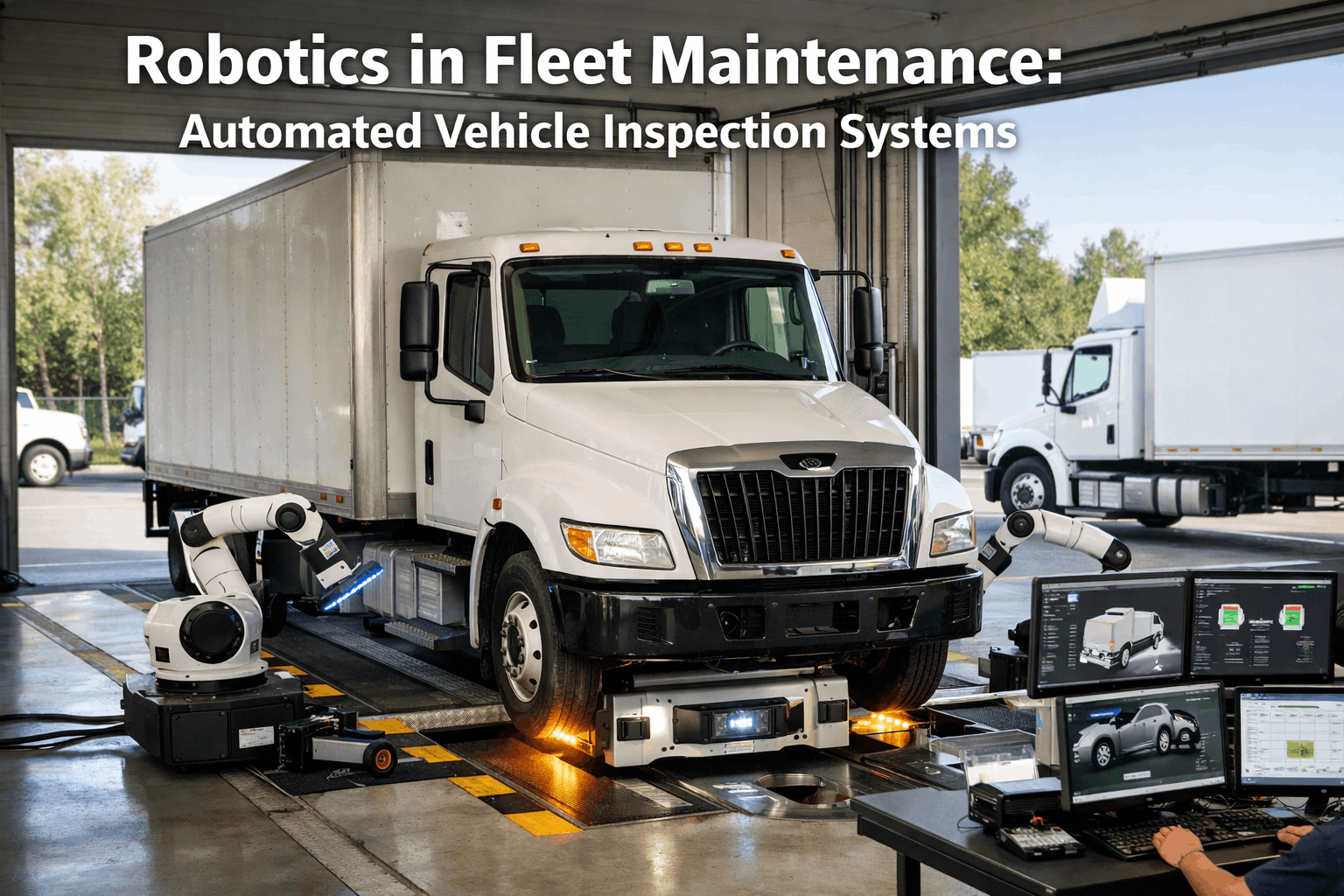
Robotic Undercarriage Inspection for Heavy Vehicles
By Alex Jordan on April 2, 2026
Heavy vehicle fleets operating across the USA, Canada, UK, Germany, Australia, and UAE face a shared blind spot: the undercarriage. Corrosion, structural cracks, fluid leaks, and worn suspension components develop completely out of sight — undetected by standard walkaround checks and missed by rushed manual pit inspections. Robotic undercarriage inspection systems using AI vision now allow fleet operators to scan the entire underbody of a vehicle in under 90 seconds, catching critical failures that manual inspection misses entirely. This article covers how AI-powered robotic inspection works, what it detects, how it integrates with SAP, PLC, and OBD systems, and why fleets adopting it are cutting unplanned downtime by over 40%.
FLEET OPERATIONS · ARTICLE · 2026
Robotic Undercarriage Inspection: AI Vision That Sees What No Inspector Can
AI camera vision, digital twin technology, OBD integration, and SAP connectivity — the complete guide to automated undercarriage inspection for heavy vehicle fleets.
"After deploying Oxmaint robotic inspection at our Texas depot, we caught a cracked rear axle mount before dispatch. That single detection avoided a potential road incident and a six-figure liability claim. The system paid for itself in week one."
— Fleet Operations Director, Tier-1 Logistics Operator, USA
Section 01
What AI Vision Detects
AI Camera Vision — Every Defect the Robot Classifies Under Your Fleet
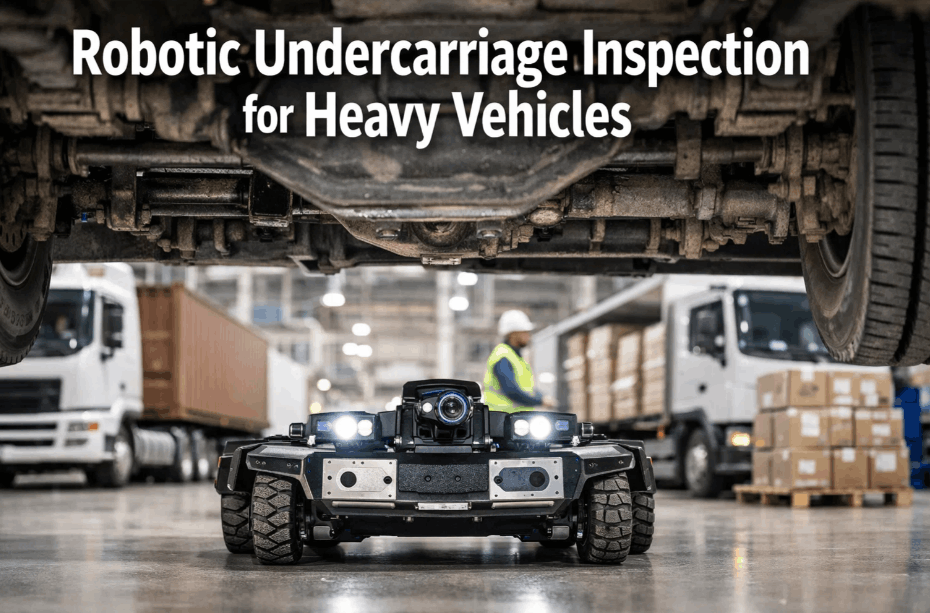
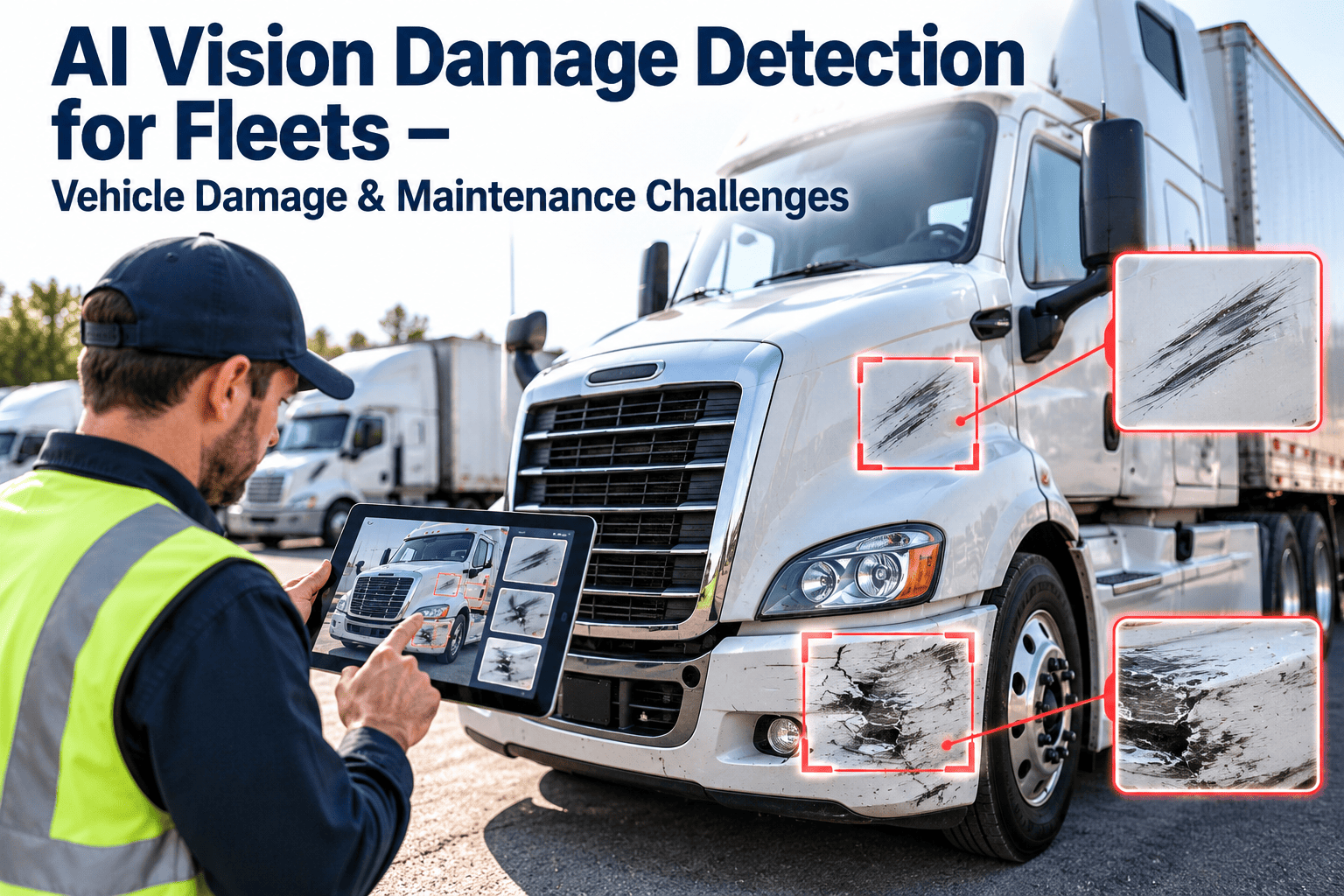
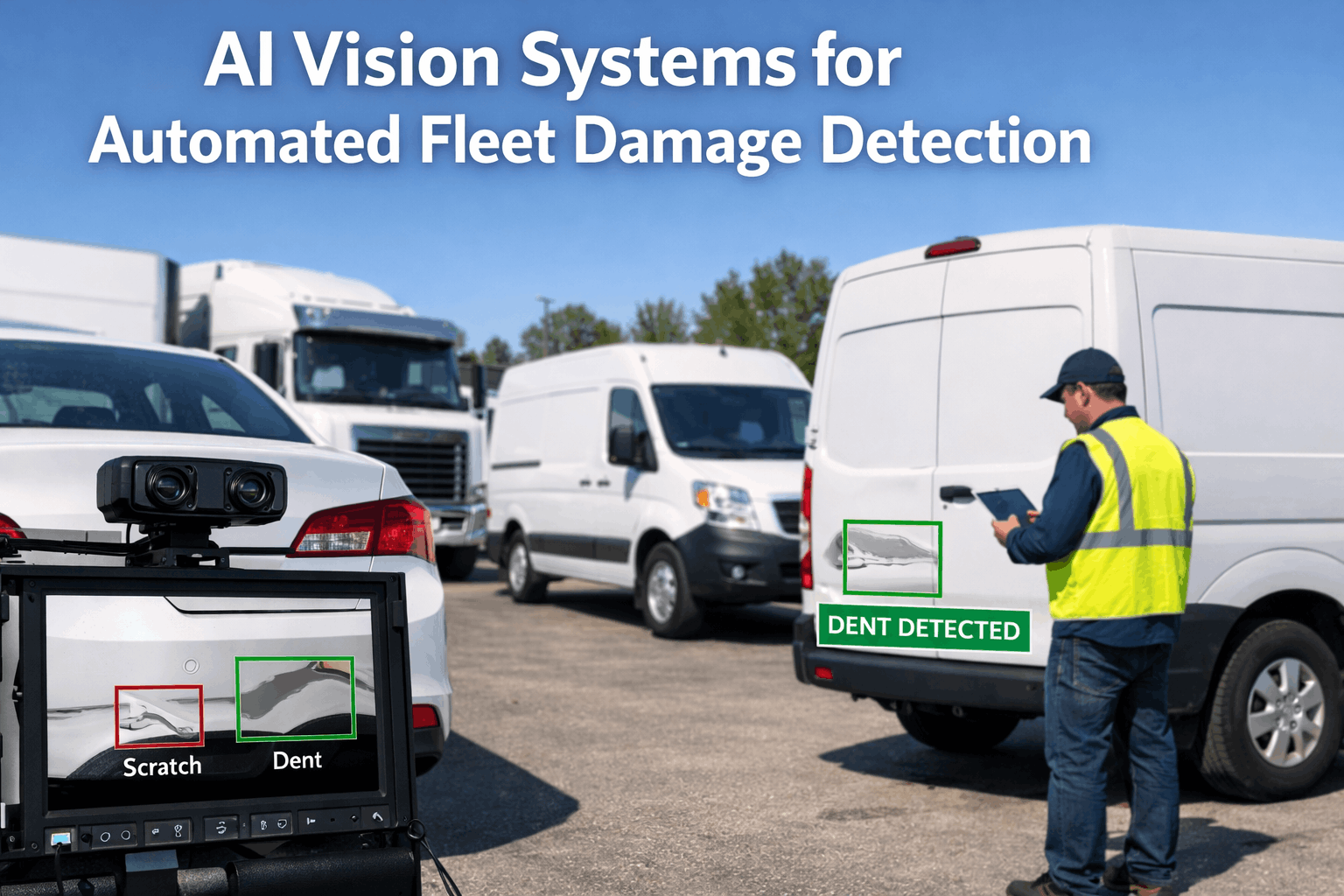
Robotic undercarriage inspection systems deploy multi-angle AI cameras on a low-profile autonomous platform that passes beneath the vehicle at walking speed. The AI vision engine — trained on millions of annotated undercarriage images — identifies defects in real time with classification, severity scoring, and spatial location tagging. The AI makes the detection call, generates a structured report, and pushes it to your maintenance system automatically — no human review queue, no inspection pit required.
Detection covers every critical zone: frame rails, cross-members, axle housings, driveshafts, leaf springs, air bags, brake chambers, ABS wiring, and fluid lines. The AI digital twin layer then persists every scan as a 3D spatial model per vehicle — and on every subsequent scan, highlights delta changes: a new crack propagation, a 2mm corrosion spread, a brake chamber shift. This longitudinal intelligence is what transforms undercarriage inspection from a compliance exercise into a predictive maintenance tool on Oxmaint.
DEFECT BREAKDOWN
What Robotic AI Finds — By Category
Corrosion & Rust
34%
Most common
Fluid Leaks
26%
Oil, coolant, air
Suspension Damage
21%
Springs, airbags
Structural Cracks
12%
Frame, welds
Brake System
7% — critical
Source: Oxmaint fleet scan data across commercial heavy vehicle operations.
Track Every Undercarriage Defect Automatically on Oxmaint
Oxmaint's AI vision robot scans the full underbody in 90 seconds — classifies defects by severity, logs findings per vehicle, and pushes work orders to your maintenance system instantly.
AI, Digital Twin, SAP, PLC, OBD — The Full Integration Architecture
The Oxmaint robotic inspection platform operates as a fully integrated technology stack, not a standalone scanner. At the hardware layer, a ruggedized autonomous robot equipped with multi-spectral AI cameras, structured light sensors, and thermal imaging traverses beneath the vehicle in 60–90 seconds — requiring no vehicle lift, no trench, and no lane modification. The AI vision engine processes scan data against a model trained specifically on heavy vehicle failure patterns, classifying each finding by component, defect type, and severity (critical / advisory / monitor), then estimating remaining useful life for progressive failure modes.
OBD integration pulls live ECU fault codes at the moment of scan — correlating electrical faults with physical findings into combined reports. A cracked air line alongside an ABS pressure fault becomes one investigation, not two. Integration with SAP PM, IBM Maximo, and PLC-controlled workshop management systems is native via API — findings flow into existing maintenance workflows without manual re-entry. Book a demo to discuss your SAP or Maximo environment.
Technology Stack — How Oxmaint Connects to Your Operations
AI Camera Vision
FOUNDATION LAYER
Multi-spectral cameras + thermal sensors scan full underbody in 90 seconds. 96%+ defect detection rate with spatial location tagging.
AI Digital Twin
INTELLIGENCE LAYER
3D per-vehicle model updated every scan. AI highlights delta changes — crack propagation, corrosion spread, component shifts over time.
OBD Correlation
DATA FUSION
ECU fault codes pulled live at scan time. Physical findings merged with electrical faults — one combined report, not two separate items.
SAP PM Integration
ERP CONNECTOR
Work orders pushed to SAP PM, IBM Maximo, or custom ERP via native API. Zero manual re-entry. Maintenance chain fully auditable.
PLC Workshop Control
AUTOMATION LAYER
Bay management systems trigger robot scans automatically. No manual initiation needed — vehicle entry starts the scan sequence.
Predictive Scheduling
MAINTENANCE AI
AI measures deterioration rate per component. Generates repair schedule based on actual condition trend — not arbitrary calendar intervals.
Section 03
Preventive Maintenance
From Breakdown Response to Predicted Repair — The Oxmaint Maintenance Intelligence Layer
Traditional fleet maintenance is triggered by failure: something breaks, the vehicle stops, the repair happens. Robotic undercarriage inspection inverts this model. The AI tracks condition trends across every scan — spotting a brake chamber that has shifted 3mm over two weeks, a leaf spring showing micro-crack propagation, a driveshaft coupling with early-stage pitting. These are not failures yet: they are predictions. Maintenance recommendations are generated based on measured deterioration rates, allowing fleet managers to schedule repairs at the lowest-cost point in the failure curve.
Preventive maintenance guided by AI undercarriage data also reshapes parts inventory. When the system predicts that four vehicles need a specific axle seal within 18 days, the parts team pre-orders against that demand — eliminating emergency procurement premiums. Fleets integrating Oxmaint with ERP procurement report a 28–35% reduction in emergency parts spend in year one. Explore predictive scheduling in Oxmaint.
LIVE KPI DASHBOARD
Oxmaint Fleet Impact — Key Performance Indicators
Downtime Reduction
40%+
vs baseline pre-deployment
Unplanned stops eliminated
Emergency Parts Spend
28–35%
reduction in year one
Parts pre-ordered on AI forecast
ROI Payback Period
8–14 mo
for fleets with 50+ vehicles
Faster in high-corrosion regions
Defect Detection Rate
96%+
vs ~62% manual
AI-consistent, inspector-independent
Scan Time Per Vehicle
90 sec
full underbody scan
No lift · no pit · no delay
Compliance Record
100%
of scans auto-documented
DOT · DVSA · NHVR audit-ready
Section 04
Deployment Roadmap
Fleet Deployment — What the First 90 Days Look Like
Oxmaint deployment does not require major infrastructure changes. The ground-level robot system operates on existing flat depot floors with a vehicle drive-over configuration — no pit, no lift, no lane repaving. Installation, network configuration, and software setup complete within one to two working days. For multi-depot fleets across regions, centralized data management with local processing nodes keeps scan data available under any network constraint.
Robot deployed. Software configured. Full fleet scanned for baseline digital twin — every vehicle gets its first structured undercarriage record.
Days 15–45
Integration & Workflow
SAP / EAM integration live. Work orders flowing automatically. Maintenance team trained on AI severity classifications and report structure.
Days 46–90
Predictive Intelligence
AI begins generating trend-based maintenance predictions. First ROI reports available. Unplanned breakdown rate measurably declining.
Section 05
Compliance & Safety
DOT, DVSA, NHVR — The Regulatory Case for Robotic Inspection Records
Every undercarriage defect discovered by a DOT roadside inspector that your fleet's own program missed is a compliance failure with a paper trail. CSA BASIC violations from brake, suspension, or structural findings remain in your safety record for 24 months and directly increase roadside targeting. Robotic inspection addresses the structural compliance gap: every scan generates a timestamped, structured inspection record — the kind of evidence that supports DataQs challenges and carrier review responses.
In jurisdictions with enhanced heavy vehicle safety standards — DVSA in the UK, NHVR in Australia, TÜV in Germany — documented inspection frequency is increasingly a carrier certification requirement. Robotic inspection delivers what paper programs structurally cannot: every vehicle, every visit, every defect, every resolution — fully auditable. Book a demo to discuss your specific regulatory environment.
Compliance Categories Oxmaint Automates for Heavy Vehicle Fleets
Structural Integrity
Every Scan
Frame rail cracks, cross-member welds, body mount corrosion, deformation from impact — classified by severity with photo evidence and spatial location tagged.
Brake System Underbody
Every Scan
Air line routing and condition, brake chamber positioning, slack adjuster accessibility, ABS sensor wiring — findings pushed to work order before dispatch.
Suspension & Drivetrain
Every Scan
Leaf spring fatigue, air bag collapse, shock mounts, torque arm wear — plus axle housing, driveshaft, and differential oil seepage detection.
Ready to Deploy?
See Oxmaint Robotic Inspection on Your Fleet
Live 30-minute demo tailored to your depot, fleet size, and compliance environment.
Robotic undercarriage inspection — answers for fleet decision-makers
What does robotic undercarriage inspection detect?
Corrosion, structural cracks, fluid leaks, suspension damage, brake system defects, and drivetrain wear — all classified by severity and spatial location in a single 90-second scan.
Does Oxmaint integrate with SAP or ERP systems?
Yes — native API integration with SAP PM, IBM Maximo, and custom ERP systems. Work orders are pushed automatically with zero manual re-entry required.
What infrastructure changes are needed at our depot?
Minimal — the robot operates on flat ground with standard network access. No inspection pit, no vehicle lift, and no lane modification required in most depot configurations.
How does the AI digital twin work?
Each vehicle's undercarriage is modeled as a 3D spatial record. Every scan updates the twin — and the AI highlights changes between scans so deterioration trends are visible before failure occurs.
How does it help with DOT compliance?
Every scan generates a timestamped, structured inspection record with defect classification and repair action logged — providing full audit documentation for DOT, DVSA, or NHVR reviews.
What is the typical ROI for a 50-vehicle fleet?
Most fleets recover system cost in 8–14 months. High-corrosion environments (salt belt US/Canada, UAE coastal) see faster payback through frame replacement avoidance alone.
Can it handle multi-depot, multi-country operations?
Yes — centralized management with local processing nodes supports fleets operating across multiple depots and countries, including data sovereignty configurations.