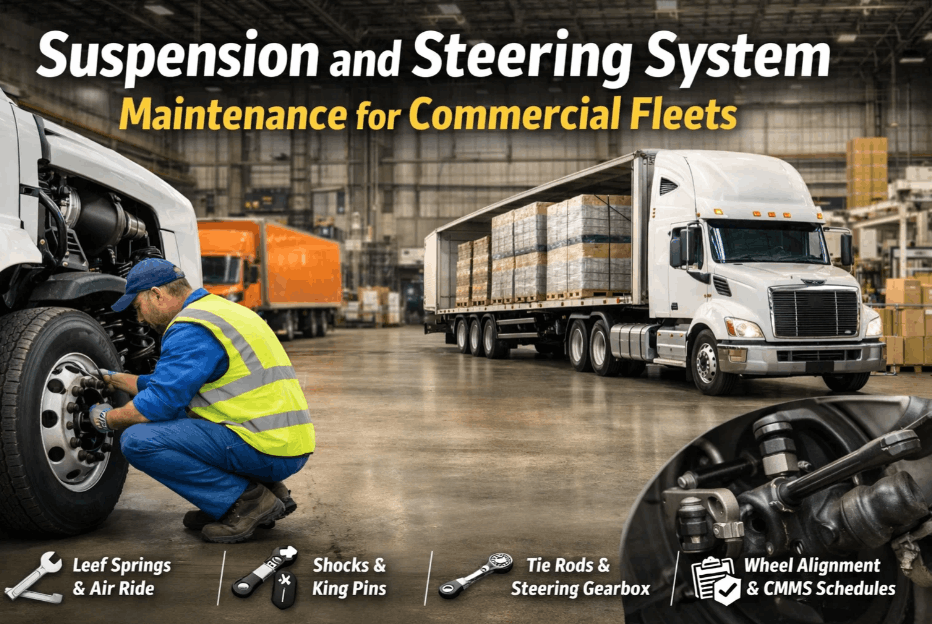
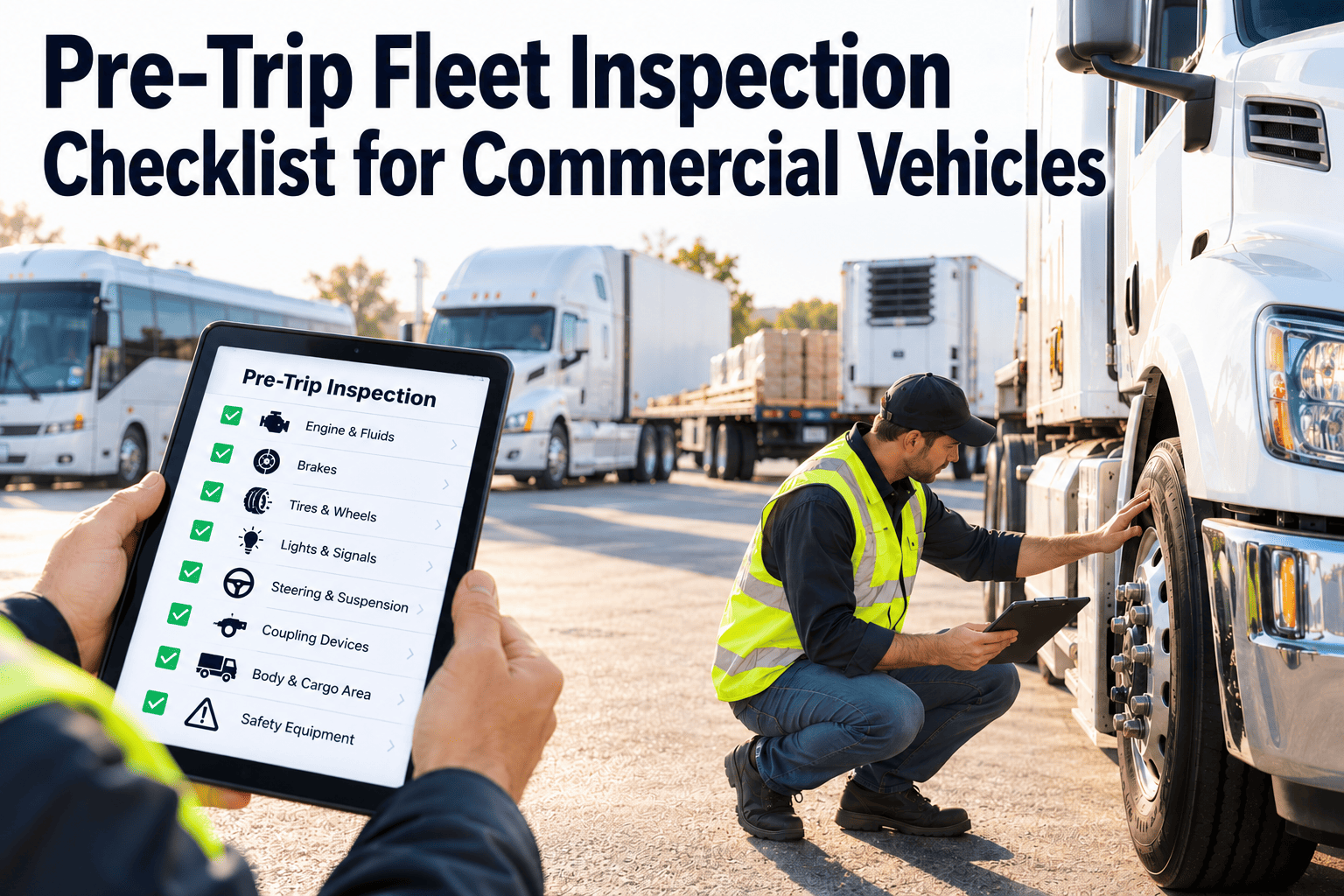
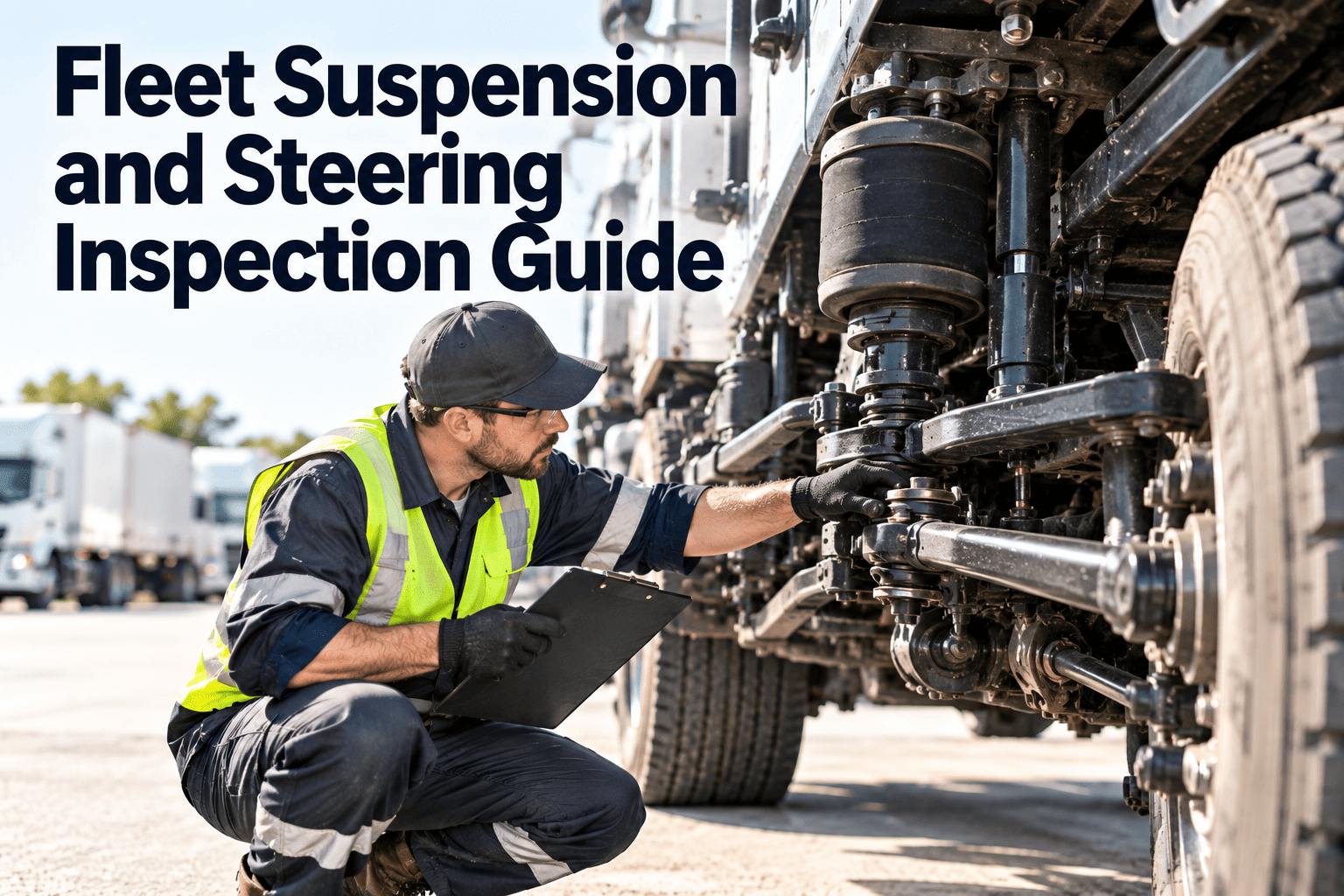
Suspension and Steering System Maintenance for Commercial Fleets
By Alex Jordan on March 30, 2026
Suspension and steering failures in commercial fleets don't announce themselves with OBD fault codes — they announce themselves with tyre blowouts, pulled loads, jackknife events, and drivers who report "something feels different" three weeks before a king pin fails on a motorway. The entire suspension and steering system degrades on predictable mileage intervals that a structured PM programme intercepts before they become roadside events. OxMaint schedules every suspension and steering PM event per vehicle automatically — leaf spring inspection, king pin measurement, tie rod check, alignment verification — without manual tracking.
Fleet Maintenance · Article ·
Suspension and Steering System Maintenance for Commercial Fleets
Leaf springs, air ride, shock absorbers, king pins, tie rod ends, steering gearbox, and wheel alignment — with CMMS-scheduled PM intervals, OBD and PLC monitoring, and predictive maintenance protocols for commercial fleet operations.
Suspension and steering failures give early warning through driver-reported symptoms long before a component reaches critical failure. The problem is that most fleets have no systematic way to connect a driver's symptom report to the specific component it implicates — so "pulls to the left" sits in an email and "steering feels loose" gets verbally passed at handover. The six symptom cards below map the most common driver-reported symptoms to their primary component cause and the urgency level the fleet maintenance team should apply. OxMaint's driver-facing DVIR module captures these symptoms digitally — automatically routing each one to the correct maintenance work order type.
Pulls Left or Right
Immediate
Primary cause
Wheel misalignment, worn tie rod ends, or unequal brake drag
Check toe alignment and tie rod play. Inspect brake callipers for drag before returning to service.
Steering Wheel Vibration
Immediate
Primary cause
Wheel imbalance, worn king pins, or loose wheel bearings
Check wheel balance and king pin axial play. Measure bearing end-float before next dispatch.
Loose / Vague Steering
Immediate
Primary cause
Worn steering gearbox, king pin wear, or loose drag link
Measure steering wheel free play — >2 inches total is a DVSA prohibition item. Inspect king pin radial play immediately.
Heavy / Hard Steering
Within 48 hrs
Primary cause
Low power steering fluid, pump wear, or seized king pin
Check PAS fluid level and condition. Inspect pump output pressure. King pin lubrication may resolve initial stiffness.
Rapid / Uneven Tyre Wear
Within 48 hrs
Primary cause
Toe/camber misalignment or collapsed spring allowing geometry change
Full 4-wheel alignment check. Inspect spring condition for sag or broken leaves. Check air bag pressure on air-ride vehicles.
Clunking Over Bumps
Next PM
Primary cause
Worn shock absorbers, broken spring leaf, or loose U-bolt
Inspect shock absorber damping and spring pack integrity. Check U-bolt torque — loose U-bolts allow spring pack separation under load.
Component Health by Mileage — Know the Risk Before You Dispatch
Every suspension and steering component has a mileage-based risk profile — but most fleet PM programmes apply a single interval across all components regardless of vehicle mileage, operating conditions, or actual measured wear. The matrix below maps 7 key components against four mileage bands to show when each component transitions from low-risk to inspection-required to replacement-due territory. If you know the mileage of each vehicle in your fleet, this matrix tells you exactly which components need attention today. OxMaint tracks mileage and wear data per component per vehicle — matching each vehicle's current odometer to the correct risk cell automatically.
Component
0–50K miles
50–100K miles
100–150K miles
150K+ miles
King Pin & Bushes
✓ NormalLubricate at PM
✓ NormalMeasure radial play
⚠ InspectReplace if >3mm play
✗ ReplaceHigh failure risk
Tie Rod Ends
✓ NormalVisual check
✓ NormalCheck for play
⚠ InspectTest ball joint play
✗ ReplaceFull steering check
Leaf Springs
✓ NormalVisual inspection
⚠ InspectCheck for sag/cracks
⚠ InspectU-bolt torque check
✗ ReplaceCheck centre bolt
Shock Absorbers
✓ NormalCheck for leaks
✓ NormalBounce test
⚠ InspectDamping performance test
✗ ReplaceAxle pair replacement
Air Ride Bags
✓ NormalPressure check
✓ NormalVisual for cracking
⚠ InspectCheck levelling valve
✗ ReplaceBag + levelling valve
Steering Gearbox
✓ NormalCheck for leaks
✓ NormalFree play <2 inches
✓ NormalFluid condition check
⚠ InspectInternal wear check
Wheel Alignment
✓ NormalCheck at 1st PM
⚠ CheckEvery 30K miles
⚠ CheckEvery 25K miles
⚠ CheckEvery 20K miles
Normal / MaintainInspect / MeasureReplace / Overhaul
PM Risk Scoring — How Well Is Your Suspension Maintained?
Suspension and steering system health is a direct safety and tyre cost variable — fleets with poor PM compliance pay for it in tyre wear, alignment frequency, and the occasional catastrophic failure that generates an HSE investigation. The scoring framework below lets maintenance engineers and fleet managers assess each vehicle's suspension and steering PM status — identifying the specific gaps that carry the highest road risk and the highest consequential cost.
Suspension & Steering PM Compliance Risk Scoring
Score 5 = safe, all intervals current · Score 1 = roadworthiness risk · Assess per vehicle
5
All PM Current — Alignment Verified
King pin play within spec. Alignment checked in last 30K miles. Shocks tested. Spring condition confirmed. Steering free play <1 inch.
Action: Maintain schedule. Monitor driver DVIR reports. No intervention required.
4
Approaching Service — Minor Indicators
Within 10K miles of next alignment interval. Steering free play 1–1.5 inches. No driver symptom reports. Shocks last tested within 50K miles.
Action: Schedule at next PM. No route restrictions needed.
3
Overdue — Wear Signs Noted
Alignment overdue by 15K+ miles. Steering free play 1.5–2 inches. Driver-reported minor vibration or pulling. One suspension component approaching end-of-life by mileage.
Action: Schedule within 2 weeks. Restrict loaded operation until alignment checked.
2
High Risk — Active Defects
Steering free play approaching 2 inches. Active pulling or vibration reported. Rapid tyre wear visible. One or more components measurably out of spec but not yet failed.
Action: Immediate inspection. Restrict to local low-speed routes until king pin and alignment checked by qualified tech.
1
Critical — Safety Risk Present
Free play exceeds DVSA limit. King pin play measurably excessive. Broken spring leaf, failed shock, or loss of steering control reported by driver.
Action: Ground vehicle immediately. Do not operate until inspected. Potential HSE and roadworthiness prohibition risk.
Technology Integration: OBD, PLC, AI Camera, Digital Twin, and SAP
Suspension and steering health monitoring is evolving from periodic pit-lane inspection to continuous condition monitoring. OBD-II and J1939 telematics capture steering torque variation, lateral G-force events, and vibration data that indicate developing king pin wear and shock absorber degradation before the driver notices. PLC integrations connect air ride pressure sensors and levelling valve cycle counters directly to OxMaint — generating work orders when air bag pressure deviates from nominal or levelling valve cycle count exceeds PM threshold. AI Camera Vision performs undercarriage geometry scanning at the depot — detecting leaf spring sag, broken spring leaves, and u-bolt displacement overnight. AI Digital Twin models per vehicle learn the suspension loading pattern from route data and vehicle weight to predict component wear rates more accurately than generic mileage intervals. SAP and ERP integrations pre-order parts before service windows open — eliminating the parts wait that inflates suspension repair downtime by an average of 5.2 hours per event.
OBD / J1939
Steering & Vibration Data
Torque variation + lateral G detects king pin wear
Steering torque deviations and lateral G-force events indicate developing component wear before driver reports symptoms.
PLC Integration
Air Ride Monitoring
Bag pressure + valve cycles fire CMMS work orders
Pressure sensors and levelling valve cycle counters trigger PM automatically. No manual logging of air system service intervals.
AI Camera Vision
Undercarriage Geometry
Spring sag + U-bolt displacement detected overnight
Depot geometry scans detect leaf spring sag, broken leaves, and u-bolt displacement — work orders before next day's dispatch.
AI Digital Twin + SAP
Load-Adjusted Intervals
Route + weight data adjusts PM intervals per vehicle
Virtual suspension model per vehicle adjusts intervals to actual loading pattern. SAP pre-orders parts before service windows open.
"
We had a king pin failure on a loaded 26-tonne rigid — on the A14, during peak hours. The investigation showed the king pin was 40,000 miles past its inspection interval. We deployed OxMaint with per-vehicle king pin mileage tracking across all 31 rigids. In two years we've had zero steering-related roadside events. The programme costs us around £280 per truck per year. That one breakdown cost £6,800 plus two days of management time.
Fleet Engineer — Distribution operator, 31 vehicles, East Midlands, UK
Frequently Asked Questions
How often should king pins be inspected on a commercial vehicle?
How does misalignment link to tyre cost in a commercial fleet?
Each 1mm of toe misalignment causes approximately 10% increase in tyre scrub per mile. A fleet running 3mm out of toe alignment is burning an extra 30% off every tyre fitted — directly translating to 25–35% higher tyre replacement frequency and cost.
Can PLC sensors monitor air suspension on a fleet scale?
Yes — pressure transducers on air bag lines and cycle counters on levelling valves connect to OxMaint via PLC integration. The system generates work orders when pressure deviates from nominal or cycle count hits the PM threshold — no manual monitoring required across a multi-vehicle fleet.
What is the DVSA limit for steering wheel free play?
DVSA prohibits vehicles where steering wheel free play exceeds 2 inches on 32-tonne GVW vehicles or 1.5 inches on lighter commercials. This is a prohibition item — vehicles can be taken off road immediately at roadside inspection without prior notice or appeal.
Track Every King Pin, Every Spring, Every Alignment Interval — Automatically.
OxMaint schedules suspension and steering PM per vehicle mileage band — no missed intervals, no roadside prohibitions. Free to start.