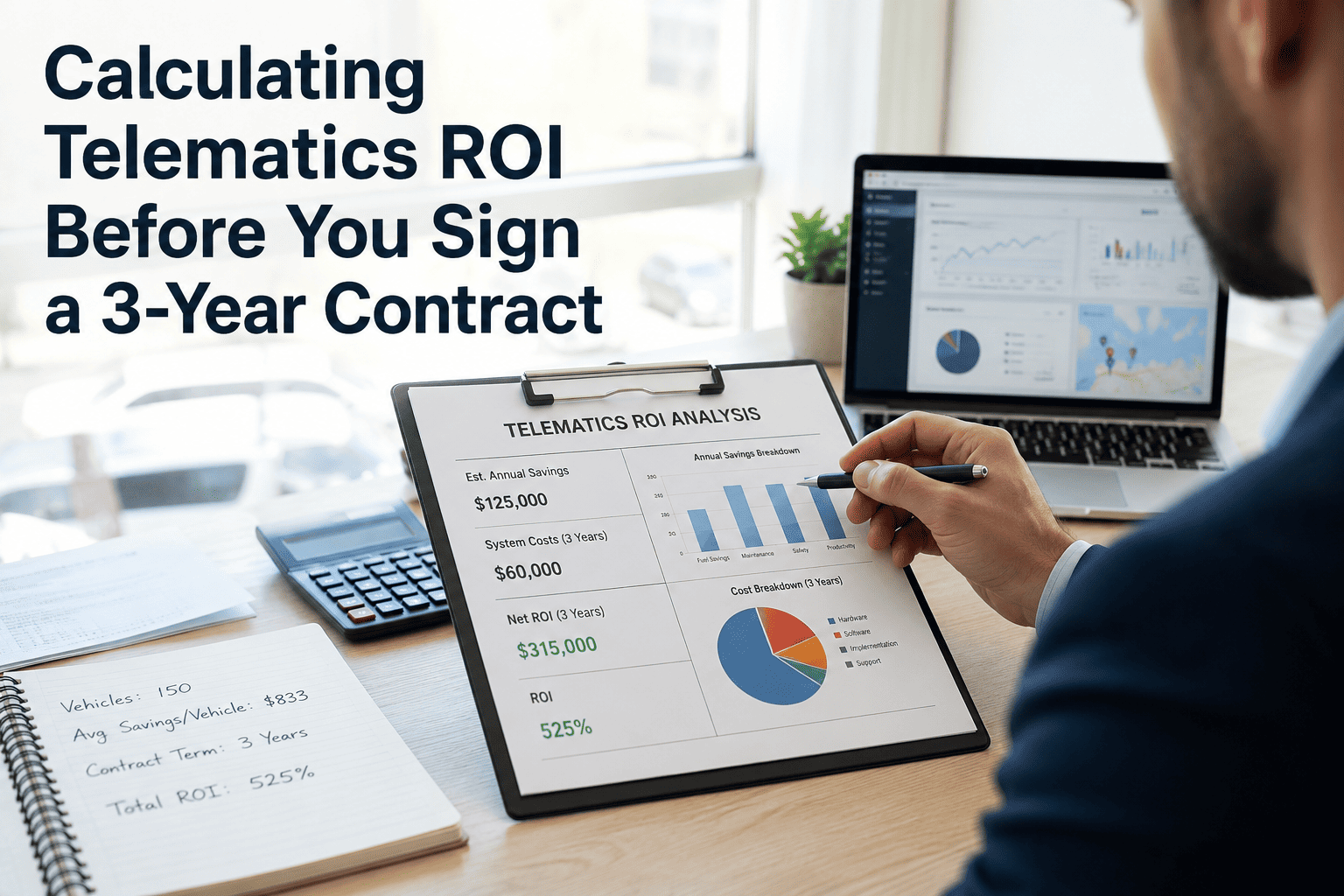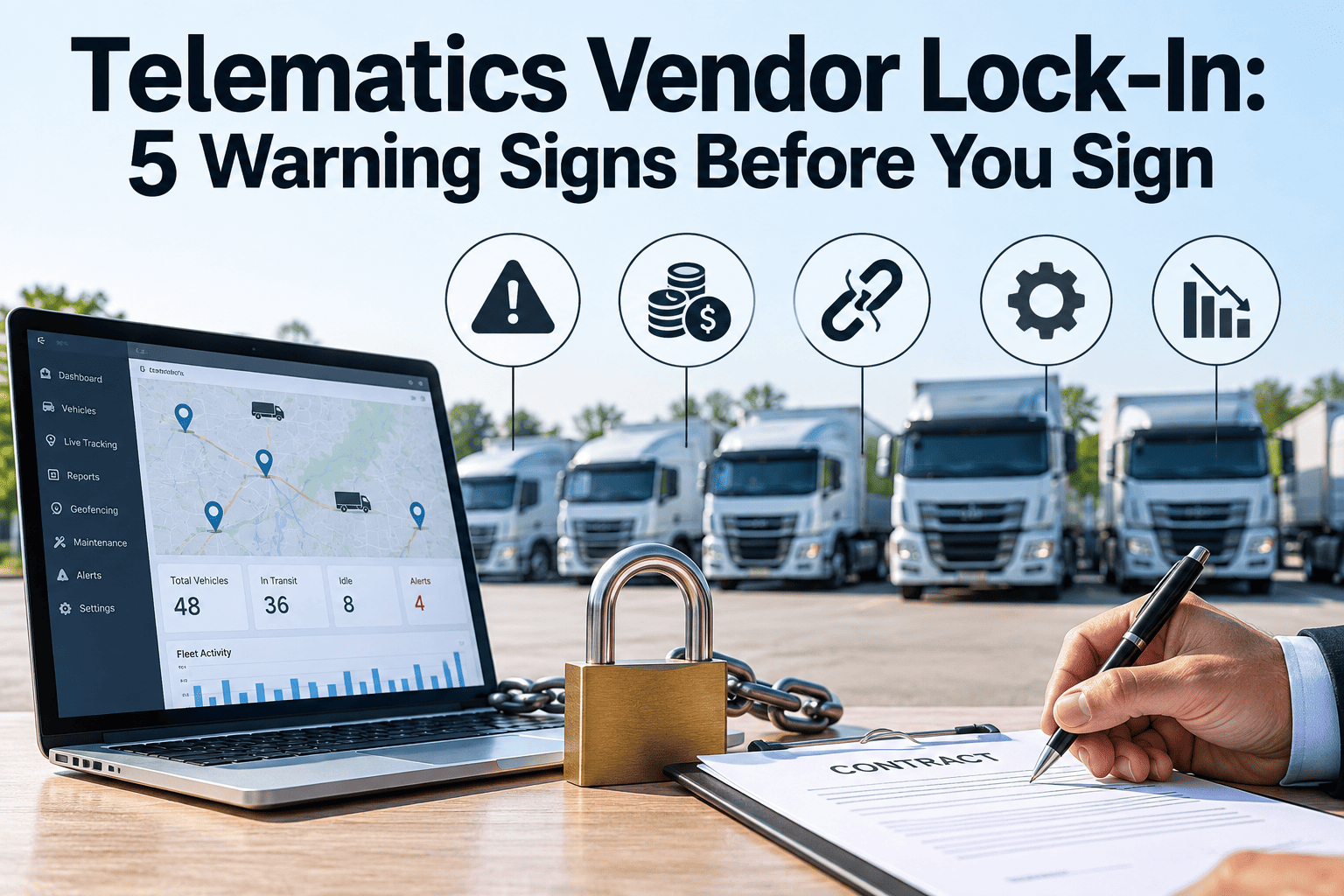
Telematics providers rarely advertise what happens after the contract is signed — the moment a fleet discovers its GPS units, integration APIs, and years of trip history are single-source, proprietary, and expensive to leave. A three-year telematics agreement that looked like a simple hardware-and-software purchase can quietly become a five-year commitment once switching costs, buried auto-renewal clauses, and non-portable hardware are factored in. Fleet managers who signed with the lowest per-unit price often pay the highest total cost later, when a vendor raises fees, retires a feature, or gets acquired and sunsets the platform their dispatch workflow depends on. The warning signs are visible before signature day, if you know where to look, and reviewing switching costs and contract terms early is what separates an open telematics stack from one a fleet cannot leave — something OxMaint's onboarding team checks for before any integration begins.
Build a Telematics Stack You Can Actually Leave
OxMaint connects to any telematics provider through open APIs, so your maintenance data, alerts, and asset history stay portable no matter who supplies the hardware.
Why Telematics Lock-In Happens in the First Place
Vendor lock-in is rarely a single decision — it accumulates across a series of choices that each seemed reasonable at the time. A fleet buys proprietary hardware because it was bundled at a discount. It builds dispatch and maintenance workflows around the vendor's dashboard because that is what the sales engineer demonstrated. It signs a multi-year term because the per-unit price dropped with a longer commitment. None of these choices are wrong individually, but together they create a dependency where every subsequent decision — adding a new depot, integrating a new CMMS, changing a compliance reporting tool — has to be filtered through what the incumbent telematics provider will allow, at what price, and on what timeline.
The providers with the highest switching costs are usually the ones with the most polished sales process, because a smooth onboarding experience and a low sticker price are what fleets evaluate before signing, while data portability, API access, and contract exit terms are what fleets evaluate only after they try to leave. By then the fleet has years of trip history, driver scorecards, and maintenance triggers locked inside a system that charges a data-export fee or simply does not offer a usable export at all. The irony is that the fleets most exposed to this risk are often the ones that grew the fastest — a telematics decision made for a 20-unit fleet rarely gets revisited once the fleet reaches 100 units, even though the switching cost has grown by the same multiple.
Proprietary Hardware With No Third-Party Compatibility
If the GPS unit, ELD, or camera only functions with that vendor's software and cannot be reflashed or repointed to another platform, the hardware itself becomes a switching cost. Ask directly whether the device firmware is open or vendor-locked before signing anything.
No Documented API or a Paywalled One
A telematics platform without a public, documented API forces every downstream system — CMMS, dispatch, payroll — to depend on manual exports or the vendor's own paid add-ons. If API access itself carries a separate line-item fee, that fee is a lock-in tax disguised as a feature.
Auto-Renewal With a Narrow Cancellation Window
Contracts that auto-renew unless cancelled 60-90 days in advance are structured so the notice window is easy to miss. Fleets that miss it are locked into another full term at the vendor's current pricing, which is frequently higher than the initial signed rate.
Historical Data Held Hostage at Termination
Some contracts state that trip history, driver scores, and maintenance alert logs are deleted or become inaccessible within 30 days of termination. Without a contractual right to a full data export in a usable format, years of operational history disappear the moment the relationship ends.
Bundled Pricing That Hides the True Per-Feature Cost
When hardware, software, support, and data access are sold as one bundled price, it becomes impossible to know which feature is actually driving the cost. Bundling also makes it harder to negotiate down or drop a feature the fleet no longer needs without renegotiating the entire agreement.
Locked-In Ecosystem vs. Open, Portable Platform
The clearest way to evaluate a telematics vendor is to compare what happens on day one against what happens on exit day. A vendor that looks identical to competitors during the sales process can behave very differently once a fleet manager asks for a full data export or wants to run a second telematics provider in parallel during a pilot.
| Capability | Locked-In Ecosystem | Open, Portable Platform |
|---|---|---|
| Hardware compatibility | Proprietary device, vendor-only firmware | Works with third-party or industry-standard devices |
| Data export | Manual request, fees, limited format | Self-service export, open formats, no fee |
| API access | Paywalled or undocumented | Public, documented, included in plan |
| Contract renewal | Auto-renews, narrow cancellation window | Month-to-month or clear opt-in renewal |
| CMMS integration | Vendor's own maintenance module only | Connects to any CMMS via open API |
| Post-termination data access | Deleted or inaccessible within 30 days | Retained and exportable for a defined period |
The Real Cost of Switching Once You're Locked In
Switching costs are not theoretical — they show up as specific line items once a fleet decides to leave a locked-in provider. Understanding the scale of each cost category before signing gives a fleet manager real leverage during contract negotiation, because a vendor confident in its product should have no objection to softer exit terms.
Contract Clauses to Check Before You Sign
Most lock-in problems trace back to four or five clauses buried in the standard agreement a sales rep hands over near the end of the sales cycle. Reading these clauses before signing, and asking for redlines where needed, is the single highest-leverage thing a fleet manager can do during procurement.
Data Ownership Clause
Confirm the contract explicitly states the fleet owns its trip, maintenance, and driver data — not the vendor — and that ownership survives termination.
Export Format Guarantee
Require export in an open, non-proprietary format such as CSV or JSON, delivered within a defined number of business days of a written request.
API Access Terms
Verify API access is included in the base subscription rather than sold as a premium add-on, and that rate limits are documented in writing.
Renewal and Notice Period
Push for a 30-day cancellation notice rather than 90, and put a calendar reminder on the file the day the contract is signed, not the week it expires.
Hardware Portability
Ask whether the physical device can be reprogrammed for another platform or must be replaced entirely, and get the answer in writing, not verbally.
Price Escalation Caps
Negotiate a cap on annual price increases at renewal — uncapped renewal pricing is one of the most common ways locked-in fleets get squeezed.
We signed a five-year telematics contract in 2021 thinking we were locking in a good rate. When we tried to bring maintenance data into our new CMMS last year, the export fee alone was more than our monthly subscription. We now read the data ownership clause before anything else in a vendor contract.
Stories like this are common enough that procurement teams at larger fleets have started requiring a legal review of the data ownership and export clauses in any telematics contract above a certain unit count, regardless of how confident the sales team is in the platform's long-term stability. That extra review step adds a week or two to procurement, but it consistently surfaces terms that would otherwise only be discovered years later, at the exact moment a fleet has the least leverage to negotiate — after the invoice has been paid and the hardware has been installed across the yard.
Keep Your Maintenance Data Portable, Regardless of Your Telematics Vendor
OxMaint's CMMS integrates with leading telematics providers through open APIs, so switching GPS vendors later never means losing your asset history, PM schedules, or alert logs.
How OxMaint Keeps Your Data Portable
A CMMS sits downstream of telematics data, which means it is directly affected by whatever lock-in terms a fleet signed with its GPS provider. OxMaint is built on the assumption that fleets will change telematics vendors over time, and structures its integration layer so that assumption never breaks a maintenance workflow.
Vendor-Agnostic Integration
Connects to most major telematics and OBD/J1939 data feeds without requiring the fleet to standardise on a single GPS provider.
Self-Service Data Export
Asset history, PM records, and alert logs export on demand in open formats, with no separate export fee or approval delay.
Documented Open API
Full API documentation is available from day one, included in every plan, so integrations built today keep working as your stack changes.
Flexible Month-to-Month Terms
No multi-year lock-in requirement to access core CMMS functionality, so the commitment scales with proven value, not contract pressure.
Already Locked In? Here's a Realistic Way Out
Not every fleet reading this is evaluating a new telematics contract — many are already three years into one and wondering whether switching is even worth the disruption. The good news is that lock-in is rarely absolute. Even restrictive contracts usually have an exit path, it just takes a structured approach rather than an abrupt cancellation that triggers penalty clauses and leaves gaps in tracking coverage.
Audit the Contract Before the Renewal Window Opens
Pull the original agreement and identify the exact cancellation notice date, any early termination penalty, and what the data export clause actually promises. Set a calendar reminder 120 days ahead of the deadline, not 30.
Request a Full Data Export in Parallel With the New Vendor Trial
Start the export request early, even if a decision has not been finalised — export timelines from locked-in vendors are frequently longer than advertised, and running a parallel trial avoids a coverage gap.
Stage Hardware Replacement by Depot, Not Fleet-Wide
Migrating one depot at a time limits the operational risk of a botched cutover and gives dispatch and maintenance teams a chance to validate the new platform before it becomes the fleet-wide standard.
Rebuild Maintenance Triggers Before Cutting Over Fully
PM schedules, DTC-based alerts, and inspection triggers tied to the old telematics feed need to be re-pointed to the new data source before the old contract lapses, or PM compliance quietly slips during the transition.
The single biggest mistake fleets make during a telematics migration is waiting until the current contract has already expired to start the conversation with a new vendor. A staged migration that overlaps the two systems for 60-90 days costs more in the short term but eliminates the blind-spot period where neither system is providing reliable coverage — the period when most preventable incidents during a vendor transition actually occur.
Frequently Asked Questions
What is telematics vendor lock-in?
Vendor lock-in is when switching telematics providers becomes prohibitively expensive or disruptive due to proprietary hardware, closed APIs, or contract terms that penalise cancellation. Read the full breakdown of how open integrations avoid this in a CMMS setup.
How do I know if my current contract has lock-in risk?
Check for auto-renewal clauses with short notice windows, paywalled API access, and any language restricting data export after termination. These three clauses account for most reported lock-in disputes.
Can I negotiate lock-in clauses out of a telematics contract?
Yes — data ownership, export guarantees, and renewal notice periods are commonly negotiable, especially before signature. Vendors confident in retention rarely resist reasonable exit terms.
Does switching telematics providers mean losing maintenance history?
Only if the CMMS or telematics platform lacks an open export path. Platforms with documented APIs and self-service exports let maintenance history move with the fleet, not stay with the vendor.
How can a CMMS reduce telematics lock-in risk?
A vendor-agnostic CMMS decouples maintenance workflows from any single telematics provider, so a GPS vendor switch never requires rebuilding PM schedules or losing alert history. Book a demo to see how it connects.
Don't Let a Telematics Contract Decide Your Fleet's Future
OxMaint keeps maintenance data portable and vendor-agnostic, so your fleet stays in control of its own technology roadmap — not the other way around.