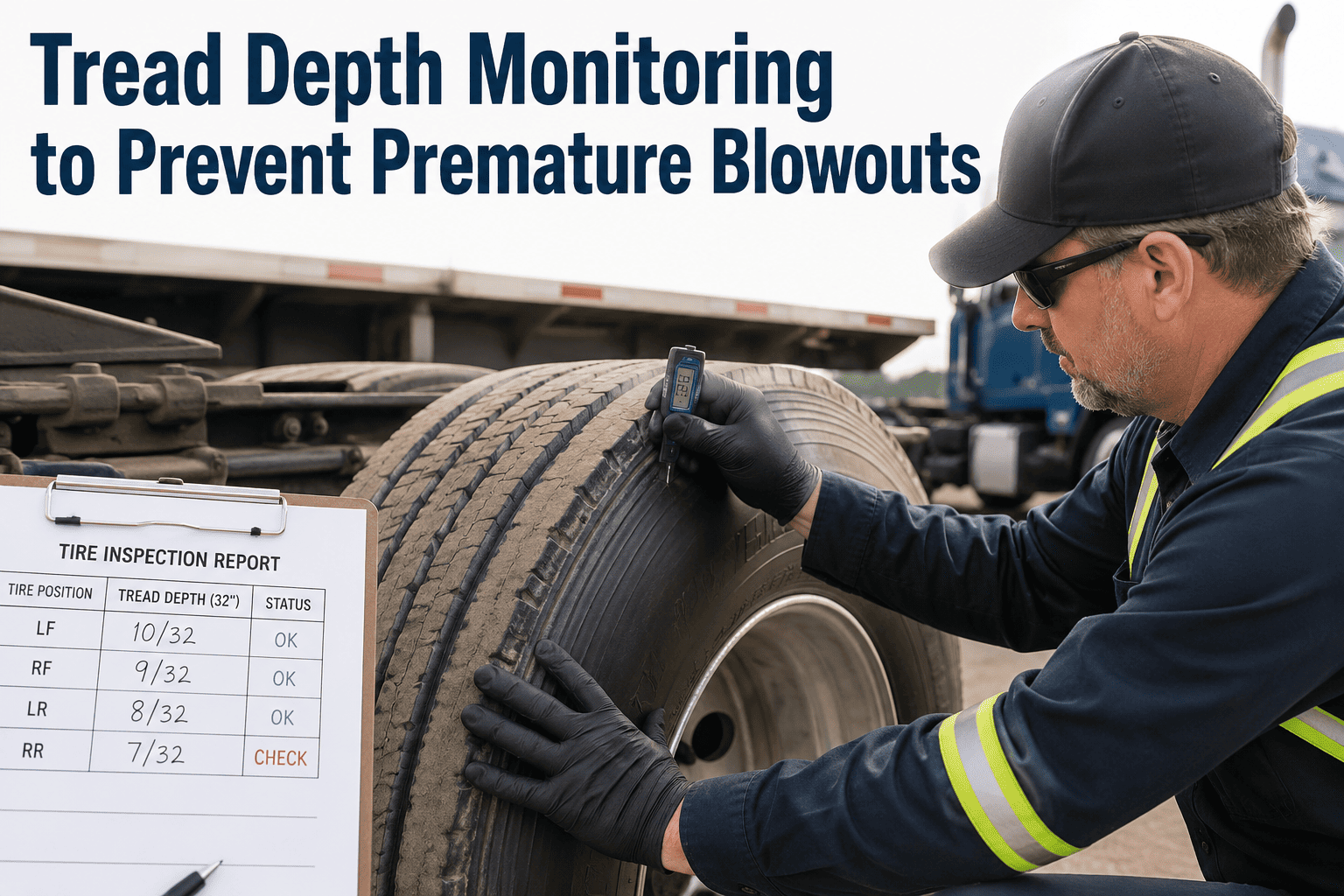
Most highway blowouts are not random mechanical failures — they are tread depth failures that were measurable weeks before the tire came apart. Federal minimums under 49 CFR 393.75 set 4/32" on steer axles and 2/32" on every other position, and CVSA inspectors write those same thresholds as out-of-service violations on the roadside. Fleets that only check tread during scheduled PMs discover just-below-minimum tires in the bay and catastrophic failures on the shoulder, when a structured per-tire wear-rate calculation would have projected the replacement date weeks earlier. Capturing a calibrated 32nd reading at every DVIR, converting it to tread loss per mile, and feeding that projection into procurement is how a $400 roadside event becomes a $0 scheduled swap. Ready to see the math on your own assets? Start Free Trial.
TREAD DEPTH MONITORING GUIDE · 2026
What if the next blowout was already visible in last week's tread reading?
A tire losing 0.01/32" per mile at 6/32" remaining has roughly 40,000 miles of predictable life left — plenty of runway to order at contract pricing and swap during a scheduled PM window instead of on the shoulder of I-40 at 2 a.m.
USEFUL LIFE, PROJECTED
FROM A SINGLE READING
FEDERAL FLOOR
The 4/32" and 2/32" thresholds that decide roadside violations
Under 49 CFR 393.75, steer-axle tires must carry at least 4/32" of tread depth at every major groove; all other axle positions floor at 2/32". CVSA inspectors apply the same numbers as out-of-service criteria — a single sub-minimum tire parks the vehicle.
49 CFR 393.75
FMCSA FLOOR
VIOLATION STATUS
PROACTIVE TREAD DATA
A dime dropped into the groove is not a tire gauge. Federal enforcement and insurance auditors both expect a calibrated 32nd measurement logged per tire position — paper "looks okay" notes will not survive a deposition after a blowout.
THE WEAR-RATE FORMULA
From a single 32nd reading to a projected replacement date
Structured monitoring converts each inspection reading into a per-tire wear rate — tread depth loss per mile driven — then projects the swap date arithmetically. Procurement orders the replacement at contract pricing; scheduling drops the tire change into a planned PM window.
Drive-axle position, 18-wheeler
- Current depth6/32"
- Minimum threshold2/32"
- Measured wear rate0.0001/32" per mile
Usable tread life remaining. At 8,000 mi/month, that tire reaches minimum in five months — procurement can order the replacement now at contract pricing and scheduling can plan the swap during the next B-service PM.
UNEVEN WEAR SIGNATURES
The four wear patterns that surface mechanical root cause
Tread depth is not only a tire metric — it is a diagnostic. Reading the wear pattern at each position catches the mechanical problem the same week it starts, long before the casing is destroyed.
Shoulder wear
Under-inflation
Tread flexes more at the shoulders, heat builds at the edges, and the center rides high. Casing fatigue accelerates and blowout risk rises sharply.
Center wear
Over-inflation
The crown balloons outward, contact patch shrinks to the center rib, and the tire sheds tread down the middle while shoulders stay full.
Cupping
Suspension issue
Worn shocks or loose bearings bounce the tire, hammering alternating high and low patches around the circumference. Fix the suspension or the next tire cups too.
Feathering
Alignment issue
Toe or camber out of spec drags the tread blocks sideways. One edge of each block wears smooth, the other stays sharp — run a finger across the rib to confirm.
INSPECTION CADENCE
Weekly DVIR minimum, more often for safety-critical fleets
Tread readings only project forward if they are captured on a regular cadence. A weekly DVIR depth capture gives the wear-rate calculation enough data points to detect a deviation inside 14 days.
Baseline depth captured
Calibrated gauge reads 10/32" on a fresh drive tire. Reading is logged against the unit's odometer and stored per tire position in Oxmaint.
Wear rate calculated
Consecutive readings and odometer deltas let the system compute tread loss per mile for each position. An outlier triggers a flagged alert.
Replacement projected
The formula forecasts minimum tread in roughly 40,000 miles. Procurement receives an automated order recommendation at contract pricing.
Tire swapped in planned window
The tire change is dropped into the next B-service PM. No roadside call, no tow, no violation — and the casing is still retreadable.
REACTIVE vs. STRUCTURED
The cost of catching it at the PM versus catching it on the road
A 180-truck fleet running an average of 8,000 miles per month per unit will lose roughly 18 tires a year to roadside blowouts if tread is only inspected at PM intervals. Structured monitoring drops that figure to under three — and the survivors arrive at the shop still retreadable.
| OUTCOME METRIC | PM-ONLY INSPECTION | STRUCTURED MONITORING |
|---|---|---|
| When sub-minimum tires are discovered | At the PM, often already below 2/32" | Weeks ahead, via projection |
| Roadside blowouts per year (180-unit fleet) | ~18 | Under 3 |
| Average cost per roadside event | $400–$1,200 (tow + callout + downtime) | $0 (planned PM swap) |
| Replacement tire procurement | Spot buy at premium pricing | Contract pricing, ordered in advance |
| Casing retreadability at removal | Often destroyed by the failure | Casing preserved, retread-ready |
| CVSA out-of-service exposure | High — tires found below minimum | Low — projections prevent violation |
| Mechanical root-cause detection | Visible only after casing damage | Surfaced same week via wear signature |
"
Every tire that blows out on the highway was measurable weeks earlier. The reading was there — the fleet just did not have a system to convert it into a projection.
Turn next week's blowout into next month's scheduled PM.
Oxmaint captures tread depth during DVIR and PM inspections, calculates per-tire wear rate automatically, and feeds replacement projections into procurement and shop scheduling.
FREQUENTLY ASKED
Tread depth monitoring, answered straight
How often should tread depth be measured on each tire position?
Weekly at minimum during the DVIR cycle, more frequently for safety-critical or high-mileage fleets. The wear-rate calculation needs at least two consecutive readings plus an odometer delta to produce a reliable projection — so a single PM-only reading cannot forecast anything. Weekly captures catch a deviation inside 14 days, which is usually enough runway to schedule the swap.
Is a coin test acceptable for tread measurement?
No. A dime inserted into the groove is a rough visual check, not a calibrated 32nd measurement. FMCSA enforcement, insurance auditors, and any post-incident deposition all expect a calibrated gauge reading logged per tire position. Oxmaint accepts the gauge reading directly in the DVIR or PM form so the data point is defensible.
How is the projected replacement date actually calculated?
The system divides the remaining usable tread (current depth minus the federal minimum for that axle) by the measured wear rate per mile. A drive tire at 6/32" with a 2/32" floor and a 0.0001/32" per mile wear rate yields 40,000 miles of remaining life. You can see the live projection per tire position when you Start Free Trial.
What does uneven wear tell me beyond the tire itself?
Shoulder wear signals under-inflation, center wear signals over-inflation, cupping points to a suspension issue, and feathering points to an alignment problem. Catching the signature early means you fix the mechanical root cause before the casing is destroyed — and before the next tire mounted on that position wears the same way.
Does structured monitoring reduce CVSA out-of-service violations?
Yes. CVSA applies the same 4/32" steer and 2/32" other-axle thresholds as 49 CFR 393.75, and any sub-minimum tire is an automatic OOS violation. Because projections flag a tire weeks before it reaches the floor, the tire is swapped during a planned PM instead of being discovered by an inspector — or by a blowout.
READY TO PROJECT YOUR NEXT REPLACEMENT?
Stop discovering tread failures on the shoulder.
Deploy Oxmaint tread depth monitoring across your fleet and turn every DVIR reading into a per-tire wear-rate projection, an automated procurement alert, and a scheduled PM swap — before the tire ever reaches minimum.
Free 14-day trial · No credit card




-for-commercial-fleets.png)