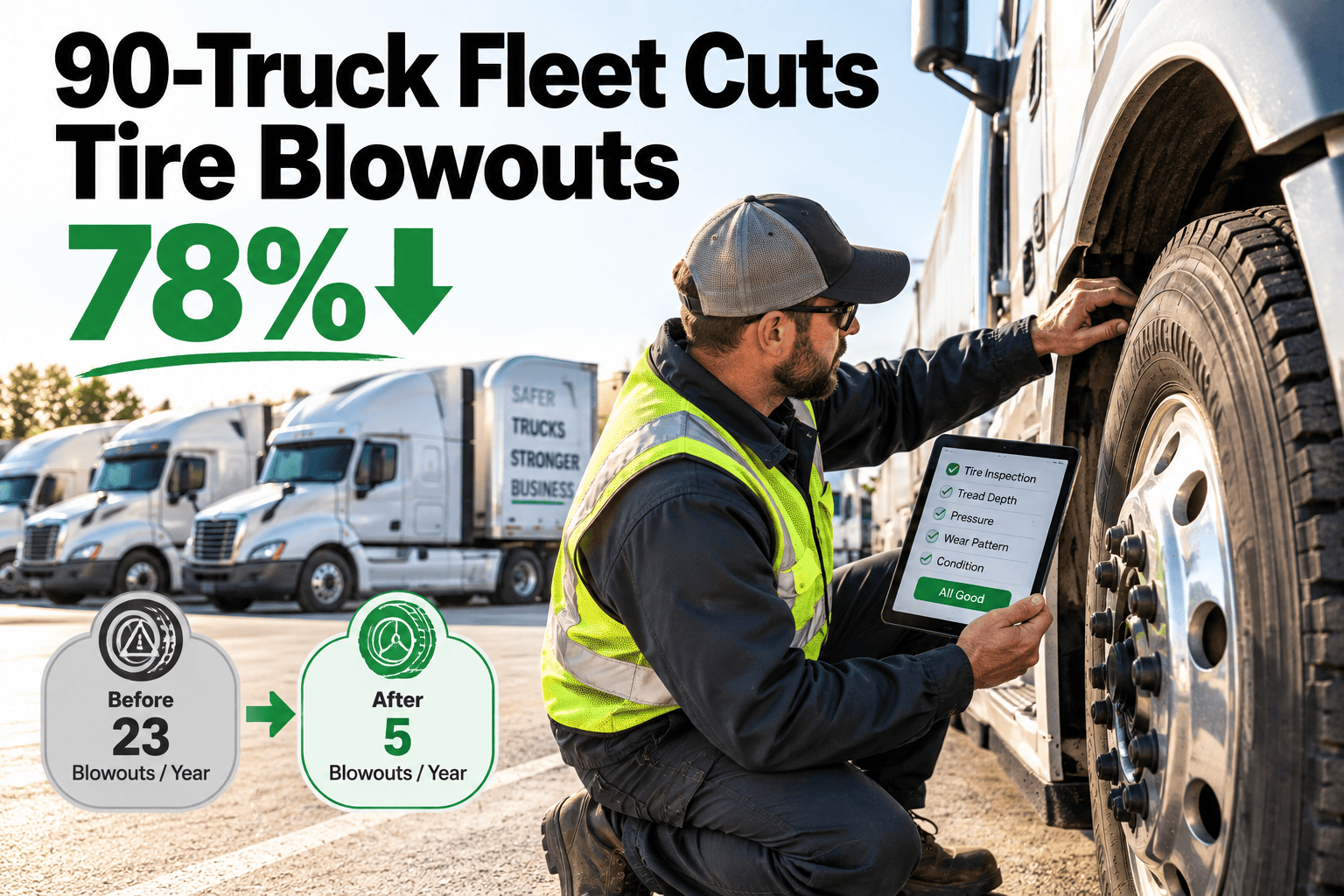
Eighteen months ago, a 90-truck regional less-than-truckload carrier was averaging one roadside tire blowout every eleven days — enough to keep a full-time driver on standby duty just to cover routes interrupted by a shredded casing on the shoulder of an interstate. Underinflation was the common thread in nearly every failure, but nobody caught it until the tire was already gone, because pressure checks happened once a day during pre-trip inspection and nowhere else. After pairing continuous tire pressure monitoring with an automated work order workflow, the fleet cut blowout incidents by 78 percent within nine months and brought roughly $147,000 a year in downtime, towing, and emergency roadside costs back onto the balance sheet — a result built entirely on catching pressure loss hours before it became a failure.
Case Study · Tire Management · TPMS Integration
90 Trucks. One Tire Program Overhaul. 78% Fewer Blowouts in Nine Months.
A regional LTL carrier replaced once-daily manual pressure checks with continuous TPMS monitoring linked directly to automated work orders — turning a reactive, roadside-driven tire program into a scheduled maintenance function.
The Problem — A Tire Program Built Entirely on Once-a-Day Snapshots
Before the overhaul, tire pressure was checked exactly once per truck, per day, during the driver's pre-trip walkaround — a manual gauge reading recorded on a paper inspection form. A tire could lose 15 to 20 percent of its pressure over the course of a shift from a slow leak, a valve stem issue, or a temperature swing, and nobody would know until the next morning's check, by which point the tire had already spent an entire route running underinflated and building heat.
Before — Manual Daily Checks
Pressure visibilityOnce per day, at pre-trip only
Leak detectionDiscovered up to 24 hours late
Repair triggerDriver report after a dash warning or blowout
Work order creationManual, after the fact
Blowout rate~33 per year fleet-wide
VS
After — Continuous TPMS + CMMS
Pressure visibilityContinuous, all wheel positions
Leak detectionWithin minutes of onset
Repair triggerThreshold-based alert, before failure
Work order creationAutomatic, routed to nearest shop
Blowout rate~7 per year fleet-wide
Root Cause — What the Data Showed Once It Existed
Once continuous pressure and temperature data started flowing in, the fleet's maintenance team could finally see the pattern that daily snapshots had always hidden. The findings reframed what had looked like random bad luck as a small number of fixable, systemic issues.
1
Slow Leaks Dominated, Not Sudden Failures
Roughly two-thirds of the fleet's blowouts traced back to a gradual pressure decline over 12 to 36 hours before failure — a window that a once-daily check could never catch in time, but that continuous monitoring flagged within the first few hours.
2
A Handful of Wheel Positions Accounted for Most Failures
Outer drive-axle positions on a subset of trailers showed a disproportionate share of pressure events, pointing to a valve stem and wheel-seal issue specific to one trailer batch rather than a fleet-wide tire quality problem.
3
Heat Buildup Compounded Existing Underinflation
Summer route data showed underinflated tires running measurably hotter than properly inflated ones on the same route — the flex-heat-failure cycle that turns a slow leak into a shoulder-of-the-highway event on a hot afternoon.
The Rollout — From Sensor Install to Closed-Loop Work Orders
1
Month 1–2: TPMS Sensor Installation Across the Fleet
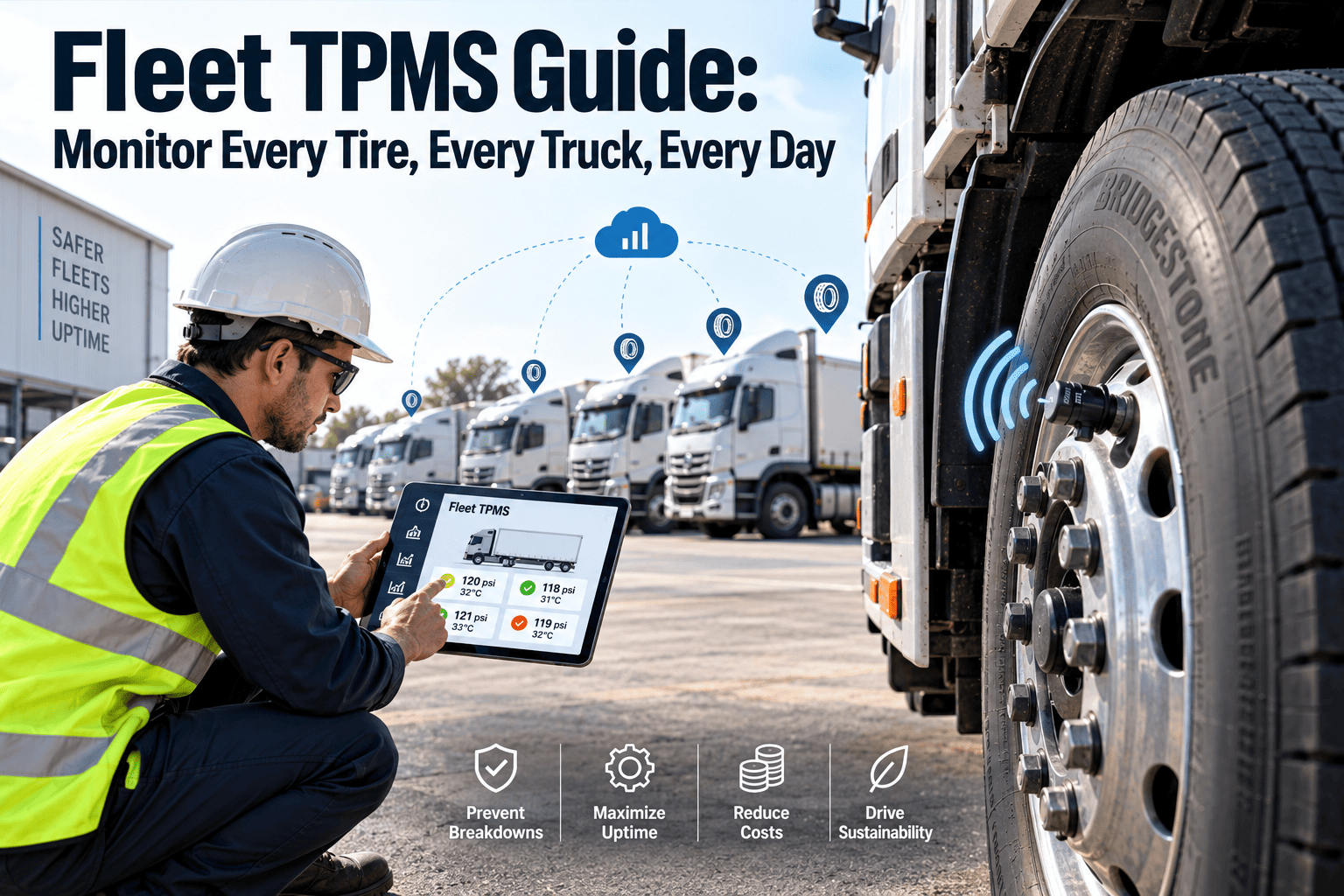
Wheel-end sensors installed across all 90 tractors and paired trailers, transmitting real-time pressure and temperature data to the fleet's maintenance platform rather than to a standalone dashboard drivers had to remember to check.
2
Month 3: Threshold Alerts Linked to Automatic Work Orders
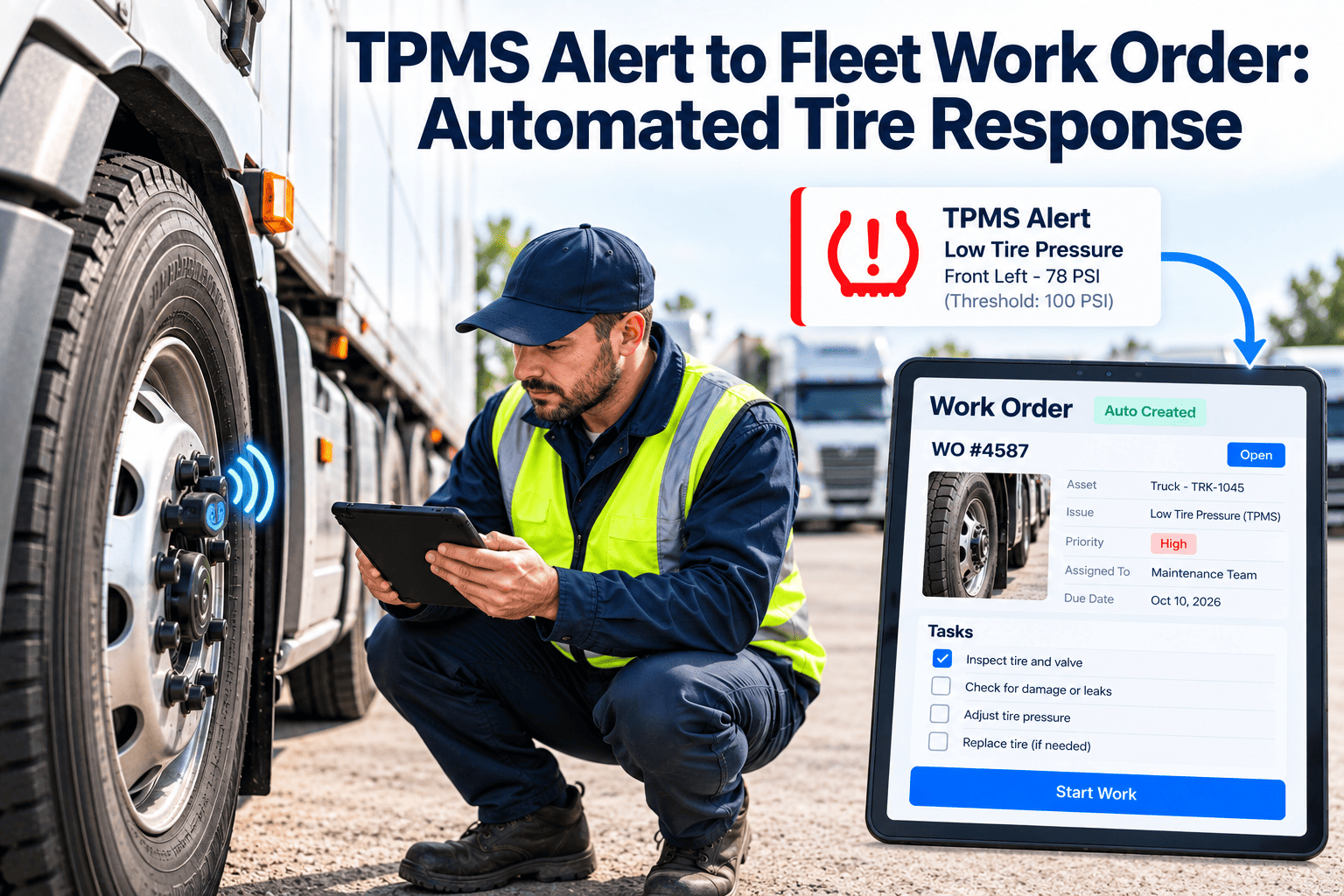
Pressure and temperature thresholds configured per tire position, so a reading outside the safe range generates a work order automatically and routes it to the nearest company shop or approved roadside vendor — no driver report required to start the process.
3
Month 4–5: Root Cause Review and Trailer Batch Correction
Aggregated pressure-event data identified the valve stem issue on one trailer batch, leading to a targeted inspection and repair campaign instead of a fleet-wide tire replacement that would have cost far more without fixing the actual problem.
4
Month 6–9: Driver Behavior and Alert Response Tuning
Alert thresholds and shop routing logic refined based on nine months of response data, reducing false-positive stops while keeping true pressure events caught early — the tuning period where most of the remaining blowout reduction was realized.
A Blowout Is a Data Failure Before It's a Mechanical One
OxMaint routes TPMS alerts straight into automatic work orders — so a slow leak becomes a scheduled shop visit instead of a roadside emergency.
Results — What Nine Months of Continuous Monitoring Delivered
78%
reduction in roadside tire blowout incidents, from roughly 33 per year to about 7
$147K
estimated annual savings across towing, downtime, emergency roadside service, and expedited replacement freight
~1–3%
fuel efficiency gain fleet-wide from consistently maintained tire pressure across all positions
Metric
Before
After (Month 9)
Change
Blowout incidents / year
~33
~7
-78%
Avg. leak detection time
Up to 24 hours
Under 1 hour
~24x faster
Roadside service calls (tire)
~40 / year
~11 / year
-73%
Unplanned downtime hours (tire-related)
~520 / year
~140 / year
-73%
We used to find out a tire was in trouble when a driver called from the shoulder. Now the work order is already sitting in the shop's queue before the driver even notices anything felt different. The trailer batch we fixed in month four was the single biggest thing we did — that one root cause was hiding behind what looked like random bad luck for two years.
— Director of Maintenance, Regional LTL Carrier · 90-truck fleet · TPMS and CMMS integration, 9-month rollout
What Made the Difference — Lessons for Fleets Planning a Similar Rollout
Why Continuous Monitoring Beats Manual Checks at Fleet Scale
A once-daily manual pressure check is not a failure of driver diligence — it is a structural limitation. A driver can only report what they observe at one moment during a pre-trip walkaround, and a slow leak that develops mid-route is invisible until the next inspection or until the tire fails outright. Continuous monitoring removes that structural gap entirely, replacing a single daily snapshot with a constant stream of data that catches a developing problem while it is still a minor pressure deviation rather than a catastrophic failure at highway speed.
The bigger shift for this fleet was not the sensors themselves but what happened after the data existed — a maintenance platform that could turn a threshold breach into a routed, tracked work order without waiting for a human to notice and manually create one. That automation is what took the leak-detection window from up to 24 hours down to under an hour, and it's the same closed-loop pattern that applies to other continuous fleet data streams beyond tires, including brake wear sensors, engine telemetry, and oil analysis alerts.
Frequently Asked Questions
How long did it take this fleet to see measurable results from TPMS integration?
Blowout reduction became measurable within the first three to four months of sensor deployment, with the largest single improvement coming after the trailer batch root cause was identified and corrected around month five.
What percentage of commercial tire blowouts are caused by underinflation?
Industry data attributes roughly 90 percent of commercial tire blowouts to underinflation-driven heat buildup, which is why continuous pressure monitoring addresses the root cause rather than just the symptom.
Does TPMS integration require replacing the fleet's existing maintenance software?
No — TPMS sensor data typically integrates into an existing CMMS platform to trigger work orders automatically, rather than requiring a fleet to run a separate standalone monitoring system alongside its maintenance software.
How much does a tire blowout typically cost a commercial fleet?
Costs range widely depending on severity, from a few hundred dollars for a simple roadside tire swap to well into six figures when vehicle damage, cargo loss, and extended downtime are factored in.
Can a smaller fleet see similar results from a TPMS and CMMS integration?
Yes — the underlying mechanism, catching pressure loss hours earlier and automating the work order response, scales down to smaller fleets, though the total dollar savings will be proportional to fleet size. Book a demo to see how the alert-to-work-order workflow is configured.
Your Fleet's Next Blowout Is Probably a Slow Leak Right Now — You Just Can't See It Yet.
OxMaint connects TPMS alerts directly to automatic work orders, so a developing pressure problem becomes a scheduled repair instead of a driver stranded on the shoulder.



-for-commercial-fleets.png)

