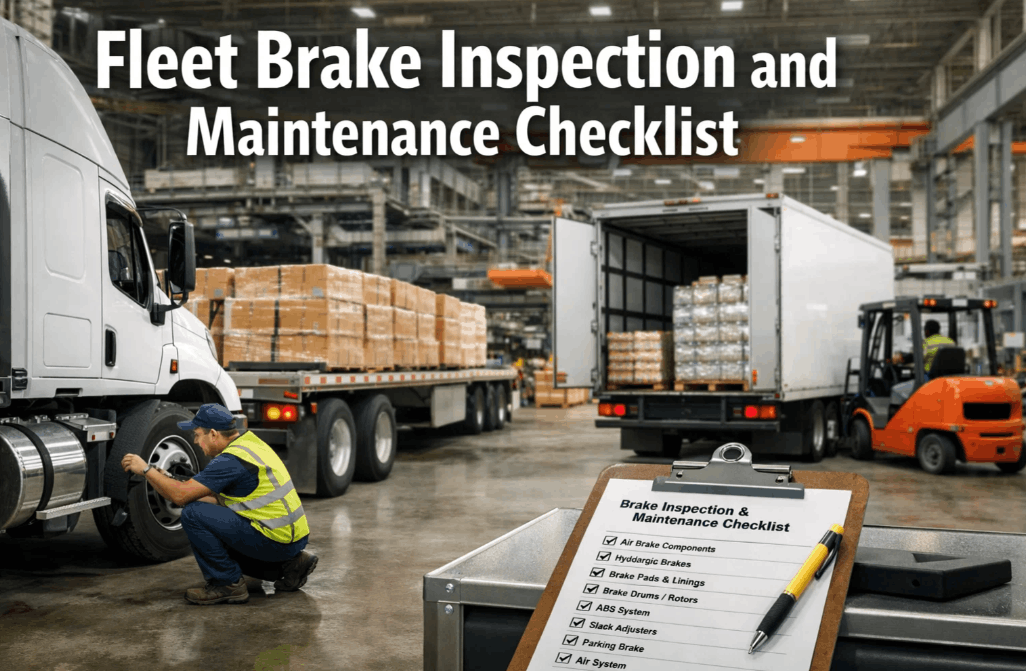
A semi-trailer or flatbed that leaves a depot without a structured inspection is not just a regulatory liability — it is a moving safety hazard carrying the carrier's operating authority on every kilometre of road. Trailer-related OOS violations account for 28% of all commercial vehicle enforcement actions, yet trailers receive far less structured maintenance attention than the tractors that pull them. Landing gear failures, seized brake chambers, corroded glad hand connections, and cracked floor boards are all detectable weeks before they produce a roadside citation — but only with a systematic, documented inspection programme applied consistently at every service interval. Oxmaint's trailer inspection module digitises every inspection zone, captures findings per axle and component, and generates DOT-compliant maintenance records linked to each trailer's asset history.
Trailer Inspection — 4-Step Process
A structured trailer inspection is not a single walk-around — it is a four-phase process that begins before the technician approaches the trailer and ends with a documented disposition. Skipping any phase creates gaps that produce either missed defects or incomplete records that fail audit. Run all four phases digitally on Oxmaint — no paper required.
How Technology Is Improving Trailer Inspection
Trailers are the most under-monitored asset class in most commercial fleets — they spend time disconnected from tractors, parked at customer sites, and operating without the OBD connectivity that tractor engines provide. Four technologies are closing that visibility gap, turning trailer inspection from a periodic manual event into a continuous, data-supported programme. Oxmaint connects all four into one trailer maintenance workflow.
Trailer Condition Rating Framework
Every trailer should receive a condition rating at each inspection — not just a pass/fail. A rating system creates trend data that prevents the "sudden" failures that were actually gradual deteriorations no one tracked. Use the framework below to score each trailer and drive the right maintenance action at the right time.
1. Brake System and Coupling Devices Checklist
Trailer brake and coupling failures are the most dangerous and most cited enforcement category. Air lines, brake chambers, glad hands, and fifth wheel components must be measured and tested — not visually estimated. Record trailer brake measurements per axle with Oxmaint.
Brake lining thickness — all trailer axle positions
Measure lining thickness at all wheel positions. OOS: 2mm or less on drum linings; 1/4" or less on disc pads at non-steer positions. Record per position — not an average. Uneven wear across axle positions indicates a slack adjuster or chamber problem requiring investigation before the next load. OOS — at/below limit
Brake pushrod stroke — all trailer chambers at 90 psi
Connect tractor air supply and measure stroke at all trailer chambers with 90 psi applied. Any chamber at or beyond the readjustment limit is OOS. Trailer chambers are the most commonly over-stroked in a combination — they are further from the driver's attention and often skipped in informal checks. OOS — at readjustment limit
Glad hand seals and air line condition
Inspect both glad hand seals for cracking, cuts, or distortion. Check all trailer air lines for chafing on frame members and heat damage near exhaust routing. A leaking glad hand seal creates a system air leak that appears as a tractor air system fault — misdiagnosed for hours before the trailer connection is identified as the source. OOS — audible leak
Kingpin condition and play measurement
Inspect kingpin for bends, cracks, or wear beyond the manufacturer wear limit. Measure kingpin diameter — below minimum is OOS under §393.70. A worn kingpin creates excessive coupling play that produces fifth wheel noise and allows trailer oscillation that accelerates tyre and suspension wear on both the trailer and the pulling tractor. OOS — below min diameter
Safety chains / breakaway cable
Inspect safety chains for broken links, worn hooks, and adequate length. Check breakaway cable condition and verify it is connected to the breakaway battery, not just looped around the trailer frame. A breakaway cable that is attached to the trailer frame rather than the tractor provides zero braking in a separation event. OOS — broken chain
Telematics tip: Trailer-mounted brake pressure sensors stream glad hand connection status and air pressure data to fleet management systems — alerting dispatchers when a trailer departs with a partially connected air line before the driver notices reduced braking at the first stop sign. See Oxmaint's trailer telematics integration.
2. Tyres, Wheels, and Landing Gear Checklist
Trailer tyres accumulate mileage without the benefit of a daily driver walk-around in most fleet operations — trailers are often parked for days between loads, and low-utilisation trailers can sit for weeks with degrading tyre pressure and UV-damaged sidewalls that no one observes until the trailer is pulled for a load.
Tyre tread depth — all positions
Measure at the shallowest major groove point on every tyre. OOS: 1/32" or less on trailer positions under FMCSA §393.75. Staggered wear between inside and outside tyre on dual positions indicates a wheel alignment or load distribution problem requiring investigation. Record per position for trend analysis across subsequent inspections. OOS — at/below 1/32"
Tyre inflation pressure — all positions including duals
Check inflation on both tyres in each dual pair individually — one flat tyre in a dual pair forces the partner tyre to carry full load, destroying it in 50–100 miles. A 10% under-inflated tyre loses 15% of its tread life. Adjust to the upper half of the manufacturer range for loaded operations. Defect — flat dual partner
Tyre condition — sidewalls, bulges, and rim seating
Inspect all sidewalls for bulges, cuts, exposed cords, and UV-induced cracking on parked trailers. Any sidewall bulge is OOS regardless of tread depth. Check tyre seating on the rim — a tyre that has been run flat and re-inflated may appear normal but has internal bead damage that can cause sudden separation at highway speed. OOS — any bulge
Landing gear — operation, structure, and bearing condition
Operate landing gear through full raise and lower cycle under the trailer's rated load. Check for bent legs, cracked cross-members, and worn gear tooth engagement. A landing gear that engages smoothly when empty but skips or jams under loaded conditions has worn gear teeth that will fail during the next live-drop operation — stranding the trailer in a customer yard. Defect — skips under load
Wheel nuts and rim integrity — all positions
Check all wheel nuts for tightness with a torque wrench. Missing or loose wheel nuts on trailer positions are OOS under §393.205 — trailers are significantly more likely to have loose wheel nuts than tractors because they are serviced less frequently. Inspect rims for cracks and corrosion at the valve stem bore — a cracked rim at the valve bore causes slow deflation that appears as a recurring low-tyre pressure fault. OOS — loose/missing nuts
3. Lighting, Electrical and Suspension Checklist
Trailer lighting violations are the most common after-dark roadside enforcement finding. Electrical connectors corrode, marker lamp seals fail, and ABS wheel speed sensors develop high-resistance faults that degrade gradually until they trigger an OOS lamp condition. Log trailer lighting defects and track repair completion with Oxmaint.
All trailer lighting circuits — stop, turn, marker, ID lamps
Connect tractor and verify all stop lamps illuminate on brake application, turn signals flash at correct rate on both sides, and all required clearance, marker, and identification lamps operate. A single inoperative stop lamp is OOS at any time of day. Test each lamp individually — a circuit that shows continuity at the connector can have a socket fault that prevents lamp illumination. OOS — any stop lamp
7-way electrical connector — pin condition and corrosion
Inspect all 7 pins for corrosion, bending, and secure retention. A corroded connector pin creates resistance that produces intermittent brake light or ABS faults that appear to clear when the connection is wiggled — misdiagnosed as a lamp or ABS fault rather than a connector problem. Clean with electrical contact cleaner and apply dielectric grease at every PM. Defect — corroded pins
Trailer ABS lamp and wheel speed sensors
Connect tractor, cycle ignition — trailer ABS lamp must illuminate and extinguish on self-test. Any stored ABS fault requires scan tool investigation. Check all wheel speed sensor air gaps and tone ring condition — trailer tone rings corrode significantly faster than tractor rings due to greater road spray exposure and less frequent inspection. Defect — lamp stays on
Suspension — leaf springs, hangers, and axle alignment
Inspect all leaf springs for cracked or missing leaves. Check spring hangers for cracks at the frame mounting point — a cracked hanger is a frame defect and a suspension defect simultaneously. Measure axle tracking — a trailer that dog-tracks (rear axles not following the front axle path) has an axle alignment or twisted frame issue causing accelerated tyre wear and increased tractor steering load. OOS — broken leaf spring
Frame rails and cross-members — cracks and corrosion
Inspect both frame rails full length for cracks, particularly at cross-member junction points and at any previous repair locations. Severe corrosion reducing rail thickness by more than 50% is OOS. Check all cross-member gussets — cracked gussets allow the frame to flex under load in ways that accelerate floor board failure and door seal deterioration. OOS — crack over 10% rail width
AI Digital Twin tip: A trailer's digital twin that tracks ABS fault code history, brake lining wear rates, and tyre pressure events across its full operating life can identify trailers trending toward OOS conditions 8–12 weeks in advance — allowing pre-emptive scheduling before the annual inspection discovers failures. Book a demo to see predictive trailer maintenance in Oxmaint.
4. Floor, Walls, Doors and Cargo Equipment Checklist
Trailer body, floor, and door defects are not just cargo protection issues — they directly affect cargo securement compliance and DOT safe loading requirements. A floor board that deflects under fork lift entry, a door that cannot be securely latched, or missing anchor rings creates both a cargo damage liability and a safe loading enforcement violation.
Floor condition — planks, aluminium extrusions, and kerb condition
Inspect all floor boards or extrusions for cracking, rot, delamination, or separation from the trailer cross-members. Test by walking the floor with loaded condition if possible — a floor board that deflects or shifts under foot pressure will fail under fork lift entry. Any floor section that shows soft spots must be replaced before the next loaded service. OOS — structural floor failure
Cargo anchor rings and tie-down rails — load rating check
Inspect all cargo anchor rings, tie-down rails, and e-track systems for cracks, deformation, or pulling free from the floor or wall mounting. Working load limit markings must be present and legible. Any anchor point that has been pulled, bent, or shows weld cracking at the mount must be taken out of service — a failed anchor ring under load releases the cargo immediately and completely. OOS — failed anchor
Rear doors — hinges, latch rods, and seal condition
Inspect all door hinges for cracks, elongated bolt holes, and seized pivot points. Operate latch rods through full open and close cycles — both doors must latch and lock securely. Inspect door seals for compression set and gaps. A door that cannot be secured with both latches is a safe loading OOS condition — and a door that blows open at highway speed creates an immediate hazard for following traffic. OOS — cannot latch
Side walls and roof — impact damage and seal integrity
Inspect all side panels and roof for impact damage, bulging, or penetration. Check roof bows for bending or separation from the side rail — a collapsed roof bow allows the roof skin to deflect under load or wind pressure and eventually tear. Inspect all roof-to-sidewall seals for separation — water ingress from a failed seal causes progressive floor board rot that is invisible until the floor fails under load. Defect — penetration/separation
Mudflaps and conspicuity tape — DOT compliance
Verify mudflaps are present at all required positions and are not torn, missing, or positioned above the regulatory height limit. Check DOT conspicuity tape condition — tape that is faded, missing sections, or peeling must be replaced. Federal Motor Carrier Safety Regulations require specific conspicuity tape coverage on trailers manufactured after 1993. Defect — missing/faded tape
Our trailer fleet was our biggest compliance blind spot — we had detailed tractor inspection records but trailers were inspected informally and inconsistently. After deploying Oxmaint's trailer inspection module across 85 trailers, we identified 12 OOS conditions in the first inspection cycle that had been missed for months. Our trailer annual inspection first-pass rate went from 64% to 91% within two cycles.
Trailer Inspection Programme — Key Metrics
Fleets with structured digital trailer inspection programmes achieve 91%+ first-attempt pass rates at DOT annual inspections vs. 64% without formal trailer PM.
Trailer-specific violations account for 28% of all CMV OOS enforcement actions — making trailer inspection the second most important compliance programme after tractor brake PM.
High-utilisation trailers should receive a full zone-by-zone PM inspection every 90 days — not just at DOT annual inspection time when OOS conditions may already be well established.
Average OOS conditions found in the first structured inspection cycle on fleets transitioning from informal to digital trailer inspection programmes — all previously undetected.
Frequently Asked Questions
The most common questions from fleet maintenance managers and technicians about trailer inspection requirements, PM intervals, and DOT compliance.
Every 90 days for high-utilisation trailers (200+ loads per year). Low-utilisation trailers should be inspected before every load assignment after a period of inactivity exceeding 30 days. All trailers require a full DOT annual inspection per 49 CFR §396.17 at least once every 12 months regardless of utilisation.
In order of frequency: inoperative trailer lighting (stop lamps, marker lamps), brake lining at or below OOS threshold, over-stroked brake chambers, glad hand air leaks, tyre tread depth violations, and improper cargo securement. All six are detectable and preventable with a structured 90-day PM programme.
For lighting and air brake testing, yes — you need tractor air supply for pushrod stroke measurement and a tractor 7-way connection for lighting circuit verification. Floor, frame, door, and structural inspections can be performed with the trailer uncoupled. Plan the inspection sequence to minimise the number of tractor connections required.
All 13 categories of 49 CFR 396 Appendix A apply to trailers including: brake system (with trailer-specific chamber stroke limits), coupling devices, exhaust (if power unit mounted), frame, fuel system, lighting, safe loading (cargo anchors and doors), suspension, tyres, wheels, and windshield glazing (if applicable to the trailer type).
Yes. Oxmaint creates a separate asset profile for each trailer with its own inspection history, defect log, work order record, and annual certificate date. Fleet managers see all trailers on a single dashboard with colour-coded condition ratings, upcoming inspection due dates, and open defect counts — without pulling individual trailer records manually.
Each trailer receives a 1–5 rating after every inspection based on the severity and number of defects found. Rating 5 (Excellent) requires no action; rating 1 (Critical) triggers immediate OOS. Trend analysis of ratings across successive inspections predicts trailers moving toward OOS before they arrive — allowing scheduled intervention rather than forced emergency repairs.