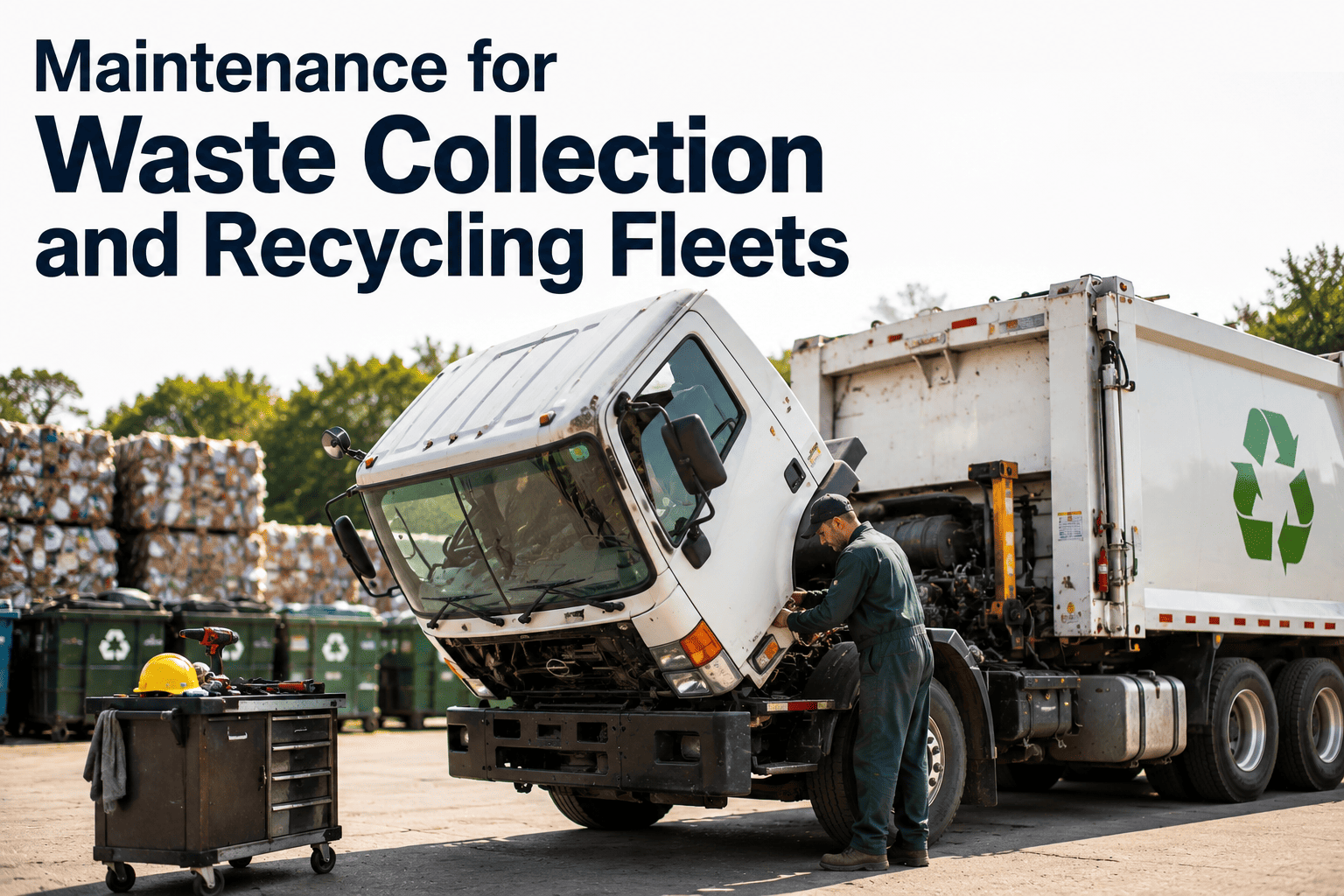
Waste fleet maintenance demands a fundamentally different playbook than standard commercial truck upkeep — and if you're managing a recycling or refuse collection operation heading into 2026, the stakes are measured in route delays, hydraulic failures, and DOT violations. Constant stop-start duty cycles, hydraulic compaction systems running 600–1,200 cycles per day, and corrosive leachate exposure create accelerated wear patterns that generic fleet maintenance software simply wasn't built to handle. This waste recycling fleet guide breaks down the specific failure modes, preventive maintenance schedules, and technology strategies that keep collection vehicles on route — and shows how an AI-powered CMMS like OxMaint can cut unplanned downtime 30–50% while eliminating paper work orders. Ready to modernize your maintenance operation? Start Free Trial and see the difference on your own assets.
Waste & Recycling Fleet Guide — 2026
Is Your Waste Fleet Bleeding Hours to Reactive Repairs and Route Delays?
The average refuse truck experiences 2.5x more brake actuations, 3x more hydraulic cycles, and 4x more frame-stress events per mile than a highway hauler — yet most waste fleets still run maintenance on spreadsheets and clipboards. OxMaint was purpose-built for the 2026 reality of route-based, high-duty-cycle fleet operations.
Why Waste Fleets Fail Differently
Why Waste Fleet Maintenance Is Nothing Like Standard Truck Maintenance
A Class-8 highway tractor logs predictable mileage at steady RPMs. A side-loading refuse truck, by contrast, may cover only 25–40 miles in a full shift — but during those miles it performs 500–800 stop-start cycles, runs a PTO-driven hydraulic compactor continuously, and absorbs frame-jarring impacts at every collection point. This recycling fleet maintenance guide is built around those realities, not generic truck PM schedules.
Hydraulic Compaction Systems
Pumps, valves, hoses, and cylinders endure 600–1,200 cycles per day. A single hose failure at $180 can sideline a $280K truck and trigger a $1,200+ missed-route penalty.
Stop-Start Brake & Drivetrain Wear
Refuse trucks average 2.5x more brake actuations per mile than highway trucks. Brake life shrinks to 4–6 months and transmission fluid degrades 40% faster under constant torque cycling.
Corrosive Leachate Exposure
Organic acids, moisture, and abrasive grit attack frame rails, wiring harnesses, and undercarriage components. Corrosion-related failures account for 18–22% of unplanned downtime in waste fleets.
Route-Critical Scheduling Pressure
A delayed truck doesn't just cost repair time — it cascades into overtime, missed collections, customer complaints, and municipal contract penalties that can exceed $500 per incident.
Preventive Maintenance Checklist
The Complete Waste Fleet Maintenance Checklist for 2026
This waste recycling maintenance guide organizes PM tasks into three tiers based on frequency and criticality. A 60-truck fleet running this structured checklist inside a CMMS typically reduces unplanned breakdowns by 30–50% within the first six months.
Daily / Pre-Route Inspection (Operator-Led, 8–12 min)
Bi-Weekly Preventive Maintenance (250–350 hours)
Quarterly Deep Maintenance (1,000–1,500 hours)
| Component | Standard Highway Fleet Life | Waste Fleet Actual Life | Recommended PM Interval |
|---|---|---|---|
| Brake Pads | 18–24 months | 4–6 months | Bi-weekly inspection |
| Hydraulic Hoses | 4–5 years | 18–30 months | Bi-weekly visual, quarterly deep |
| Transmission Fluid | 100K miles | 40–50K miles | Quarterly sampling |
| Hydraulic Pump | 8–10 years | 4–6 years | Quarterly flow test |
| Tires (Rear Drive Axle) | 150K miles | 45–60K miles | Weekly pressure + tread |
The Cost of Reactive Maintenance
What Reactive Waste Fleet Maintenance Actually Costs You
A mid-sized waste fleet of 60 trucks running reactive maintenance — waiting for failures, then scrambling parts and crews — typically spends 40–60% more on unplanned repairs than a fleet with structured preventive maintenance. Here's the math that should keep every fleet manager awake.
Annual Reactive Maintenance Cost Formula
Unplanned Repairs + Route Delay Penalties + Overtime Labor + Towing + Lost Contract Revenue
A 60-Truck Municipal Waste Fleet Spending $42K/Month on Unplanned Repairs
This fleet averages 14 unplanned breakdowns per month. Each breakdown sidelines a truck for 1.5 days, triggers $1,200 in missed-route penalties, and costs $850 in overtime for rerouted crews and after-hours repair. Monthly reactive cost: $42,000 in parts and labor + $16,800 in route penalties + $11,900 in overtime = $70,700/month or $848,400/year.
After implementing OxMaint with route-based PM triggers and predictive hydraulic monitoring, the same fleet reduced unplanned breakdowns by 43% in six months — recovering over $365,000 annually and achieving full ROI on the platform in under 90 days.
How OxMaint Helps
How OxMaint Solves Waste & Recycling Fleet Maintenance Challenges
OxMaint is an AI-powered CMMS and EAM platform engineered for maintenance and reliability teams managing high-duty-cycle assets. For waste and recycling fleets in 2026, these four capabilities directly address the failure modes and scheduling pressures unique to refuse collection and recycling operations.
Route-Based PM Triggers
Trigger preventive maintenance on actual collection stops, compaction cycles, or PTO hours — not just odometer miles. OxMaint automatically generates work orders when a truck hits 800 packer cycles or 30 route days, cutting missed PMs by 60–70%.
Predictive Hydraulic Monitoring
AI-driven trend analysis on hydraulic fluid samples, cycle times, and pressure data predicts pump and cylinder failures 2–4 weeks before they happen — preventing the $1,200-per-day route disruptions that define waste fleet downtime.
Digital Work Orders & Compliance
Eliminate paper work orders and clipboard inspection sheets. OxMaint digitizes the entire PM workflow — from technician mobile app to DOT-compliant audit trail — cutting admin time by 50% and ensuring FMCSA inspection records are always audit-ready.
Spare-Parts Inventory Automation
Auto-replenish critical hydraulic hoses, brake pads, and filters based on PM schedules and consumption trends. Fleets using OxMaint reduce parts stockouts by 75% and cut inventory carrying costs by 20–30% without increasing downtime risk.
Switching Guide
How to Switch from Spreadsheets to a CMMS in 30 Days
Most waste fleets delay switching to maintenance software because they fear a long, painful migration. In reality, a structured 4-week implementation gets your entire fleet live on OxMaint — with historical asset data, PM schedules, and parts inventory imported and operational.
Week 1 — Asset Import & Hierarchy Setup
Upload your fleet roster (VINs, asset numbers, component hierarchies) via CSV or API. OxMaint maps each truck to its subsystems — hydraulic, drivetrain, braking, electrical — and creates the asset tree automatically.
Week 2 — PM Schedule Configuration
Define preventive maintenance triggers based on route days, compaction cycles, engine hours, or mileage. OxMaint's template library includes pre-built waste fleet PM schedules aligned to common OEM recommendations.
Week 3 — Parts & Technician Onboarding
Import spare-parts inventory with min/max levels. Train technicians on the mobile app for work order completion, photo documentation, and digital inspections — most teams reach full adoption in 3–4 shifts.
Week 4 — Go Live & Analytics Dashboard
First automated PM work orders generate. Dashboards populate with MTBF, MTTR, downtime cost, and PM compliance metrics. Fleet managers gain real-time visibility into asset health across all routes.
See OxMaint on Your Waste Fleet Assets — Book a 30-Minute Demo
Walk through a live CMMS environment configured for waste and recycling fleet operations. See route-based PM triggers, predictive hydraulic monitoring, and digital work orders in action — then decide if OxMaint fits your fleet.
Frequently Asked Questions
Waste Fleet Maintenance Software — Your Questions Answered
What makes waste fleet maintenance different from standard commercial fleet maintenance?
Waste and recycling trucks operate under constant stop-start duty cycles, run hydraulic compaction systems 600–1,200 times per day, and face corrosive leachate exposure — all of which accelerate wear on brakes, hydraulics, drivetrains, and frames 2–4x faster than highway driving. Standard fleet PM schedules based on mileage alone miss critical failure patterns. A purpose-built waste fleet maintenance strategy uses cycle counts, PTO hours, and route days as PM triggers, which is exactly what OxMaint automates.
How often should hydraulic systems be inspected on refuse trucks?
Hydraulic fluid levels and visible leaks should be checked daily by operators (8–12 minutes). Full fluid analysis, hose inspection, and pump flow-rate testing should occur every 250–350 operating hours (roughly bi-weekly) and quarterly for deep maintenance. OxMaint can automate these inspection schedules and trigger work orders automatically — Start Free Trial to configure your hydraulic PM intervals today.
How much does waste fleet maintenance software cost compared to reactive repairs?
A 60-truck waste fleet typically spends $700K–$900K annually on unplanned repairs, route penalties, and overtime. Implementing a CMMS like OxMaint reduces unplanned breakdowns by 30–50%, recovering $200K–$400K+ per year. Most waste fleets achieve full ROI within 90 days. The platform cost is a fraction of the downtime it prevents.
Can OxMaint integrate with our existing fleet GPS and telematics systems?
Yes. OxMaint supports API integrations with major fleet telematics and GPS providers, allowing route data, engine hours, PTO cycles, and fault codes to flow directly into the CMMS. This enables true predictive maintenance — the system flags potential failures based on real-time sensor data, not just calendar intervals.
How long does it take to migrate from spreadsheets to OxMaint?
Most waste fleets go fully live on OxMaint within 30 days. Week 1 covers asset and hierarchy import via CSV or API. Week 2 configures PM schedules. Week 3 onboards technicians on the mobile app and imports parts inventory. Week 4 goes live with automated work orders and analytics dashboards. To see the implementation roadmap for your fleet, Book a Demo with our team.
Ready to Modernize Your Waste Fleet Maintenance?
Stop Managing Breakdowns. Start Preventing Them.
Join the waste and recycling fleets using OxMaint to cut unplanned downtime 30–50%, eliminate paper work orders, and keep every truck on route. Your 14-day free trial includes full CMMS access — no credit card required.
Free 14-day trial · No credit card