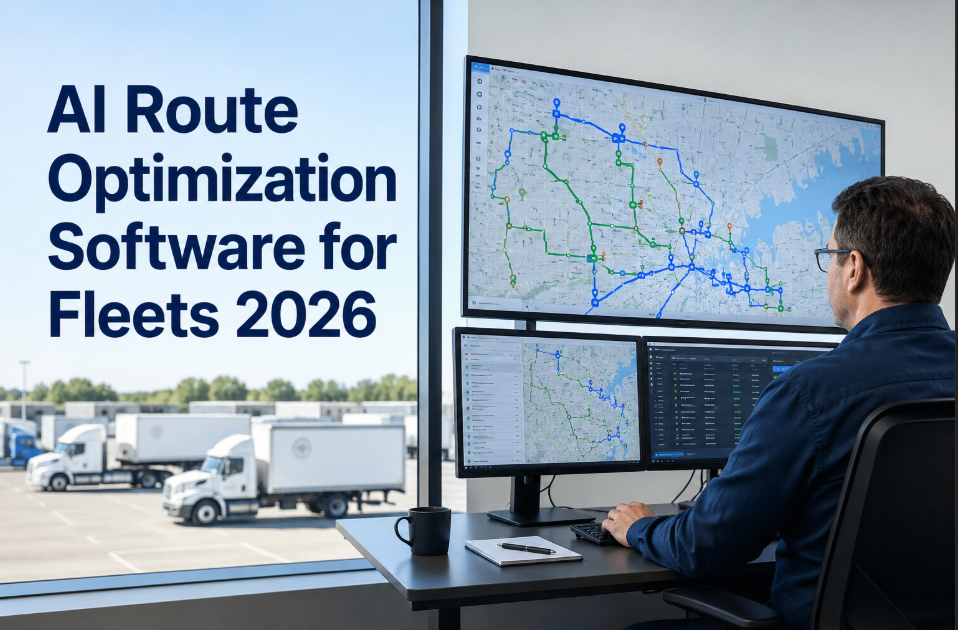
Fleet managers running 50+ vehicles are still losing an average of 22% of their fuel budget to inefficient routing — routes planned manually the night before, static sequences that ignore real-time traffic, and dispatchers making gut-call adjustments that cost $1,200 per truck per month in wasted miles. In 2026, AI-powered route optimization software has matured beyond experimental pilots into production-grade platforms that process thousands of delivery constraints in seconds, dynamically reroute around disruptions, and consistently deliver 18–25% fuel savings within 90 days of deployment. The gap between fleets using AI routing and those still on legacy planning tools is no longer marginal — it is the difference between profitable operations and margin erosion. Platforms like OxMaint now integrate route optimization data directly into maintenance scheduling, ensuring that vehicles assigned to optimized routes are also the ones with confirmed mechanical readiness — closing the loop between dispatch efficiency and asset reliability. Want to see how AI routing integrates with fleet maintenance? Start a free trial or book a demo to see it in action.
AI Route Optimization Software for Fleets: The 2026 Buyer's Guide
How machine learning routing engines are saving fleets 18–25% on fuel, cutting driver overtime by 30%, and turning dispatch from a bottleneck into a competitive advantage — with real ROI data and platform evaluations.
What Is AI Route Optimization — And Why 2026 Is the Tipping Point
AI route optimization uses machine learning algorithms to calculate the most efficient sequence of stops, factoring in time windows, vehicle capacity, traffic patterns, driver hours-of-service, and real-time disruptions. Unlike static routing tools that solve a fixed problem once, AI routing continuously learns from historical delivery data, driver behavior, and road conditions to improve route quality over time.
The 2026 tipping point is driven by three converging forces: fuel costs averaging $4.12 per gallon in the US (up 14% from 2023), commercial insurance premiums now pricing mileage-based risk at $0.08 per mile, and customer delivery windows shrinking from 4-hour to 1-hour slots across 67% of B2C operations. Manual route planning simply cannot process these competing constraints at the speed business now demands.
Fleets that combine AI routing with asset management platforms like OxMaint gain an additional layer of intelligence — routes are assigned only to vehicles with current preventive maintenance status, tire condition above threshold, and no open safety work orders. This eliminates the 6.3% of dispatched vehicles that break down mid-route due to deferred maintenance, costing an average of $2,800 per roadside event. See how maintenance-aware routing works — start a free trial or book a demo with the OxMaint fleet team.
Core Capabilities Every AI Routing Platform Must Have in 2026
Not all route optimization software is equal. These six capabilities separate production-grade AI routing from basic mapping tools with an algorithm bolted on.
Real-time route adjustment based on traffic incidents, weather delays, and last-minute stop additions. Reduces idle time by 19% compared to static plans.
Simultaneous processing of vehicle capacity, driver HOS limits, customer time windows, and vehicle type restrictions across 500+ stops in under 30 seconds.
ML models trained on historical traffic patterns deliver ETAs within 4-minute accuracy — 78% more precise than GPS-only estimates that ignore dwell time patterns.
Routes assigned only to vehicles with green maintenance status. OxMaint flags assets with overdue PMs, open safety work orders, or low condition scores before dispatch.
AI distributes workload evenly across drivers and zones, preventing the 40% workload imbalance that causes burnout in top-performing drivers and underutilization in others.
Automatic CO2 calculation per route with Scope 1 emissions reporting. Critical for the 52% of enterprise shippers now requiring ESG data from fleet partners.
Why Manual Route Planning Is Costing Your Fleet More Than You Think
Dispatchers are experienced, but human route planning hits a mathematical wall at scale. Here are the hidden costs that spreadsheet-based routing creates every single day.
Manual planners sequence stops geographically but miss optimal sequencing that accounts for turn penalties, loading dock access, and time-of-day traffic. Result: 15–22% excess mileage per route.
Routes planned without accurate service-time data consistently underestimate total route duration. 38% of manual routes exceed planned hours, triggering overtime at 1.5x labor cost.
Without integration to asset management, dispatchers assign routes to vehicles with overdue brake inspections, failing cooling systems, or expiring certifications. 6.3% of dispatched trucks experience mid-route breakdowns.
When a road closes, a customer cancels, or a vehicle breaks down, manual re-routing takes 25–40 minutes per incident. AI systems re-optimize the entire fleet in under 90 seconds.
Manual routing achieves 71–76% on-time delivery in dense urban environments. AI routing consistently delivers 91–94%. Each missed delivery window costs an average of $35 in re-delivery and customer churn risk.
Without AI analytics, fleet managers cannot compare planned vs actual routes, identify chronic inefficiency zones, or measure cost-per-stop trends. Decisions are made on anecdote, not data.
Manual Routing vs AI-Optimized Routing: Side-by-Side
The operational difference between legacy planning and AI routing is not incremental — it is structural. Every metric shifts when routing decisions move from human estimation to algorithmic optimization.
| Performance Metric | Manual / Spreadsheet Routing | AI-Optimized Routing |
|---|---|---|
| Route planning time (100 stops) | 45–90 minutes | 12–30 seconds |
| Average miles per route | 127 miles | 98 miles (23% reduction) |
| On-time delivery rate | 71–76% | 91–94% |
| Driver overtime frequency | 38% of routes | 9% of routes |
| Mid-route breakdown rate | 6.3% (no maintenance check) | 1.1% (with OxMaint integration) |
| Re-routing after disruption | 25–40 minutes manual | Under 90 seconds automatic |
| Fuel cost per delivery stop | $4.80 | $3.40 (29% savings) |
| Carbon emissions tracking | Not available | Automatic per-route CO2 calculation |
For a 75-vehicle fleet running 250 days per year, the fuel savings alone from AI routing translate to $630,000 annually — before accounting for reduced overtime, fewer breakdowns, and improved customer retention. Connecting your routing platform to OxMaint asset data ensures every dispatched vehicle is mechanically ready, further reducing the $2,800-per-incident cost of roadside failures. Calculate your fleet savings — start a free trial or book a demo today.
How OxMaint Bridges the Gap Between Route Optimization and Fleet Reliability
AI routing tells you the fastest path. OxMaint tells you which vehicles are safe and ready to take that path. Together, they eliminate the two biggest sources of fleet cost leakage: inefficient routes and unplanned breakdowns.
Every asset in OxMaint carries a real-time condition score based on PM compliance, open work orders, and inspection results. Dispatchers see at a glance which vehicles are route-ready and which need service before assignment.
OxMaint triggers PMs based on actual odometer readings and engine hours — not calendar dates. Vehicles running high-mileage AI-optimized routes get serviced when they need it, not when a spreadsheet says so.
Drivers complete mobile inspections before departure. Failed items auto-generate work orders. 89% of DOT-reportable defects are caught before the vehicle leaves the yard — preventing $4,200 average roadside violation costs.
When a vehicle does experience a mid-route issue, OxMaint creates a priority work order with GPS location, asset history, and nearest service provider data — cutting mean-time-to-repair from 6.2 hours to 2.8 hours.
Every maintenance dollar is tracked by vehicle, route zone, and cost type. Fleet managers identify the 15% of vehicles consuming 45% of maintenance budget and make data-driven replacement decisions.
For fleets operating across multiple depots, OxMaint provides portfolio-level dashboards showing PM compliance, cost trends, and asset condition scores across every location — not just the one the manager happens to visit.
ROI Reality Check: What Fleets Actually Save
These numbers come from fleet operations that combined AI route optimization with OxMaint asset management. The savings compound because efficient routing and reliable vehicles reinforce each other.
How to Evaluate AI Route Optimization Platforms
Not every platform marketed as "AI routing" delivers genuine machine learning optimization. Use this evaluation framework when comparing vendors in 2026.
The most common mistake fleets make is evaluating routing software in isolation from vehicle maintenance data. A perfectly optimized route assigned to a vehicle with a failing transmission is worse than a mediocre route on a healthy truck. OxMaint ensures the maintenance side of this equation is always current and visible to dispatchers. Evaluate how this works for your fleet — start a free trial or book a demo with the OxMaint team.
Frequently Asked Questions
How quickly can AI route optimization show measurable fuel savings?
Does OxMaint replace route optimization software or work alongside it?
What fleet size is needed to justify AI routing investment?
How does AI routing handle electric vehicles with range limitations?
Stop Losing 22% of Your Fuel Budget to Inefficient Routes
AI route optimization delivers the fastest path. OxMaint ensures every vehicle on that path is safe, maintained, and ready to perform. Together, they cut fleet operating costs by $8,400 per vehicle per year. See your fleet data inside OxMaint in under 15 minutes — no implementation fees, no long onboarding, no contracts.


.png)