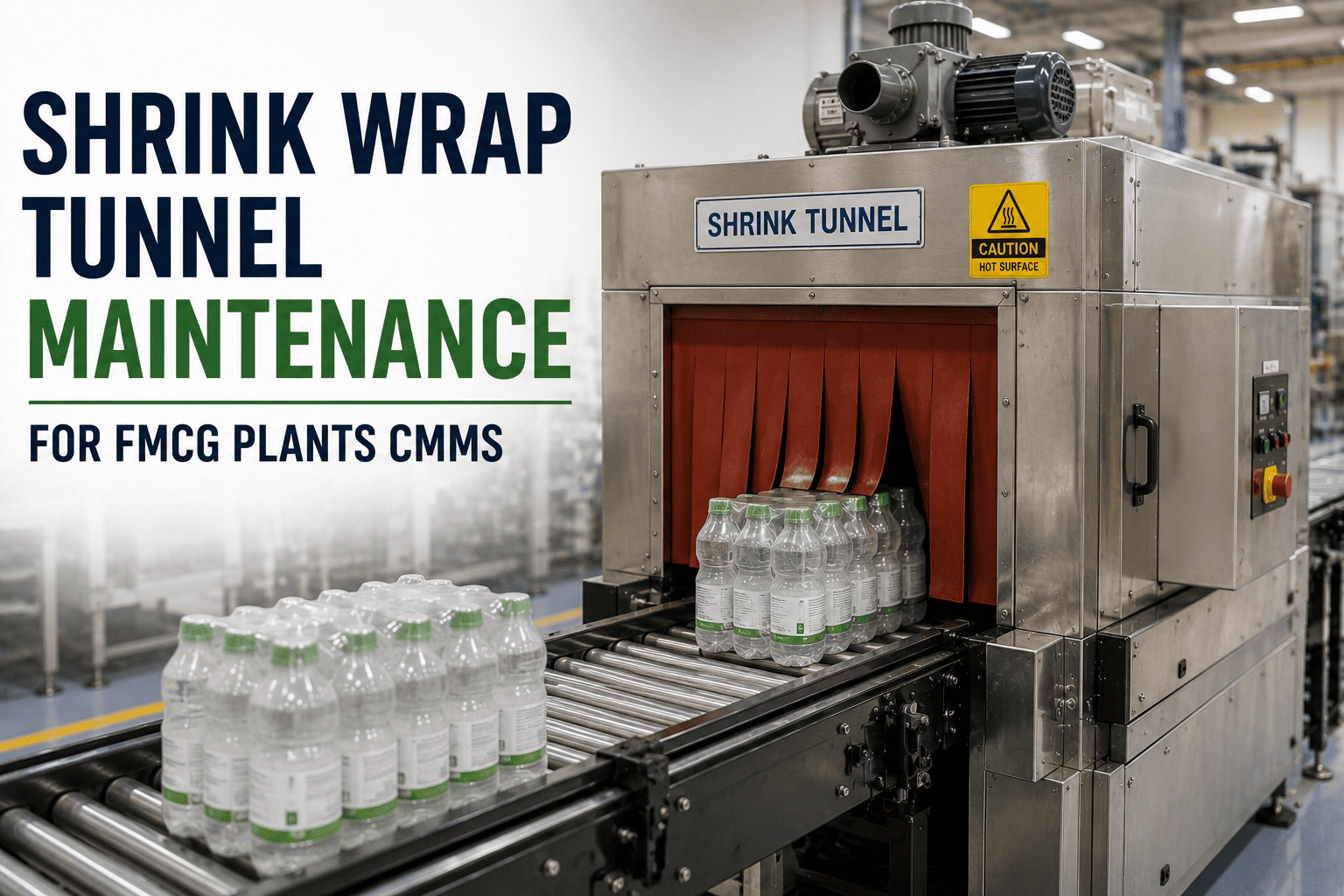
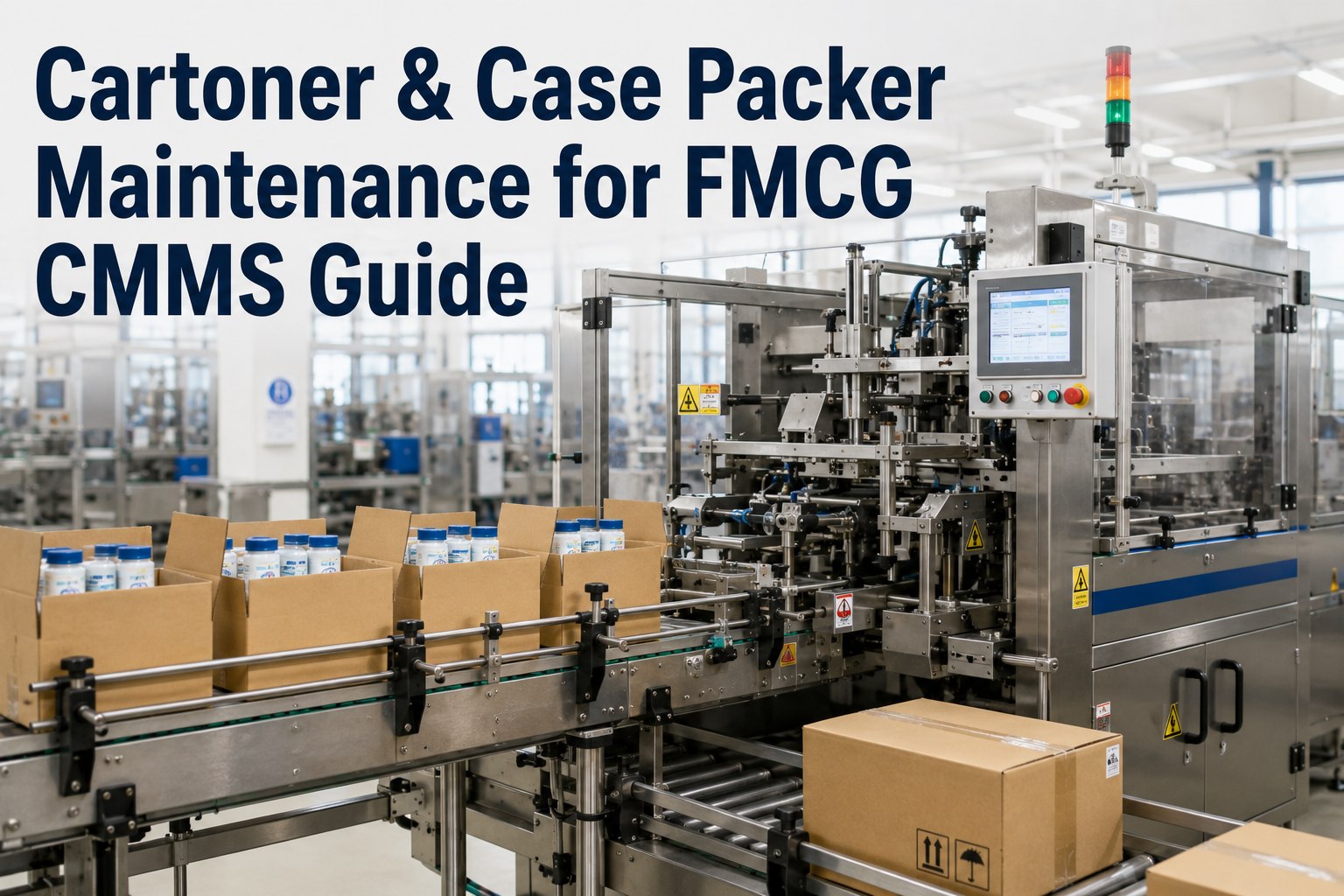
Case packers and shrink wrappers sit at the most expensive corner of an FMCG plant — the place where every reject or downtime minute is multiplied by everything upstream that already added cost to the product. Three failure modes quietly destroy reliability on this equipment class: heat-tunnel temperature drift that turns good shrink film into wrinkled rejects, film tracking failures that telescope a $400 roll into edge folds and breaks, and sealing-jaw wear that produces angel-hair strands and open packs no auditor will accept. This page lays out the PM cadence that catches each issue weeks before it becomes a line stop — across drop case packers, wrap-around case packers, and high-throughput shrink wrappers. Start a free trial to build your end-of-line PM in Oxmaint, or book a demo with our FMCG packaging team.
$95K
Avg Cost Per End-of-Line Stop
Industry-reported cost of a single unplanned case-packing cell shutdown — lost throughput plus scrap plus emergency labour
38%
Downtime From End-of-Line
Share of FMCG packaging downtime that traces to end-of-line case packers, shrink wrappers, and palletisers
320-380°F
Polyolefin Shrink Tunnel Range
Operating temperature window for polyolefin shrink film — drift outside this band causes wrinkles, tears, and rejects
3.2hr
MTTR Unplanned vs 45min Planned
Mean time to repair an unplanned case-packer failure versus 45 minutes for the same fix as a planned PM intervention
What Case Packer and Shrink Wrapper Maintenance Covers
End-of-line packaging maintenance is the structured PM and condition-monitoring programme for the equipment that converts cartons or primary packs into stackable cases ready for the palletiser. In an FMCG plant, this includes drop case packers, wrap-around case packers, side-load case packers, and shrink-bundle wrappers that use heat-shrinkable film and a tunnel to apply a tight, tamper-evident outer pack.
Each piece of equipment carries its own failure profile. Case packers fail at servo-driven loaders, grippers, vacuum systems, glue heads, and case-erector mandrels. Shrink wrappers fail at seal jaws, heating elements, film-tracking guides, and shrink-tunnel temperature controllers. A defensible end-of-line programme treats each subsystem with its own PM template, OEM cadence, and spare-parts BOM. Start a free trial to register your end-of-line equipment in Oxmaint.
The 6 Failure Domains That Quietly Wreck End-of-Line Reliability
Domain 01
Heat Tunnel Temperature Drift
Thermocouples drift, heater banks lose elements, airflow imbalance develops. Polyolefin needs 320-380°F; even 15°F drift creates wrinkled rejects or burnt film.
Domain 02
Sealing Jaw Wear and Misalignment
Worn seal jaws produce angel-hair strands, partial seals, and leaking packs. Routine paper-pressure check catches alignment drift before it generates retail rejects.
Domain 03
Film Tracking and Tension
Misaligned reels telescope into edge folds, tunnel wrinkles, and film breaks. A few millimetres of drift wastes a full reel and triggers a 20-minute changeover.
Domain 04
Servo Drive & Robotic Pickup
On wrap-around and robotic case packers, servo timing drifts, EOAT wears, and vision systems lose calibration. Pickup misses look random until logged per recipe.
Domain 05
Case Erector and Glue System
Mandrel wear, suction-cup hardness, and hot-melt drift produce non-square cases and failed bottom-flap seals. Pallets reject at the warehouse for case-strength failure.
Domain 06
Conveyor & Accumulation
Worn timing belts, drifting photo-eyes, and out-of-spec dead-plate gaps create back-pressure failures and crushed packs. Looks like a sensor problem, traces to mechanical wear.
The three failure modes the page promised — heat tunnel drift, film tracking, sealing-jaw wear — sit inside domains 01, 02, and 03. Each one has a measurable signal weeks before line collapse. Book a demo to see how Oxmaint catches each on your specific equipment.
Where End-of-Line Maintenance Quietly Bleeds Throughput
!
Heat Tunnel Setpoint Trusted Without Verification
Tunnel reads 350°F on the controller but actual film-zone temperature is 320°F. Wrinkled bundles run for hours before QA flags rejects.
!
Seal-Jaw Pressure Check Skipped
Paper-pressure test absent from daily checklist. Misaligned jaws produce angel hair and partial seals across thousands of packs before anyone notices.
!
Film Reel Loaded Off-Centre
Each operator loads the reel a slightly different way. Telescoping film, edge folds, and breaks become "the way the wrapper runs." Reels burn at $400 each.
!
No Cycle-Based PM on Robotic Cells
Robotic case-packer cells run on calendar PM. Cycle-driven wear on grippers and servos invisible. EOAT fails mid-shift, line down 3.2 hours.
!
Spare Heating Elements Not Stocked
When a tunnel heater bank fails, emergency overnight ship at 4× cost. Tunnel down for 18 hours. Production rerouted to inferior backup line.
!
Case Strength Failures Found at the Warehouse
Non-square cases and weak bottom seals discovered only when pallets collapse in shipping. Brand cost, customer complaint, return logistics all stack up.
End-of-line equipment quietly drives 30-40% of total packaging-hall losses through these six gaps — Oxmaint converts each one into a tracked work order, a verified setpoint, or a stocked spare. Start a free trial to see where your line sits.
How Oxmaint Operationalises End-of-Line Maintenance
End-of-Line Asset Registry
Case packers, shrink wrappers, tunnels, and bundlers registered by family with OEM PM intervals, cycle counters, BOM, and critical-spare flagging.
Heat Tunnel Setpoint Verification
Daily film-zone temperature verification with hand-held probe captured on a mobile checklist. Drift from setpoint auto-triggers a thermocouple investigation WO.
Seal-Jaw Pressure & Alignment Check
Daily paper-pressure test recorded with photo and signed sign-off. Out-of-tolerance pressure auto-creates corrective WO before angel-hair strands appear at retail.
Film Tracking SOP and Logging
Reel-change SOP enforced as a checklist with photo references. Every reel change logged with operator, time, and pass/fail tracking signal. Burn-rate per reel tracked.
Cycle-Based PM on Robotic Cells
EOAT, grippers, servos, and vision systems linked to cycle counters. PM fires by cycle count, not by date. Failures shift from unplanned to planned.
Critical-Spare Inventory Automation
Heating elements, sealing wire, thermocouples, suction cups, and timing belts auto-stocked. PM consumption depletes inventory; PO requisitions trigger at re-order point.
The result is an end-of-line programme that protects throughput, brand quality, and the bottom line — without buying new equipment. Start a free trial and configure your first end-of-line PM template in under an hour.
Reactive vs. Structured End-of-Line Maintenance
| Performance Metric |
Reactive End-of-Line PM |
Structured Programme on Oxmaint |
| Heat-tunnel verification |
Trust the controller display |
Daily probe test with photo evidence |
| Seal-jaw pressure check |
When defects already visible |
Daily paper-pressure test, signed off |
| Film reel loading |
Operator memory |
Photo SOP enforced as checklist |
| Robotic-cell PM trigger |
Calendar dates |
Cycle-count based per asset |
| Spare parts availability |
Emergency overnight orders |
Min/max stocked, auto-reordered |
| MTTR on end-of-line |
3-4 hours unplanned |
Under 45 minutes planned |
| Reject rate at warehouse |
2-5% non-square / weak seal |
Under 0.5% sustained |
| End-of-line OEE |
55-70% |
82-88% achievable |
Documented ROI from Structured End-of-Line Maintenance
75%
Lower MTTR on Case Packers
Reduction in mean time to repair when end-of-line failures shift from unplanned to planned PM interventions
5-8×
Lower Warehouse Reject Rate
Reduction in pallet-level case-strength rejects after seal-jaw, glue, and erector PM stay ahead of wear
30%+
Film Cost Reduction
Reduction in shrink-film consumption when tracking, tension, and tunnel temperature are properly controlled
$95K
Saved Per Avoided Cell Shutdown
Avoided cost of each prevented unplanned end-of-line cell shutdown through cycle-based PM and stocked spares
...which is why FMCG operations leaders who structure end-of-line PM the way they structure their hero production assets see brand-quality complaints, scrap, and downtime all drop in the same quarter — start a free trial to see this in your packaging hall, or book a demo and we'll model the savings on your specific equipment.
Frequently Asked Questions
What signal catches heat-tunnel temperature drift before rejects start?
The most reliable signal is a daily film-zone probe measurement compared to the controller setpoint. Even a 10-15°F gap between displayed and actual film-zone temperature is enough to push polyolefin shrink film out of its 320-380°F operating window, producing wrinkles, tears, or burnt film. Oxmaint captures the probe reading on a mobile checklist, and a gap larger than the threshold auto-creates a thermocouple-and-element investigation work order before reject piles up at QA.
How does Oxmaint stop film tracking failures from wasting full reels?
Every reel change is run through a checklist with photo references showing correct reel centring, mandrel alignment, and tension setting. Operators sign off each step. Burn-rate per reel — how many reels are scrapped before producing a full run — is tracked per shift and per operator. Repeated misload events trigger a retraining work order; chronic mechanical drift triggers a mandrel and tracking-guide inspection.
Can Oxmaint manage PM differently for drop, wrap-around, and robotic case packers?
Yes. Each case-packer family has its own PM template. Drop case-packer templates focus on overhead collation, drop heads, and discharge belts. Wrap-around case-packer templates focus on hot-melt heads, blank magazines, and pre-break station alignment. Robotic case-packer templates focus on end-of-arm tooling, gripper wear, vision calibration, and servo timing. Cycle thresholds are different for each, so the PM cadence reflects actual usage rather than a generic calendar.
How does Oxmaint help reduce shrink-film consumption?
Shrink-film overconsumption is rarely a film-quality problem — it is a setpoint and PM problem. Oxmaint tracks tunnel temperature, conveyor speed, dwell time, and sealing parameters per recipe and per asset. When any drift away from the validated setpoint shows up on the daily checklist, a corrective work order is generated. Combined with controlled reel loading and verified seal pressure, plants typically see 20-35% reduction in scrap film and reject rate within 90 days of going live.
Stop Losing End-of-Line Throughput to Three Preventable Failures
Catch Heat Tunnel Drift, Film Tracking, and Sealing-Jaw Wear Weeks Before They Stop the Line
See how cycle-based PM, daily setpoint verification, and structured reel-change SOPs turn end-of-line into your most reliable asset class, not your most expensive.
- Daily heat-tunnel and seal-jaw verification with auto-WO on drift
- Cycle-based PM on case packers, shrink wrappers, and robotic cells
- Critical spares auto-stocked, PO requisitions triggered at reorder point
Used by FMCG operations teams managing thousands of end-of-line assets across multi-site portfolios.