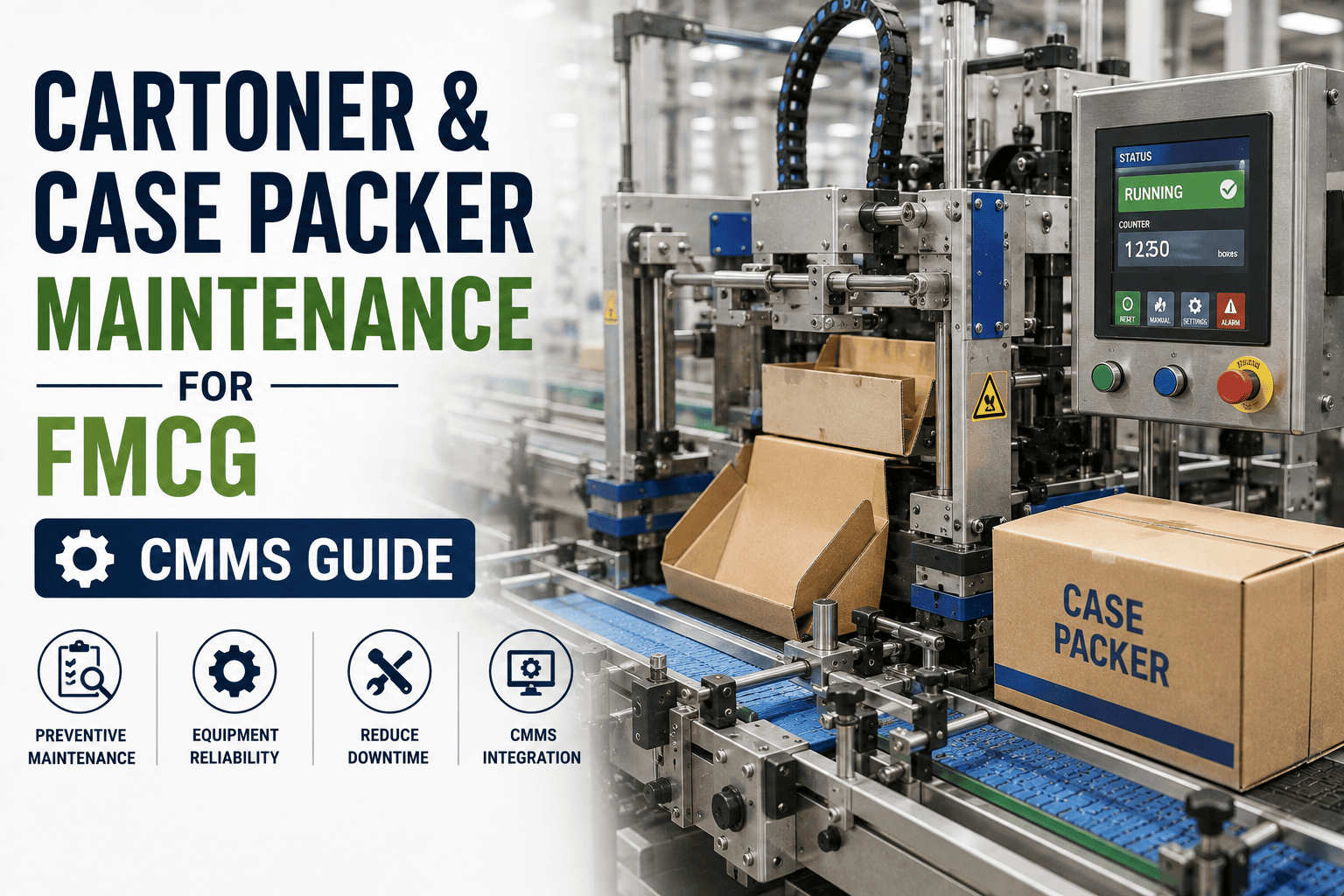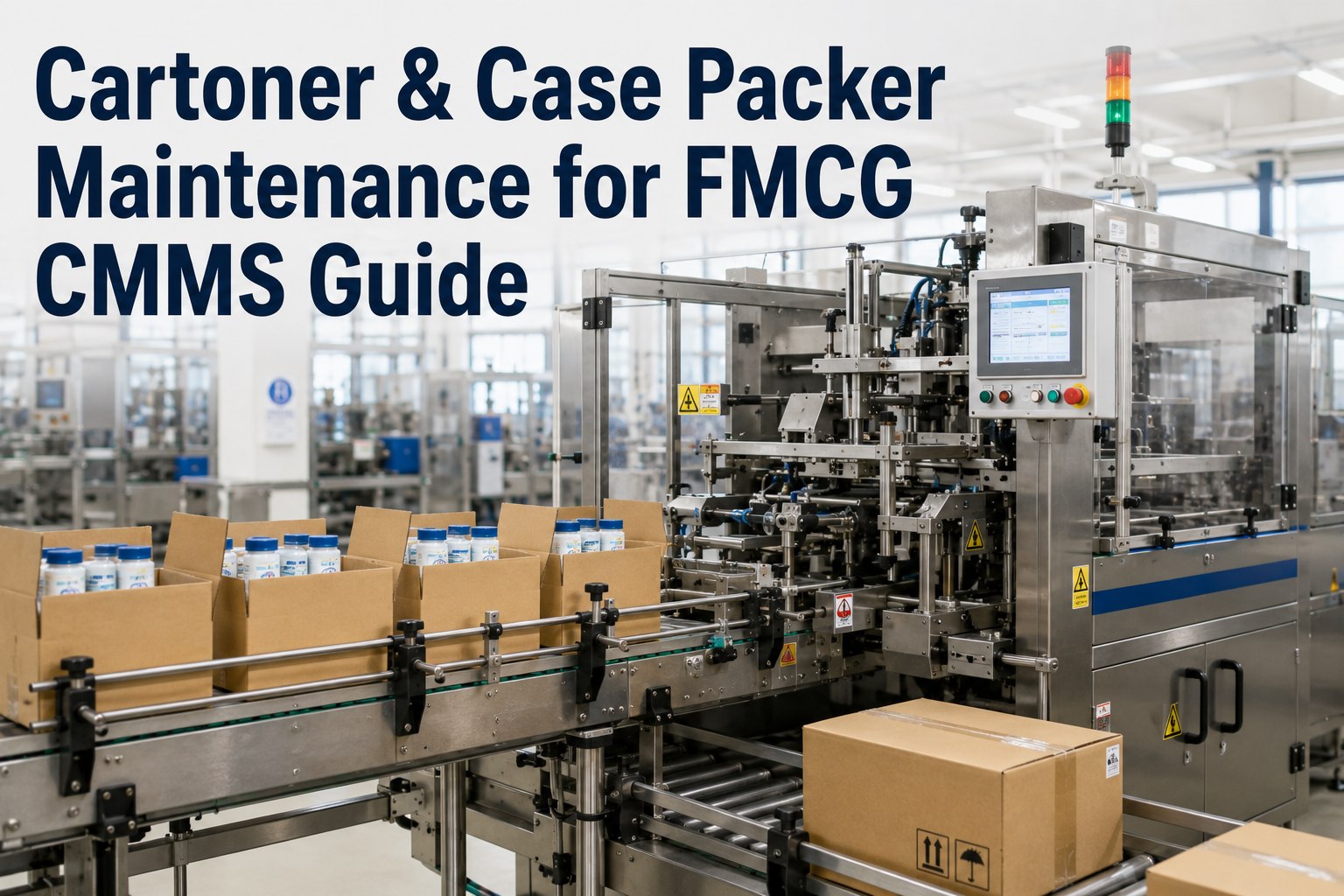
Cartoner & Case Packer Maintenance for FMCG CMMS Guide

By Sierra Donovan on July 17, 2026

cartoner-case-packer-maintenance-fmcg-cmms-guide

End-of-line cartoners and case packers run at the narrowest reliability margin on an FMCG line — a single folded-flap misalignment or a dried glue nozzle can halt palletizing within seconds and wipe out an entire shift's OEE gain. This CMMS-driven guide translates flap-folding PM, glue-system service, and carton-feed adjustment into a structured reliability program that keeps case-packing throughput matched to filler speed. Plants that formalize cartoner maintenance typically recover 6–12% of lost end-of-line throughput within the first quarter. You can Start Free Trial to deploy the work-order, PM-checklist, and meter-based scheduling logic described below.

CMMS RELIABILITY GUIDE · END-OF-LINE

Is one cartoner jam quietly costing your line 90 minutes of filler output every shift?

Cartoners and case packers sit at the end-of-line choke point — when they stop, palletizing stops with them and upstream fillers back up within minutes. A CMMS-driven PM program for flap folding, glue dosing, and carton feed keeps end-of-line throughput matched to filler speed and protects the 85%+ OEE target most FMCG plants are chasing.

22 min
AVG UNPLANNED DOWNTIME PER CARTONER JAM — RECOVERABLE TO UNDER 6 MIN WITH STRUCTURED PM
WHY END-OF-LINE FAILS FIRST

Cartoners fail 3× more often than fillers — and the cost compounds downstream

End-of-line packaging equipment carries the highest cumulative failure rate on an FMCG line because it inherits every upstream variation — bottle shape, fill weight, label placement — and converts it into mechanical stress at 300+ cartons per minute.

38%
OF FMCG UNPLANNED DOWNTIME ORIGINATES AT END-OF-LINE CARTONING & CASE PACKING
$4,200
AVG LOST REVENUE PER HOUR OF CARTONER STOPPAGE ON A MID-TIER BEVERAGE LINE
72 hrs
TYPICAL MEAN TIME BETWEEN ADJUSTMENT-INDUCED JAMS ON UNTUNED CARTON FEED SYSTEMS

Consider a typical 180-asset FMCG plant running two cartoners and two case packers at 300 units/min. Without a CMMS-scheduled PM program, each end-of-line machine averages 4.2 unplanned stops per shift — 22 minutes of recovery per event. At $4,200/hr lost contribution margin, that is roughly $42K per week in unrecovered throughput. Plants that implement meter-based PM triggers and standardized flap-fold inspections inside a CMMS routinely cut jam frequency by 55–70% inside one quarter.

PREVENTIVE MAINTENANCE CHECKLISTS

Tiered PM checklists for flap folding, glue systems & carton feed

Cartoner and case packer PM splits cleanly into daily operator checks, weekly technician tasks, and monthly precision inspections. Each tier below maps to a CMMS work-order template with meter-based or calendar triggers.

DAILY · OPERATOR 8–12 min
  • Inspect flap-fold rails for carton dust buildup and wipe down contact surfaces
  • Verify glue pot temperature within ±2°C of recipe setpoint (typ. 165–175°C hot-melt)
  • Check suction-cup vacuum pressure gauge reads 0.6–0.8 bar at carton feed station
  • Clear carton magazine of warped or humidity-deformed blanks
  • Confirm case packer infeed lane guide spacing matches current SKU carton width
WEEKLY · TECHNICIAN 35–50 min
  • Lubricate flap-fold cam followers with food-grade H1 grease per OEM chart
  • Flush glue nozzle heads and inspect for carbonized adhesive buildup
  • Inspect suction cups for edge cracking — replace at 0.5mm lip wear
  • Torque-check case packer side-belt drive sprockets to spec (typ. 18 Nm)
  • Calibrate carton presence photo-eye response time under 30 ms
MONTHLY · PRECISION 2–3 hrs
  • Laser-align main cartoner drive shafts — tolerance ±0.05mm runout
  • Replace glue filter mesh and inspect gear-pump stator for wear
  • Measure case packer flap-fold timing with strobe — variance <3° per station
  • Inspect vacuum pump vanes — replace below 8mm residual thickness
  • Audit CMMS failure codes against last 30 days of jam logs for pattern drift
PM TASKFREQUENCYCMMS TRIGGER TYPETYPICAL DOWNTIME IF SKIPPED
Flap-fold rail cleaning & inspectionDailyShift-based checklist14 min/jam
Glue nozzle flush & temperature calWeeklyCalendar + run-hours22 min/jam, 3.2% rejects
Suction cup wear replacement2,000 hrsMeter-based9 min/jam, mis-pick cascade
Drive shaft laser alignmentMonthlyCalendarCatastrophic bearing failure, 6+ hrs
Case packer lane guide resetPer SKU changeEvent-based (changeover)18 min of restart jams
Vacuum pump vane inspectionQuarterlyCalendarFeed starvation, 11 min/jam
GLUE SYSTEM DEEP DIVE

Glue failures cause 41% of carton rejects — here is the PM math

Hot-melt adhesive systems are the single highest-leverage maintenance target on a cartoner. Carbonized adhesive in nozzles, drift in pot temperature, and worn gear-pump stators together account for the majority of reject-carton events.

REJECT RATE FORMULA
Rejects per 1,000 = (Nozzle Failures × 4.2) + (Temp Drift Events × 2.8) + (Stator Wear Hours ÷ 200)
Target: under 3 rejects per 1,000 cartons. Most untuned systems run 8–14.
GLUE PM PAYBACK
Weekly nozzle flush cost ≈ $18 labor + $4 parts. Prevented rejects per week ≈ 340 units @ $0.38 = $129.
7× weekly ROI. Pays for the entire glue PM program in under one shift.
01
Nozzle carbonization control
Flush nozzles every 40 run-hours with purge-grade adhesive. Carbonized buildup at the tip distorts spray pattern and causes flap-edge glue skips — the leading cause of case-pack failures detected at palletizing.
02
Pot temperature drift calibration
Verify glue pot thermocouple against a certified probe weekly. Drift beyond ±3°C changes viscosity enough to alter bead volume by 18%, producing both open-flap failures and stringing contamination on downstream conveyors.
03
Gear-pump stator wear tracking
Log pump-hours in the CMMS and replace stators at 4,000 hours. Worn stators deliver inconsistent bead volume — the symptom is intermittent open flaps that pass cartoner inspection but fail at case packer compression.
04
Hose and filter lifecycle management
Replace glue hoses every 12 months and mesh filters quarterly. Degraded hose linings shed particles that clog nozzles within hours — a single clogged nozzle produces 40+ rejected cartons before operator detection.
CMMS WORKFLOW

From jam log to closed PM — the 5-step reliability loop

A CMMS turns ad hoc cartoner repairs into a closed reliability loop. Each step below maps to a module inside the maintenance platform — meter triggers, work-order templates, failure-code analytics, and KPI dashboards.

1
Meter-based PM triggering
Cartoners log run-hours and carton counts directly into the CMMS. PM work orders auto-generate at 40-hour nozzle-flush intervals, 2,000-hour suction-cup replacements, and 4,000-hour stator changes — no spreadsheet tracking, no missed intervals.
2
Standardized digital checklists
Each PM work order carries a 5–12 item checklist with pass/fail thresholds — glue temp ±2°C, vacuum 0.6–0.8 bar, shaft runout ±0.05mm. Technicians log readings on mobile; out-of-spec values auto-create corrective work orders.
3
Failure-code pattern analytics
Every jam is logged with a standardized failure code — flap-fold misalignment, glue skip, feed mis-pick, lane-guide collision. The CMMS surfaces top-3 recurring codes weekly so reliability engineers attack root cause, not symptom.
4
Spare-parts linkage
PM templates auto-link to BOM parts — suction cups, glue filters, stator kits. Min-max triggers reorder at 30-day lead-time so critical spares are always in stock without over-binding working capital.
5
KPI dashboard & OEE feedback
MTBF, MTTR, PM compliance, and cartoner-caused filler stop-minutes feed a live dashboard. Plants using this loop typically lift end-of-line OEE from 71% to 84% within two quarters by eliminating reactive firefighting.

Stop losing filler output to preventable cartoner jams

Deploy CMMS-driven PM for cartoners and case packers in under 48 hours. Pre-built cartoner maintenance templates, glue-system PM triggers, and failure-code analytics included.

RELIABILITY IMPACT

What structured cartoner PM delivers in 90 days

Plants that formalize end-of-line maintenance inside a CMMS see measurable shifts within one quarter. The numbers below are drawn from typical FMCG deployments across beverage, personal care, and dry-foods lines running 2–4 cartoners.

−63%
UNPLANNED CARTONER JAMS PER SHIFT AFTER PM FORMALIZATION
+9%
END-OF-LINE OEE LIFT — TYPICALLY 71% TO 84% RANGE
−41%
REJECT CARTONS PER 1,000 — GLUE & FLAP-FOLD IMPROVEMENTS
$42K
AVG WEEKLY THROUGHPUT RECOVERED ON A DUAL-CARTONER BEVERAGE LINE
"

We cut cartoner jams from 4.2 per shift to 1.3 in 11 weeks after wiring glue-temperature checks and suction-cup wear triggers into our CMMS. The filler stoppage minutes disappeared with them.

— Reliability Lead, mid-tier beverage plant running 2 cartoners at 300 units/min
FREQUENTLY ASKED

Cartoner & case packer CMMS — five questions answered

How often should glue nozzles be flushed on a high-speed cartoner?
For lines running 250+ cartons per minute with hot-melt adhesive, flush nozzles every 40 run-hours using a purge-grade compound. The CMMS should auto-trigger this based on meter readings. Skipping beyond 60 hours typically produces carbonized tip buildup that distorts spray pattern and causes 3–5% reject cartons within a single shift. Start Free Trial to deploy meter-based glue PM triggers pre-built for cartoner workflows.
What is the single highest-impact PM task for reducing case packer jams?
Lane-guide spacing verification at every SKU changeover. Misaligned lane guides are the root cause of roughly 28% of case packer jams because they feed cartons into the flap-fold station at a slight skew. A 2-mm offset is enough to trigger chronic restart failures. Build this into the CMMS as an event-based checklist triggered by changeover work orders.
How do I justify the CMMS investment to plant leadership?
Use the reject-rate and downtime formulas: a dual-cartoner line losing 22 minutes per jam at 4.2 jams per shift is forfeiting roughly $42K per week in unrecovered throughput. A CMMS deployment that cuts jam frequency by 60% pays back in under 30 days. Most plants recover the full annual CMMS cost within the first quarter of structured end-of-line PM.
Can a CMMS integrate with existing cartoner PLC data?
Yes — modern CMMS platforms accept run-hours, carton counts, and fault codes via OPC-UA or MQTT bridges from cartoner PLCs. This enables true meter-based PM instead of calendar guessing. The integration typically takes 2–4 days per machine and unlocks real-time jam logging, automated PM triggers, and live OEE feedback. Book a Demo to review integration paths for your cartoner OEM.
What failure codes should we standardize for cartoner and case packer maintenance?
Start with eight: flap-fold misalignment, glue skip/open flap, carton feed mis-pick, suction-cup failure, lane-guide collision, drive jam, photo-eye fault, and glue temperature drift. Standardizing these across all end-of-line machines lets the CMMS surface recurring patterns and direct PM effort where it actually reduces downtime rather than where intuition points.

Your cartoners are one PM program away from rated throughput

Pre-built cartoner and case packer PM templates, glue-system meter triggers, failure-code analytics, and OEE dashboards — deployed in 48 hours, not 8 weeks.

Free 14-day trial · No credit card

Share This Story, Choose Your Platform!