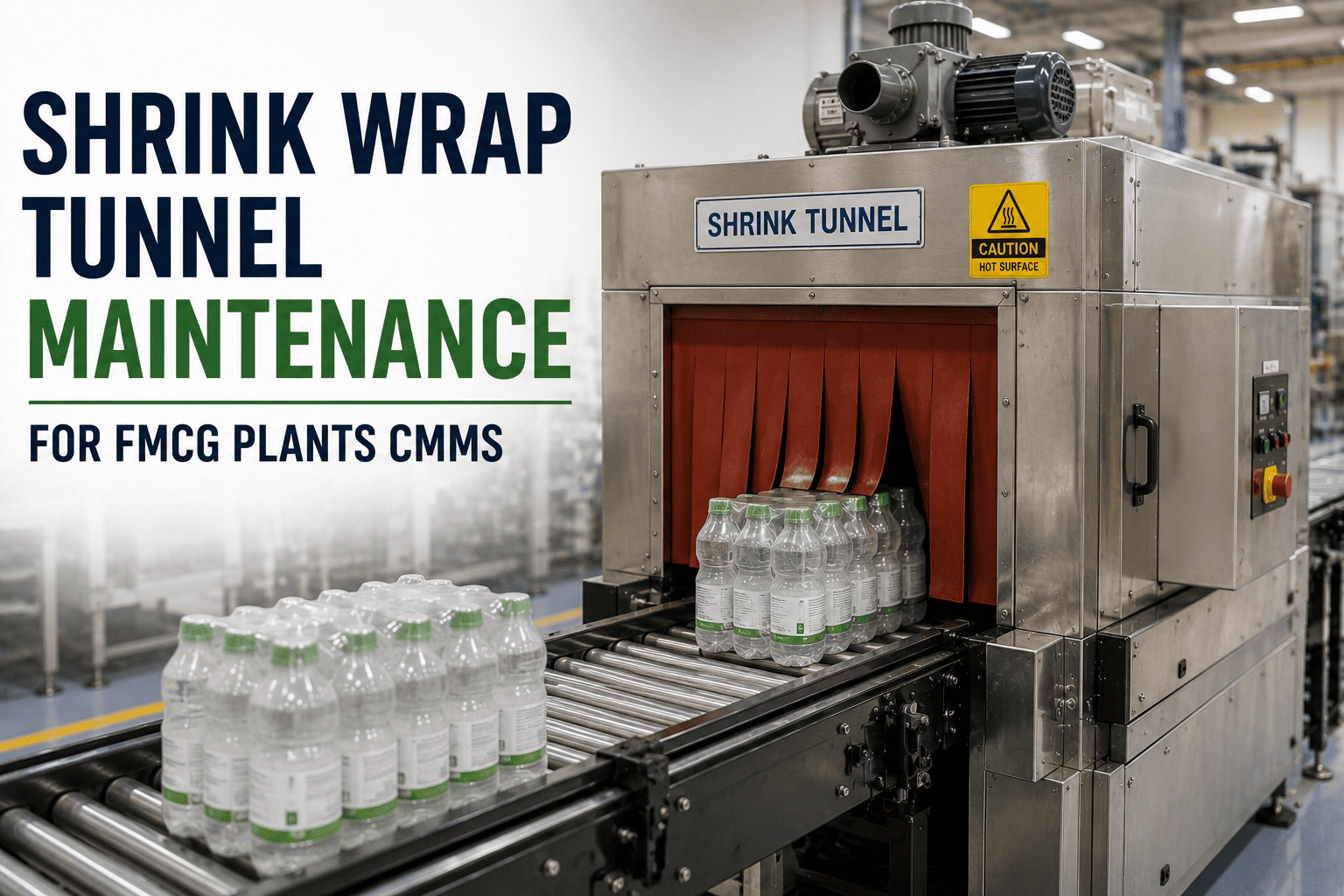
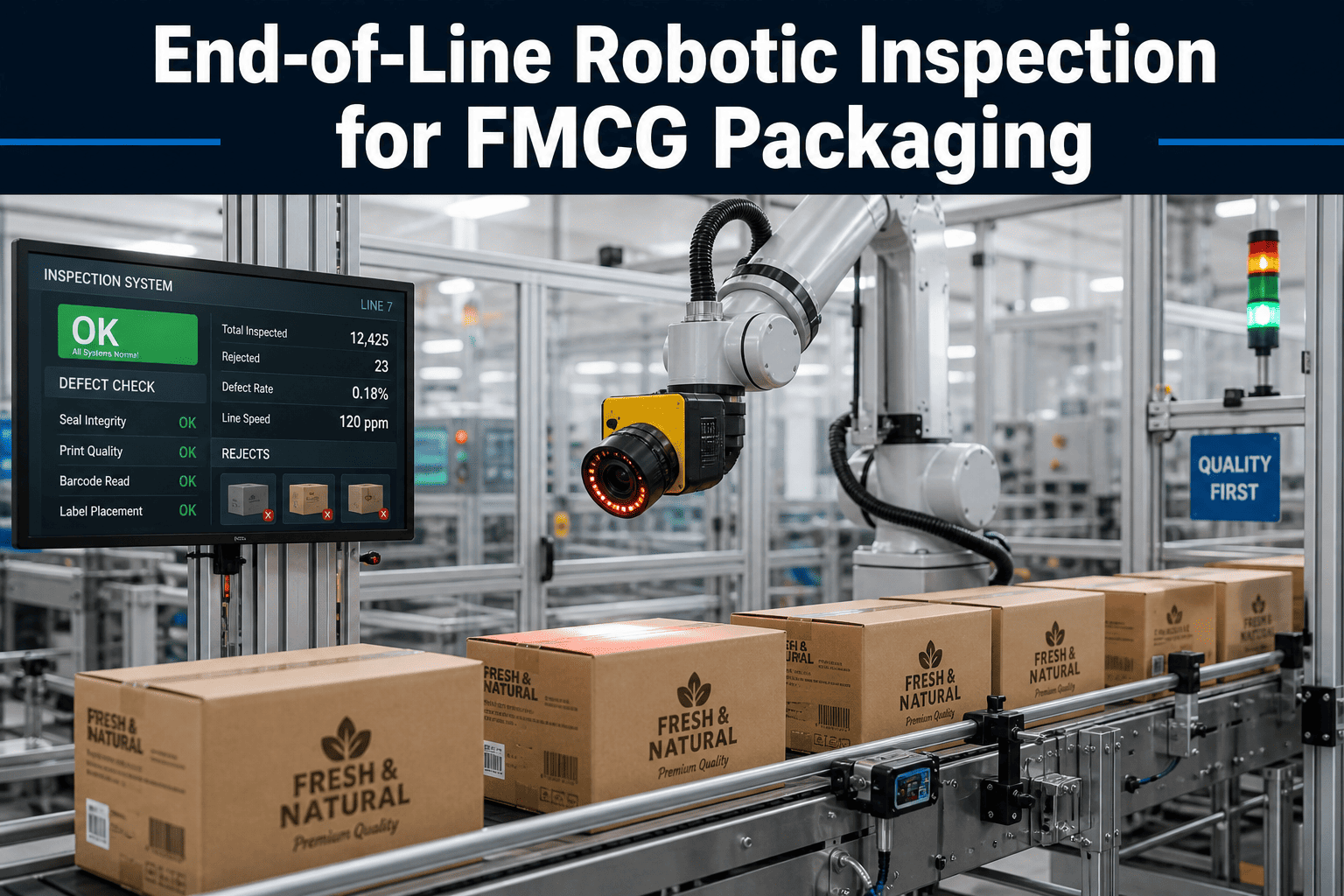
Every minute a shrink wrap line goes down, cases stack up on conveyors, pallets miss their dock appointments, and retail customers start fielding out-of-stock alerts. For fast-moving consumer goods manufacturers running shrink wrap robots across multiple end-of-line packaging stations, the real threat is not the cost of a replacement heating element — it is the $8,000-to-$22,000-per-hour production loss that follows an unplanned shutdown. With FMCG margins already compressed and retailers tightening delivery penalties, the operational resilience of your shrink wrap automation is no longer a maintenance question — it is a P&L question. Schedule a 15-minute operational walkthrough to see how structured maintenance intelligence can protect throughput across your packaging floor.
Why Shrink Wrap Robots Demand a Different Maintenance Playbook
Shrink wrap packaging robots operate under conditions that most general-purpose maintenance programs simply are not built for. They combine high-cycle mechanical motion with sustained thermal stress, adhesive film residue accumulation, and continuous interaction with variable product geometries — all running at line speeds that leave zero tolerance for hesitation or misfeeds. Treating them like standard conveyors or case packers creates gaps that compound into costly failures.
Shrink Wrap Robot vs. General Packaging Equipment Maintenance
General Packaging Equipment
Maintained on fixed quarterly or semi-annual schedules
Mechanical wear is gradual and predictable
Operates at stable, consistent temperatures
Spare parts are generic and widely stocked
Failure typically impacts a single packaging station
Shrink Wrap Robots (FMCG)
High-cycle operations require weekly to daily maintenance interventions
Heating elements, cutting blades, and film tensioners degrade rapidly under continuous thermal cycling
Heat tunnel temperatures (300–500°F) accelerate seal bar and conveyor belt wear
OEM-specific heating elements, sealing wires, and film dispensing rollers carry 4–8 week lead times
Failure cascades across the entire end-of-line — palletizer, stretch wrapper, and shipping dock stall simultaneously
Key Takeaway: Shrink wrap robots in FMCG environments need maintenance programs driven by cycle counts, thermal exposure hours, and real-time spare parts visibility — not calendar-based checklists borrowed from upstream equipment. A purpose-built CMMS closes this gap.
Anatomy of a Shrink Wrap Line — and What Fails First
A modern FMCG shrink wrap line is not a single machine — it is a coordinated system of film dispensing, product collation, sealing, heat tunnel shrinking, and cooling. Each subsystem has distinct failure modes, and a maintenance program that treats them uniformly will over-service some components while ignoring the ones that actually shut you down. Here are the six critical subsystems and the maintenance realities behind each.
Critical Subsystems and Maintenance Priorities
Subsystem 01
Film Dispenser & Unwind Station
Primary StressTension roller wear, film tracking drift
Failure RiskFilm wrinkles, misfeeds, and line jams
PM FocusMonthly sensor validation, quarterly E-stop and light curtain testing per OSHA 1910.147
Running multiple shrink wrap lines with different OEM configurations? Oxmaint lets you build subsystem-specific PM templates per line so every heat tunnel, seal bar, and film dispenser gets the exact maintenance its duty cycle demands.
The Preventive Maintenance Schedule Your Shrink Wrap Robots Actually Need
Most FMCG plants either over-maintain their shrink wrap lines — burning technician hours on tasks that do not matter this week — or under-maintain them until a heating element failure takes the entire end-of-line down for a full shift. The schedule below is built from OEM specifications, FMCG operational data, and ISO 55001 asset management principles — and is designed to be executed entirely through a CMMS like Oxmaint.
Recommended Shrink Wrap Robot PM Schedule
Task
Interval
Time Required
Work Order Type
Skill Level
Visual inspection: film path, seal quality, tunnel output
Every shift
5–10 min
Checklist inspection
Operator
Seal bar cleaning and sealing wire condition check
Daily
10–15 min
Condition-based inspection
Operator
Film tension calibration and roller surface inspection
Weekly
15–20 min
Scheduled PM
Technician
Heat tunnel element resistance testing and duct cleaning
Bi-weekly
30–45 min
Scheduled PM
Technician
Safety system validation (E-stops, light curtains, guards) per OSHA 1910.147
Monthly
30–45 min
Compliance work order
Technician
Cutting blade replacement and seal bar temperature recalibration
Every 500 operating hours
45–60 min
Scheduled PM
Technician
Servo motor diagnostics, conveyor belt replacement, full thermal profiling
Semi-annually
3–5 hours
Planned corrective
Engineer
Comprehensive line audit: mechanical, electrical, software, and compliance review
Annually
6–8 hours
Scheduled PM
Engineer
Oxmaint auto-generates these work orders based on operating hours, cycle counts, or calendar intervals — and tracks spare parts inventory so replacement heating elements and sealing wires are on hand before they are needed. Sign up to configure PM schedules for your specific shrink wrap line models.
Spare Parts Inventory: The Hidden Killer of FMCG Packaging Uptime
In FMCG packaging, a perfectly executed PM schedule means nothing if the replacement part is sitting in a warehouse six states away. Heating elements, sealing wires, cutting blades, and PTFE tape are consumables with short, predictable lifespans — yet most plants either overstock (tying up capital) or understock (inviting extended downtime). A CMMS-driven inventory approach eliminates both failure modes.
Critical Spare Parts Inventory Map for Shrink Wrap Lines
High-Turnover
Sealing Wires & PTFE Tape
Avg. Lifespan80–120 operating hours
Lead Time1–2 weeks (OEM), 2–3 days (aftermarket)
Stocking RuleMin. 4 weeks supply on hand per line
High-Turnover
Cutting Blades
Avg. Lifespan400–600 operating hours
Lead Time1–3 weeks depending on blade profile
Stocking RuleMin. 2 spares per line at all times
Critical
Heating Elements (Tunnel)
Avg. Lifespan3,000–5,000 operating hours
Lead Time4–8 weeks (OEM-specific)
Stocking RuleMin. 1 full set per tunnel; reorder at 75% estimated life
Critical
Conveyor Belts (Heat-Rated)
Avg. Lifespan6,000–10,000 operating hours
Lead Time3–6 weeks (custom width/material)
Stocking Rule1 spare per tunnel; track glazing progression monthly
Moderate
Film Tension Rollers
Avg. Lifespan8,000–12,000 operating hours
Lead Time2–4 weeks
Stocking Rule1 spare set per dispenser station
Moderate
Proximity Sensors & Photoeyes
Avg. Lifespan12,000–20,000 operating hours
Lead Time1–2 weeks (common models); 4+ weeks (OEM-proprietary)
Stocking Rule2 of each type; film dust accelerates failure
Quantifying the ROI: What Structured Maintenance Delivers to Your Bottom Line
When operations leaders ask whether a CMMS investment is justified for their shrink wrap lines, the answer lives in four numbers. These metrics come from FMCG packaging facilities that transitioned from reactive or paper-based maintenance to a digitally managed preventive program — and the impact on both uptime and annual maintenance spend was measurable within the first quarter.
Measured Impact of CMMS-Driven Shrink Wrap MaintenanceAggregated from FMCG packaging facilities, 2024–2025
52%
Reduction in unplanned end-of-line downtime after implementing automated PM scheduling and spare parts alerts
3.4×
Improvement in spare parts turn rate — less dead stock, fewer emergency freight charges for overnight element shipments
31%
Lower annual maintenance spend per shrink wrap line through optimized task scheduling and inventory right-sizing
94%
PM compliance rate achieved — up from an average of 48% with paper-based tracking and whiteboard scheduling
We used to lose an entire shift every two weeks to a heat tunnel element failure — not because the element was expensive, but because nobody tracked when it was due for replacement and we never had the right spare on the shelf. Within 90 days of deploying Oxmaint, we eliminated that failure mode entirely.
— VP of Operations, Multi-Site FMCG Beverage Manufacturer
Want to quantify what unplanned shrink wrap downtime is costing your facility? Book a personalized audit. We will walk through your current PM coverage, spare parts gaps, and the specific dollar impact of your most frequent failure modes.
Decision-Tree: How a $12 Sealing Wire Prevents a $100K Production Failure
The economic logic of preventive maintenance on shrink wrap lines is best understood as a cascade. A single missed inspection does not immediately cause a catastrophe — it starts a chain of degraded performance that compounds into a full production failure. The decision-tree below maps the two paths every maintenance decision creates, and the financial outcomes that follow.
Economic Impact Flowchart: The $12 Part vs. the $100K Failure
Decision Point: Sealing Wire at 85% of Rated Life
Path A — CMMS triggers replacement work order. Technician replaces $12 wire in 15 minutes during a scheduled changeover. Zero downtime. PM compliance logged. Spare auto-reordered. Total cost: $12 part + $18 labor = $30.
Failure Cascade: Wire Not Replaced (No CMMS Trigger)
Path B — Wire degrades undetected. Seal quality drops → intermittent rejects increase 15% → operators compensate with temperature increases → accelerated heat tunnel element wear → element fails mid-shift.
Financial Impact of Path B (Unmanaged Failure)
Element replacement: $850. Emergency freight: $1,200. Lost production (6-hour shutdown at $15K/hr): $90,000. Quality holds and customer chargebacks: $8,000–$15,000. Overtime labor for recovery: $3,500. Total exposure: $103,550–$110,550.
$100K+
Net Decision Value
The difference between Path A and Path B is not $12 — it is $100,000+. A CMMS does not just schedule tasks. It prevents the cascade from starting by ensuring every consumable is tracked against its operational life and every spare part is available before it is needed.
Work Order Analytics That Expose the Patterns Costing You Shifts
Every completed work order on your shrink wrap line is a data point. Most plants file them and forget them. Oxmaint structures that data into fleet-wide analytics that answer the questions packaging directors actually need answered: which lines are trending toward failure, where consumable costs are spiking, and whether your team is spending time on the right tasks.
Critical Maintenance KPIs for Shrink Wrap Operations
OEE Contribution by Line
Isolate how maintenance-related availability losses impact overall equipment effectiveness on each shrink wrap line. Target: maintain availability above 92% to protect downstream palletizing throughput.
MTBF Trending by Subsystem
Track mean time between failures for seal bars, heat tunnels, and film dispensers individually. A declining MTBF on a specific subsystem signals root-cause investigation is overdue — before it becomes a line-down event.
Consumable Cost per 10,000 Cases
Normalize spare parts consumption against production output to compare true maintenance efficiency across lines running different SKUs, film gauges, and shift patterns.
PM Compliance and Schedule Adherence
Monitor whether preventive tasks are completed on time, overdue, or skipped. In FMCG packaging, PM compliance below 85% is directly correlated with a 2–3× increase in emergency work orders within 60 days.
94%
From Reactive Firefighting to Predictive Packaging: Your Maturity Roadmap
No FMCG plant jumps from "replace it when it breaks" to AI-driven predictive models overnight. The path forward is staged, and every stage depends on the discipline and data infrastructure established in the one before it. A CMMS is the foundation — the system of record that makes each progressive stage possible. Here is where your shrink wrap maintenance program likely sits today, and the roadmap for where it needs to go to protect throughput as your operation scales.
Shrink Wrap Maintenance Maturity Journey
Stage 1
Reactive
Run shrink wrap lines until something fails. No operating-hour tracking, no spare parts visibility. Maximum unplanned downtime and emergency freight costs. Typical annual cost penalty: 18–25% above optimized baseline.
Stage 2
Preventive + Inventory
CMMS-scheduled PM tasks by operating hours and calendar intervals. Spare parts tracked with min/max reorder points. Eliminates 40–55% of unplanned downtime. The non-negotiable foundation for FMCG operational resilience.
Stage 3
Condition-Based
Monitor heating element resistance, seal bar temperature profiles, and motor current draw in real time. Trigger work orders when thresholds are crossed — not when the calendar says so. Extends component life 15–30% by eliminating premature replacements.
Stage 4
Predictive
AI models trained on historical work order data, thermal profiles, and production output predict heat tunnel element failures 2–3 weeks in advance. Near-zero unplanned downtime. Maximum asset lifecycle value extraction.
Oxmaint supports every stage — from basic PM scheduling and spare parts tracking to IoT-integrated condition monitoring and predictive analytics. Book a walkthrough to identify your current maturity stage and map the fastest path forward.
Your Shrink Wrap Lines Are Only as Reliable as Your Maintenance Program
Every missed PM task, every heating element that runs past its rated life, every sealing wire that fails mid-shift — it all compounds into lost production, retailer chargebacks, and eroded margins. Oxmaint gives your packaging maintenance team a single platform to schedule preventive tasks by operating hours, track every spare part from purchase order to installation, and surface the analytics that turn reactive firefighting into predictive operational resilience.
Can Oxmaint handle spare parts tracking for multiple shrink wrap OEMs on the same floor?
Yes. Every shrink wrap line — whether from ARPAC, Texwrap, Shanklin, Polypack, or any other manufacturer — is registered as an individual asset with its own bill of materials, spare parts catalog, and min/max reorder points. When a technician completes a work order and logs a part replacement, inventory levels update in real time and reorder alerts fire automatically when stock drops below threshold. You get unified visibility regardless of how many OEMs are on your floor.
Do we need to install sensors on our shrink wrap lines before we can use Oxmaint?
No. Oxmaint delivers immediate value through operating-hour-based PM scheduling, mobile inspection checklists, and integrated spare parts inventory — no additional sensors required. When your operation is ready to move into condition-based or predictive maintenance, Oxmaint integrates with IoT platforms and PLC data feeds to auto-trigger work orders from real-time equipment data. Sign up free to start with preventive scheduling and inventory tracking today.
How does Oxmaint help us meet OSHA compliance requirements for our packaging equipment?
Oxmaint generates compliance-specific work orders for safety system validations — including E-stop testing, light curtain verification, and lockout/tagout procedure audits per OSHA 1910.147. Every completed compliance task is time-stamped, photo-documented, and stored in a permanent audit trail. When inspectors request records, you export them in seconds rather than digging through filing cabinets.
How quickly can we have Oxmaint running for our shrink wrap operations?
Most FMCG packaging teams have their shrink wrap assets registered, PM schedules configured, spare parts catalogs loaded, and technicians submitting work orders within one to two weeks. Oxmaint's mobile-first design means minimal training — floor technicians are typically productive on day one, and supervisors have full dashboard visibility by the end of week one.
Can line operators report issues directly from the packaging floor?
Yes. Operators can submit maintenance requests from any smartphone or tablet — with photos of the issue, severity levels, and location tags. Requests flow directly into the work order queue where maintenance supervisors assign, prioritize, and track them through completion. This eliminates verbal handoffs, lost notes, and the delay between an operator noticing a degraded seal and the maintenance team acting on it.