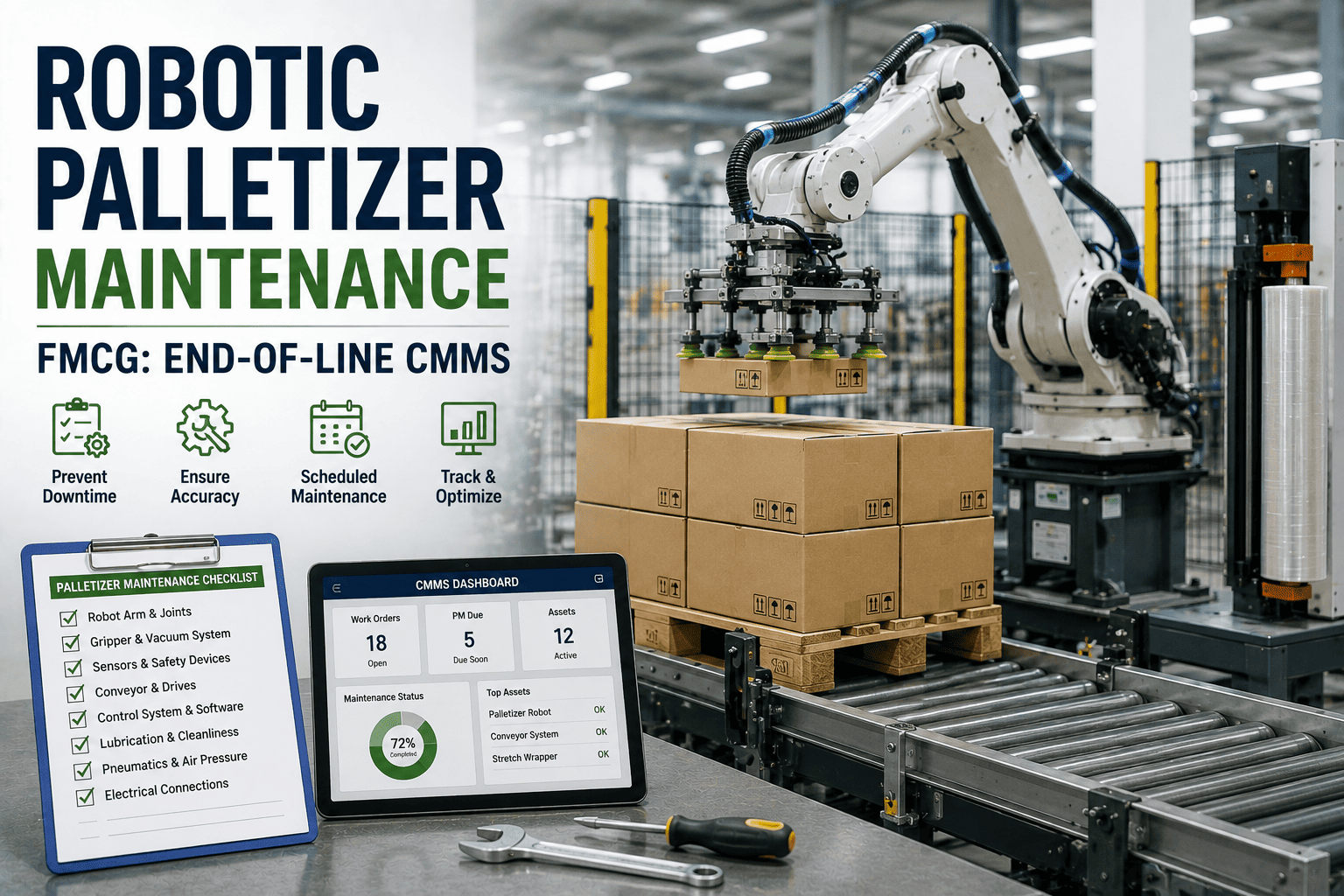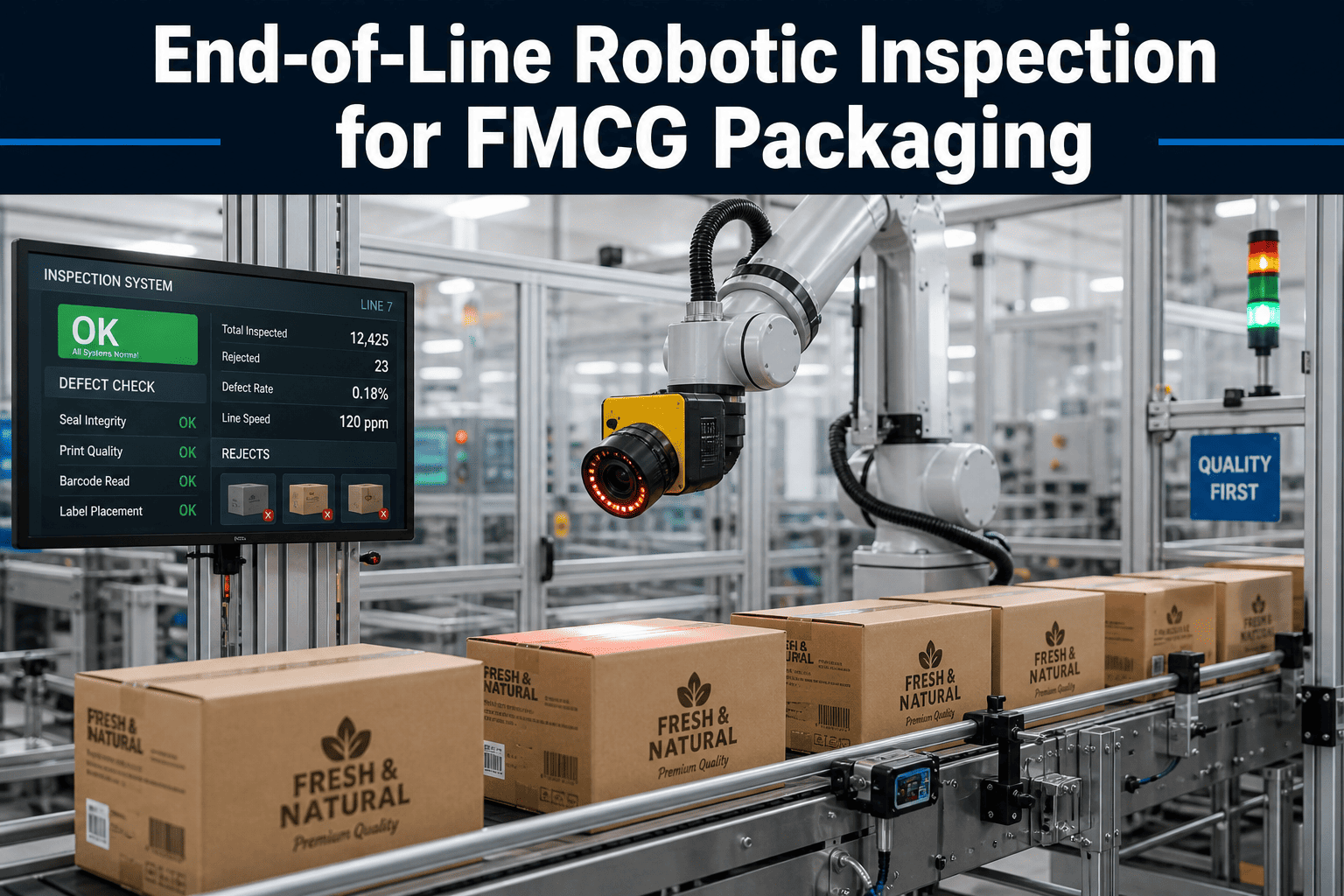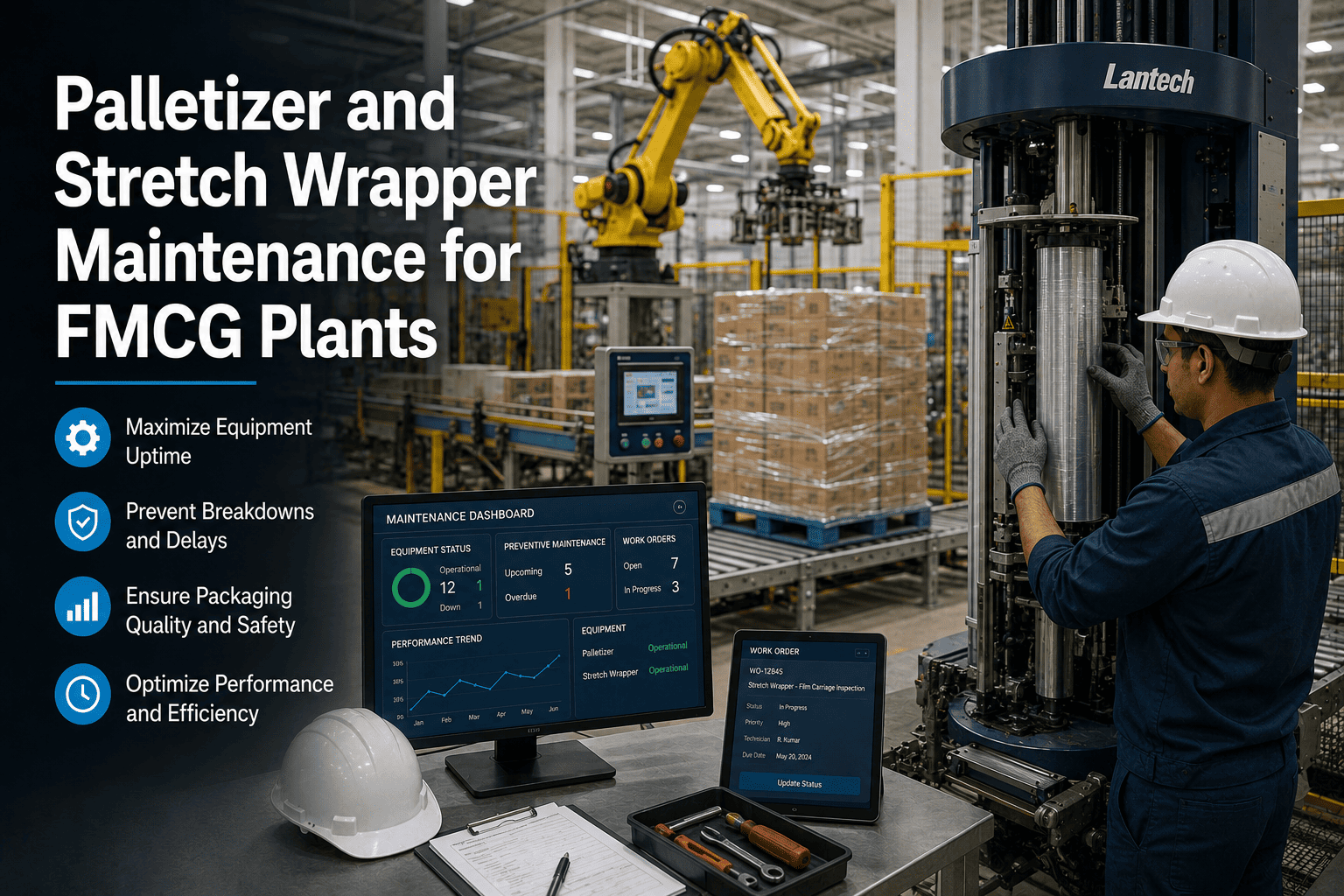
End-of-line is where FMCG plants either ship on time or do not ship at all. The palletizer and stretch wrapper sit at the last meter of every production line — and when either fails, the upstream filler, capper, labeller, and case-packer all back up within minutes. A single mid-shift palletizer fault on a 1,200-case-per-hour line burns roughly 90 cases of work-in-progress and forces operators into a manual stacking workaround that introduces a downstream shipping-damage risk. Across North American FMCG plants, robotic palletizers and stretch wrappers now account for 18 to 24% of end-of-line downtime hours despite representing under 8% of plant asset count. In European operations the picture is sharper still: aging facility workforces and rising labour costs push robotic palletizer payback below 24 months, but only for plants that hold uptime above 92%. Middle East and GCC operators running ADNOC-grade hygiene standards in personal care and beverage plants face the same end-of-line math with an additional constraint — replacement parts often carry a 6 to 10 week ocean-freight lead time. The plants that close this gap have stopped treating the palletizer and wrapper as standalone machines and started treating them as a single, instrumented end-of-line system. Operations leaders start a free trial or request a demo to see how Oxmaint operationalizes end-of-line maintenance across the palletizer-wrapper handoff.
Eliminate End-of-Line Downtime Where FMCG Plants Lose the Most
Robotic and layer palletizers, stretch wrappers, and film carriages tracked as a single end-of-line system. Every fault attributed, every spare staged, every shift handover digital — from North American beverage lines to European confectionery plants to Gulf personal-care operations.
- NA 1,200 cph robotic and high-level layer palletizers
- EU CE-compliant, EHEDG-aligned hygienic palletizer cells
- ME Gulf operators with extended spare-parts logistics
What End-of-Line Palletizer and Wrapper Maintenance Actually Covers
End-of-line maintenance is the structured set of asset-linked PMs, condition-monitoring inputs, and spare-staging decisions that keep the palletizer-stretch-wrapper pair running at line cadence. The palletizer side covers robotic-arm joints and end-effectors (or layer-palletizer hoist drives and row strippers), pattern-formation conveyors, infeed and outfeed photo-eyes, safety-fence interlocks, and vision systems used for case verification. The stretch wrapper side covers film carriages, pre-stretch rollers, turntable bearings, film cutters, top-sheet dispensers, and load sensors. Together they form one operational unit because the wrapper cannot start until the palletizer has finished and the next pallet cannot enter until the wrapper has released.
Where most FMCG plants lose value is in attribution. End-of-line faults get logged as generic "packaging downtime" rather than against specific sub-components, so the same row-stripper bearing fails three times before anyone notices the pattern. A working program treats every sub-component as a discrete asset with its own PM schedule and failure history — and runs the palletizer-wrapper handoff as a single instrumented workflow. Teams that start a free trial can configure their first end-of-line asset tree in under an hour.
The Six Sub-Component Classes That Drive End-of-Line Failures
Across robotic, layer, and high-level palletizers paired with rotary-arm or turntable stretch wrappers, six sub-component classes account for the substantial majority of end-of-line downtime. Each needs its own PM cadence and condition-monitoring input.
Each sub-component needs its own asset record, PM schedule, and failure history. Request a demo to see Oxmaint's end-of-line sub-component tree mapped against your specific palletizer-wrapper configuration.
Where End-of-Line Maintenance Programs Actually Break Down
FMCG plants rarely fail at the palletizer because the machine is poorly maintained. They fail because the workflow around it does not match the failure modes. Four patterns repeat across most operations.
Each pattern is a workflow gap that a sub-component asset tree closes — start a free trial to see how Oxmaint maps your end-of-line as one instrumented system.
How Oxmaint Operationalizes End-of-Line Maintenance
Oxmaint's end-of-line module treats the palletizer-wrapper pair as a single instrumented system — with each sub-component as a discrete asset, cycle-count and time-based PM running in parallel, and spare logistics built into the workflow from day one.
Six end-of-line failure patterns closed in one workflow — request a demo to map the configuration against your plant's specific palletizer and wrapper models.
Generic Packaging-Downtime Tracking vs Oxmaint End-of-Line Workflow
The difference between treating end-of-line as one line item and treating it as an instrumented sub-component system shows up in every metric a plant manager tracks.
| Operational Metric | Generic Packaging-Downtime | Oxmaint End-of-Line Workflow |
|---|---|---|
| Fault attribution level | Line-level only | Sub-component level |
| Row-strip bar replacement basis | Calendar interval | Cycle-count threshold |
| Recurring-failure detection | Quarterly review at best | Automatic pattern alerts |
| Spare-part lead-time awareness | Generic min-max stocking | Region-specific reorder logic |
| Palletizer-wrapper handoff visibility | Orphan conveyor, no owner | Modeled as discrete asset |
| CE / OSHA function-check logging | Paper, end-of-week entry | In-app at the asset |
| End-of-line OEE visibility | Monthly roll-up | Live, sub-component drill-down |
Outcomes Reported by FMCG Plants Across NA, EU, and ME Markets
Results from FMCG packaging operations — beverage, personal care, household products, confectionery, and snack — that activated Oxmaint's end-of-line workflow within the past 12 to 18 months.
End-of-line maintenance modernization pays back inside one operational quarter — request a demo to model the recovery profile for your specific palletizer-wrapper pair.
Frequently Asked Questions
Does Oxmaint support both robotic and high-level layer palletizers
How does the system handle cycle-count tracking from PLC sources
Can spare-part lead times be configured per facility location
Does the system integrate with stretch wrapper film-tension and load-containment sensors
Stop Losing End-of-Line Hours to Generic Packaging Downtime
Oxmaint treats the palletizer and stretch wrapper as one instrumented end-of-line system. Every joint, every roller, every row-strip bar, every safety interlock tracked as a discrete asset with its own PM cadence, failure history, and spare-logistics profile. From North American beverage plants to European confectionery lines to Gulf personal-care operations — end-of-line stops being the line item that hides the real losses.
- NA · EU · ME end-of-line palletizer-wrapper workflow
- PLC, vision, and tension-sensor integration built in
- CE Machinery Directive, OSHA 1910.212, GCC compliance-ready