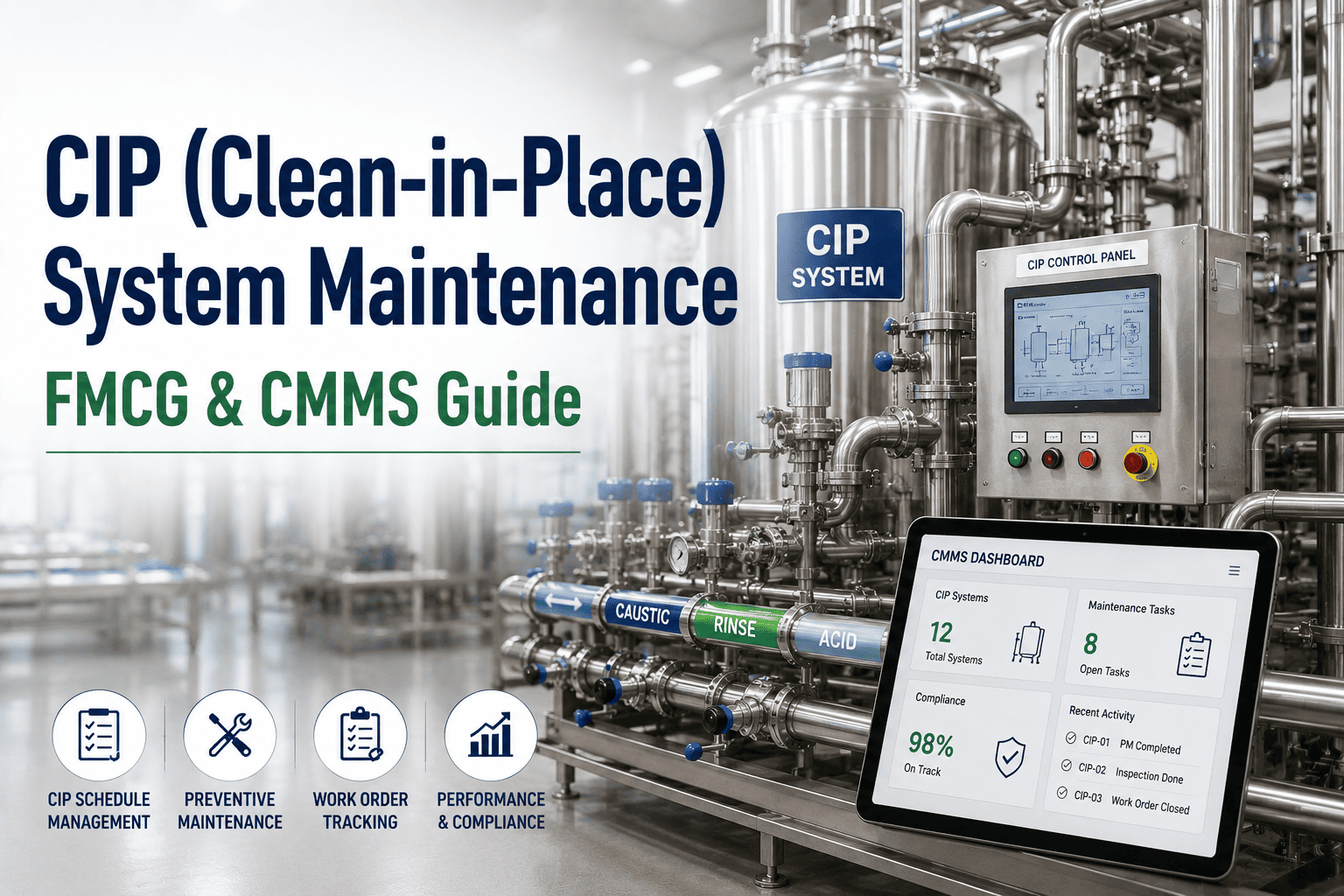
CIP (Clean-in-Place) System Maintenance FMCG & CMMS Guide

By Derek Whitfield on July 17, 2026

coming-soon

Clean-in-Place systems sit at the intersection of food safety and throughput — a single failed cycle can trigger a contamination event, a product hold, or hours of unplanned downtime on a filling line. For FMCG plants running 15–20 CIP circuits across dairy, beverage, and ready-to-eat lines, the maintenance discipline behind those cycles is what separates a 92% OEE line from one bleeding 8–12 hours weekly to re-cleans. This guide breaks down the PM routines, inspection cadences, and CMMS workflows that keep spray balls, dosing pumps, sensors, and valves validated — and shows how a structured Start Free Trial of oxmaint turns CIP maintenance from a paper chase into a closed-loop reliability program.

CIP Reliability · FMCG Maintenance

Is your next CIP cycle one failed sensor away from a product hold?

A single missed spray-ball inspection or a conductivity probe drifting 4% can turn a 38-minute cycle into a re-cleaning event — or worse, a contamination recall. The plants that consistently pass swab tests and hit cycle-time targets don't rely on memory; they run a CMMS-driven CIP maintenance program with enforced PM cadences, calibration logs, and cycle-parameter traceability.

43%
of FMCG CIP failures trace back to just three components — spray balls, dosing pumps, and conductivity sensors — all preventable with scheduled PM.
The Cost of Neglect

Why CIP maintenance is a food-safety KPI, not a janitorial task

In a typical FMCG plant running two shifts, a CIP circuit executes 8–14 cycles per day across silos, lines, and filler circuits. Each cycle is a validated sanitation event — and each one depends on five mechanical and chemical subsystems working within spec.

$28K
Average cost of a single re-cleaning event on a high-speed dairy line — lost production, chemicals, water, labor.
6–9 hrs
Weekly unplanned CIP downtime at mid-sized FMCG plants without a CMMS-enforced PM schedule.
38 min
Typical target cycle time for a dairy filler CIP — a 10-minute overrun compounds across 12 daily cycles.
Worked Example

A 180-asset beverage plant in the Midwest was spending roughly $42K annually on CIP-related re-cleans, ATP retests, and delayed changeovers. After implementing a CMMS-driven PM program — quarterly spray-ball inspection, monthly dosing-pump calibration, biweekly conductivity-sensor verification — re-cleaning events dropped 61% in the first quarter, and average CIP cycle time fell from 44 to 39 minutes, freeing ~5.2 production hours per week.

CIP Inspection Checklist

The five-component CIP maintenance checklist

Every CIP circuit fails through one of five subsystems. This tiered checklist maps the inspection task, the cadence, and the failure mode it prevents — designed to be loaded directly into a CMMS as PM triggers.

01

Spray balls & distribution

  • Remove and visually inspect for clogged, enlarged, or eroded nozzle orifices
  • Verify rotation on spinning-type balls under nominal flow pressure
  • Check coverage pattern via riboflavin or fluorescein test quarterly
Cadence: Quarterly
02

Chemical dosing pumps

  • Calibrate stroke length and frequency against titration results
  • Inspect check valves and diaphragms for chemical attack or fatigue
  • Verify dosing accuracy within ±2% across the full stroke range
Cadence: Monthly
03

Conductivity & temperature sensors

  • Two-point calibration with certified reference solutions
  • Inspect probe faces for fouling, coating, or electrode erosion
  • Verify RTD accuracy against a certified reference thermometer
Cadence: Biweekly
04

Valves & seat integrity

  • Leak-detect mix-proof valve seats and body vents
  • Inspect actuator stroke travel and positioner feedback
  • Replace valve seats on a fatigue-life schedule, not run-to-failure
Cadence: Semi-annual
05

Pumps & seals

  • Monitor mechanical seal flush flow and temperature trend
  • Vibration analysis on CIP supply and return pumps
  • Verify NPSH margin and check for cavitation signatures
Cadence: Quarterly
06

Cycle parameters & logging

  • Log time, temperature, concentration, and flow for every cycle phase
  • Flag any cycle that deviates beyond validated tolerance windows
  • Archive electronic batch records for audit and recall readiness
Cadence: Every cycle
CIP PM Schedule

Preventive maintenance cadence at a glance

The table below reflects industry-benchmark PM intervals for FMCG CIP systems. Plants operating in high-acid or high-fat product profiles should compress sensor and seal inspections by 30–40%.

Component PM Task Cadence Failure Mode Prevented
Spray ball Visual inspection + coverage pattern test Quarterly Incomplete surface coverage, residual soil
Dosing pump Stroke calibration vs. titration Monthly Under/over-dosing, cycle validation failure
Conductivity sensor Two-point calibration + probe cleaning Biweekly Phase-cut errors, chemical carryover
Mix-proof valve Seat leak detection + actuator stroke check Semi-annual Cross-contamination between product and CIP
CIP supply pump Vibration analysis + seal flush check Quarterly Flow loss, cavitation, seal failure
Heat exchanger Tube inspection + gasket replacement Annual Temperature deviation, cross-leak
Cycle log / SCADA Parameter deviation review + archive Every cycle Audit non-conformance, recall exposure
CMMS-Driven Reliability

From paper logs to a closed-loop CIP reliability program

Most FMCG plants already capture CIP cycle data in a SCADA or PLC historian — but that data rarely reaches the maintenance team in time to prevent the next failure. A CMMS closes the loop between cycle execution and PM action.

CIP Reliability Index
CRI = (Validated Cycles ÷ Total Cycles) × (PM Compliance %) × (Sensor Accuracy Factor)
A CRI above 0.92 correlates with sub-40-minute cycle times and zero re-cleans over a 30-day window. Below 0.78, expect weekly contamination holds.
Month 1

Asset & PM baseline

Load every CIP component — spray balls, pumps, sensors, valves, heat exchangers — into the CMMS with manufacturer specs, validated cycle parameters, and current PM history. Establish baseline CRI and cycle-time benchmarks.

Month 2

Trigger-based PM scheduling

Auto-generate PM work orders from cycle counts, calendar intervals, and deviation flags. A conductivity sensor that drifts past 2% tolerance automatically creates a calibration work order — no manual triage.

Month 3

Cycle-parameter traceability

Every CIP cycle — time, temperature, concentration, flow, conductivity — is logged against the asset and archived electronically. Audit readiness moves from days of manual compilation to a one-click report.

Month 4+

Predictive optimization

Trend analysis on cycle duration, chemical consumption, and sensor drift surfaces degrading components 2–4 weeks before failure. Cycle times tighten, chemical use drops 8–15%, and re-cleans approach zero.

Compliance & Validation

Audit-ready CIP records without the spreadsheet scramble

When a QA auditor or a customer due-diligence team asks for the last 90 days of CIP cycle records, plants without a CMMS spend 6–14 hours pulling, formatting, and reconciling data from three systems. With oxmaint, that same request is a filtered export.

Without CMMS
  • Paper log sheets scattered across shift handovers
  • Calibration records trapped in individual technician notebooks
  • Cycle deviations flagged manually, often days late
  • Audit prep takes 8–14 hours per event
  • No trend visibility until a failure occurs
With oxmaint CMMS
  • Every cycle logged to asset, timestamped, immutable
  • Calibration PMs auto-triggered and digitally signed
  • Deviations flagged in real time, routed to maintenance
  • Audit export in under 5 minutes — filter by line, date, or cycle
  • Live CRI dashboard and drift trends on every CIP circuit

Stop betting your next audit on a clipboard

Deploy a CMMS-built CIP maintenance program in days, not months — and turn every cycle into a validated, traceable, optimized record.

FAQ

CIP system maintenance — the questions plants ask most

How often should CIP spray balls be inspected in an FMCG plant?

Quarterly visual inspection is the baseline for most dairy and beverage circuits, but high-solids or high-fat product profiles may require monthly checks. A riboflavin or fluorescein coverage test should run at least twice a year to confirm the spray pattern hasn't degraded from nozzle erosion or mineral buildup. Any cycle showing a conductivity or turbidity anomaly between scheduled inspections should trigger an immediate spray-ball pull.

What conductivity sensor drift tolerance is acceptable before recalibration?

Most validated CIP programs flag any sensor reading that drifts more than ±2% from a certified reference solution. Beyond that threshold, phase-cut accuracy between rinse and chemical phases degrades — risking chemical carryover or incomplete rinse confirmation. A biweekly two-point calibration with probe cleaning keeps drift within spec, and a CMMS auto-generates the calibration work order when the threshold is crossed.

Can a CMMS actually reduce CIP cycle time, or does it only help with compliance?

Both. Compliance is the floor — cycle-parameter logging and audit-ready records are non-negotiable. But the bigger win is cycle-time optimization. By trending cycle duration, chemical consumption, and sensor drift together, a CMMS surfaces degrading components — a fouling heat exchanger, an aging dosing pump — weeks before they push a 38-minute cycle to 48. Plants typically see 8–15% cycle-time reduction within 90 days. You can Book a Demo to see the cycle-optimization dashboard live.

What cycle parameters must be logged for every CIP event?

At minimum: duration of each phase (pre-rinse, caustic, intermediate rinse, acid, final rinse), temperature at the return line, chemical concentration via conductivity or titration, flow rate or supply pressure, and the conductivity reading at the final rinse endpoint. These six parameters form the validation record auditors and QA teams expect — and they should be electronically archived against the specific asset and product that ran before the clean.

How quickly can a mid-sized FMCG plant deploy a CMMS for CIP maintenance?

A plant with 10–20 CIP circuits and existing SCADA cycle data can be fully live in 2–4 weeks. The bulk of the work is asset registration, PM-template setup, and integrating cycle-deviation triggers from the PLC historian. Once configured, the system runs on auto-generated work orders and requires only 15–20 minutes of maintenance-supervisor review per day to manage exceptions and sign off completed PMs.

Your CIP system is only as reliable as the maintenance program behind it

Join FMCG plants that cut re-cleans by 60% and reclaimed 5+ production hours weekly with a CMMS-driven CIP reliability program.

Free 14-day trial · No credit card


Share This Story, Choose Your Platform!