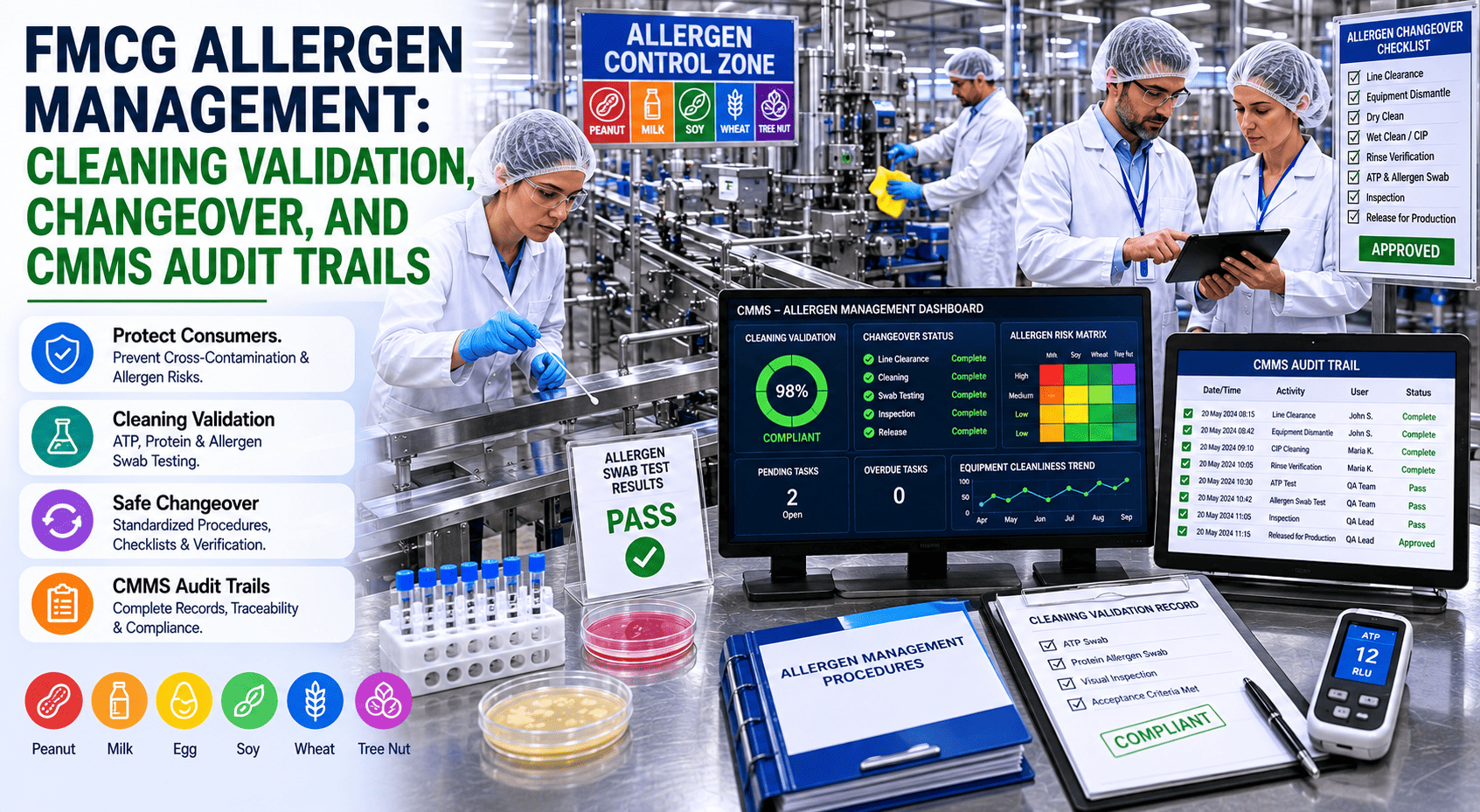
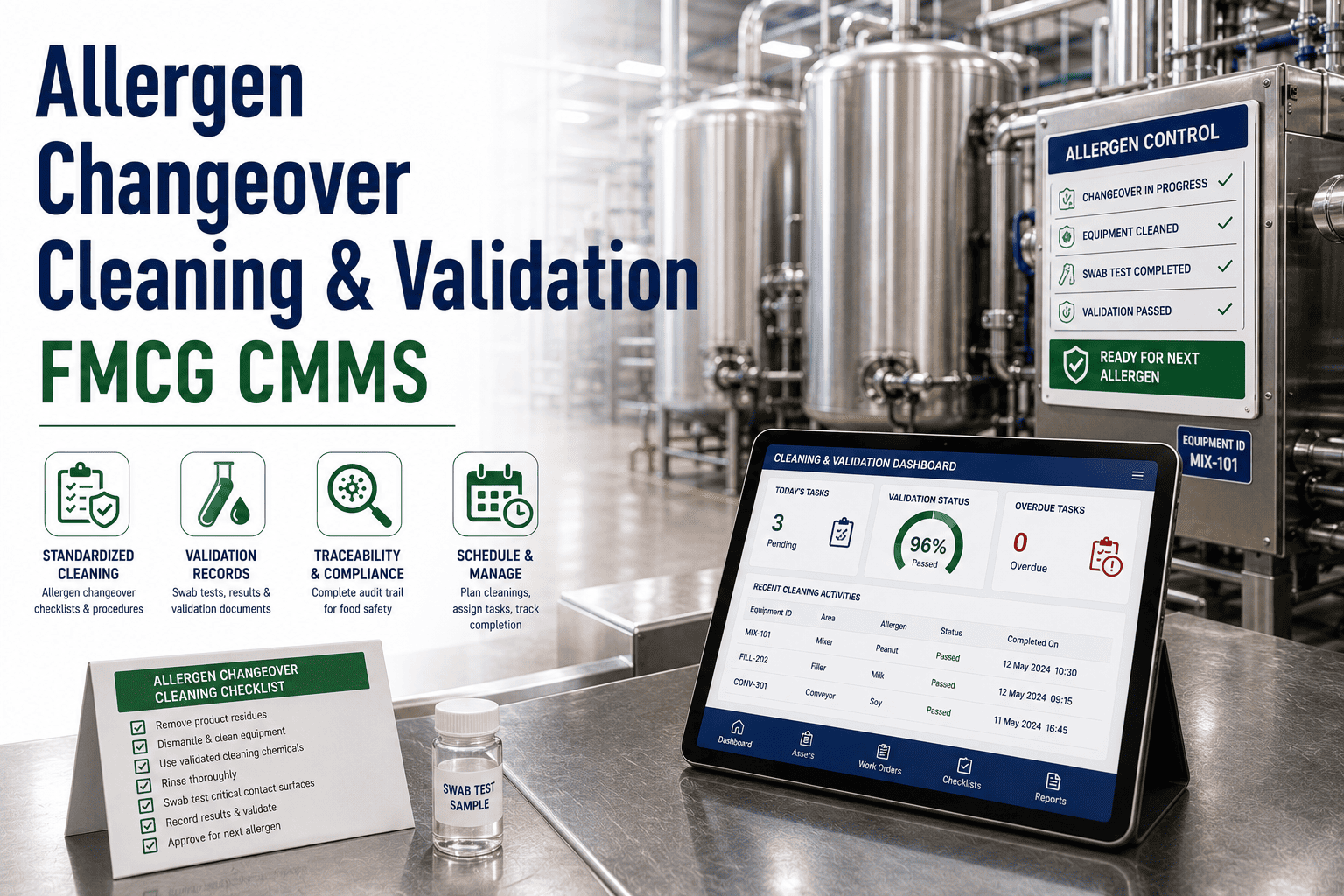
Undeclared allergens were responsible for 101 food recalls in 2024, representing 34% of all FDA recall events and maintaining their position as the single largest cause of food product withdrawals for three consecutive years. For FMCG manufacturers producing allergen-containing foods on shared lines, compliance depends not on avoiding allergens but on eliminating cross-contact through validated cleaning procedures, structured changeover workflows, and digital audit trails that prove every allergen risk was controlled before the next production run started. When these controls exist only as checklists and spreadsheet logs, FMCG plants face the recurring risk of undeclared allergen incidents where a free trial of Oxmaint's allergen management module replaces paper-based changeover sign-offs with ELISA-verified cleaning protocols, schedule-aware allergen sequencing, and timestamped batch traceability — or book a 30-minute demo to see how FMCG facilities digitize allergen control from changeover execution to regulatory audit readiness.
FMCG Food Safety · Allergen Control Programs
FMCG Allergen Management: Cleaning Validation, Changeover, and CMMS Audit Trails
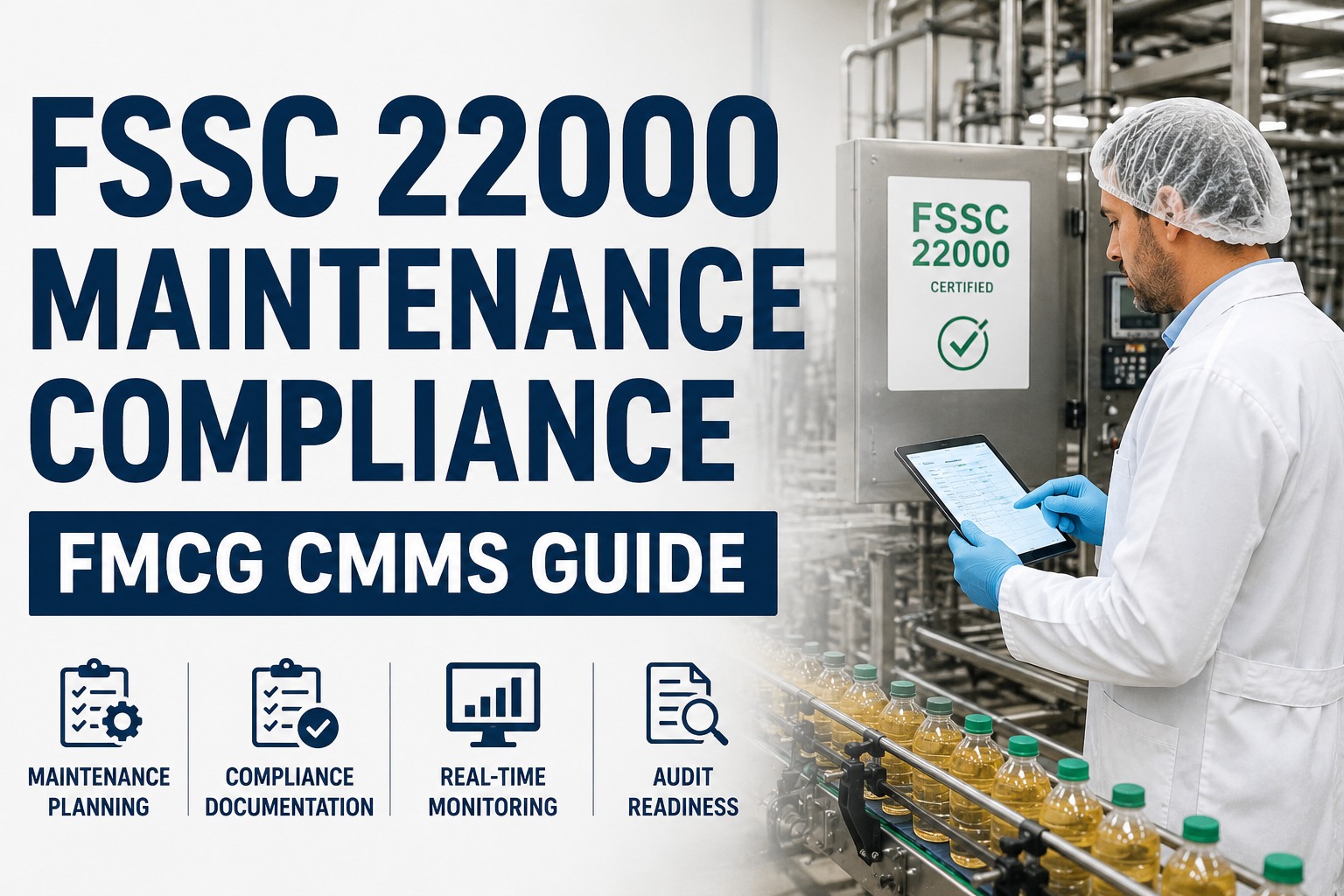
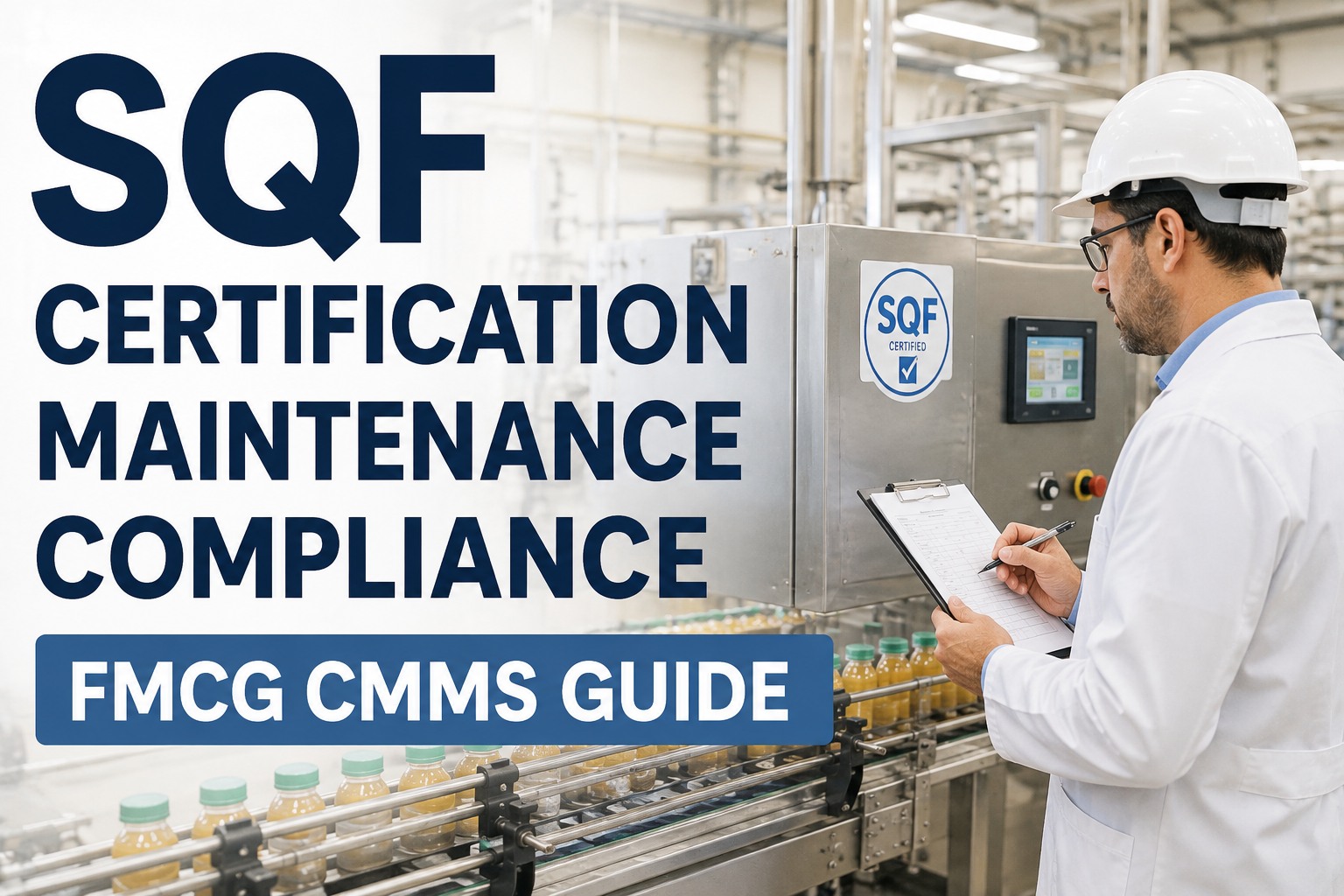
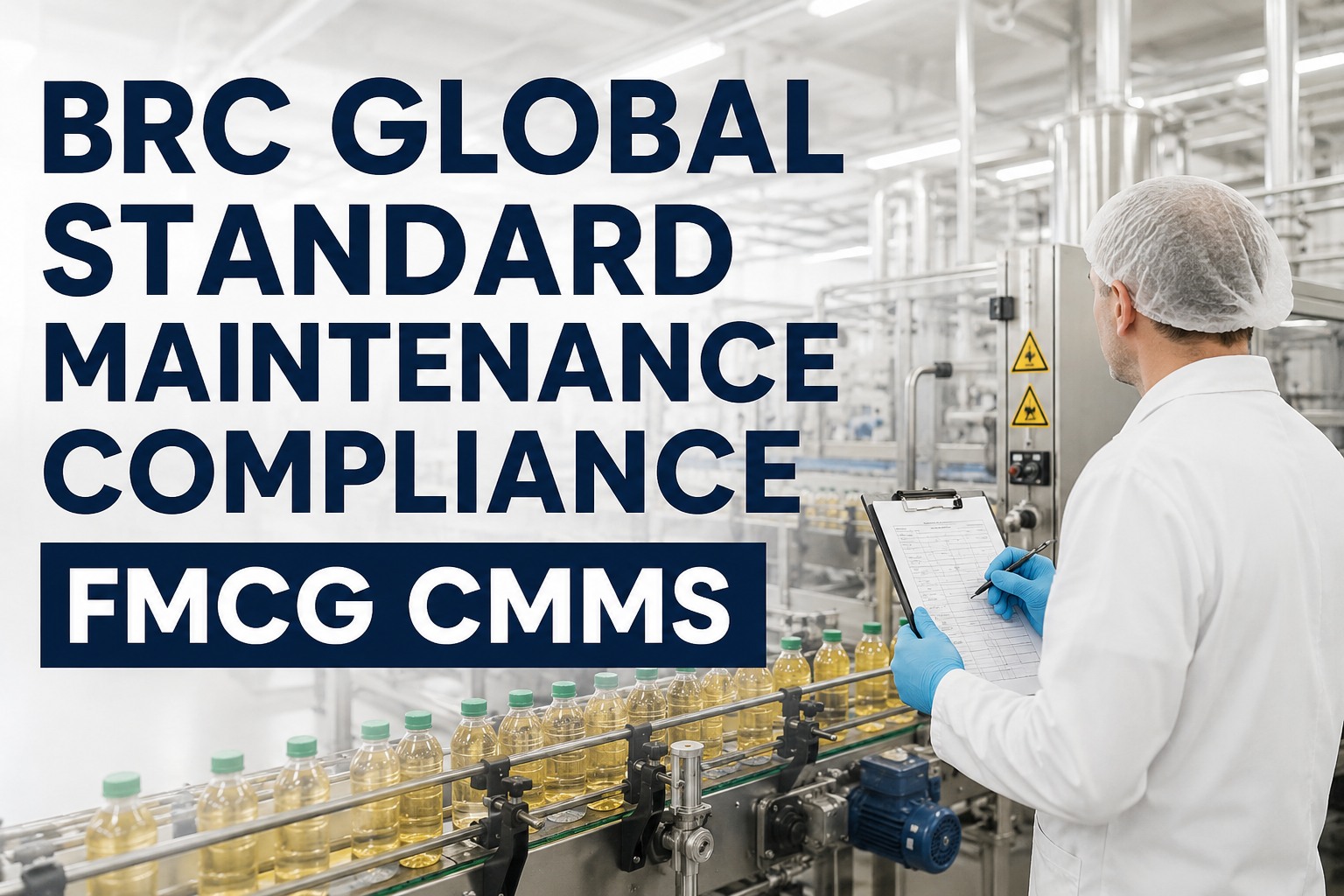
This guide covers how FMCG maintenance and quality teams implement validated allergen cleaning procedures, digital changeover protocols, and CMMS-driven audit trails that satisfy FSMA Preventive Controls, BRCGS Clause 5.3, SQF Element 2.8, and FSSC 22000 allergen management requirements across multi-line production facilities handling the nine FDA-recognized major food allergens.
101
Undeclared allergen recalls in 2024 (FDA) — 34% of all food recalls
22%
Class I recalls (most serious) caused by undeclared allergens
$10M
Average direct cost of a single undeclared allergen recall (GMA study)
42%
All FDA/USDA recalls in 2021–2022 due to undeclared allergens
What Is Allergen Management in FMCG Production Environments
Allergen management in FMCG manufacturing is the systematic process of identifying all allergenic ingredients present at a facility, documenting controls to prevent cross-contact between allergen-containing and allergen-free products, validating cleaning procedures to remove allergenic residues below detectable thresholds, and maintaining audit-ready records that prove allergen risks were controlled throughout production, changeover, and packaging. For facilities handling any of the nine FDA-recognized major food allergens — milk, eggs, fish, crustacean shellfish, tree nuts, peanuts, wheat, soybeans, and sesame — allergen management is not optional. It is a regulatory requirement under FSMA Preventive Controls, a fundamental requirement under BRCGS Issue 9 where noncompliance results in automatic audit failure, and a documented program requirement under SQF Edition 9 Element 2.8 and FSSC 22000 Version 6.
The operational challenge is that most FMCG facilities do not run dedicated allergen lines. They produce allergen-free and allergen-containing products on shared equipment, creating hundreds of allergen changeover events each month where the margin between compliant production and undeclared allergen contamination depends entirely on cleaning validation, swab verification, and digital documentation that proves the cleaning worked. Facilities that start a free trial gain access to allergen-aware production scheduling, equipment-specific cleaning protocols with mandatory ELISA verification, and automated batch traceability that links every finished product lot to the changeover cleaning records that preceded it.
The Eight Core Components of a Compliant FMCG Allergen Control Program
BRCGS, SQF, and FSSC 22000 define specific requirements for allergen management programs in food manufacturing. These eight components represent the operational baseline that FMCG facilities must implement to pass third-party food safety audits and satisfy FSMA allergen controls under the Preventive Controls for Human Food rule.
01
Allergen Risk Assessment and Site Mapping
Documented identification of every allergen present at the site, allergen flow maps showing how each allergen moves through receiving, storage, production, and packaging areas, and risk assessments for each potential cross-contact point including rework, shared equipment, and airborne contamination zones.
02
Equipment-Specific Validated Cleaning Procedures
Written cleaning procedures for every piece of shared equipment specifying disassembly steps, cleaning agents, contact times, rinse protocols, and swab verification requirements. Procedures must be validated through worst-case allergen challenge testing with ELISA or PCR confirmation that allergen residues are reduced to non-detectable levels.
03
Allergen-Aware Production Scheduling
Production sequences designed to minimize full allergen changeovers by running allergen-free products first, followed by products in allergen-ascending order. Reduces unnecessary cleaning downtime while maintaining safety. A facility running five allergen-free SKUs and eight allergen-containing SKUs can reduce daily changeover count from 22 to 18 through scheduling optimization.
04
Swab-Verified Changeover Execution
Digital changeover checklists requiring step-by-step completion of cleaning procedures, post-clean ELISA or lateral flow device swab testing at defined sampling points, and production hold until swab results confirm allergen levels are below threshold. A positive swab automatically re-triggers the cleaning procedure and blocks line restart.
05
Allergen Training and Competency Verification
Documented training programs covering allergen awareness, cross-contact risks, cleaning procedure execution, and swab collection technique for all personnel involved in production, sanitation, and maintenance. Training records must include competency verification through written tests or demonstrated proficiency before operators are authorized to perform allergen changeovers.
06
Rework and Hold Material Allergen Segregation
Physical segregation of rework and hold materials by allergen status, with color-coded containers, dedicated storage areas, and digital inventory tracking that prevents allergen-containing rework from being added to allergen-free products. Rework is the highest-risk allergen cross-contact point in most FMCG facilities because it bypasses the changeover controls applied to fresh ingredients.
07
Label Review and Packaging Change Control
Allergen-specific label review process requiring quality approval before any label change or new product introduction, with verification that all allergens present in the formulation are declared in bold on the ingredient statement and that precautionary allergen labeling is applied consistently based on documented risk assessments, not arbitrary decision-making.
08
Batch Traceability and Mock Recall Verification
Digital batch records linking every finished product lot to the allergen changeover cleaning records, swab results, and ingredient lot numbers that preceded production. Annual mock recall exercises verifying that allergen-related incidents can be traced forward to affected lots and backward to root cause within four hours, satisfying FSMA and GFSI traceability requirements.
The Four Allergen Control Failures That Drive Undeclared Allergen Recalls
FMCG facilities with documented allergen management programs still experience undeclared allergen incidents when execution does not align with written procedures. These four failure modes account for the majority of allergen recalls traced back to production and maintenance execution gaps across BRCGS, SQF, and FSSC 22000 certified facilities.
Failure Mode 01
Cleaning Procedures Documented But Not Validated for Allergen Removal
The facility has written cleaning procedures for shared equipment, but no validation study confirms that the procedures actually remove allergens to non-detectable levels. A procedure that removes visible residue and passes an ATP swab does not necessarily remove allergenic proteins below the 5 ppm detection limit of ELISA methods. Validation requires worst-case allergen challenge testing with quantitative analysis, not assumption.
Failure Mode 02
Swab Testing Performed After Cleaning But Results Do Not Gate Production
Post-clean swabs are collected and sent to the lab, but production restarts before results return. If the swab comes back positive for allergen residue, the next product run is already complete and contaminated. Swab-gated production means the line cannot restart until swab results confirm allergen levels are below threshold — adding 10 to 15 minutes to changeover time but eliminating the risk of releasing contaminated product.
Failure Mode 03
Allergen Changeover Checklists Signed Off Without Step-Level Verification
A changeover checklist shows all cleaning steps completed and signed, but no digital verification confirms the steps were actually performed in the correct sequence, with the specified cleaning agents, for the required contact times. Paper sign-off can be completed in 30 seconds; the actual cleaning takes 45 minutes. Digital changeover workflows require timestamped completion of each step before the next step unlocks.
Failure Mode 04
Rework Added to Production Without Allergen Status Verification
Rework from a previous run is added back into production based on visual identification or verbal confirmation, without digital verification that the rework allergen profile matches the current product formulation. This is the most common root cause of allergen cross-contact incidents in FMCG facilities because rework bypasses the ingredient receiving controls and changeover protocols that prevent allergen contamination from fresh materials.
Over 22% of Class I food recalls — the most serious category where exposure may cause serious adverse health consequences or death — are caused by undeclared allergens, making allergen control failures the highest-severity food safety risk in FMCG manufacturing.
How Oxmaint Converts Allergen Management Requirements Into Digital Operational Workflows
Oxmaint's FMCG allergen management module provides the structured digital infrastructure that maintenance and quality teams need to execute validated cleaning procedures, enforce swab-gated changeover protocols, and maintain audit-ready batch traceability that satisfies BRCGS, SQF, FSSC 22000, and FSMA allergen control requirements. The platform eliminates the execution gaps, documentation theater, and traceability failures that generate undeclared allergen recalls even when allergen management programs appear compliant on paper.
Equipment-Specific Validated Cleaning Protocols
Digital cleaning procedures specific to each piece of shared equipment, with validated parameters for disassembly, cleaning agent type and concentration, contact time, rinse protocol, and swab sampling points. Each procedure links to the validation study confirming allergen removal to non-detectable levels, with revalidation triggers when equipment is modified or cleaning agents change.
Swab-Gated Production Release with ELISA Integration
Post-clean allergen swab results enter the changeover work order directly from lateral flow devices or lab ELISA systems. A positive result automatically re-triggers the cleaning procedure and locks the production line until retest confirms allergen levels are below threshold. Production cannot restart without verified swab clearance — no manual override, no production pressure bypass.
Allergen-Aware Production Scheduling Engine
AI-driven production sequencing that reads your allergen matrix and product demand to automatically schedule runs in allergen-ascending order, minimizing full allergen changeovers while satisfying customer deadlines. A four-line bakery reduced allergen-driven full cleans by 40% through intelligent grouping, cutting daily changeover time by 18% without compromising food safety.
Timestamped Digital Changeover Execution
Mobile changeover checklists requiring step-by-step completion with photo verification, barcode scanning of cleaning agents to confirm correct chemicals were used, and time-stamped completion records that prove each cleaning step was executed in sequence. A checklist cannot be signed complete until every step is digitally verified — eliminating the 30-second paper sign-off that bypasses actual execution.
Rework Allergen Tracking and Release Approval
Digital rework inventory with allergen status tagging, barcode linking to source batch records, and automated approval workflows that block rework addition to production unless allergen profiles match. When a production order calls for allergen-free product, the system prevents addition of rework containing milk, egg, or any declared allergen — enforcing segregation without relying on operator memory.
Batch-Level Allergen Traceability and Mock Recall Readiness
Every finished product batch links to the allergen changeover cleaning records, swab results, and ingredient lot numbers used in production. Mock recall exercises generate complete traceability reports in minutes — identifying which batches were produced after a failed swab, which ingredient lots contributed to allergen exposure, and which customers received potentially affected product.
Multi-site FMCG operations gain portfolio-level visibility into allergen control performance across all facilities, with comparative dashboards showing which sites have the highest changeover failure rates, the longest swab clearance times, or the most frequent allergen-related customer complaints, and can book a demo to see how portfolio reporting works across geographically distributed allergen management programs.
Paper-Based Allergen Control vs Digital CMMS-Driven Allergen Management
BRCGS Clause 5.3 and SQF Element 2.8 require validated allergen cleaning procedures and ongoing verification of effectiveness. This comparison illustrates the operational and audit-readiness difference between paper-based allergen control programs and digital CMMS-driven systems that enforce execution, verify cleaning effectiveness, and maintain audit-ready traceability.
| Control Activity |
Paper-Based Allergen Control |
Digital CMMS Allergen Management |
| Cleaning Procedure Access |
SOPs in binders on production floor. Generic procedures applied to all equipment. No validation link. |
Equipment-specific digital procedures with photos, disassembly diagrams, and validated parameters. Accessible via mobile device at point of use with QR code linking to validation study. |
| Changeover Execution Verification |
Checklist signed complete by operator at end of cleaning. No step-level verification. 30-second sign-off possible. |
Timestamped digital completion of each cleaning step required before next step unlocks. Photo verification and barcode scanning of cleaning agents enforced. Impossible to skip steps. |
| Swab Testing and Production Release |
Swabs collected and sent to lab. Production restarts before results return. Positive swab discovered after next product run is complete. |
Lateral flow or ELISA swab results enter changeover work order directly. Production locked until swab clearance confirmed. Positive result auto-triggers recleaning before line restart approved. |
| Rework Allergen Control |
Rework stored in labeled containers. Operator visually verifies allergen status before adding to production batch. Reliance on memory and label reading. |
Rework tagged with allergen profile in digital inventory. Barcode scan required to add rework to batch. System blocks addition if allergen status does not match production order. No manual override. |
| Training and Competency Records |
Attendance sheets for allergen training sessions. No competency verification. Training records stored in HR files separate from production records. |
Digital training assignments with completion tracking, competency quizzes requiring 85% pass rate, and operator authorization linked to changeover work orders. Untrained operators cannot execute allergen changeovers. |
| Batch Traceability and Mock Recall |
Manual assembly of batch records, changeover logs, and swab results from multiple binders and Excel files. Mock recall takes 8–12 hours to complete traceability investigation. |
One-click batch traceability report showing all changeover cleaning records, swab results, and ingredient lot numbers linked to finished product batch. Mock recall investigation complete in under 30 minutes. |
FMCG Allergen Management: Measurable Outcomes from Digital Implementation
FMCG facilities that implement digital allergen management systems with validated cleaning protocols, swab-gated production release, and automated batch traceability achieve measurable reductions in allergen incidents, changeover time, and audit non-conformances. These outcomes are derived from facilities using Oxmaint's allergen management module across bakery, confectionery, snack food, and prepared meal production environments.
68%
Reduction in Allergen-Related Customer Complaints
First 18 months post-implementation vs 18-month baseline period
Zero
Undeclared Allergen Recalls
Across facilities with 24+ months of swab-gated changeover enforcement
58%
Reduction in Average Allergen Changeover Time
Through schedule optimization and validated procedure enforcement
4.2×
Faster Mock Recall Completion
Median time from initiation to complete traceability report
92%
First-Pass Swab Clearance Rate
Post-clean allergen swabs passing threshold on first test
$8.7M
Avoided Recall Cost Per Facility
Based on preventing one moderate undeclared allergen recall event
Industry Expert Perspective on FMCG Allergen Management
JT
Jennifer Torres
Food Safety Consultant · BRCGS Lead Auditor · Former FMCG Quality Director
The allergen management programs I audit fail not because facilities lack written procedures or training programs — they fail because execution does not match documentation, and there is no enforcement mechanism to close that gap. I see changeover checklists signed complete in 30 seconds for procedures that require 45 minutes to execute properly. I see swab results that come back positive three hours after production restarted, contaminating the next batch. I see rework added to allergen-free products based on verbal confirmation instead of digital verification of allergen status. These are not documentation failures — they are operational execution failures that paper-based systems cannot prevent. Digital allergen management platforms like Oxmaint solve this by making execution gaps impossible. A changeover checklist cannot be signed complete until every step is timestamped. Production cannot restart until swab results confirm allergen clearance. Rework cannot be added unless the system verifies allergen profiles match. For FMCG manufacturers operating under BRCGS, SQF, or FSSC 22000, this enforcement layer is the difference between a program that passes audits because documentation looks good and a program that prevents undeclared allergen incidents because execution is verified at every step.
Frequently Asked Questions
What is the difference between allergen cleaning validation and verification in FMCG facilities?
Allergen cleaning validation is the initial study that confirms a cleaning procedure removes allergens to non-detectable levels under worst-case conditions. It involves applying the maximum allergen load to equipment, executing the cleaning procedure, and testing with quantitative ELISA or PCR to verify residues are below 5 ppm detection limits. Validation is performed once per equipment type and allergen combination, with revalidation required when equipment or procedures change. Allergen cleaning verification is the ongoing swab testing performed after each changeover to confirm the validated procedure continues to work in routine production. Verification uses lateral flow devices or ELISA swabs to detect allergen residues at predefined sampling points, confirming the line is clear before production restarts.
Start a free trial to configure validation study tracking and ongoing verification workflows linked to production release.
How does allergen-aware production scheduling reduce changeover time without compromising food safety?
Allergen-aware scheduling sequences production runs in allergen-ascending order — running allergen-free products first, followed by products containing progressively more allergens. For example, a bakery line might run plain crackers, then sesame crackers, then peanut butter crackers. This sequence requires only one full allergen changeover at the end of the shift instead of three full changeovers if products were run in demand-only order. The allergen-free product to allergen-containing product transition requires validated cleaning, but allergen-to-allergen transitions of the same allergen require only standard sanitation. A four-line FMCG facility reduced daily allergen changeovers from 22 to 18 through intelligent scheduling, cutting total changeover time by 18% while maintaining full allergen control.
Book a demo to see how AI production scheduling optimizes allergen sequencing for your specific product portfolio.
Can FMCG facilities use lateral flow devices instead of ELISA for allergen swab verification?
Lateral flow devices are acceptable for routine allergen verification if the facility has validated correlation between lateral flow results and quantitative ELISA results during the initial cleaning validation study. Lateral flow devices provide qualitative yes/no detection at predefined threshold levels, typically 5 to 10 ppm, and deliver results in 10 minutes without laboratory equipment. This makes them ideal for at-line swab verification where production release cannot wait for lab ELISA turnaround. However, validation studies must use quantitative ELISA to confirm allergen removal levels, and periodic verification with ELISA is recommended to confirm lateral flow devices continue to correlate with laboratory methods. Oxmaint supports both lateral flow and ELISA swab workflows, with automated selection of the appropriate method based on the changeover type and risk level.
What documentation must FMCG facilities maintain to satisfy BRCGS allergen management audit requirements?
BRCGS Clause 5.3 requires a documented allergen policy, site-specific allergen risk assessment, validated cleaning procedures for all shared equipment, ongoing verification records showing swab testing frequency and results, allergen training records with competency verification, rework segregation and usage logs, label review procedures with allergen-specific approval steps, and annual mock recall documentation proving batch-level traceability. All records must be timestamped, attributable to specific personnel, and retained for the duration required by customer specifications or regulatory requirements. Digital CMMS systems like Oxmaint automatically generate and retain these records as production, cleaning, and changeover activities occur, eliminating the manual assembly of documentation during audit preparation and reducing the risk of missing records that generate audit non-conformances.
Allergen Control · Cleaning Validation · BRCGS | SQF | FSSC 22000 Compliance
Stop Managing Allergen Changeovers with Paper Checklists
Oxmaint gives you the validated cleaning protocols, swab-gated production release, allergen-aware scheduling, and batch-level traceability that FMCG facilities need to prevent undeclared allergen incidents and pass BRCGS, SQF, and FSSC 22000 allergen management audits without execution gaps or missing documentation.
- Equipment-specific cleaning procedures with ELISA-verified validation studies
- Swab-gated production lock preventing line restart until allergen clearance confirmed
- Rework allergen tracking with automated release approval based on digital verification
Used by FMCG facilities managing allergen programs across 8+ production lines. 68% reduction in allergen-related customer complaints within the first 18 months. Measurable ROI through avoided recall costs and reduced changeover time.