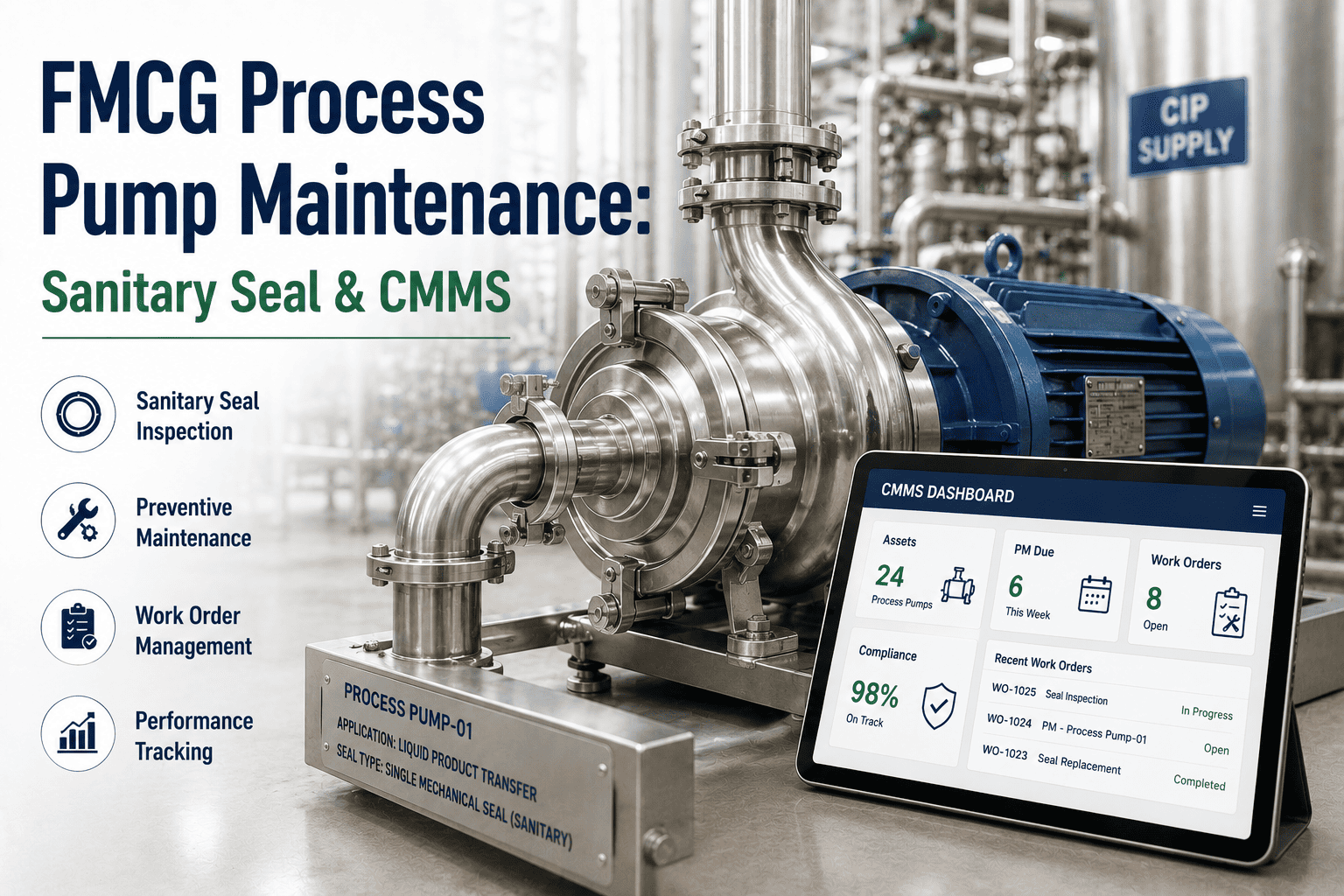
Sanitary process pump seals are the single most frequently replaced consumable on the wet side of every FMCG plant — a single mechanical seal failure can dump 200–600 liters of product, trigger a CIP rewash, and halt a filling line for 2–4 hours. Because seal failures are simultaneously a reliability event and a food-safety event, they belong inside a structured CMMS work-order program rather than a run-to-failure mindset. This guide breaks down FMCG process pump maintenance for sanitary seal and CMMS workflows: PM cadence by pump type, condition-monitoring thresholds, spare-seal stock logic, and the CMMS reliability program that keeps centrifugal and positive-displacement pumps audit-ready. Ready to operationalize it? You can Start Free Trial and build your pump PM plan today.
Is a single failed sanitary seal quietly costing your line $18,000 a week?
For most FMCG plants, mechanical seals are the highest-turnover wet-side consumable — and the least tracked. Without a CMMS-driven seal PM cadence, bearing wear, product dilution, and CIP thermal shock compound until a $400 seal becomes a multi-thousand-dollar line stop.
The cost of doing nothing: what a seal actually costs your plant
A standard single mechanical seal on a centrifugal sanitary pump runs $250–$650 as a part — yet the fully loaded cost of its failure averages $4,800–$14,000 once product loss, CIP rewash, labor, and lost OEE are counted.
A 180-asset dairy plant spending $42K/yr on seal failures
A Midwest UHT dairy running 47 process pumps was logging 110 unplanned seal changes per year at an average loaded cost of $5,200 each — roughly $57,200 in seal-driven downtime alone, before counting the bearing damage that often followed. After moving sanitary seal PM into a CMMS with 90-day inspection cadence, flush-plan monitoring, and min/max spare-seal thresholds, unplanned seal events dropped 61% in the first year and seal spend fell to $22,400. Payback on the CMMS implementation was under four months.
Maintenance ROI: what a CMMS-driven seal program pays back
The economics of sanitary seal maintenance are unusually clean because the failure mode is well-understood, the parts are standardized, and the cost of inaction is fully measurable. Use these formulas to size the opportunity at your own site.
N = pumps in service · F = failures/pump/yr · P = part cost · L = labor · C = CIP + product loss · D = downtime cost per event. Most FMCG sites find F drops from ~2.4 to under 0.9 once CMMS-scheduled PM is live.
S = CMMS subscription (annual) · I = implementation cost · AC₀ = pre-CMMS annual seal cost · AC₁ = post-CMMS annual seal cost. Typical FMCG payback: 3–6 months when seal PM is one of the first three workflows deployed.
| Seal Program Metric | Run-to-Failure | Time-Based PM | CMMS + Condition-Based |
|---|---|---|---|
| Unplanned seal events / pump / yr | 2.3 – 3.1 | 1.1 – 1.6 | 0.4 – 0.8 |
| Mean time to detect leakage | 9 – 14 days | 3 – 5 days | < 24 hours |
| Average loaded cost per event | $5,200 | $3,400 | $1,900 |
| Spare seal stockout rate | 22% | 9% | < 2% |
| Seal-related product hold/recall risk | High | Moderate | Low — logged & auditable |
| Audit-ready PM records | Manual / incomplete | Spreadsheet | Auto-archived in CMMS |
Sanitary pump maintenance checklist by pump type
Centrifugal and positive-displacement pumps fail differently and need different PM cadences. The checklist below is calibrated for FMCG wet-side duty — CIP-capable, product-contact, running 16–24 hr/day.
- Inspect mechanical seal for product-side weepage; log drip rate (target: 0 drops/min at rest).
- Check flush-plan flow (API Plan 53A or 54 equivalent) and barrier-fluid level.
- Vibration trend at drive-end and pump-end bearings (alarm: 0.18 in/s RMS).
- Verify shaft alignment with laser tool — angular misalignment under 0.002 in/in.
- Confirm impeller clearance and back-pull-out seal condition.
- Grease bearing per LubePlan; purge old grease, do not over-lubricate.
- Photograph seal faces and upload to CMMS work order for audit trail.
- Inspect rotor-to-stator clearance (lobe / circumferential-piston / PC types).
- Check double mechanical seal barrier fluid pressure (must exceed product pressure by 10–15%).
- Trend motor amperage under normal load — rising amps signal rotor wear.
- Verify relief valve setting and CIP-bypass operation.
- Inspect O-rings and elastomeric seats for swelling, hardening, or product ingress.
- Check gear-case oil level and moisture (target: < 200 ppm water).
- Confirm pump mounting bolts torqued to spec; re-torque after thermal cycling.
- Inspect bellows seal for thermal fatigue cracking (UHT, HTST, pasteurizer feed).
- Verify CIP/SIP thermal-shock log — rapid temperature swings > 60°C are the leading aseptic seal killer.
- Check steam-trap operation on heated seal flush lines.
- Trend barrier-fluid temperature; flag excursions above 80°C.
- Inspect insulation and clamp fittings for product-side pooling that masks early leakage.
- Validate pressure-hold test before every aseptic run, logged in CMMS.
| Inspection Task | Centrifugal | Positive Displacement | Aseptic Duty | Trigger Threshold |
|---|---|---|---|---|
| Seal weepage visual check | Weekly | Weekly | Per shift | Any visible drip |
| Vibration trend (DE + NDE) | 30 days | 30 days | 30 days | 0.18 in/s RMS |
| Barrier fluid level / pressure | — | 30 days | Per shift | Below product pressure |
| Laser shaft alignment | 90 days | 90 days | 90 days | 0.002 in/in angular |
| Bearing grease / oil service | 180 days | 90 days | 90 days | Per LubePlan |
| Full seal replacement | 18–24 mo | 12–18 mo | 9–12 mo | Performance-based |
From spreadsheet PM to a closed-loop pump reliability program
A CMMS turns sanitary seal maintenance from a calendar-driven chore into a closed-loop reliability workflow — detection, work order, parts, execution, and audit archive all in one record. Below is the recommended 6-month rollout for an FMCG site bringing pumps under CMMS control.
Build the pump asset hierarchy
Import every process pump as a parent asset with seal, bearing, motor, and flush plan as child components. Tag each with pump type, criticality (A/B/C), CIP circuit, and product-contact status. Target: 100% of wet-side pumps registered before any PM is scheduled.
Deploy pump-type PM checklists
Load the centrifugal, PD, and aseptic PM checklists above as repeating work-order templates. Set cadences (90 / 60 / 45 day), assign technicians, attach LubePlans and seal OEM specs. Aim for 80% of pumps under a live PM within 30 days of registry completion.
Set min/max seal stock with auto-reorder
For each registered pump, define min (1 spare) / max (2–3) seal stock levels in the CMMS parts module. Enable auto-reorder triggers so a seal consumed in a work order generates a purchase request automatically. Stockout rate should fall below 5% in the first quarter.
Wire vibration, amps, and barrier-fluid data
Connect vibration sensors (or manual routes), motor amperage logs, and barrier-fluid pressure readings to each pump asset record. Configure threshold alarms that auto-generate inspection work orders. Mean time to detect leakage should drop below 24 hours on monitored pumps.
Standardize root-cause failure codes
Adopt a pump-specific failure-code tree (seal face wear, elastomer extrusion, dry run, CIP thermal shock, cavitation, misalignment). Every closed work order must carry a failure code — this is what makes MTBF trendable and audit-defensible under FSMA and 3-A Sanitary Standards.
Run the first quarterly pump reliability review
Pull CMMS dashboards: MTBF by pump type, seal spend per asset, PM compliance %, stockout rate, and failure-code Pareto. Identify the top 10% of bad actors and move them to condition-based PM. Target: unplanned seal events down 40–60% versus Month 0 baseline.
What a CMMS-driven seal program looks like on the floor
"We were replacing 90+ sanitary seals a year across two filling lines and accepted it as normal. Once we put every pump into OxMaint with a 60-day PM, barrier-fluid checks, and auto-reorder on spares, our seal spend dropped 58% in the first year and we passed our SQF audit without a single maintenance finding."
Maintenance Manager · Beverage co-packer, 3 lines
"The biggest shift was failure coding. Before, every seal failure was just 'replace seal.' Now we know 41% were CIP thermal-shock events, and we fixed the SIP ramp rate. You can't fix what you don't code — and you can't code without a CMMS."
Reliability Lead · Dairy processing, 180 wet-side assets
Stop replacing seals you could have predicted.
Deploy a CMMS-driven sanitary pump PM program in under 30 days. Your seals, bearings, and auditors will all thank you.
FMCG process pump maintenance & CMMS — the questions that come up first
How often should sanitary mechanical seals be inspected in an FMCG plant?
For centrifugal sanitary pumps on typical 16–24 hr/day duty, inspect seals every 30 days visually and run a full PM (faces, flush plan, alignment, barrier fluid) every 90 days. Positive-displacement pumps in viscous or particulate product duty warrant a 60-day full PM, and aseptic or high-temperature service should be on a 45-day cycle due to thermal-fatigue risk. All cadences and findings should be logged as CMMS work orders for audit traceability under 3-A and FSMA.
What is the single biggest cause of premature sanitary seal failure?
Dry running and CIP thermal shock together account for over half of premature seal failures in FMCG plants. A seal that runs even 30 seconds without product or flush fluid destroys the faces; a CIP cycle that swings more than 60°C in under five minutes fatigues the elastomers and bellows. A CMMS that schedules pre-CIP flush verification and logs SIP ramp rates catches both failure modes before they become unplanned downtime. You can Start Free Trial to build these checks into your pump PM templates today.
How does a CMMS specifically improve seal spare-parts management?
A CMMS links each pump asset to its exact seal part number, sets min/max stock levels, and auto-generates a purchase request the moment a seal is consumed in a work order. This eliminates the two classic problems — stockouts that extend downtime by 2–5 days waiting on OEM delivery, and overstocking of obsolete seals when a pump model is retired. Sites typically cut spare-seal inventory value by 25–35% while dropping stockout rates below 2%.
Can a CMMS help with FSMA and 3-A sanitary audit readiness for pumps?
Yes — and that is often the fastest payback path. Every PM work order, seal replacement, flush-plan check, and failure code becomes a time-stamped, technician-signed record that an auditor can pull in seconds. Instead of binders and spreadsheets, you produce a clean asset history showing inspection cadence, corrective actions, and parts traceability. Most sites report audit prep time dropping from days to hours. To see the audit-report module in action, Book a Demo with the OxMaint team.
What is a realistic payback period for moving pump maintenance into a CMMS?
For an FMCG site with 30 or more process pumps, payback typically lands between 3 and 6 months. The savings come from three places: fewer unplanned seal failures (down 40–60%), lower loaded cost per event (earlier detection = less product loss and CIP rewash), and reduced spare-seal inventory carrying cost. A 180-asset dairy plant in the worked example above recovered its full CMMS implementation cost in under four months on seal savings alone.
Build your FMCG pump PM program in OxMaint this week.
Register every pump, deploy seal PM templates, enable spare auto-reorder, and pass your next audit — all from one CMMS built for maintenance teams that cannot afford downtime.
Free 14-day trial · No credit card