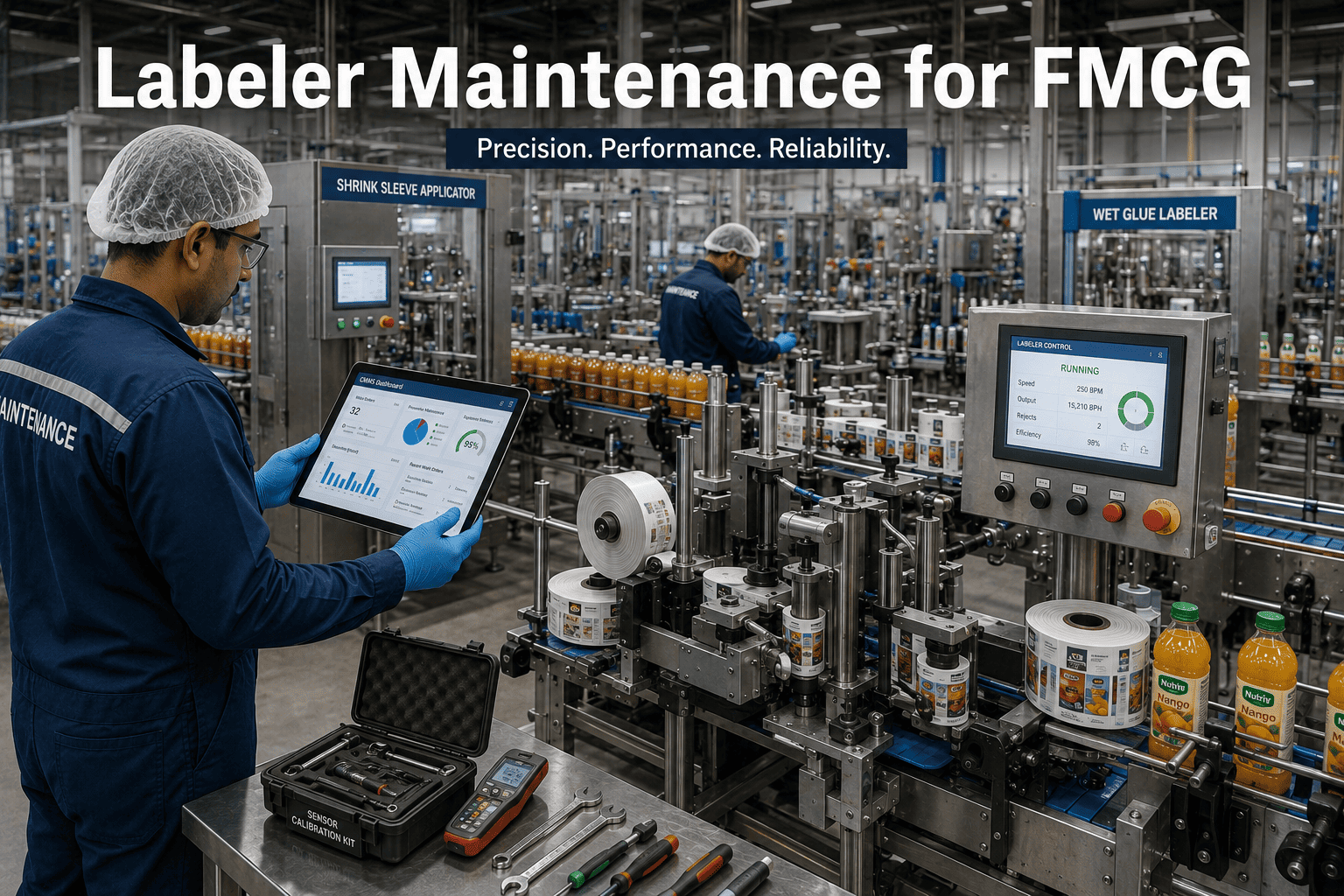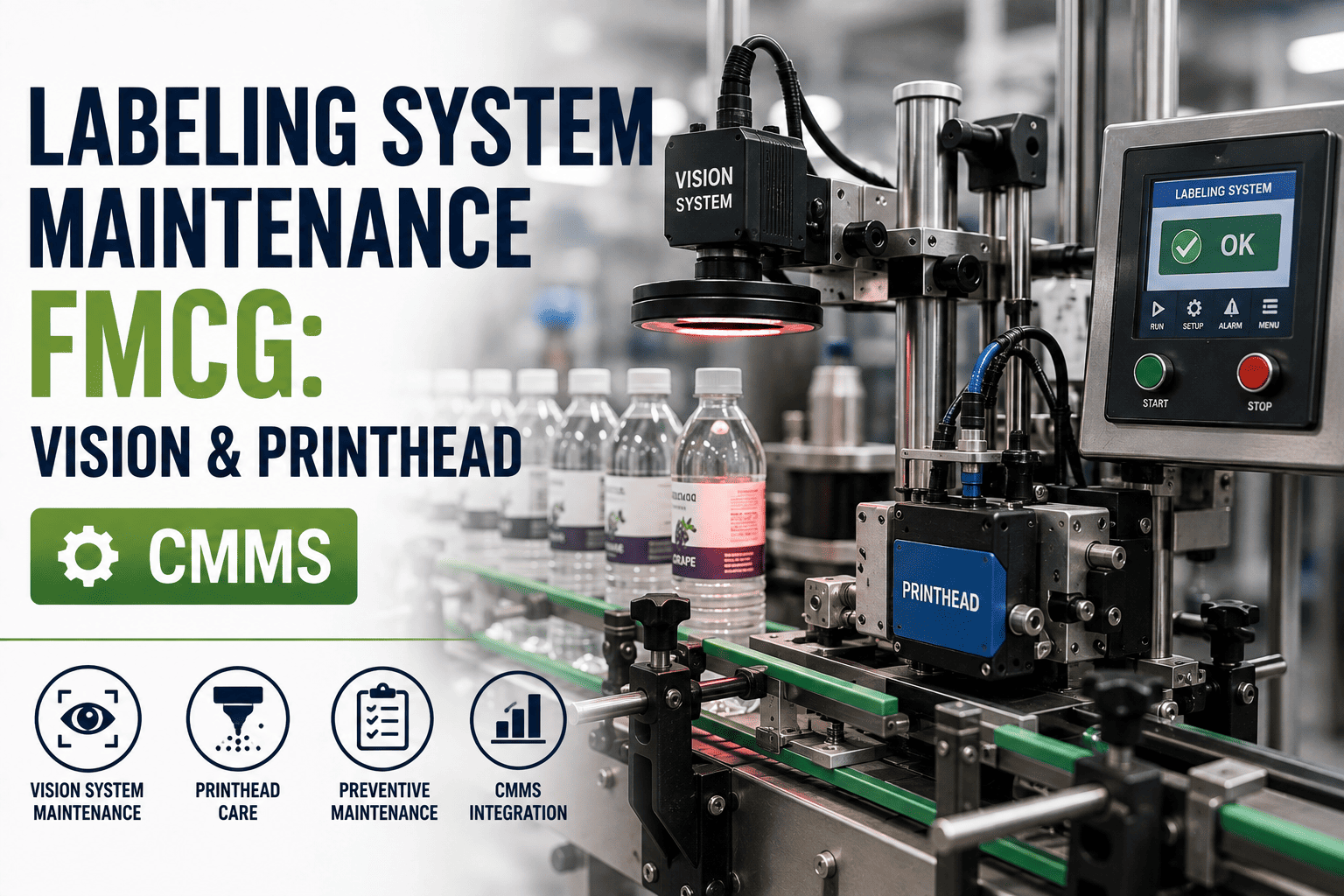
Labeling failures on a fast-moving consumer goods line rarely stay maintenance problems for long — within minutes they become quality events, traceability gaps, and retailer chargebacks that cost ten times the price of the label itself. A single 12-hour production run on a beverage line can apply 40,000 labels, and even a 0.5 percent defect rate means 200 mislabeled cases entering a cold-chain distribution network where rework is no longer possible. The labeling system — printhead, vision camera, label sensor, and applicator — is therefore a compliance asset, not an auxiliary machine, and it deserves the same CMMS discipline you apply to a filler or capper. Start Free Trial to build the structured preventive maintenance program that keeps every label scan-readable and audit-defensible.
CMMS RELIABILITY GUIDE · FMCG LABELING
Is one misaligned label costing you more than a full pallet of product?
In FMCG, the printhead, vision camera, label sensor and applicator form one chain — break any link and a 12-hour run can generate thousands of non-conforming cases. This guide turns labeling system maintenance into a CMMS-driven program that protects scan-readability, retailer compliance and uptime.
$23,800
Average annual chargeback exposure on a single FMCG line from labeling defects, per a 2023 retailer compliance benchmark.
THE FAILURE MODES
Four labeling defects that escalate into quality events
On an FMCG line running 300–600 units per minute, the gap between a maintenance defect and a documented quality non-conformance is measured in seconds, not shifts.
Print quality degradation
A thermal printhead losing 8–12 percent of its element resistance produces faded barcodes that fail retailer scan-verification at the distribution center. GS1 verification grades below C trigger automatic rejections and per-case chargebacks of $2–$7.
Label misalignment
Worn applicator pads and drifted label sensor timing push label placement outside the ±2 mm tolerance auditors check. Misalignment on a beverage multipack often means the entire pallet is flagged, not just the affected cases.
Missing or duplicate labels
A label sensor accumulating adhesive residue begins missing gaps, producing double-fed labels on one container and bare containers downstream — a traceability break that forces a full line stop and quarantined stock.
Vision system false rejects
An uncalibrated vision camera rejecting 3–5 percent of good product quietly steals capacity. Plants often absorb the loss as "normal" scrap until a CMMS audit reveals the camera drifted from its last calibration by 18 months.
PRINthead PM SCHEDULE
Tiered printhead and applicator maintenance
A 300 dpi thermal printhead costs $180–$420 to replace — but a failed printhead on a Friday night shift can stop a $25,000/hour line for 90 minutes. Tier the PM so the cheap, frequent tasks actually get done.
Shift-start checks
- Isopropyl alcohol wipe of printhead element — 10 strokes, single-direction
- Visual inspect label web path for adhesive build-up
- Confirm darkness/heat setting matches label stock spec
- Run 10-sample print test and log barcode grade
Applicator & sensor
- Clean label sensor optics with lint-free wipe
- Inspect applicator pad wear — replace if edge radius exceeds 1 mm
- Check label web tension against OEM spec (typically 8–12 N)
- Verify peel-edge angle and remove adhesive residue
Deep preventive
- Printhead resistance test — log element-by-element values
- Platen roller inspection and cleaning
- Backup firmware and print-format templates
- Review defect trend in CMMS — trigger corrective work order if scrap rate > 0.3%
| Component | PM frequency | Replacement trigger | Cost of inaction |
|---|---|---|---|
| Thermal printhead | Daily clean / monthly resistance test | Element failure or 4M linear feet printed | $25K/hr line stop, 90 min MTTR |
| Label sensor | Weekly optic clean | False gap detection rate > 0.1% | Missing-label quarantine, full batch hold |
| Applicator pad | Weekly inspect | Wear beyond 1 mm radius | Misalignment chargebacks, $2–$7/case |
| Platen roller | Monthly inspect | Grooving or durometer shift | Print skew, web tracking failure |
| Vision camera lens | Weekly clean / quarterly calibrate | Calibration drift beyond tolerance | False rejects 3–5% or escaped defects |
VISION CALIBRATION & SENSORS
Keeping the inspection layer retailer-defensible
A vision system that has drifted does not just miss defects — it quietly rejects good product, or worse, passes bad product that auditors later trace back to your line.
Lens & lighting baseline
Clean the camera lens and diffuser, verify LED intensity with a lux meter, and capture a reference image of the gold-standard label. Store the reference in the CMMS as the calibration anchor — any drift beyond 5 percent brightness triggers an automated work order.
Golden-template verification
Run 50 known-good and 20 known-defect samples through the vision system. If false-reject rate exceeds 1 percent or defect-catch rate falls below 99.5 percent, recalibrate the match tolerance and re-run the sample set before resuming production.
Label sensor & web tension sync
Test the gap sensor with the current label stock, confirm web tension sits within the 8–12 N OEM band, and verify the applicator fires within ±5 ms of the sensor trigger. Log all values to the CMMS asset record for trend analysis.
Audit-ready documentation
Generate a calibration certificate from the CMMS containing the reference image, tolerance values, technician signature, and timestamp. Retailers and regulators increasingly demand this evidence during traceability audits — a paper logbook no longer satisfies GS1 and BRCGS expectations.
THE CMMS RELIABILITY PROGRAM
From reactive fixes to a structured labeling reliability program
A CMMS does not just schedule PMs — it converts every printhead wipe, sensor clean and calibration check into traceable data that proves compliance and predicts failure before it reaches the line.
LABELING LINE OEE IMPACT
OEE gain = (defect rate before PM − defect rate after PM) × line throughput × scrap value per unit
Worked example: a bottling line running 400 units/min, 2 shifts, 250 days/year. Reducing label defects from 0.8% to 0.2% saves 120,000 units/year. At $0.85 scrap value per unit, that is $102,000 in recovered capacity — plus avoided chargebacks.
42%
Reduction in labeling-related unplanned downtime when a CMMS-driven PM program replaces calendar-based maintenance, per cross-industry TPM benchmarks.
18 mo
Typical calibration drift window before vision false-reject rate exceeds 2% on an unmonitored FMCG labeler.
4.3×
ROI in year one for a CMMS labeling program at a mid-size FMCG plant, driven by scrap reduction and chargeback avoidance.
"We moved printhead cleaning from a clipboard to CMMS-triggered work orders with photo evidence. Printhead life went from 11 months to 19, and our last retailer audit had zero labeling findings for the first time in six years."
BUILD YOUR LABELING PM PROGRAM
Turn labeling maintenance into a compliance advantage
Deploy printhead PM, vision calibration and label sensor schedules in OxMaint in under a day — with audit-ready records attached to every asset.
FREQUENTLY ASKED
Labeling system maintenance in FMCG — common questions
How often should I clean a thermal printhead on an FMCG labeler?
Clean the printhead element with isopropyl alcohol at every shift change, or every 4 hours of continuous printing, whichever comes first. On high-speed beverage lines running abrasive paper labels, increase to every 2 hours. Log each clean in the CMMS — printhead failures almost always correlate with skipped cleans in the trend data.
What barcode grade threshold triggers a quality event?
GS1 and most major retailers require a minimum overall grade of C (70 percent) on a 300 dpi scan-verification. Below C, the case is rejectable at the distribution center. Set your vision system to flag any grade below B as a CMMS alert so you catch drift before it reaches the reject threshold. Start Free Trial to configure automated grade-threshold alerts on your labeling assets.
When should a printhead be replaced versus cleaned?
Replace the printhead when individual element resistance deviates more than 15 percent from the array average, when visible burning or buildup cannot be removed, or after 4 million linear feet of printing — whichever comes first. A resistance test during the monthly PM catches degradation weeks before print quality becomes visible to the eye.
How do I calibrate the vision system on a labeling line?
Run a golden-template verification weekly using 50 known-good and 20 known-defect samples. Confirm false-reject rate stays below 1 percent and defect-catch rate above 99.5 percent. Every quarter, perform a full recalibration with a certified reference target. Store the reference image, tolerance values and technician sign-off in the CMMS for audit traceability.
Can a CMMS really reduce labeling chargebacks?
Yes — chargebacks are overwhelmingly traceable to missed PMs: a skipped sensor clean, an overdue printhead replacement, or a vision system 18 months past calibration. A CMMS enforces the schedule, captures evidence, and surfaces drift before it becomes a defect. Book a Demo to see the labeling PM templates and audit-report export in OxMaint.
START IN UNDER A DAY
Deploy your FMCG labeling CMMS today
Join the plants that cut labeling defects by 60%+ with structured PMs, audit-ready records and predictive printhead replacement.
Free 14-day trial · No credit card