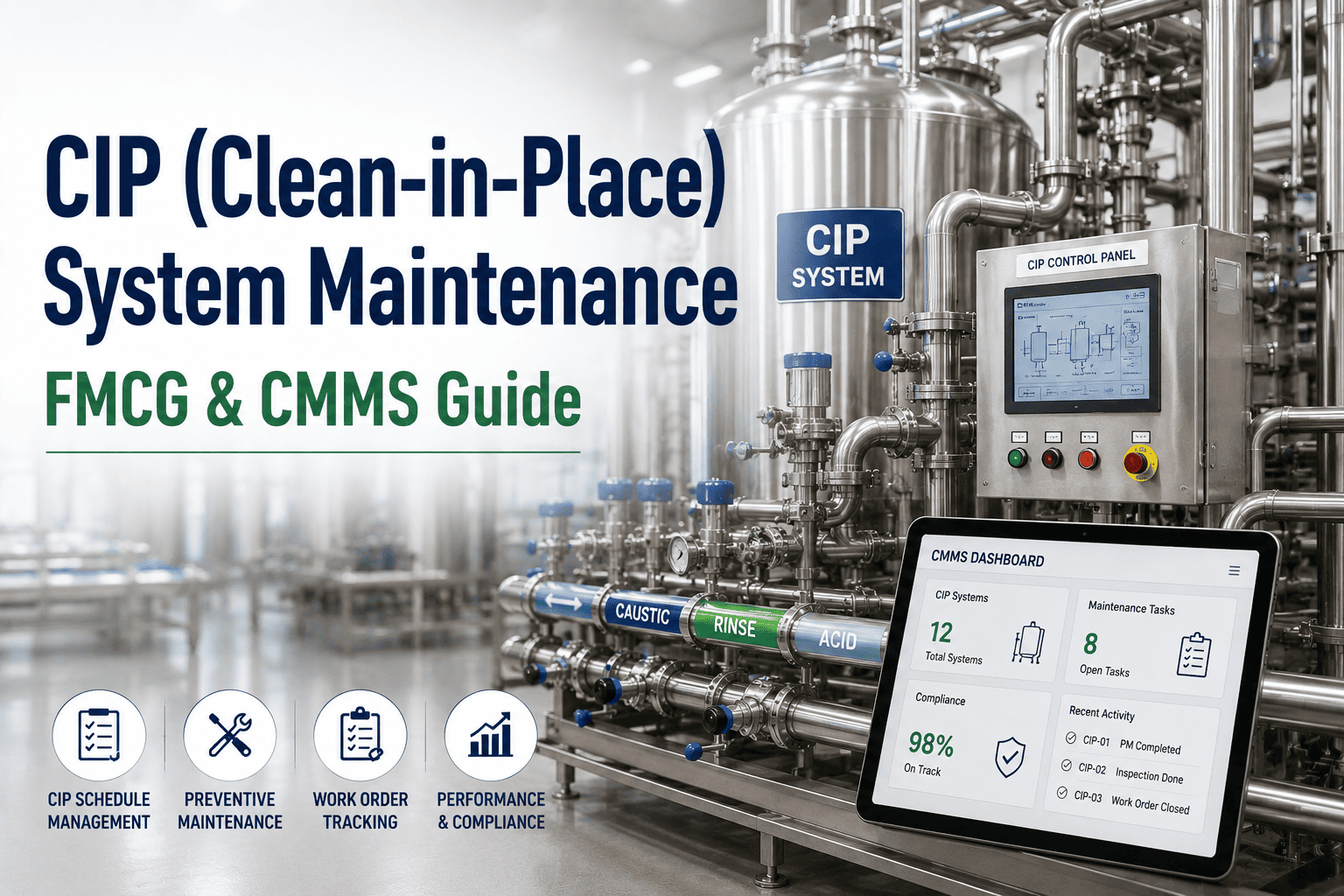
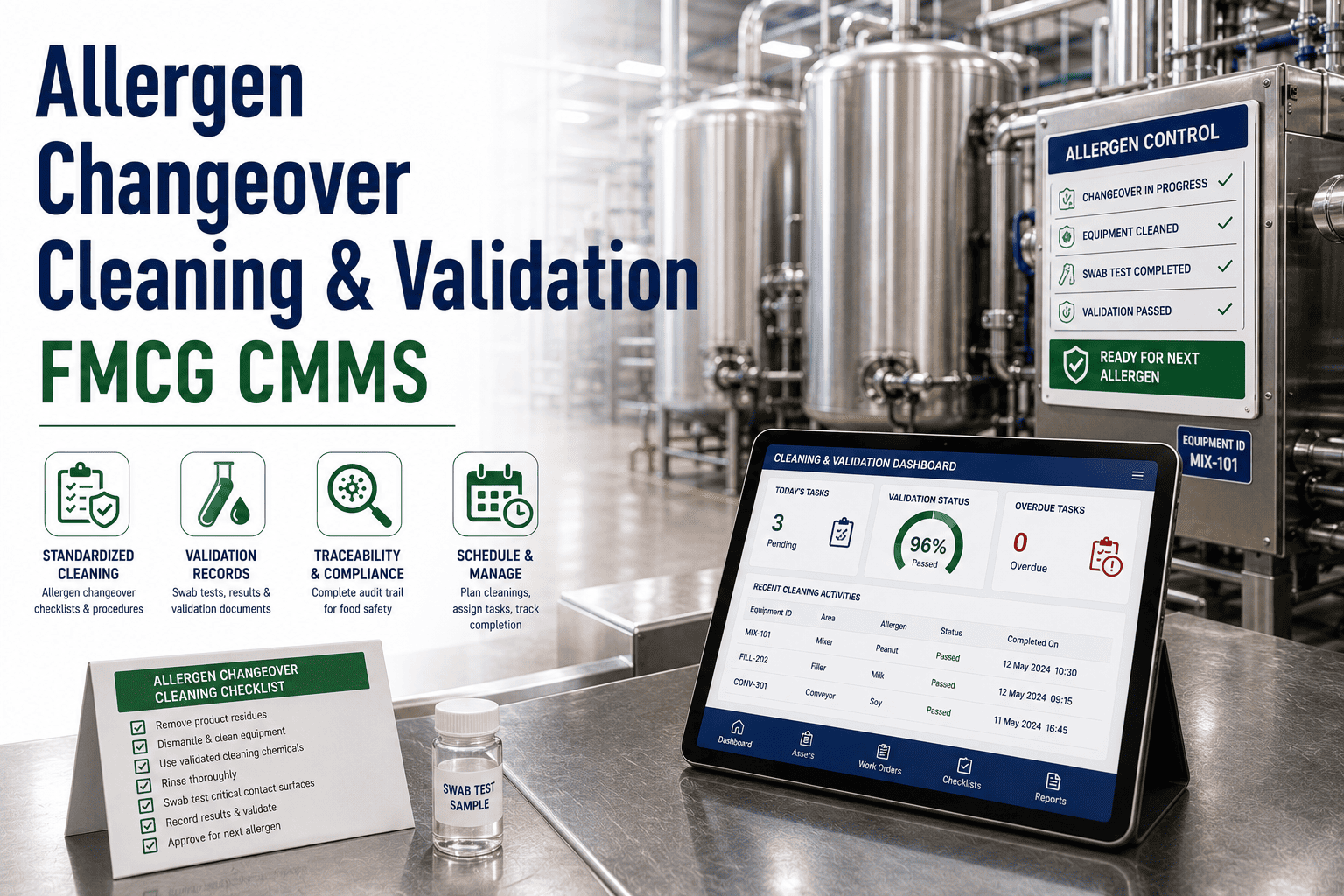
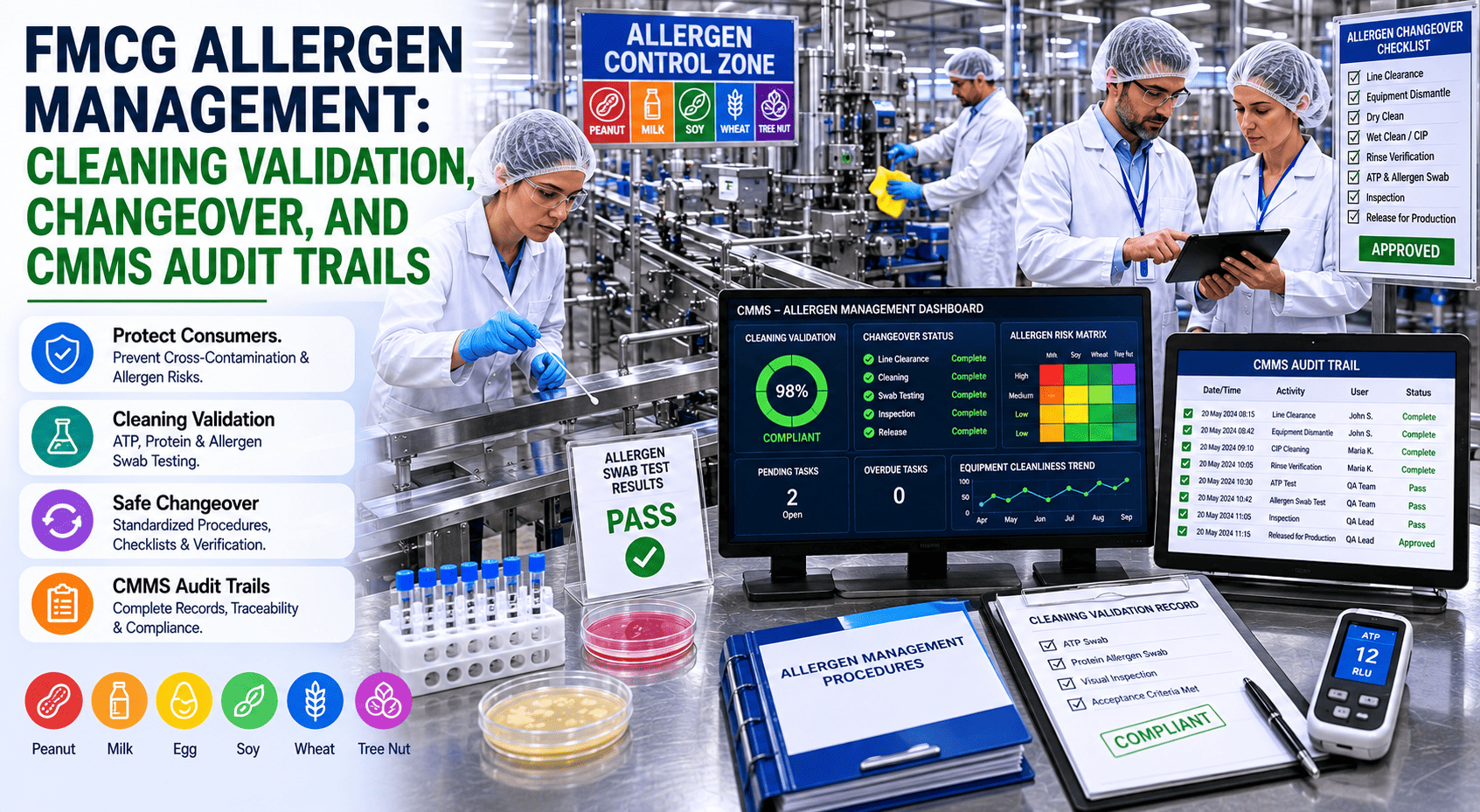
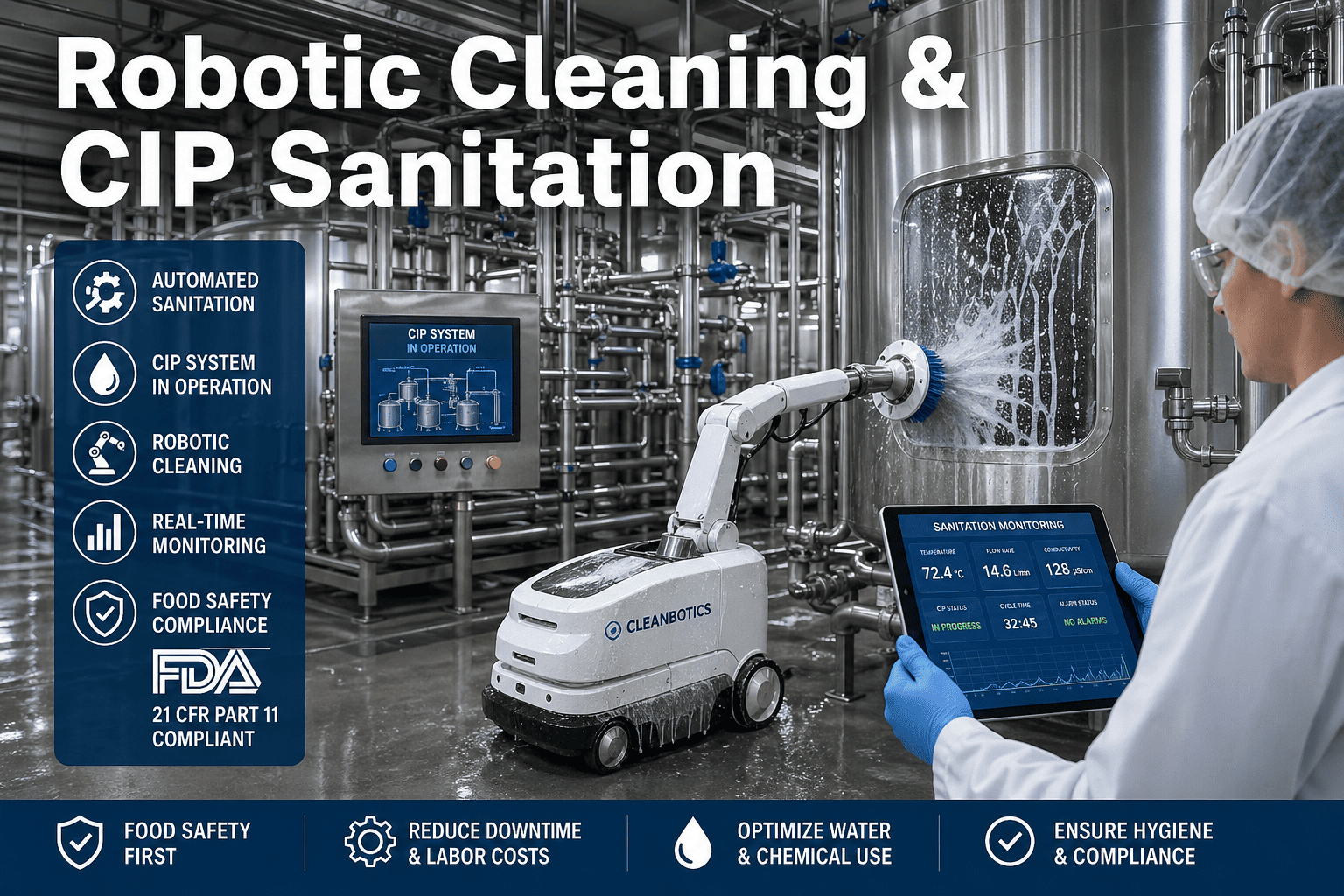
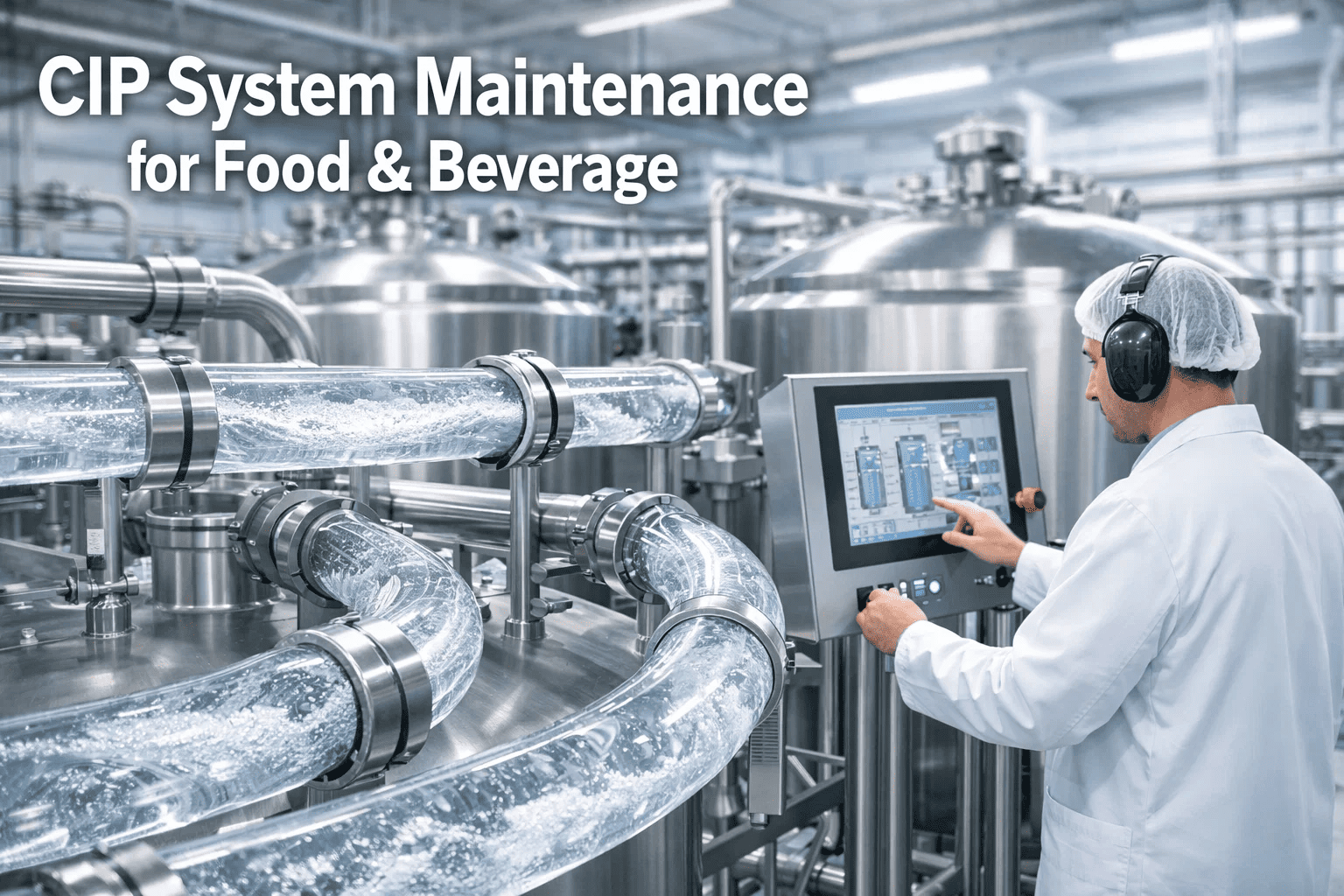
A CIP system at a beverage plant failed its chemical concentration validation midway through a caustic wash cycle — conductivity sensors had drifted, the return line strainer was partially blocked, and the last maintenance record in the facility's binder was dated eleven weeks earlier. The cycle completed. The tanks were declared clean. Three days later, a routine ATP swab triggered an investigation that reached back through every batch produced since the last verified clean. This kind of failure is not unusual — it is the predictable outcome of treating CIP and robotic cleaning as operational processes rather than maintenance-managed systems with their own PM schedules, validation records, and corrective action workflows. This guide covers the full maintenance architecture for CIP systems and robotic cleaning equipment in FMCG food and beverage plants — what to inspect, when, what to record, and how Oxmaint's CIP scheduling and sanitation checklist features close the gap between cleaning operations and audit-ready compliance. Start your free trial to build CIP-aligned PM schedules, or book a demo to see how Oxmaint automates sanitation maintenance records.
Reactive Sanitation vs Maintenance-Managed CIP Programs
Performance gap between FMCG plants treating CIP as an operational task versus a structured maintenance-managed programme
Reactive / Unmanaged CIP
CIP Validation Records
Paper charts — incomplete, no corrective action trail
Chemical Monitoring
Manual titration when problems arise — no schedule
Replacement on defined wear schedule — records on file
Food Safety Risk
Zero undocumented CIP deviations — recall exposure eliminated
Programme Outcome: Reactive Cleaning Failures → Zero with Scheduled CIP Maintenance
Why CIP and Robotic Cleaning Systems Require Dedicated Maintenance Programs
CIP systems and robotic cleaning equipment are not self-maintaining. Every component that delivers, monitors, or validates a cleaning cycle — conductivity sensors, flow meters, spray devices, heat exchangers, chemical dosing pumps, tank agitators, and robotic actuators — degrades over time in ways that compromise cleaning efficacy without generating visible failure signals. A CIP cycle can appear to complete correctly while delivering inadequate chemical concentration, insufficient temperature hold time, or incomplete spray coverage — because the sensors validating it have drifted, the nozzles are partially blocked, or the return pump is underperforming.
In FMCG food and beverage production, a CIP or robotic cleaning failure is not a maintenance failure — it is a food safety event. Biofilm accumulation, chemical residues, inadequate rinse cycles, and physical soiling in food contact zones are direct HACCP hazards. The maintenance program governing CIP and robotic cleaning equipment is therefore a prerequisite for the validity of every cleaning record, every ATP swab result, and every food safety audit that relies on those records as evidence of hygiene control.
Six CIP System Components That Require Dedicated Maintenance Protocols
Each CIP system component has specific failure modes that directly affect cleaning efficacy and food safety compliance. These six components represent the highest-risk maintenance gaps identified across food and beverage plant audits — and the specific maintenance tasks, frequencies, and records that auditors and quality teams check at every inspection cycle.
Six CIP System Components — Maintenance Requirements and Failure Modes
Conductivity & Temperature Sensors
Validation-Critical
Sensors drift over time, especially in high-temperature caustic environments. Calibrate conductivity cells against certified reference solutions weekly. Full sensor replacement threshold: verify against external reference at each calibration — replace when offset exceeds ±2% of setpoint.
Spray Balls & Rotary Nozzles
Coverage-Critical
Mineral deposits, protein fouling, and mechanical wear block orifices and reduce spray coverage. Remove and inspect all spray devices weekly. Soak in descaling solution monthly. Full spray pattern verification with riboflavin test quarterly — replace any device failing coverage test immediately.
Chemical Dosing Pumps & Injectors
Concentration-Critical
Peristaltic pump tubing degrades, injector check valves foul, and flow rates drift without visible indication. Verify chemical concentration against manual titration every CIP cycle. Inspect pump tubing condition weekly — replace on a defined wear cycle, not on failure. Full pump calibration monthly.
CIP Return Lines & Strainers
Flow-Critical
Return line strainers accumulate debris that reduces flow velocity below the turbulent flow threshold required for mechanical cleaning action. Inspect and clean return strainers after every CIP cycle. Check return flow rate against validated minimum weekly. Flush dead legs monthly and verify no accumulation zones exist in piping layout.
CIP Tanks & Heat Exchangers
Temperature-Critical
Chemical solution tanks accumulate residue and scale that affects chemical activity. Heat exchangers foul and lose thermal transfer efficiency, reducing solution temperature at point of use. Inspect and clean CIP tanks weekly. Descale heat exchanger plates monthly. Full heat exchanger revalidation quarterly after descaling.
Valves, Seals & Gaskets
Integrity-Critical
CIP-rated butterfly valves, plug valves, and tri-clamp gaskets degrade under repeated thermal and chemical cycling. Inspect all valve seats and tri-clamp gaskets monthly. Replace CIP-contact seals on a defined wear schedule — not on visible failure. Leak path inspection on all dead-leg elimination points quarterly.
A compliant CIP maintenance programme covers twelve specific tasks distributed across four time intervals. This schedule applies to single-use and multi-use CIP systems serving tanks, pipelines, heat exchangers, and filling lines in FMCG food and beverage plants.
CIP System Preventive Maintenance Schedule
Covers single-use and multi-use CIP systems, tank cleaning circuits, and in-line CIP for filling and processing lines
Verify CIP cycle chart — time, temp, and chemical concentration vs validated parameters
All three parameters within validated range — corrective action logged if any deviation found
Each Cycle
Manual titration check on caustic and acid chemical concentrations
Concentration within ±5% of setpoint — adjust dosing pump if outside tolerance
Each Cycle
Inspect and clean return line strainers — log flow rate before and after
No debris accumulation — return flow rate at or above validated minimum velocity
Post-Cycle
ATP bioluminescence swab on post-CIP food contact surfaces
ATP result under 100 RLU on all sampled surfaces — corrective re-clean if exceeded
Post-Cycle
Calibrate conductivity sensors against certified reference solution
Sensor reading within ±2% of reference — replace sensor if offset cannot be corrected
Weekly
Remove, inspect, and descale all spray balls and rotary nozzles
All orifices clear — no mineral deposits, no protein fouling, spray pattern unobstructed
Full CIP system revalidation — time, temp, flow, and chemical concentration mapping
All parameters meet original validation criteria — full revalidation report filed with QA
Quarterly
Plants without a dedicated CIP maintenance programme — treating cleaning as an operational task with no scheduled equipment PM — account for 73% of all sanitation-related audit non-conformances and cleaning-related food safety events in FMCG beverage and dairy processing. A CIP cycle that completes on time is not evidence of a clean system. Maintenance of the equipment executing the cycle is.
Robotic Cleaning System Maintenance — FMCG Tank and Vessel Applications
Robotic tank cleaning systems — rotating jet heads, programmable orbital cleaners, and autonomous cleaning robots deployed in FMCG tanks, silos, and vessels — require a separate maintenance programme from the CIP chemical delivery system they operate within. Mechanical wear, bearing failure, drive system degradation, and nozzle erosion in robotic cleaning heads change spray patterns and rotation speeds in ways that reduce cleaning coverage without triggering process alarms.
Robotic Cleaning System PM Schedule — FMCG Tank and Vessel Applications
Rotating jet heads, orbital cleaners, and autonomous tank cleaning robots in food contact zones
Verify rotation speed and coverage pattern against validated cleaning program
Rotation speed within ±5% of validated RPM — coverage pattern matches qualification record
Each Cycle
Inspect food-contact nozzle tips and orifices for erosion and blockage
No visible erosion — orifice diameter within 5% of specification — replace eroded nozzles immediately
Daily
Check drive shaft seals and bearing housing for chemical ingress or leakage
No chemical ingress marks — seals intact — replace any seal showing discolouration or cracking
Weekly
Lubricate drive bearings with food-grade NSF H1 lubricant per OEM specification
NSF H1 certified lubricant only — log product name, lot number, and application volume
Weekly
ATP swab verification on tank zones served by robotic cleaning system
ATP result under 100 RLU on all sampled zones — corrective re-clean if exceeded
Weekly
Full nozzle set replacement — all food-contact nozzle tips replaced to defined wear schedule
New nozzles installed — OEM specification confirmed — old nozzle erosion documented with photo
Monthly
Complete riboflavin UV coverage test — full tank surface coverage validation
100% tank surface coverage confirmed — UV photo evidence archived — requalify if shadow zones found
Monthly
Drive system torque check and gear mechanism inspection — confirm OEM torque specs
All drive components to OEM torque specification — gear mesh and backlash within tolerance
Monthly
Full robotic cleaning system requalification — spray coverage, rotation, and chemical delivery
All parameters meet original qualification criteria — full requalification report archived with QA team
Quarterly
Robotic tank cleaning systems operating without dedicated PM programmes account for 61% of all tank-based biofilm incidents in FMCG beverage and dairy applications. Nozzle erosion — the leading cause of coverage failure — is undetectable without dimensional inspection. By the time cleaning failures appear in ATP results, the erosion has typically been progressive for 8–12 weeks.
GMP Sanitation Maintenance Schedule by Equipment Type
GMP Prerequisite Programs require that every sanitation equipment category in a food facility has a defined maintenance schedule with documented frequencies, acceptance criteria, and corrective action triggers. This schedule covers the six highest-risk sanitation equipment categories in FMCG food and beverage processing, including the food safety classification that determines documentation depth.
Titration log + pump calibration record + chemical SDS on file
Open Plant Cleaning EquipmentDaily + Weekly
Foam lance pressure and concentration check, squeegee and brush condition, drainage system inspection, ATP verification
PRP
Inspection record with chemical concentration check and ATP result
Conveyor & Transfer SanitationDaily + Monthly
Belt and surface hygiene inspection, spray bar nozzle check, drainage point function, food-grade lubricant verification
PRP
Inspection record with lubricant NSF cert reference on file
Drainage & Waste SystemsDaily + Monthly
Drain trap and cover inspection, backflow prevention check, odour and biofilm assessment, drain jetting and descaling
PRP
Inspection log with drain condition rating and jetting record
Plants maintaining CMMS-managed sanitation PM schedules across all equipment categories achieve first-pass audit rates of 94% versus 38% for reactive sanitation programs. The difference is not cleaning performance — it is the availability of structured, retrievable records that demonstrate hygiene control to auditors.
HACCP Documentation Requirements for CIP and Sanitation Maintenance
HACCP Principle 7 and GMP Prerequisite Programs require that sanitation equipment maintenance generates records satisfying verification and validation requirements. Auditors from the FDA, BRC, SQF, and FSSC 22000 schemes check four specific document categories for CIP and sanitation maintenance at every on-site inspection — and the absence of any one constitutes a major non-conformance.
Four Documentation Categories for CIP and Sanitation Maintenance Teams
01
CIP Cycle Validation Records
Time, temperature, and chemical concentration per cycle
Deviation log with corrective action if any parameter out of range
ATP bioluminescence result post-cycle — linked to cycle record
Operator or QA counter-signature on each cycle record
Frequency: Every CIP cycle — auto-generated by CMMS
02
Sensor Calibration Records
Conductivity, temperature, and flow sensor calibration records
As-found and as-left readings against certified reference standard
Traceability certificate reference for each calibration standard used
Out-of-tolerance events with product impact assessment completed
Frequency: Weekly for conductivity — per schedule for all others
03
PM Work Order Records
Spray ball and nozzle inspection with coverage test result
Chemical dosing pump calibration with output verification
Gasket and seal replacement with food-grade material lot number
Photo evidence at task level — archived with work order record
Format: Timestamped digital records — instant export for auditors
04
Revalidation Documentation
Riboflavin spray pattern test with UV photographic evidence
Full CIP parameter mapping against original validation criteria
Revalidation records after any major component replacement
QA sign-off before CIP system returns to production service
Trigger: Quarterly + after any repair or modification
How Oxmaint Automates CIP Scheduling and Sanitation Maintenance Records
A CMMS built for food and beverage manufacturing doesn't just schedule CIP maintenance tasks — it creates the structured, retrievable documentation that validates every cleaning cycle, links every work order to the food safety function it supports, and generates the compliance reports auditors need without manual reconstruction.
Four-Layer CIP Compliance Automation in Oxmaint
01
CIP Scheduling Engine
Auto-generate PM work orders at defined CIP maintenance intervals
Cycle-triggered tasks — post-CIP checklist auto-generated on cycle completion
Calibration WOs for conductivity, temperature, and flow sensors
Quarterly revalidation reminder with QA counter-sign requirement
Output: Zero Missed CIP Maintenance Tasks
02
Sanitation Checklists
Digital checklist per sanitation activity — mandatory fields before close
ATP result field linked to CIP cycle record automatically
Photo capture at task level — nozzle condition, coverage test, gasket state
Spray pattern and riboflavin test results archived with work order
Output: Complete Sanitation Record per Activity
03
Deviation & Corrective Action
CIP parameter deviation auto-triggers corrective action work order
QA notification on out-of-specification ATP or chemical concentration
Product impact assessment field required before corrective action closes
Full deviation trail linked to affected production batch records
Output: HACCP Principle 5 Fully Documented
04
Audit-Ready Reporting
Filter all CIP and sanitation records by date, equipment, or system
Export signed, timestamped audit package for BRC, SQF, FSSC 22000
PM compliance rate dashboard — overdue tasks visible before audit
Revalidation status per CIP circuit — continuous audit readiness
Output: Audit Package in Under 10 Minutes
ROI of CMMS-Managed CIP and Sanitation Maintenance
The economic case for structured CIP and sanitation maintenance is driven primarily by recall and production shutdown risk elimination. For a four-line FMCG food or beverage facility, the annual value of a fully documented CIP maintenance programme consistently exceeds 20x the cost of the platform managing it — because the alternative is not cheaper maintenance, it is uncontrolled food safety risk.
FMCG food & beverage processing facility — single site, 4 production lines
Product Recall Cost Avoidance
0.8 cleaning-related recall events/yr × $2.1M average — eliminated by zero undocumented CIP deviations and corrective action audit trail
$1,680,000
Production Shutdown Reduction
$380K per unplanned shutdown (avg 1.1/yr) — reduced to $45K planned maintenance windows with scheduled PM replacing reactive intervention
$335,000
Regulatory Penalty Avoidance
$180K–$420K per sanitation-related FDA or GFSI violation — eliminated by first-pass audit outcomes and complete CIP documentation
$300,000
CIP Chemical Optimisation
17% average chemical reduction from calibrated dosing vs over-dosing compensation — 4 lines × $48K/yr chemical spend
$32,640
Oxmaint Platform Investment
Platform, implementation, and ongoing support — all lines and CIP circuits included
$65K–$95K/yr
Net Annual Value of CMMS-Managed CIP Maintenance Programme
$2.35M 25–36x ROI
Against $2.35M+ in annual avoided costs, the payback period for a CMMS implementation at a four-line food and beverage facility is typically under 3 weeks. Over a 10-year programme, the compounding value of recall elimination, audit-pass rates, and reduced regulatory exposure consistently exceeds $23M per facility.
Six CIP Maintenance Failures That Trigger Food Safety Non-Conformances
Even plants with active CIP programs receive major audit findings when maintenance and food safety operate as separate systems. These six failures account for the majority of sanitation-related non-conformances across food and beverage facilities audited under BRC, SQF, and FSSC 22000.
Six CIP and Sanitation Maintenance Gaps That Trigger Non-Conformances
CIP Cycle Completed — No Validation Record
Non-Conformance
CIP cycle ran to completion but the time/temperature/concentration chart wasn't filed or was incomplete. Auditor treats the cycle as unvalidated — all product from that production run becomes an open deviation requiring disposition and root cause investigation regardless of actual cleaning outcome.
Conductivity Sensors Not Calibrated
Non-Conformance
CIP chemical concentration is controlled by conductivity sensors that haven't been calibrated in three months. The sensor may be reading accurately — but without a calibration record, the auditor cannot verify it was in tolerance at the time of any prior cycle. Every CIP cycle since the last calibration record becomes a potential deviation.
Spray Ball Coverage Never Verified
Non-Conformance
Spray balls are installed at commissioning and never tested again. A single blocked orifice can create shadow zones where biofilm develops undetected for months. Without riboflavin coverage test records on file, the facility cannot demonstrate that its CIP system delivers full surface coverage — a fundamental GMP requirement.
ATP Failure — No Corrective Action Record
Non-Conformance
An ATP swab exceeded 500 RLU on a food contact surface. The area was re-cleaned and re-swabbed. No corrective action record. No root cause investigation. No product impact assessment. The re-clean happened — the evidence of the process of controlling the deviation did not. GFSI auditors require the full corrective action trail, not just the final clean result.
Non-Food-Grade Gaskets in CIP Lines
Non-Conformance
Standard nitrile gaskets used as replacement seals on tri-clamp fittings in the CIP return line. Only food-grade EPDM or PTFE gaskets are acceptable in food contact zones. Without a gasket replacement log showing material specification and lot number, the facility cannot prove food-grade materials are in use throughout the CIP circuit.
CIP Revalidation Overdue After Modification
Non-Conformance
A new tank was added to the CIP circuit three months ago. The existing CIP parameters were applied without revalidation. CIP parameters validated for one circuit configuration are not automatically valid for a modified circuit — any change in pipe length, tank volume, spray device count, or heat exchanger capacity requires a new validation record before the system is relied upon for food safety control.
Frequently Asked Questions
How often should CIP conductivity sensors be calibrated?
CIP conductivity sensors used to validate chemical concentration should be calibrated against a certified reference solution at least weekly for continuous production facilities, or before each CIP campaign for batch operations. The calibration record must capture the sensor ID, reference solution used (with lot number and certificate), as-found and as-left readings, and the name of the person performing the calibration. Any sensor found outside ±2% of the reference standard should be replaced before the next CIP cycle — and all cycles performed since the last successful calibration should be assessed for product impact. Oxmaint schedules these calibrations automatically and blocks cycle sign-off if calibration is overdue.
What is a riboflavin test and why is it required for CIP spray coverage?
A riboflavin (vitamin B2) spray test is a validation method for CIP spray coverage in which a riboflavin solution is applied to tank or vessel surfaces and the CIP spray cycle is run. Under UV light, any unsprayed surface zones fluoresce yellow, identifying shadow areas where cleaning solution did not reach. The test is required by most GFSI schemes as evidence that a CIP spray device delivers full surface coverage under actual operating conditions — not just at commissioning. Riboflavin tests should be performed quarterly and after any spray device replacement, tank modification, or nozzle change. Results, including UV photographs of all zones, must be retained as validation records.
What NSF certification is required for lubricants used on robotic cleaning systems?
NSF H1 certified lubricants are required for any robotic cleaning system component where incidental food contact with the lubricant is possible — typically drive shafts, bearing housings, and rotation mechanisms operating above food contact surfaces or within CIP-cleaned zones. NSF H2 lubricants are permitted only for fully enclosed mechanisms with no possible food contact path. All lubricant applications must be logged in the maintenance record with the NSF certificate reference number, product name, lot number, and application volume. A missing lubricant application record or an undocumented change from NSF H1 to a non-food-grade product constitutes a major non-conformance under every GFSI scheme.
How does Oxmaint schedule CIP maintenance tasks across multiple circuits?
Oxmaint manages CIP maintenance as asset-linked work order programs — each CIP circuit, tank cleaning robot, and dosing system is registered as a separate asset with its own PM schedule. Cycle-triggered tasks (post-CIP checklist, ATP swab, strainer inspection) are auto-generated when a cycle work order is marked complete. Time-based tasks (weekly sensor calibration, monthly spray ball descaling, quarterly revalidation) are scheduled against each asset independently. The compliance dashboard shows outstanding CIP maintenance tasks across all circuits in real time, and the Oxmaint team configures initial CIP schedules during implementation — typically within one week of onboarding.
When does a CIP system need to be revalidated?
A CIP system requires formal revalidation whenever the system configuration changes in a way that could affect cleaning efficacy. Trigger events for revalidation include: addition or removal of tanks, vessels, or pipe runs from the circuit; replacement of spray balls or nozzles with a different model or specification; change in CIP parameters (time, temperature, concentration, or flow rate); replacement or modification of the heat exchanger; and any change in the food products being cleaned from the circuit. Periodic revalidation is also required on a defined schedule (typically quarterly) regardless of whether configuration changes have occurred, as a verification that the system continues to perform within its validated parameters.
How long must CIP and sanitation maintenance records be retained?
FDA FSMA requires a minimum 2-year retention for all HACCP and preventive control records, which includes CIP validation records and sanitation equipment maintenance records. BRC and SQF require records to cover the full product shelf life plus one year — for ambient FMCG products this can mean 5–7 years. CIP revalidation records should be retained for the life of the system. Digital CMMS records eliminate the paper storage burden, ensure instant retrieval at any point within the retention window, and provide access audit trails that demonstrate record integrity to regulatory inspectors — a requirement that paper binders cannot satisfy.
CIP & Sanitation Maintenance for Food & Beverage
Your CIP System Is Only as Clean as Its Maintenance Records Say It Is.
Oxmaint connects every CIP maintenance task to the food safety function it protects — auto-generating cycle validation records, sensor calibration logs, spray coverage test results, and corrective action trails that satisfy BRC, SQF, FSSC 22000, and FDA FSMA requirements. Stop treating sanitation equipment as infrastructure that maintains itself.
CIP Scheduling — Cycle-Triggered and Time-Based PM Automation
Sanitation Checklists with ATP Results and Photo Evidence Capture
Conductivity and Flow Sensor Calibration Records — Auto-Scheduled
CIP Deviation Auto-Triggers Corrective Action with QA Notification
Robotic Cleaning System PM — Nozzle, Bearing, and Coverage Records
BRC, SQF, FSSC 22000 and FDA FSMA Audit Export in Under 10 Minutes
Used by maintenance and quality teams across FMCG food processing, beverage, and dairy facilities worldwide. Deployment support included. No minimum contract term.