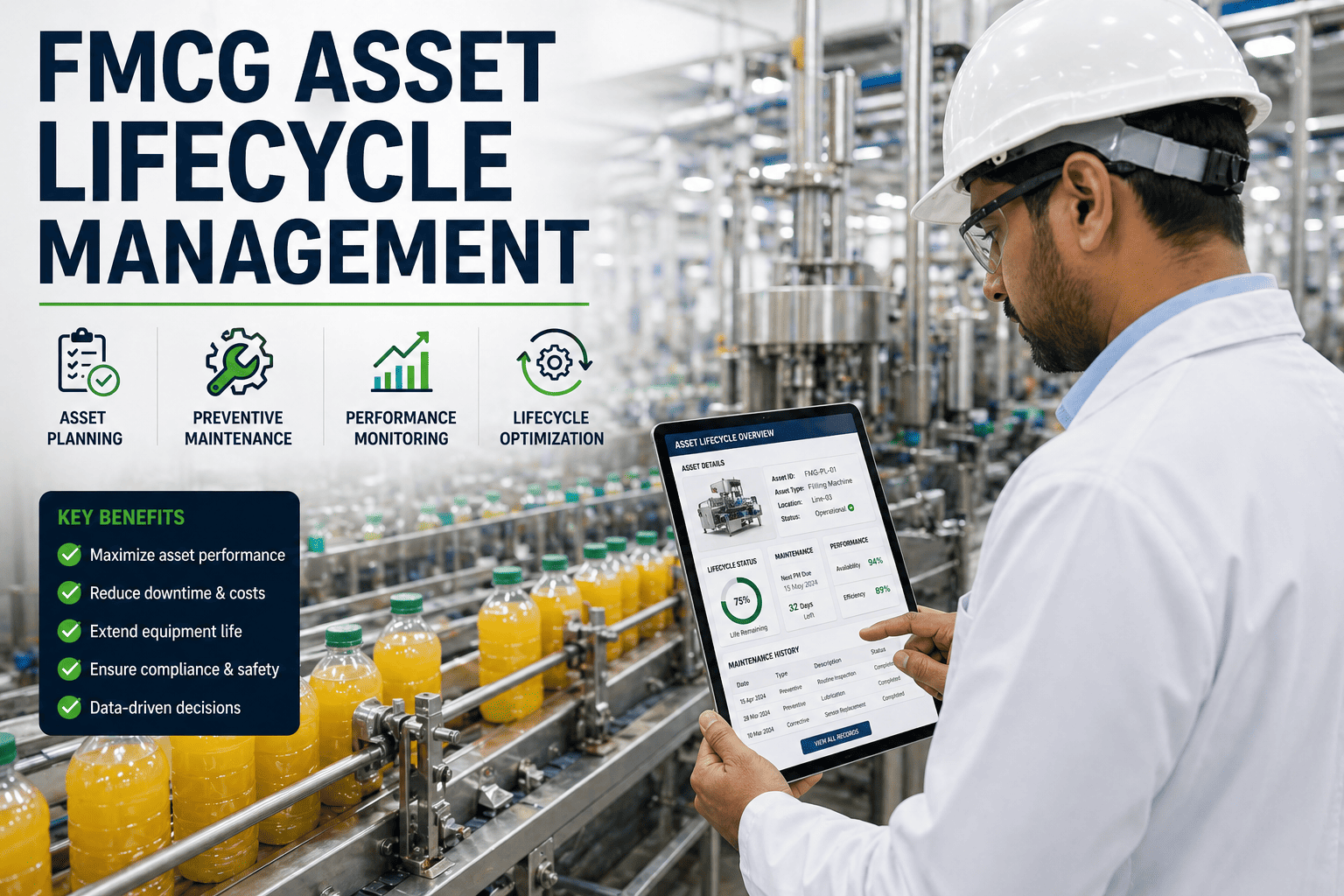
The traditional "take-make-dispose" linear model in FMCG is being replaced by circular economy principles that prioritise resource regeneration and asset longevity. In this shift, maintenance evolves from a repair function into a restoration engine. By implementing closed-loop maintenance strategies — where components are remanufactured, lubricants are filtered for reuse, and assets are upgraded modularly — FMCG plants can reduce virgin material input by 35% and eliminate landfill waste from technical operations. Maintenance is the critical barrier that prevents equipment degradation from turning into environmental waste. Plants building circular asset management programs through Oxmaint's lifecycle tracking module achieve 2.4× higher ROI on restored versus replaced equipment. Book a demo to see closed-loop maintenance workflows applied to your FMCG asset fleet.
Closed-Loop Asset Management — Oxmaint
Build a Circular Maintenance Program. Reduce Waste. Extend Asset Life Indefinitely.
Oxmaint tracks part lifecycles, flags components prime for remanufacturing before failure, and connects restoration decisions directly to MRO procurement — so your maintenance team creates longevity, not landfill.
35%
Reduction in Virgin Material Input Through Component Remanufacturing Programs
92%
Asset Life Extension Achievable Through Precision Restoration and Modular Upgrades
Zero
Landfill Waste Target for MRO and Technical Operations Under Circular Model
2.4×
ROI Increase on Restored vs Replaced Equipment Across FMCG Asset Fleet
LINEAR vs CIRCULAR
Linear Maintenance vs Closed-Loop Maintenance
How shifting to circular practices transforms asset lifecycles, material consumption, and financial performance
Linear — Waste-Heavy Model
Part Management
Remove and scrap — run-to-failure policy eliminates any chance of component reclamation or reuse
Asset Lifecycle
Accelerated depreciation and early disposal — assets retired well before physical end-of-life
Material Consumption
High volumes of new lubricants and filter waste — no recirculation or condition-based management
Financial Impact
Constant capital expenditure for new assets — CapEx compounds as disposal and replacement cycle accelerates
Circular — Closed-Loop Model
Part Management
Repair, reuse, and remanufacture internally — components tracked through multiple lifecycle loops
Asset Lifecycle
Indefinite life via modular component upgrades — physical assets refreshed rather than replaced
Material Consumption
Oil micro-filtration and closed-loop recycling — lubricant volumes reduced by 60%, filter waste eliminated
Financial Impact
Reduced CapEx and optimised MRO OpEx — restoration investment replaces asset replacement spend
Potential MRO Procurement Savings from Circular Transition
$540K – $1.4M Annually
FOUR PILLARS
The 4 Pillars of Closed-Loop Maintenance
Transforming into a circular operation requires a shift from corrective to restorative governance — these four pillars provide the structural framework
01
Asset Refresh Programs
Scheduled deep cleaning and structural restoration
Modular electrical cabinet upgrades in-place
Corrosion remediation and surface protection programs
Impact: +15 Year Asset Life Extension
02
Component Reclaiming
Laser cladding for worn shafts and precision surfaces
Seal and gasket remanufacturing internally
Valve seat resurfacing without OEM replacement
Impact: −40% Spares Procurement Cost
03
Fluid Circularity
Bypass micro-filtration for oils and hydraulic fluids
Coolant recycling with pH balancing and testing
Lubricant condition-based change intervals from oil analysis
Impact: −60% Fluid Waste Volume
04
MRO Reverse Logistics
Vendor take-back schemes for used bearings and seals
Battery and electronic waste tracking to certified recyclers
Circular procurement of green and recertified spares
Impact: 100% ESG Audit Compliance
Lifecycle Tracking — Oxmaint CMMS
Is Your Maintenance Team Creating Waste or Creating Longevity?
Oxmaint's AI tracks part lifecycles and flags components prime for remanufacturing before they fail — so reclamation is planned, not reactive, and restoration replaces disposal across your entire asset base.
ROI FRAMEWORK
Closed-Loop ROI — Measuring the Financial Gains
How restorative practices reduce procurement spend, disposal costs, and virgin material consumption across FMCG operations
New Asset Procurement
Avoiding CapEx through second and third lifecycle refreshes — assets restored rather than replaced on fixed depreciation schedules
$480K – $960K
Technical Waste Disposal
Eliminating hazardous lubricant and scrap metal landfill fees — vendor take-back and internal reclaiming replace disposal
$60K – $145K
Virgin Material Input
Using remanufactured shafts, bearings, and rollers — 35% reduction in new material procurement across MRO spend categories
35% Reduction
Fluid and Lubricant Costs
Bypass micro-filtration and condition-based oil change intervals reduce lubricant volume consumption by 60% annually
$95K – $215K
Compliance and Audit Efficiency
Pre-built circular MRO documentation satisfies CSRD, ESG, and ISO 14001 audit requirements — preparation time reduced 50%
$72K – $120K
Total Annual Sustainability Value
$540K – $1.4M
Program investment: $95K–$215K/year including digital lifecycle tracking, remanufacturing tooling, and training. Net ROI: 2.4× on first closed loop. Value compounds as more components enter the reclaiming pipeline.
Frequently Asked Questions
Recycling breaks materials down to their raw form — for example, melting scrap metal back into feedstock for new parts. Remanufacturing is fundamentally different: it restores a worn component such as a gearbox, pump, or motor to its original performance standards using restorative machining, precision grinding, modular part replacement, and functional testing. Remanufacturing preserves the high energy-intensity already embedded in the original manufactured form, making it significantly more resource-efficient than recycling. In FMCG maintenance, remanufacturing is applied to high-value components — drive shafts, bearing housings, valve bodies, motor casings — where the base material and precision geometry represent most of the original value. A remanufactured gearbox typically costs 40–60% of a new equivalent while meeting identical performance specifications.
A CMMS is the operational backbone of any circular maintenance program because it holds the complete lifecycle history of every component in the plant. Oxmaint tracks the accumulated runtime, repair history, and remaining useful life of individual parts — and uses this data to identify when a component is approaching its natural service threshold while it is still structurally reclaimable. Without this visibility, technicians typically discover components at the point of catastrophic failure, at which point the component is often too damaged for remanufacturing and goes directly to scrap. With CMMS-driven lifecycle alerts, the same component is pulled from service three to six weeks before failure, refurbished at a fraction of replacement cost, and re-entered into the active spare parts pool. Oxmaint also tracks MRO reverse logistics — vendor take-back shipments, reclaiming batch records, and circular procurement orders — creating an audit trail for ESG and sustainability reporting.
Yes — and many FMCG plants in Europe and increasingly in India are achieving 95–98% landfill diversion from technical operations. The pathway has three components. First, establish reverse logistics agreements with bearing, battery, and electronic component suppliers for take-back and recycling. Second, build internal reclaiming capability for mechanical components — grinding, laser cladding, and seal remanufacturing equipment can be justified on a 12–18 month payback at most mid-size plants. Third, implement oil micro-filtration and condition-based fluid management to eliminate lubricant waste as a disposal category. The remaining 2–5% of technical waste that cannot be diverted — typically degraded elastomers and contaminated composite materials — can be sent to specialist industrial waste-to-energy processors rather than landfill. Full zero-landfill certification is achievable within 24–36 months of a structured circular maintenance program launch.
The highest-value circular opportunities in FMCG maintenance are in five asset categories. Drive trains and gearboxes — high original cost, reclaimable housing and shaft geometry, remanufacturing restores to specification at 40–60% of replacement cost. Pump bodies and impellers — corrosion and wear are surface phenomena that laser cladding and grinding address without replacing the body. Pneumatic and hydraulic cylinders — bore re-honing and new seal kits restore function at 20–30% of new cost. Heat exchanger plates — chemical descaling and gasket replacement restore thermal performance without plate replacement. Control panel and electrical cabinet components — modular upgrades replace specific failed boards or drives without replacing the cabinet or field wiring. Combined, these five categories typically represent 65–75% of annual MRO spend in FMCG plants — making them the priority targets for any circular program launch.
Circular Maintenance Module — Oxmaint CMMS
Every Component That Reaches Landfill Is a Cost That Could Have Been Avoided.
Oxmaint's lifecycle tracking connects part condition data, remanufacturing workflows, and MRO reverse logistics into a single platform — so your maintenance team builds circular asset loops that reduce CapEx, eliminate waste, and satisfy ESG reporting requirements from the same system.
Full Component Lifecycle Tracking — Runtime, Repairs, Remaining Life
Remanufacturing Alerts — Flag Parts Before Failure, Not After
Fluid Management — Condition-Based Oil Change and Filtration Tracking
MRO Reverse Logistics — Vendor Take-Back and Reclaiming Records
ESG and Sustainability Reporting — Audit-Ready Circular MRO Data
CapEx Deferral Tracking — Quantify Value of Every Restoration Decision
Circular lifecycle module included on all plans · ESG reporting templates included · No minimum contract