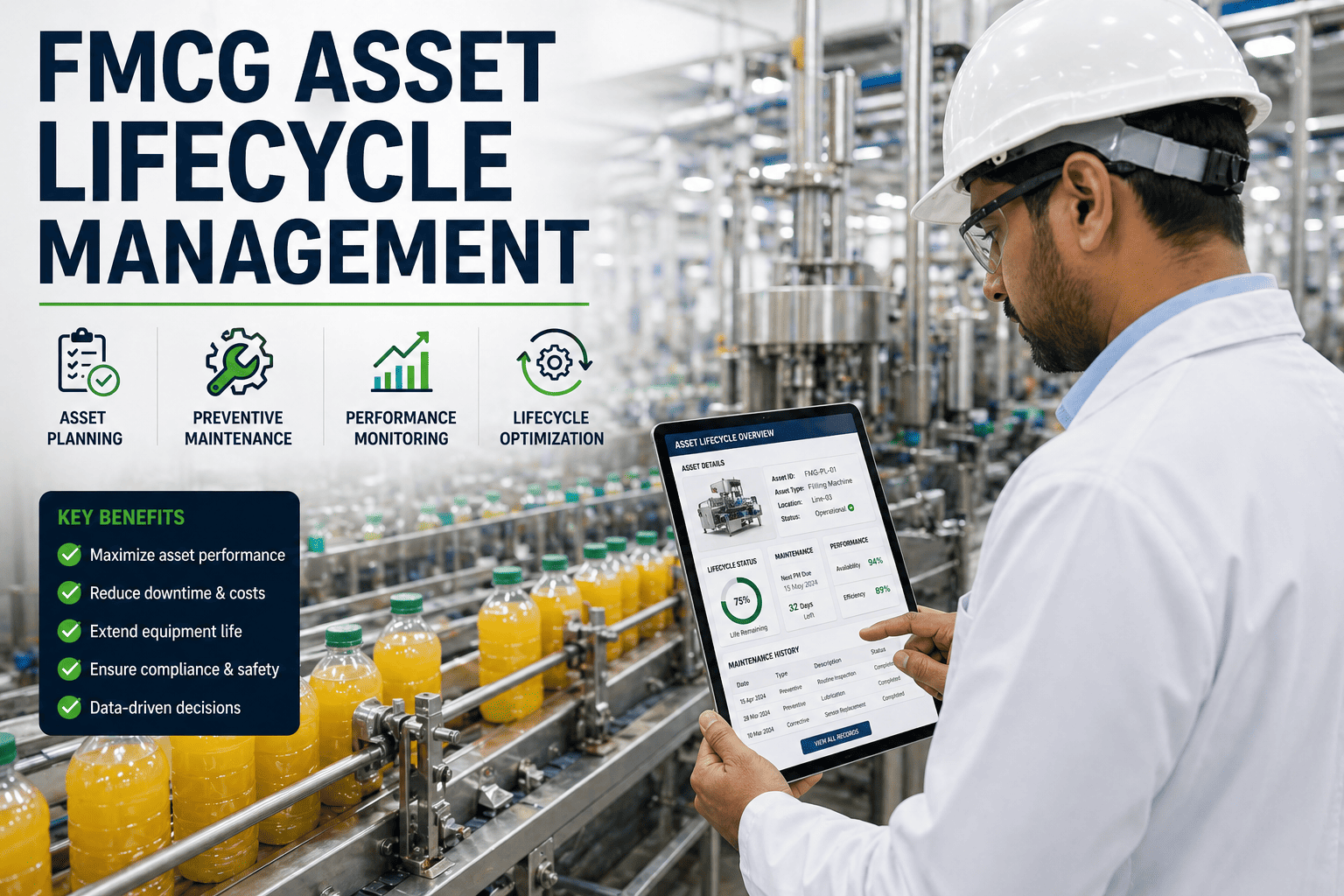
A dairy plant in Wisconsin made a $1.4M decision in 2024 to fully replace a 14-year-old continuous yogurt line because it was "old". Six months after commissioning the replacement, the engineering director ran the historical maintenance data through a structured asset lifecycle review and discovered the previous line had been operating at 89% effectiveness with 3.4 years of useful life remaining — the failure history was concentrated entirely in two homogenizer assemblies that could have been retrofitted for $186,000. The company spent $1.4M on a CapEx event a $186K targeted intervention would have deferred for three full years. This is the cost of treating equipment as line items on a fixed-asset schedule rather than as living assets with a tracked lifecycle. Start a free trial to see how OxMaint scores every FMCG asset on condition, remaining useful life, and total cost of ownership — turning replacement decisions from guesswork into defensible CapEx forecasts. CapEx spending across major FMCG manufacturers hit a five-year high in 2025, and 11-14% of operations and maintenance funding is recoverable simply by structuring asset data correctly. Book a demo to see your CapEx forecast model in action.
Asset Lifecycle Management for FMCG Equipment — From Install to Replace
Most FMCG plants replace equipment too early or run it too long — both decisions cost millions. AI-driven lifecycle management tracks every asset from installation through disposal with condition scoring, remaining-useful-life forecasts, and rolling 5-10 year CapEx models that give finance teams defensible numbers instead of guesses.
A Systematic Framework for Every Asset, From CapEx to Disposal
Asset Lifecycle Management (ALM) for FMCG equipment is the structured tracking of every capital asset across six defined stages — needs assessment, acquisition, installation, operation, maintenance, and disposal — with quantified condition, performance, and cost data captured at each stage. The objective is to maximise total value extracted across the asset's economic life while making replacement decisions defensible with data rather than tribal knowledge. Done correctly, ALM compresses 5-10 year CapEx forecasts into a rolling, evergreen model finance teams can update monthly. Curious how this looks for your portfolio? Start a free trial and import your asset register to see baseline lifecycle scores within hours.
The Six Stages of FMCG Asset Lifecycle
Each stage produces decisions, costs, and data that feed the next. Plants that skip stages — for example, treating "operate" and "maintain" as one bucket — lose the granularity that makes informed replacement decisions possible. The six-stage model below is the foundation of every world-class ALM program.
Production gap analysis, OEE benchmarking, and capacity modelling identify whether new equipment is justified — or whether retrofit, refurbishment, or process change solves the problem at 15-25% of the CapEx.
Total Cost of Ownership analysis comparing purchase price, energy consumption, expected lifespan, parts availability, and after-sales support — not just sticker price. TCO often inverts the apparent cheapest option.
Asset registered with serial number, manufacturer details, warranty terms, baseline performance readings, and full bill-of-materials. This stage establishes the reference point against which all future degradation is measured.
Production-based maintenance triggers tied to units, cycles, or runtime hours. OEE, MTBF, MTTR, and energy intensity tracked continuously per asset — not at the line average that hides outliers.
PM compliance, predictive maintenance signals, refurbishment events, and major component replacements logged against the asset record. Maintenance analytics reduce expenses 18-25% across heavy industry.
Decision driven by condition score, escalating maintenance cost ratio, and remaining useful life — not by depreciation schedule alone. Salvage value, decommissioning cost, and replacement TCO all modelled before the order is placed.
The Hidden Cost of Lifecycle-Blind FMCG Operations
When asset lifecycle data is fragmented across spreadsheets, ERP modules, and paper folders, four predictable failures recur — each one quietly burning capital that should have funded growth.
Equipment retired on age alone — not condition. A 14-year-old line at 89% effectiveness gets replaced at $1.4M when a $186K component swap extends life 3+ years. Multi-million dollar mistake repeated annually.
Critical asset fails catastrophically because remaining useful life was never quantified. Emergency replacement at premium pricing, expedited freight, and 2-6 weeks of unplanned downtime — ballooning the real cost 3-5x.
CMMS holds work orders, ERP holds financial value, OEM portal holds warranty terms, SCADA holds runtime — and none of them talk. 40% of engineering hours go to locating and validating asset information.
Annual capital plan built on tribal knowledge and one-time spreadsheets. Finance challenges every line item, projects get deferred or rejected, and the most-needed assets often lose to the loudest advocates.
Every Asset Should Tell You Exactly When It Needs Replacing — and Exactly How Much It Will Cost.
OxMaint scores every FMCG asset on condition, calculates remaining useful life from real maintenance and runtime data, and rolls every plant's projection into a portfolio CapEx model your CFO can defend in front of the board.
How OxMaint Manages the Full FMCG Asset Lifecycle
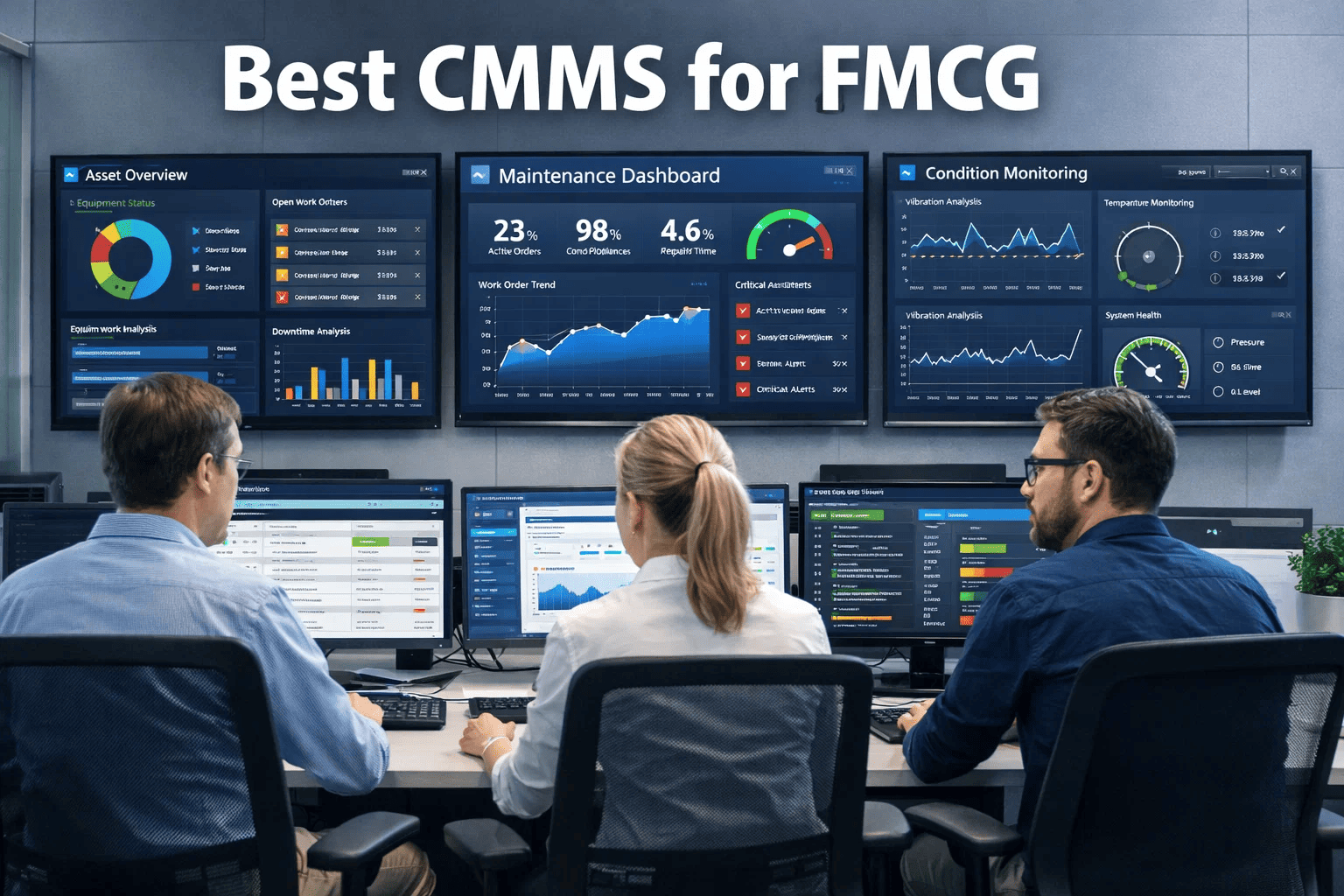
OxMaint connects asset register, work order history, condition data, and financial records into a single living lifecycle model — so every replacement, refurbishment, or run-on decision has data behind it.
Portfolio > Property > System > Asset > Component structure captures every level of detail. A bottling line is not one asset — it is 240+ trackable components with individual lifecycle records.
Each asset receives a 0-100 condition score updated continuously from work order frequency, mean-time-between-failure trends, sensor data, and inspection results — not just the depreciation curve.
AI-driven projections estimate months-to-replacement for each asset using historical degradation patterns, manufacturer data, and current usage rate. Refreshed monthly without manual intervention.
Every asset's projected replacement window auto-aggregates into a portfolio-level CapEx forecast finance can update without rebuilding the spreadsheet. Investor-grade reporting out of the box.
Acquisition cost + cumulative maintenance + energy + downtime cost + parts spend = real TCO per asset. Decisions to refurbish vs. replace become arithmetic, not arguments.
Standardised asset taxonomy across plants enables peer benchmarking — Plant A's 12-year-old depalletizer at $0.018/case vs. Plant B's 8-year-old unit at $0.041/case shows where the next CapEx really belongs.
Lifecycle-Driven vs. Date-Based Asset Decisions
The single biggest CapEx improvement in FMCG comes from shifting replacement decisions from age and depreciation schedules to condition and remaining useful life. The contrast below quantifies what that shift is worth in a typical mid-size facility.
- Assets replaced on depreciation schedule, regardless of condition
- CapEx decisions defended with anecdote and tribal knowledge
- Reactive failures average 4.8x the cost of planned replacement
- Asset register updated annually at audit time, often inaccurate
- Engineering team spends 40% of time finding asset information
- 30-45% of CapEx submissions rejected by finance for weak data
- Assets replaced on condition score and remaining useful life data
- CapEx defended with TCO models, peer benchmarks, and trend lines
- Planned replacements scheduled — emergency CapEx near zero
- Asset register updated continuously from work order activity
- Engineering time on data-finding drops to under 8% of total
- CapEx approval rate rises 60-85% with structured submissions
What Lifecycle Management Delivers in 12-18 Months
Aggregated outcomes across FMCG manufacturers running OxMaint asset lifecycle workflows for at least one full CapEx cycle.
Frequently Asked Questions
How does OxMaint calculate remaining useful life for FMCG equipment?
Can OxMaint integrate with our ERP system for capital planning?
How long does it take to populate a multi-site lifecycle dashboard?
What level of asset detail does OxMaint require to start?
Stop Replacing Equipment by Calendar. Start Replacing It by Data.
OxMaint registers every FMCG asset, scores its condition continuously, forecasts remaining useful life, and rolls up portfolio-wide CapEx projections — so your replacement decisions are defensible to finance, your boards, and your investors.