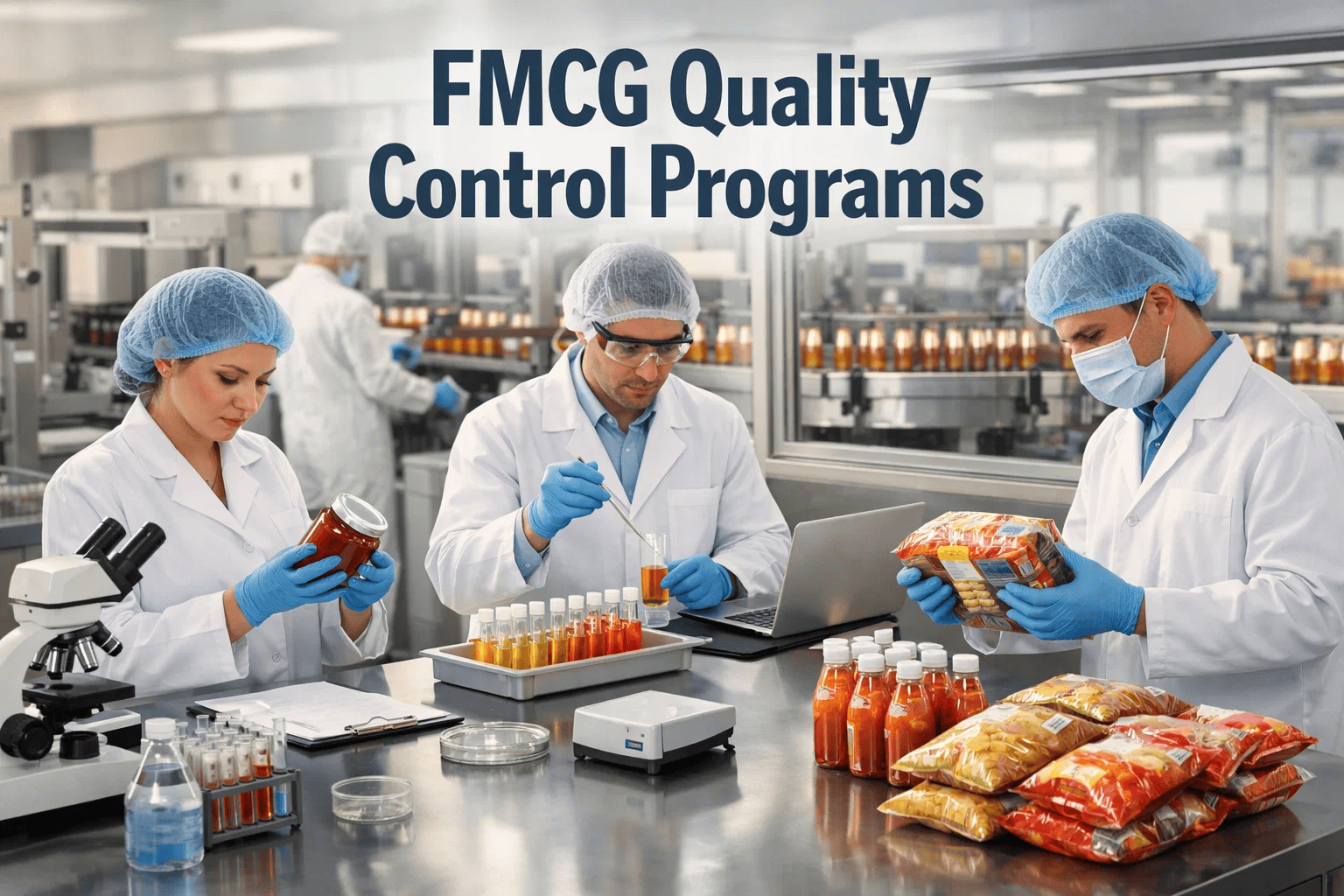
FMCG quality control programmes fail most commonly not because the standards are wrong, but because the execution disciplines around them are inconsistent. A well-written HACCP plan that is not executed on schedule is legally worthless. A visual inspection standard that is applied differently by each shift operator produces data that cannot be trended or benchmarked. A sampling plan that specifies frequency but has no enforcement mechanism gets compressed under production pressure until the next customer complaint or BRC audit finds the gap. The gap between having a quality system and running one in practice is where most FMCG brands accumulate their biggest risks — consumer safety events, retailer chargebacks, and audit non-conformances that could have been avoided by consistent execution of a programme that already existed. Start a free trial of Oxmaint and connect your quality control programme to structured maintenance execution — or book a demo to see how FMCG plants manage quality control programmes in Oxmaint.
FMCG Quality Control Programs 2026: Best Practices for Consistent Product Standards
A practical guide for FMCG quality and operations managers covering QC programme structure, inspection systems, statistical process control, AI-driven quality management, and CMMS integration for consistent product quality at production scale.
The Five Pillars of an Effective FMCG Quality Control Programme
A best-practice FMCG quality control programme is not a document library — it is a managed execution system. The five pillars that separate consistently high-performing quality programmes from aspirational ones are: structured inspection scheduling that enforces frequency regardless of production pressure; standardised measurement that eliminates operator-to-operator variation; statistical process control that detects drift before specification limits are breached; complete traceability that links every product unit to its quality evidence; and closed-loop corrective action that ensures every non-conformance drives a verified improvement. Most FMCG plants have all five documented. The gap is in the systems that enforce them in practice, every shift, every day, at production speed. Start a free trial of Oxmaint to connect your QC programme execution to a structured CMMS platform — or book a demo to see how quality inspection programmes are managed in Oxmaint.
Six Inspection Types Every FMCG Quality Programme Must Execute Consistently
Certificate of conformance review, visual inspection, and specification-matched sampling at goods-in. Frequency and sample size defined by ANSI/ASQ Z1.4 Acceptable Quality Level. High-risk ingredients require 100% or elevated AQL sampling. Certificate discrepancies trigger quarantine hold and supplier deviation.
Scheduled checks at defined production intervals — every 30 minutes on high-speed lines, every hour on lower-speed processes. Weight, dimension, appearance, and process parameter verification. Results feed SPC charts in real time. Operator-completed on mobile with standard reference values displayed.
Final product release check before palletisation — verifying label accuracy, batch code legibility, date coding correctness, seal integrity, and pack presentation against specification. Release sign-off is a legal gate: any product released without documented QC sign-off has no compliance evidence if recalled.
ATP swab testing for surface hygiene, air quality sampling in high-care zones, temperature and humidity logging in temperature-controlled areas. Results trended against alert and action limits. Positive findings trigger immediate cleaning verification re-test and root cause investigation per HACCP programme.
Representative samples from every production batch retained at specified storage conditions for the full shelf life plus minimum 6 months. Enables retrospective investigation of customer complaints, regulatory enquiries, and challenge testing. BMIS sample tracking links every retained sample to its batch quality record.
Scheduled and unannounced internal audits against BRC, SQF, IFS, or internal QMS standards. Supplier audit programme with frequency driven by risk classification. Corrective action tracking with verified close-out. Audit-ready documentation assembled from CMMS records, not manual document gathering.
Quality Control Execution Requires the Same Discipline as Maintenance Scheduling
Oxmaint gives FMCG quality teams a CMMS-grade execution platform for every inspection type — scheduled work orders, mobile digital checklists, digital sign-off, and batch-level traceability — so every QC check is enforced, documented, and audit-ready without a single paper form.
Ad Hoc Quality Checking vs Structured Programme Execution
Oxmaint Capabilities for FMCG Quality Control Programme Management
Build inspection schedules for every check type — incoming goods, in-process, end-of-line, environmental. Work orders trigger automatically at defined frequencies. Mobile escalation if not completed within the grace period. Completion rates tracked per line, shift, and operator.
Build mobile inspection forms with acceptance criteria, reference images, and pass/fail thresholds embedded. Operators see the standard and the decision criteria on every check — eliminating subjective interpretation and operator-to-operator variation.
Every non-conformance found in inspection creates a CAPA work order — capturing defect description, immediate containment action, root cause investigation, corrective action, and verified close-out. CAPA status tracked in real time against defined response timeframes.
All inspection results, non-conformances, CAPAs, and release sign-offs linked to the specific production batch. Complete batch quality dossier available on demand for customer complaints, recall investigations, or regulatory enquiries — in under 15 minutes.
QC instruments — checkweighers, spectrophotometers, pH meters, thermometers — managed as assets with calibration schedules. Calibration compliance linked to quality release decisions: product released on an out-of-calibration instrument is flagged automatically.
Quality directors see QC execution performance — completion rates, CAPA close-out status, non-conformance trends, and audit readiness — across all sites in a single portfolio dashboard. Identify systematic quality programme gaps before they become audit non-conformances.
Frequently Asked Questions
What frequency should in-process quality checks be performed at on FMCG production lines?
Industry best practice for in-process QC frequency is based on line speed and product risk. High-speed lines (600+ units/minute) typically require checks every 30 minutes. Medium-speed lines (100–600 units/minute) typically check every 60 minutes. Minimum frequency for any production line is every 2 hours, which is also the maximum interval permissible under most food retailer codes of practice (Tesco Technical Standard, Aldi Supply Code). Lower frequency increases the risk window between a defect forming and being detected — each missed interval is additional potential non-conforming product in the flow. Oxmaint enforces your specified frequency through scheduled work orders with escalation on missed intervals. Start a free trial to configure your inspection schedules.
How do I achieve BRC Grade AA with a structured quality programme?
BRC Grade AA requires not just a documented QMS but demonstrable evidence that the system is executed consistently. The specific areas where AA grades are won or lost are: documented completion records for all scheduled inspections (no gaps), CAPA close-out within specified timeframes, instrument calibration records showing continuous compliance, and corrective action trend analysis demonstrating systematic improvement. Oxmaint provides the execution platform that generates this evidence automatically — replacing manual assembly of paper records with structured digital documentation that is always audit-ready. Book a demo to see how Oxmaint supports BRC/SQF audit preparation.
What is the right sampling plan for incoming material inspection in FMCG?
The standard reference is ANSI/ASQ Z1.4 for attribute inspection. Sampling level and AQL are determined by lot size, supplier risk classification, and ingredient risk level. High-risk ingredients (allergens, high-microbial-risk raw materials) typically use Level II sampling with AQL 1.0. Standard ingredients use Level II with AQL 2.5 or 4.0. Approved-supplier programmes with strong historical performance may use skip-lot or reduced inspection plans. The critical requirement is that sampling plans are documented, consistently applied, and the results recorded against each delivery. Oxmaint captures all incoming goods inspection records against the batch and supplier — providing the trending data needed to maintain or modify supplier risk classifications. Start a free trial to set up your incoming goods inspection workflow.
How does Oxmaint handle CAPA (Corrective and Preventive Action) management?
In Oxmaint, every non-conformance found during a quality inspection triggers a CAPA work order. The work order captures: defect description and evidence, immediate containment action taken, root cause investigation findings, corrective action defined with responsible person and target date, and verified close-out with evidence. Open CAPAs are tracked on a live dashboard with age, priority, and close-out status visible to quality managers and plant directors. Overdue CAPAs escalate automatically. CAPA completion rate and average close-out time are key metrics for BRC, SQF, and IFS audit performance. Book a demo to see the CAPA workflow from non-conformance to verified close-out.
The Best Quality Programme Is One That Is Executed, Not Just Documented
Oxmaint gives FMCG quality managers the execution infrastructure to enforce every inspection, every calibration, and every CAPA — consistently, across every shift, every line, and every site. Audit-ready evidence, always. No paper. No gaps. No surprises.


-in-fmcg-monitoring-production-quality-in-real-time.png)


