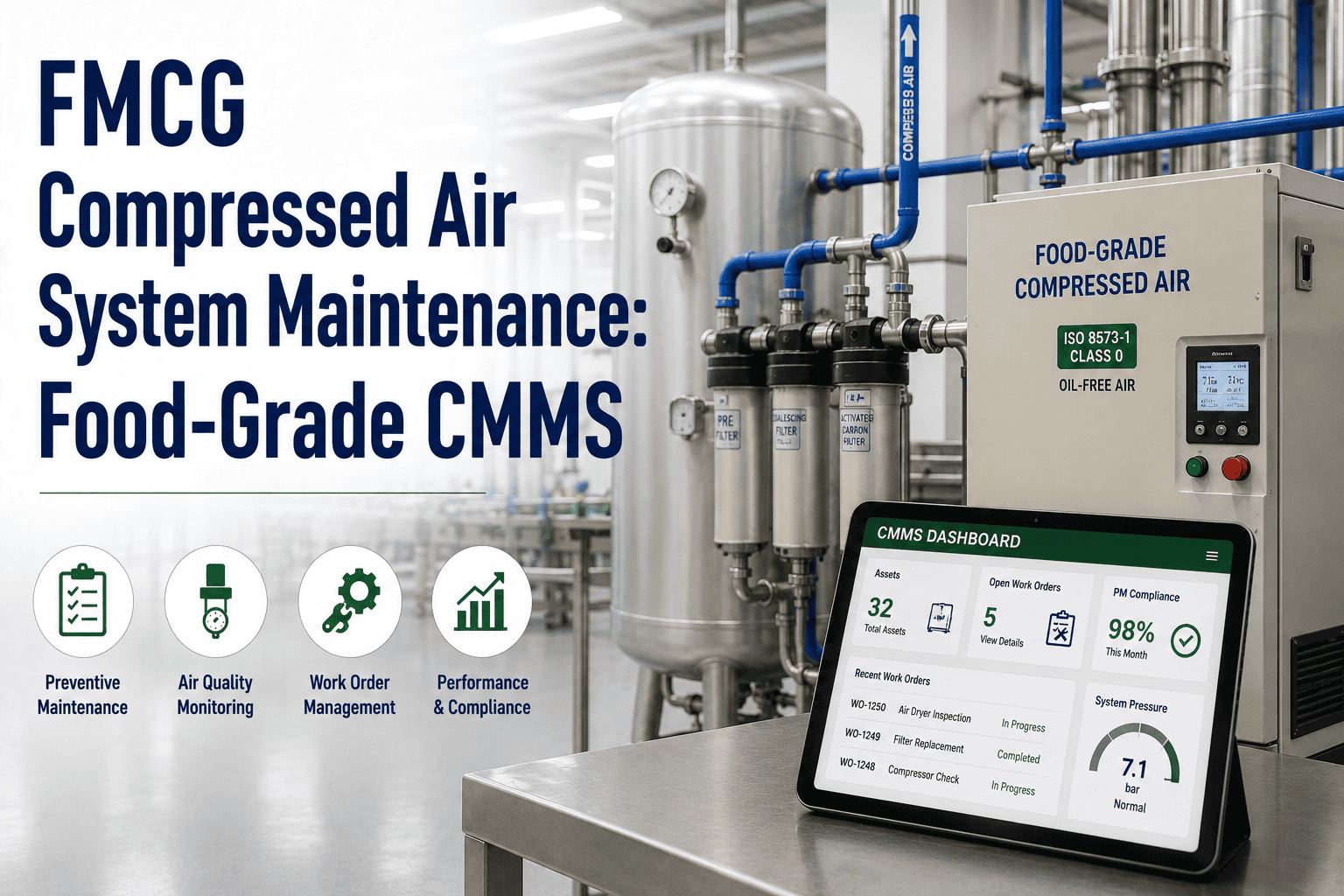
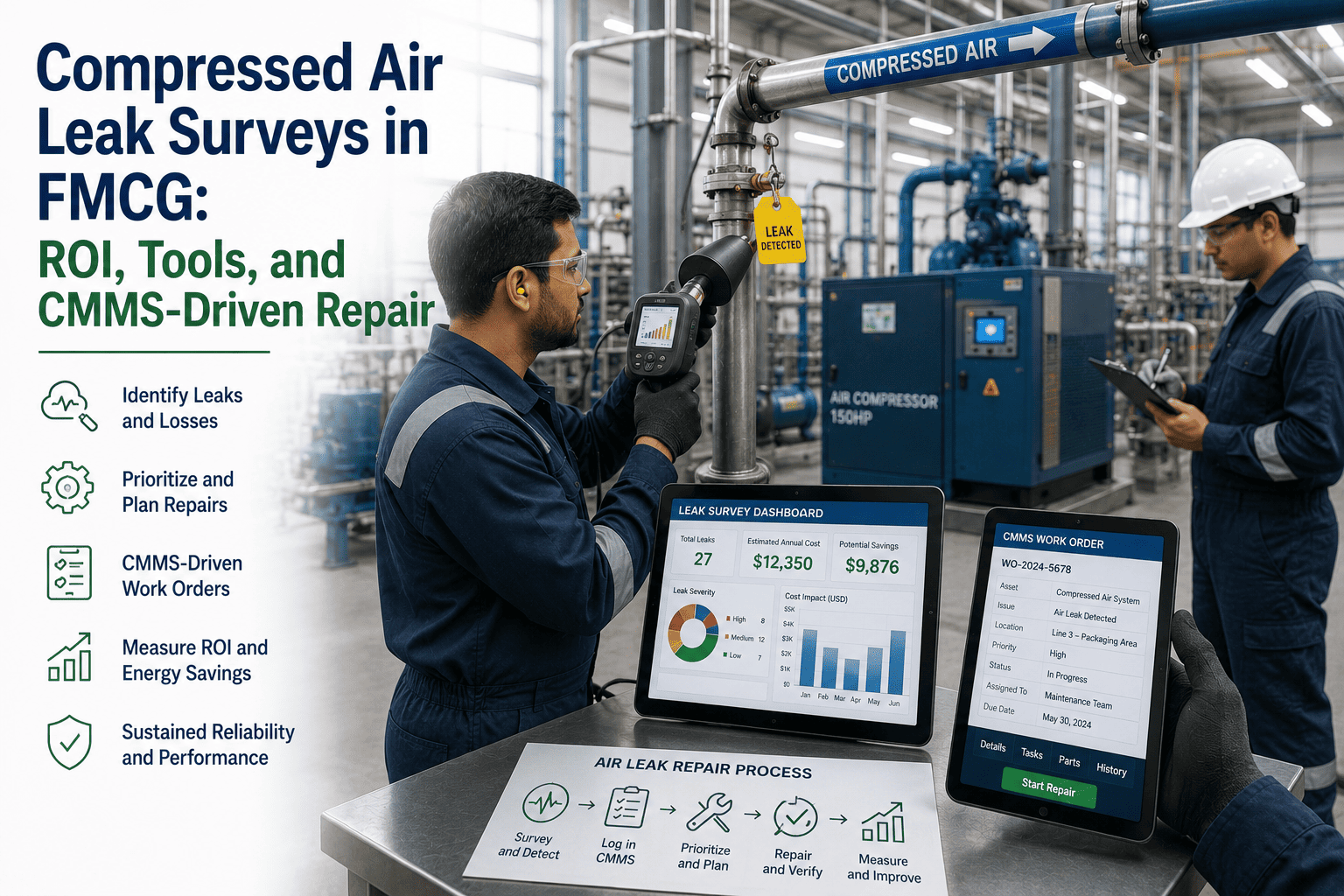
Compressed air is the most expensive utility in an FMCG plant and the most invisibly wasted. In an unaudited facility, roughly 30% of the air a compressor produces leaks straight into the rafters before reaching a single point of use — and on a 132 kW system, that 30% can be $200,000 or more per year in pure electricity, gone. Add saturated dryers, fouled filters, and ISO 8573-1 air-quality failures at food-contact points, and compressed air quietly becomes the single largest preventable line item in plant utilities. This page lays out the leak survey, compressor PM, and dryer cadence that closes the gap and keeps food-grade air defensible to BRCGS, SQF, and FDA auditors. Start a free trial to map your compressed air assets and leak losses in Oxmaint, or book a demo with our FMCG utilities team.
30%
Air Lost to Leaks Pre-Audit
Typical leak rate as a share of total compressed air produced in an FMCG plant with no formal survey programme
$200K+
Annual Leak Cost per 132 kW
Electricity wasted on a single mid-sized compressor running 20% in unloaded or leak-driven runtime per year
70-80%
System Energy Consumed by Compressor
The compressor itself is by far the single largest energy consumer in any compressed air system — PM has a direct kWh impact
7-8%
Saved per 1 bar Pressure Reduction
Compressor energy saving for each 1 bar reduction in system pressure achieved through demand-side optimisation
What Compressed Air Maintenance Means in an FMCG Plant
Compressed air maintenance is the structured programme of compressor PM, dryer and filter care, leak detection and repair, distribution audits, and ISO 8573-1 quality testing that protects both the energy bill and the product. In an FMCG plant, air does double duty — it drives pneumatic actuators on fillers and cappers, and at food-contact points it physically touches the product through blow-off jets, conveying lines, and packaging air knives.
That means every shortcut on the air system has two bills attached: an electrical bill from running the compressor harder than needed, and a quality bill from contamination risk at the product. A defensible FMCG compressed air programme treats both equally — every air-quality test, every leak repair, every dryer service is logged against its asset record. Start a free trial to register your full air system inside Oxmaint.
The 6 Subsystems an FMCG Compressed Air Programme Must Manage
Subsystem 01
Air Compressor PM
Oil sampling, filter changes, intercooler cleaning, motor bearing lubrication, VSD service. OEM intervals must be followed for warranty and to keep specific power kW/cfm at design.
Subsystem 02
Dryers and Aftercoolers
Refrigerated and desiccant dryers checked for dew point, condensate drain function, and desiccant condition. A saturated dryer ruins ISO 8573-1 water class and corrodes downstream lines.
Subsystem 03
Filters and Separators
Pre-filter, coalescing filter, oil-vapour filter, sterile filter at food-contact points. Differential pressure monitored at every shift; element changes by dP not by calendar guesswork.
Subsystem 04
Leak Survey Programme
Quarterly ultrasonic walk-through plus annual overnight pressure-decay test. Every leak tagged, costed in kWh, work-ordered with deadline. Survey-to-repair time tracked as a KPI.
Subsystem 05
Distribution Network
Mains and drops sized correctly, isolation valves on every zone, condensate drains functional, pressure drop from compressor discharge to point of use kept under 10% baseline.
Subsystem 06
ISO 8573-1 Quality Testing
Monthly point-of-use testing for particles, water, and oil at every food-contact location. Failure raises an immediate critical work order and a quality hold on the affected zone.
When all six subsystems live in one platform, the programme becomes auditable, defensible, and cost-trackable to the kWh. Book a demo to see all six subsystems mapped to your compressors inside Oxmaint.
Where FMCG Compressed Air Programmes Bleed Money
!
No Leak Survey, No Leak Visibility
Plant has 200+ active leaks but zero work orders. 30% of compressor output dumped to atmosphere, paid for at industrial power rates.
!
Pressure Set High to Cover Problems
Set point raised 1 bar over years to mask leaks and undersized lines. Every extra bar burns 7-8% more compressor energy permanently.
!
Dryer Service Skipped or Delayed
Refrigerated dryer running 3°C above dew point spec, desiccant pulled past its end-of-life. ISO 8573-1 water class quietly failing at the filler.
!
Filter dP Not Monitored at Every Shift
Coalescing element loaded to 0.6 bar dP — that single filter is now costing 4-5% of total compressor energy until it is changed.
!
Compressor Hours Logged in a Spreadsheet
No automated PM trigger. OEM 4,000-hour service runs to 5,500 hours. Warranty exposure, oil degradation, and bearing wear all compounding.
!
ISO 8573-1 Testing Done Without Records
Test done but no signed result against required class, no work order on failure, no audit trail. BRCGS or SQF auditor finds the gap, not the plant.
Most facilities lose 20-40% of their compressed air operating budget to untracked leaks, drift, and missed PM — Oxmaint closes every one of these gaps with structured work orders, mobile capture, and asset-level history. Start a free trial to see where your plant sits.
How Oxmaint Operationalises Compressed Air Maintenance
Full Air System Asset Registry
Compressors, receivers, dryers, filter banks, mains, drops, and every point-of-use registered with rated capacity, OEM service intervals, and required ISO 8573-1 class.
Ultrasonic Leak Survey Workflow
Each leak tagged by location, leak size, estimated kWh and dollar loss, and assigned to a technician. The plant sees its total leak cost and the repair backlog in dollars.
Auto-Scheduled Compressor PM by Run-Hour
Compressor run-hour counter drives the PM schedule, not the calendar. 1,000-hour, 4,000-hour, and 8,000-hour OEM services trigger automatically with full checklist.
Dryer Dew Point and Filter dP Capture
Operators log dew point and filter dP from a mobile checklist at every shift. Out-of-spec values raise a critical work order routed to the utilities lead.
ISO 8573-1 Quality Test Audit Trail
Monthly point-of-use quality tests with signed result, retained per asset, instantly retrievable for BRCGS, SQF, FDA, and customer audits. Failures auto-flag the affected zone.
Energy and Cost Dashboards
kWh per unit produced, compressor load factor, system pressure, and total leak cost all tracked over time so the savings from each repair are visible at a glance.
The outcome is a compressed air programme that's defensible to auditors, costed to the kWh, and tuned to drop pressure and waste every month rather than letting them quietly drift up. Start a free trial to see this run on your assets.
Unaudited vs. Structured Compressed Air Programme
| Programme Element |
Unaudited Compressed Air |
Oxmaint-Managed Programme |
| Total system leak rate |
25-35% of compressor output |
Under 10% within 12 months |
| Leak survey frequency |
Once every 2-3 years (if ever) |
Quarterly ultrasonic plus annual decay test |
| System pressure setpoint |
Raised over years to mask issues |
Optimised; reduced by 0.5-1 bar typical |
| Dryer dew point monitoring |
Checked when contamination occurs |
Shift-level capture with auto-escalation |
| Filter element change trigger |
Calendar guess or visual inspection |
Differential pressure threshold |
| Compressor PM compliance |
50-70% of OEM intervals met |
95%+ run-hour-triggered compliance |
| ISO 8573-1 audit defence |
Inconsistent paper records |
One-click audit pack by zone and date |
| Annual compressed air energy waste |
$150,000 - $400,000 per plant |
Recovered to baseline within 12 months |
Documented ROI from Structured Compressed Air Maintenance
15-25%
Compressed Air Energy Cut
Average energy reduction achieved within 12 months from combined leak repair, pressure optimisation, and PM compliance
$200K+
Annual Leak-Repair Recovery
Typical electricity recovered per site by closing the leak inventory uncovered in the first ultrasonic survey
95%+
PM Compliance Rate
Documented OEM PM compliance on compressors and dryers after Oxmaint run-hour scheduling replaces spreadsheets
0.5-1 bar
System Pressure Reduction
Typical pressure reduction enabled by leak closure and demand audit — worth 4-8% of compressor energy each
...which is why FMCG utilities teams that move from reactive to structured compressed air maintenance see kWh per case produced drop in the first quarter — start a free trial to map your leaks and PM schedule today, or book a demo and we'll model the savings for your specific compressor mix.
Frequently Asked Questions
How often should a full compressed air leak survey be conducted in an FMCG plant?
For an active FMCG plant, the recommended cadence is a full ultrasonic leak survey quarterly across all production zones, plus an annual overnight pressure-decay test to measure total system leak rate. New leaks develop continuously in pneumatic-heavy production environments, and quarterly cadence catches them before they compound into double-digit percentage loss. Oxmaint schedules every survey, captures each tagged leak as a work order, and tracks survey-to-repair time as a programme KPI.
What ISO 8573-1 classes does Oxmaint support tracking for food-contact points?
Oxmaint supports tracking required ISO 8573-1 class per point of use across all three contaminant types — solid particles, water, and oil. Food-contact applications typically require Class 1.2.1 or 1.4.1 air quality. Each point of use is registered with its required class, monthly test results are captured, and any failure raises an immediate critical work order plus a quality notification to the QA team. Full test history is retained per asset for audit and customer review.
How does Oxmaint trigger compressor PM based on run-hours instead of calendar dates?
Compressor run-hour counters are logged either manually at each shift handover or via integration with the compressor controller. Oxmaint maps each OEM PM interval — typically 1,000, 4,000, 8,000, and 16,000 hours — to a scheduled work order that fires automatically when the counter crosses the threshold. The same approach drives oil-sampling intervals, filter element checks, and intercooler cleaning. The result is OEM-compliant PM tied to actual usage rather than a calendar that ignores duty cycle.
Can Oxmaint quantify the dollar cost of each leak and prioritise the repair backlog?
Yes. When a leak is tagged during an ultrasonic survey, the technician records the orifice size, system pressure, and operating hours per year. Oxmaint calculates the kWh loss and dollar cost using the plant's electricity tariff. The repair backlog is automatically prioritised by annual dollar loss, so the largest leaks are fixed first. Managers can see total leak cost across all sites in one dashboard and report energy savings as each work order is closed.
Stop Paying for Air You Never Use
Cut 20-30% of Compressed Air Energy Without Buying a New Compressor
See exactly where your air is leaking, where your dryers are drifting, and where your compressor PM is overdue — all in one auditable platform.
- Leak inventory costed in dollars, prioritised in work-order order
- Compressor PM triggered by run-hours, not calendar dates
- ISO 8573-1 audit-ready documentation at every food-contact point
Used by operations teams managing 10,000+ assets across multi-site FMCG portfolios — live in days, not months.