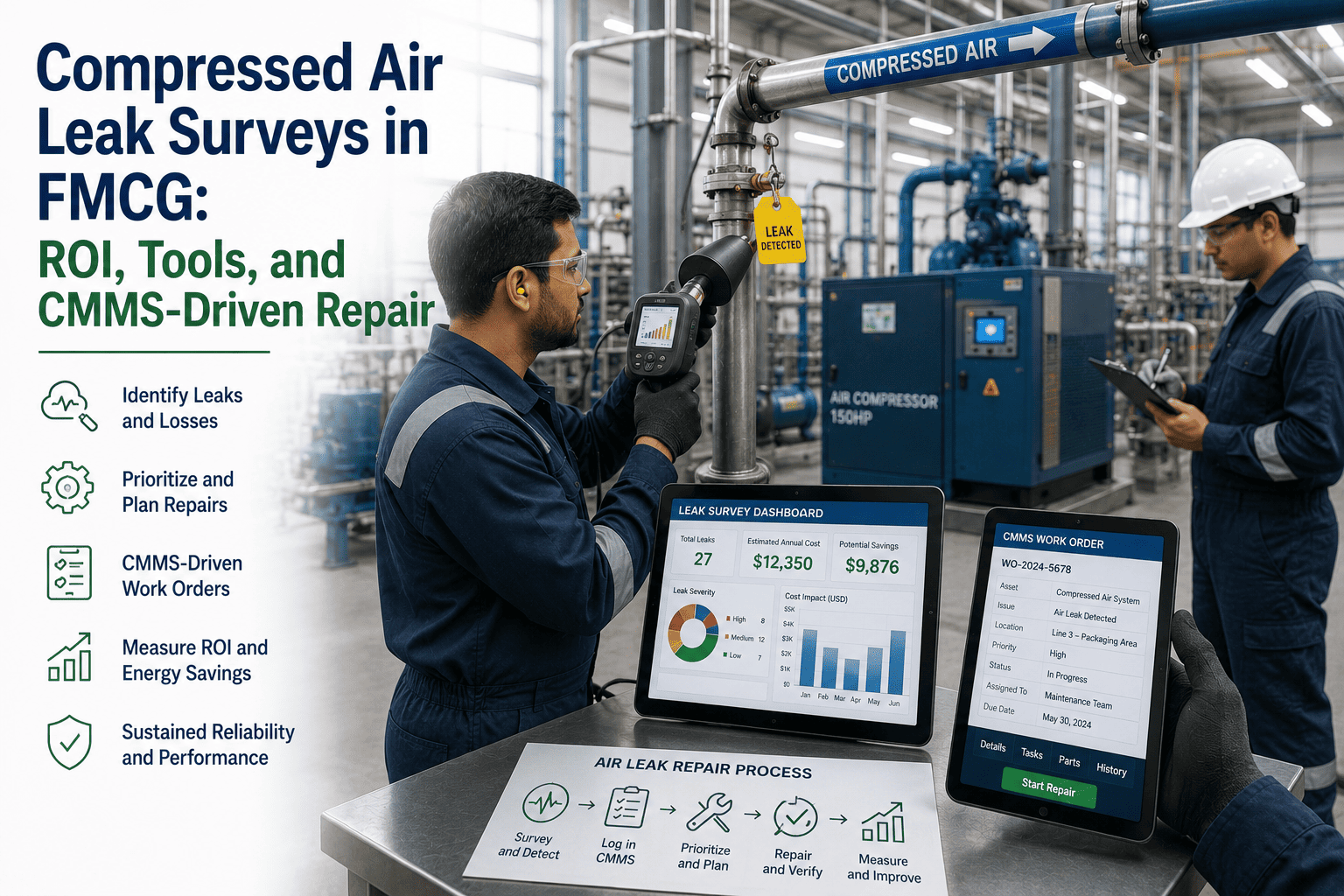
Compressed air is the most expensive utility in your plant and the one nobody tracks. The U.S. Department of Energy reports that compressed air leaks waste 20-30% of a compressor's output in a typical facility and FMCG plants run leakier than average because of high-vibration packaging lines, frequent line changes, and quick-disconnect fittings that loosen over thousands of cycles. A medium-sized plant spending $250,000 annually on compressed air typically has $36,000-$200,000 in identifiable leak losses hiding in plain sight. Ultrasonic leak surveys find them, CMMS-routed repair workflows close them, and the cost recovery happens inside 90 days. To see how OxMaint turns leak survey findings into prioritized, ROI-ranked work orders that actually get completed start a free trial or book a demo with our team.
Compressed Air Leaks · Ultrasonic Survey · CMMS Repair Workflow
Compressed Air Leak Surveys in FMCG: ROI, Tools, and CMMS-Driven Repair
Most FMCG plants leak $200-600K per year in compressed air. See the ultrasonic survey, tag, and CMMS-routed repair workflow that finds the leaks, prioritizes them by dollar value, and captures the savings inside 90 days.
Annual Leak Cost by Plant Size
Medium (15K CFM)
$200-400K
Large (30K+ CFM)
$500K-1.2M
20-30%
Of compressor output wasted to leaks (US DOE)
8 HP
Of electricity needed for every 1 HP of compressed air
$2,500
Annual cost of a single 1/8-inch leak at 100 PSI
<90 days
Typical payback on a full leak survey program
Understanding the Loss
What Is a Compressed Air Leak Survey and Why Does FMCG Need One?
A compressed air leak survey uses ultrasonic detection equipment to find air leaks that are inaudible to the human ear. When compressed air escapes through an orifice, it generates ultrasonic sound in the 38-42 kHz frequency range well above human hearing. Ultrasonic detectors convert this signal into an audible tone and a signal intensity reading, allowing technicians to locate leaks smaller than 0.01 inches in diameter even in high-noise production environments.
FMCG plants are unusually leak-prone because of the operational profile: high-vibration packaging machinery loosens fittings, frequent product changeovers cycle quick-disconnects daily, and washdown chemistry corrodes seals and O-rings. The result is that a standard FMCG facility with no leak management program attributes 30% or more of its compressed air consumption to leaks and pays for every kWh of it on the utility bill. A structured annual survey can cut leak rates by 50% on average. To see the survey-to-repair workflow inside OxMaint, start a free trial or book a demo with our team.
The Six-Step Survey Workflow
Find-Fix-Verify: The Compressed Air Leak Management Cycle
A successful leak program is not a one-time survey. It is a continuous cycle of detection, repair, and verification that becomes part of the plant's standard maintenance cadence. Plants that follow this six-step workflow consistently sustain leak losses below 10% of total air production half the industry average.
01
Baseline Measurement
Measure off-shift compressor flow rate. With production halted, any flow above zero is leakage. This establishes the baseline cost being lost 24 hours a day.
02
Ultrasonic Scan
Technician sweeps the plant with an ultrasonic detector or camera. Modern cameras like the UE UltraView visualize the leak location and quantify CFM in real time.
03
Tag and Photo Each Leak
Every leak gets a numbered physical tag, a photo, a CFM estimate, a dollar value, and a priority ranking. All data uploaded to CMMS against the asset record.
04
CMMS Work Order Routing
Each tagged leak becomes a work order ranked by dollar value. High-cost leaks on critical lines get scheduled first. Low-priority leaks wait for next changeover.
05
Repair and Document
Technicians close work orders with photo evidence of repair, parts used, and time taken. The asset record captures what failed and what was fixed for trend analysis.
06
Verify Savings
Re-measure off-shift flow rate after repairs complete. Calculate actual energy reduction and verify against estimated savings. Lock the gain into next year's budget.
Industry Pain Points
Why Most FMCG Leak Programs Quietly Fail
Most FMCG plants have done at least one compressed air survey. Few have sustained the savings beyond 18 months. The failure pattern is consistent and predictable across every sub-vertical. If your last survey delivered short-term savings that quietly disappeared, start a free trial to see the CMMS-routed sustainment workflow, or book a demo.
01
Survey Reports That Never Become Work Orders
External surveyor delivers a 40-page PDF. It sits in a shared drive. 60% of the identified leaks are never actually repaired. Savings on paper, not on the meter.
02
No Priority Ranking by Dollar Value
Technicians fix the easiest leaks first the ones near the maintenance shop. The expensive leaks on the far end of the plant never make the list.
03
New Leaks Develop Faster Than Old Ones Are Fixed
Without continuous monitoring or quarterly mini-surveys, new leaks accumulate. By the time the next annual survey arrives, leak rates are back to 30%.
04
No Verification of Actual Savings
Without before-and-after measurement at the compressor, savings remain theoretical. Plant managers cannot prove ROI and the program loses budget priority.
05
Trained Operator Turnover
The one technician trained on the ultrasonic detector leaves. The equipment sits in a cabinet. Knowledge dies, program dies, savings die.
06
Energy and Maintenance Budgets Are Separate
The maintenance team fixes leaks; the energy savings show up on the utility bill. Without shared accountability, the maintenance team has no incentive to prioritize leak work.
How Oxmaint Solves It
How OxMaint Turns Leak Surveys Into Captured Savings
OxMaint makes the survey-to-savings cycle continuous and accountable. Each identified leak becomes a structured work order with a dollar value, a priority ranking, and a sustainment PM that triggers the next survey before leak rates recover. Plant managers see the leak inventory and dollar exposure on a single dashboard. Start a free trial or book a demo to see it on your plant.
Survey Capture
Mobile Leak Tagging Workflow
Technician scans an asset QR tag, enters leak CFM, takes photos, and OxMaint auto-calculates dollar value and priority. No clipboard, no spreadsheet, no lost data.
Prioritization
Dollar-Ranked Repair Queue
Leaks sort by annual cost descending. The $4,500 leak on the bottling line gets scheduled before the $80 leak in the warehouse capturing 80% of savings in the first 30 days.
Sustainment
Quarterly Mini-Survey PMs
Scheduled quarterly mini-surveys catch new leaks before they accumulate. Annual deep surveys become a verification rather than a discovery exercise.
Verification
Compressor Flow Tracking
Integration with compressor flow meters or IoT sensors lets OxMaint show before-and-after kWh consumption. Savings are proven in actual energy data, not estimates.
Multi-Site
Portfolio-Level Leak Dashboards
Operations leaders see total dollar exposure across every plant. Cross-site rankings expose outlier plants and accelerate best-practice sharing.
ISO 50001
Audit-Ready Energy Evidence
Every leak repaired with documentation supports ISO 50001 Significant Energy Use evidence. The CMMS becomes the auditable record of energy improvement.
Before vs After CMMS-Driven Repair
PDF-Based Survey vs OxMaint Workflow: Side-by-Side
| Workflow Step | Traditional PDF Survey | OxMaint CMMS Workflow |
| Leak Documentation |
PDF report in shared drive |
Each leak becomes a work order |
| Priority Ranking |
By location or convenience |
By dollar value, descending |
| Assignment |
Manual whiteboard or email |
Auto-routed to technician queue |
| Repair Tracking |
Maybe a spreadsheet |
Closed work order with photo evidence |
| Repair Rate |
40-60% completed in 12 months |
90%+ completed in 90 days |
| Verification of Savings |
Estimated only |
Measured at compressor flow meter |
| Sustainment |
Annual repeat survey |
Quarterly mini-surveys + annual |
| Multi-Site Visibility |
None |
Portfolio dashboard, all sites |
ROI and Captured Savings
What a Structured Compressed Air Program Delivers
50%
Reduction in Leak Rate
Annual ultrasonic surveys combined with quarterly mini-surveys cut overall leak rates by 50% on average from typical 30% of output to under 15%.
$200-600K
Annual Savings on Mid-Size Plant
Mid-size FMCG plants with $250K-$800K annual compressed air bills typically capture $200-600K in identified leak savings within the first 12-month cycle.
<90 days
Typical Program Payback
From survey to repair completion to verified savings, a structured leak management program pays back its entire cost including detector equipment in under 90 days.
2 PSI
Pressure Reduction Per 0.5-1% kWh
Every 2 PSI reduction in system pressure delivers 0.5-1% compressor energy savings. Closing leaks enables sustainable pressure reduction without starving production.
Frequently Asked Questions
Compressed Air Leak Survey Common Questions
How often should an FMCG plant conduct a compressed air leak survey?
A full survey annually combined with quarterly mini-surveys focused on high-traffic and high-vibration areas. Annual-only programs see leak rates recover to baseline within 18 months. Quarterly cadence sustains the gains.
Book a demo to see the quarterly survey PM template.What equipment do we need to run leak surveys in-house?
A handheld ultrasonic detector ($2K-5K) is sufficient for smaller plants. Mid-to-large plants benefit from an ultrasonic camera ($15K-30K) that visualizes and quantifies leaks in real time. Both options pay back in weeks on a typical FMCG plant. OxMaint integrates with both.
Start a free trial to see the integration.How accurate are ultrasonic surveys at predicting actual savings?
Independent studies show ultrasonic leak survey estimates land within 20% of actual measured savings on average. With proper baseline and post-repair flow measurement, the gap closes further. Verification through compressor flow meters is the gold standard.
Can the leak survey be done during production, or do we need a shutdown?
Surveys are most accurate during off-shift or weekend periods when background noise is lowest. However, ultrasonic detectors and cameras work effectively during production as well. Best practice combines both off-shift survey for accuracy, in-production survey for hard-to-access leaks under load.
Compressed Air Leaks · Ultrasonic Survey · CMMS Workflow · Free to Start
Capture $200-600K in Hidden Compressed Air Savings Inside 90 Days
Compressed air is the most expensive utility nobody manages, and leaks are the easiest savings in your plant if the survey-to-repair workflow actually closes the loop. OxMaint routes every tagged leak into a dollar-ranked work order, schedules quarterly mini-surveys automatically, and verifies savings against compressor flow data. Live in days, not months. No heavy implementation.