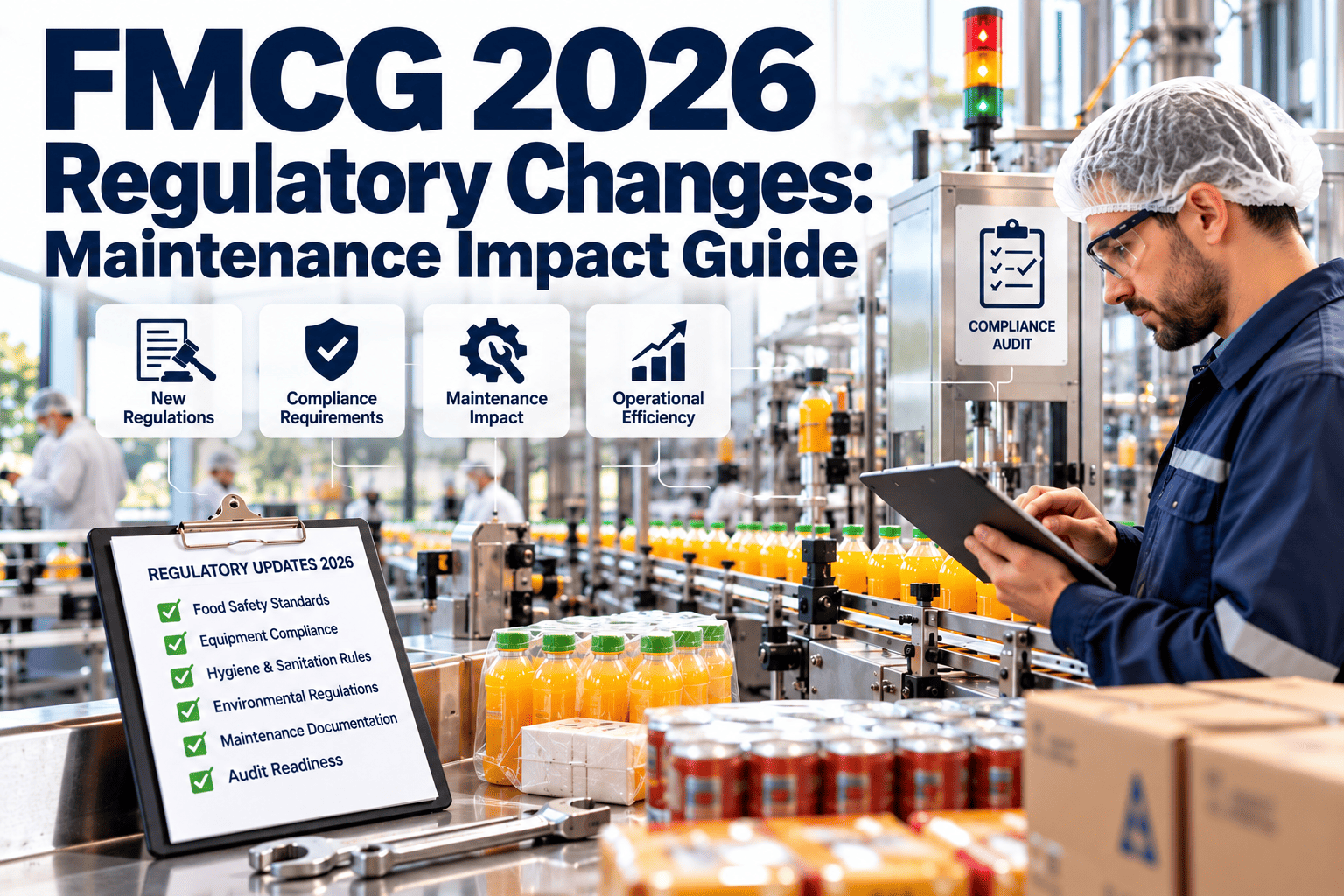
Regulatory change in food manufacturing seldom arrives as a maintenance instruction, yet it lands on maintenance teams all the same. A shifted compliance date, a revised audit standard or a tighter customer requirement changes what records must exist, how fast they must be produced and which equipment needs closer control. This guide separates what is confirmed from what is still developing in 2026, and translates it into maintenance actions, supported by workflows in Oxmaint maintenance management software.
2026 Regulatory Changes: What FMCG Maintenance Teams Need to Act On
A practical map of FSMA 204 timing, BRCGS developments and customer expectations, and what each means for maintenance records, equipment control and audit evidence.
Confirmed, In Development, and Customer-Driven
Compliance planning goes wrong when rumours and requirements get mixed. Sort every item into one of three groups before assigning work.
- FSMA 204 compliance date moved to July 20, 2028
- FSMA 204 substantive requirements unchanged
- BRCGS Issue 9 remains the current standard
- BRCGS position statements apply to audits from 10 August 2026
- BRCGS Issue 10 drafting by a technical working group
- Expected emphasis on food safety culture, environmental monitoring and consistency
- Possible further FDA guidance and stakeholder sessions
- Retailer supplier contracts that set earlier traceability timelines
- Customer audits that request records at short notice
- Market-specific requirements for export lines
FSMA 204: The Date Moved, the Work Did Not
FDA extended the Food Traceability Rule compliance date by 30 months, from January 20, 2026 to July 20, 2028. The extension changed timing only. Covered businesses still need Key Data Elements for Critical Tracking Events and must supply records within 24 hours of a request.
- Line and equipment records need to align with lot records
- Repairs, sanitation and changeover events must be timed accurately
- Retrieval within 24 hours demands searchable, digital records
- Treating the delay as permission to postpone data work
- Assuming only the food company, not equipment records, is affected
- Ignoring customer contracts with earlier requirements
Not all FMCG products fall under the Food Traceability List, so confirm applicability for your product range with your regulatory adviser.
BRCGS in 2026: Issue 9 Today, Issue 10 on the Horizon
Issue 9 remains the audit standard in use, with maintenance requirements in Clause 4.7. Public consultation on Issue 10 has closed and drafting continues. Published commentary points toward stronger expectations on culture, environmental monitoring and consistent day-to-day application.
| Expected emphasis | What it signals | Maintenance implication |
|---|---|---|
| Food safety culture | Behaviour matters as much as procedure | Technician adherence to clearance and hygiene steps will be tested |
| Environmental monitoring | Closer control of the production environment | Drains, condensation, leaks and building fabric need documented upkeep |
| Consistent application | Controls must work daily, not only before audits | PM completion and record quality are reviewed over time |
| Risk analysis and prerequisite programmes | Position statements affect audits from 10 August 2026 | Link maintenance tasks to documented risk ranking |
A Maintenance Readiness Path for 2026 and 2027
Use a staged path so effort matches the real deadlines, not the loudest headline.
From Regulation to Record: A Translation Table
Every external requirement should end up as a task, a field or a report in your maintenance system.
| Requirement theme | Maintenance task or record | Review point |
|---|---|---|
| Rapid record retrieval | Searchable work order history by asset and line | Quarterly retrieval drill |
| Equipment suitability | Inspection checklists on food contact assets | Monthly open findings review |
| Calibration of monitoring devices | Scheduled calibration tasks with certificates attached | Calibration currency report |
| Post-repair hygiene control | Mandatory clearance sign-off on work orders | Weekly sample check |
| Environmental control | Drain, roof, door and seal inspection routes | Trend review with quality |
| Corrective action discipline | Linked corrective work orders with verification | Age and closure rate |
How Oxmaint Helps Maintenance Teams Adapt
Oxmaint supports preventive maintenance, work orders, inspections, calibration scheduling and compliance records on one platform, so a new requirement becomes a configured task rather than a new spreadsheet. Review your compliance workflows and adjust checklists as standards change.
What Changes in Day-to-Day Maintenance Work
Regulatory language is abstract. Technicians and planners need to know what is different on the shift.
| Role | Likely change | Practical example |
|---|---|---|
| Technician | More precise, contemporaneous records | Start and end times logged on a mobile work order during the job |
| Planner | Tasks linked to risk and compliance themes | PM tasks tagged by food safety relevance and reviewed for frequency |
| Supervisor | Stronger checks on consistency | Weekly sample review of sign-offs and completion notes |
| Quality lead | Faster retrieval and shared data | Equipment history pulled alongside lot records in one session |
| Maintenance manager | Evidence of trends and follow-up | Monthly report on overdue tasks, repeat findings and closure times |
Data Quality: The Quiet Compliance Risk
Faster record retrieval exposes weak data. A fast search that returns inconsistent results is worse than a slow one, because it shows the weakness quickly.
- Use one naming convention for lines, assets and locations across maintenance, production and quality systems
- Replace free-text downtime reasons with a controlled list that people actually use
- Retire duplicate assets and outdated PM tasks that clutter reports
- Check that time stamps come from a consistent clock source
- Define which fields are mandatory before a work order can close
- Audit a small sample of closed work orders each month for completeness
Supplier, Contractor and Equipment Vendor Expectations
Regulatory change flows outward. Customers push requirements to suppliers, and plants push them to contractors and equipment vendors.
- Require work records in your system format
- Include hygiene and clearance steps in contracts
- Verify that calibration providers supply traceable certificates
- Ask for hygienic design documentation
- Request recommended PM and spare lists
- Confirm software and data export capability
- Review supplier manuals for record requirements
- Plan responses to short-notice record requests
- Clarify timelines that are earlier than regulatory dates
Environmental Monitoring and the Maintenance Link
Environmental monitoring programmes identify contamination patterns. Many of the underlying causes are maintenance items, which is why the two functions need to share data.
- Leaking roofs, doors and seals that let moisture or pests into production areas
- Damaged floors, drains and wall junctions that hold standing water
- Condensation from chillers, pipework and poorly insulated surfaces
- Air handling filters and pressure differentials that drift out of range
- Equipment with worn seals or hollow sections that harbour residue
Link positive environmental results to maintenance work orders, and track whether the corrective work removed the cause.
Planning Capacity for Compliance Work
Compliance work competes with production support. Plan it explicitly, so it does not fall to whoever has spare time.
Scenario: Responding to a Short-Notice Record Request
Consider a customer asking for equipment records on one line for a specific production window, with a short deadline. A prepared team follows a clear route.
Questions to Put to Your Certification Body and Customers
Interpretations vary by scheme, market and customer. Asking early avoids building to the wrong target.
- Which version of the standard will our next audit use, and when does the transition apply?
- Do the August 2026 position statements change expectations for our risk analysis or prerequisite programmes?
- Does any customer require traceability evidence before July 2028?
- Are electronic records and signatures acceptable in the format we use?
- What is the expected response time for record requests, and who is the contact?
- Are maintenance and calibration records within scope of the traceability exercise?
Keeping Guidance Current
Regulatory information changes, and older guides can quote superseded dates. Build a simple habit for staying accurate.
- Assign one person to monitor regulator, standard owner and certification body announcements
- Record the source and date for every compliance decision in your change log
- Review internal procedures that quote dates or versions at least twice a year
- Treat content published before March 2025 on FSMA 204 with caution, because it often cites the earlier January 2026 date
- Check any claim against the primary source before it reaches a training slide or procedure
Cost of Waiting Versus Cost of Preparing
Delay is tempting when deadlines move. The comparison below shows why steady preparation tends to be cheaper than a late scramble.
- Data clean-up competes with peak production
- Technicians are trained in a rush
- Customer audits find gaps before you do
- Fixes are rushed and inconsistent
- Records improve a little each month
- Training fits into normal routines
- Gaps are found in your own drills
- Changes are tested before they matter
Using the Time Between Now and the Deadlines Well
Extended dates reward teams that spend the extra months on fundamentals. The most valuable work is rarely glamorous.
- Standardise asset and line naming so records match across systems
- Move paper checklists to mobile work orders on the highest-risk lines first
- Run two retrieval drills a year and publish the times internally
- Train technicians on why timing and sign-off accuracy matter to traceability
- Review PM tasks against food safety risk, and retire tasks that add no control
- Agree a standard format for evidence packages that customers and auditors request
Owning the Compliance Calendar
A shared calendar prevents deadlines from living in one person's head. Keep it simple, visible and reviewed monthly.
- List each external date, such as standard transitions, customer deadlines and audit windows
- Attach an internal milestone for records, training and checklists ahead of each date
- Name an owner for every milestone and review progress in the monthly maintenance meeting
- Remove or update entries when a regulator or standard owner changes a date
Turn Regulatory Change Into a Scheduled, Evidenced Task
Update checklists once and apply them across every line, with records ready for the next audit or request.
Where Regulatory Changes Hit Maintenance Hardest
Some areas of the plant feel the pressure sooner than others. Prioritise by exposure to audit and traceability scrutiny.
Common Mistakes When Reacting to Regulatory News
Teams tend to overreact to dates and underreact to the quiet requirements that remain unchanged.
- Pause all traceability work after an extension
- Wait for the final version of a standard to begin
- Rely on one person to know what changed
- Rewrite procedures but not the records
- Use the extra time to fix data quality
- Strengthen fundamentals that every version expects
- Assign owners and review dates for each change
- Reflect each change in checklists and fields
A Change Log That Auditors Respect
When a standard or procedure changes, keep a short, dated record of how maintenance responded.
- The requirement or update, with its source and effective date
- The decision on applicability to your site and products
- The task, checklist or field that was changed or created
- The person responsible and the date of implementation
- Evidence of training or communication to technicians
- A review date to confirm the change is working
Metrics for Regulatory Readiness
Review these alongside normal maintenance metrics in your monthly meeting.
Frequently Asked Questions
Be Ready for the Next Requirement Before It Becomes an Audit Finding
Bring maintenance, calibration and clearance records into one system you can adapt as standards evolve.
.png)