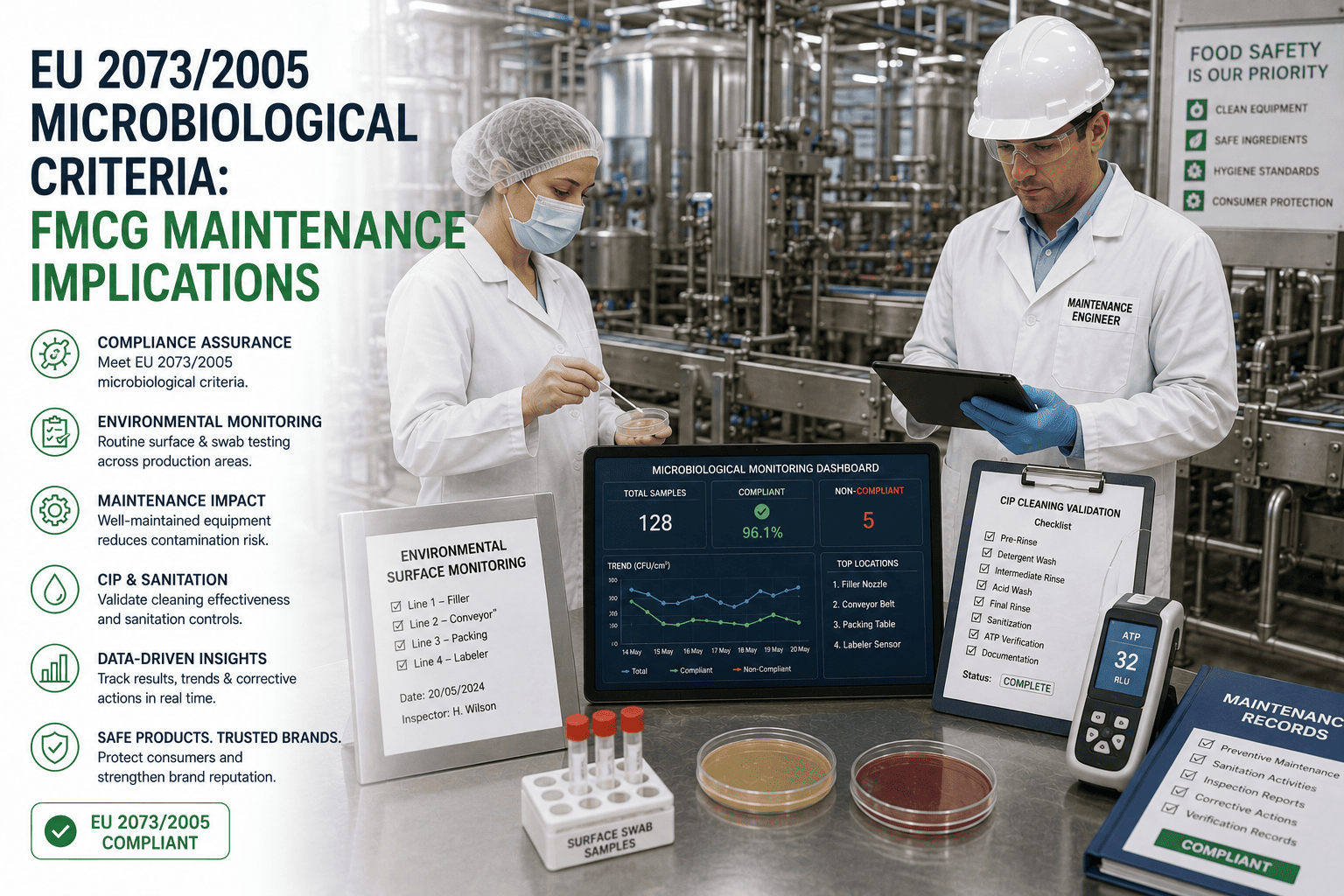
EU Regulation 2073/2005 defines the microbiological criteria that determine whether food products are safe for market — specifying acceptable limits for Salmonella, Listeria monocytogenes, and other pathogens in ready-to-eat foods. For FMCG manufacturers, compliance is not a documentation exercise but a daily operational requirement enforced through environmental monitoring, CIP validation, and surface swab programs that generate thousands of data points each month. When these programs lack structured workflows, FMCG plants face audit failures, batch holds, and the escalating costs of reactive microbial control, where a free trial of Oxmaint's environmental monitoring module can replace spreadsheet-based tracking with zone-mapped sampling schedules, lab result trending, and automated corrective action workflows — or book a 30-minute demo to see how FMCG facilities digitize their microbiological compliance from sample collection to audit readiness.
FMCG Regulatory Compliance · EU Food Safety Standards
EU 2073/2005 Microbiological Criteria: FMCG Maintenance Implications
EU Regulation 2073/2005 establishes the microbiological safety baseline for ready-to-eat foods across Europe, the UK, and international markets that reference EU standards. This guide covers how FMCG maintenance teams implement environmental monitoring programs, CIP validation workflows, and digital audit trails that satisfy both the regulation's food safety criteria and process hygiene criteria requirements.
1,392
People became ill from contaminated food recalls in 2024 (US PIRG 2025)
65
Recalls due to Listeria contamination in 2024 — 39% of all pathogen recalls
10.0%
Mean Listeria monocytogenes prevalence in cheese facilities (2024 study)
What Is EU Regulation 2073/2005 on Microbiological Criteria
EU Regulation 2073/2005, applicable from January 2006 and amended most recently in 2019, lays down microbiological criteria for foodstuffs to ensure they do not pose an unacceptable risk to human health. The regulation establishes two types of criteria that FMCG manufacturers must satisfy: food safety criteria, which define the acceptability of products placed on the market, and process hygiene criteria, which indicate whether production processes are functioning correctly. Food safety criteria apply to finished products throughout their shelf life and cover organisms including Salmonella, Listeria monocytogenes, Enterobacter sakazakii, staphylococcal enterotoxins, and histamine. Process hygiene criteria apply during manufacturing and cover indicators such as Enterobacteriaceae and aerobic colony counts at defined stages of production.
For FMCG maintenance teams, this regulation translates into ongoing validation responsibilities: CIP systems must deliver repeatable sanitation outcomes, environmental monitoring programs must detect pathogens before they contaminate product contact surfaces, and all hygiene-critical equipment must maintain documented calibration and performance records. The regulation places responsibility on food business operators to demonstrate compliance through sampling plans, microbiological testing, and trend analysis of results, with actions required when unsatisfactory results indicate a loss of process control. Facilities that start a free trial gain access to automated environmental monitoring workflows that map testing zones, schedule sampling frequencies, and trigger corrective actions when microbial limits are exceeded.
The Six Core Requirements EU 2073/2005 Imposes on FMCG Maintenance Operations
EU Regulation 2073/2005 does not merely set microbial limits — it defines operational expectations for how FMCG manufacturers validate, monitor, and respond to microbiological risks in production environments. These six requirements constitute the regulatory baseline that maintenance programs must satisfy to demonstrate HACCP compliance and pass third-party food safety audits under BRC, SQF, or FSSC 22000 schemes.
01
Food Safety Criteria Compliance Throughout Shelf Life
Ready-to-eat foods must meet Listeria and Salmonella limits not just at release but across the declared shelf life. For foods supporting Listeria growth, limits are 100 CFU/g at production and below 100 CFU/g throughout shelf life. This requires validated challenge testing, durability studies, and environmental controls that prevent post-process contamination.
02
Process Hygiene Criteria for In-Process Monitoring
Process hygiene criteria apply at defined production stages to verify that HACCP-based procedures are working correctly. Enterobacteriaceae counts on pasteurized milk or meat carcass surfaces indicate sanitation effectiveness. Exceeding these limits does not trigger recall but requires immediate investigation and corrective action to restore process control.
03
Documented Sampling Plans with Statistical Validity
Microbiological criteria are defined using five components: the organism, analytical method, sampling plan (n and c values), analytical unit size, and microbiological limits. Sampling plans must be statistically valid, not arbitrary. Two-class plans distinguish acceptable from unacceptable; three-class plans add a marginally acceptable category for process hygiene monitoring.
04
Trend Analysis of Test Results Over Time
Food business operators must analyze trends in test results and take action without undue delay when they observe movement toward unsatisfactory results. This prevents microbiological risks before limits are breached. Trend analysis requires historical data visibility — impossible with spreadsheet-based logging systems where patterns remain invisible until audit preparation begins.
05
Environmental Monitoring for Listeria Control
While the regulation does not mandate environmental monitoring explicitly, it is the practical mechanism for demonstrating that production environments do not harbor Listeria reservoirs that compromise product safety. Environmental programs test zones 2 to 4 (non-product-contact surfaces) to detect and eliminate Listeria before it migrates to zone 1 food contact surfaces.
06
Immediate Corrective Action on Unsatisfactory Results
When food safety criteria are not met, affected product must be withdrawn, recalled, or subjected to further processing that eliminates the hazard. When process hygiene criteria are exceeded, production must be reviewed, sanitation revalidated, and HACCP plan reassessed. Corrective actions must be documented with root cause analysis and evidence that control is restored.
The Four Maintenance Failures That Drive Microbiological Non-Conformances
FMCG facilities with active HACCP plans and documented environmental monitoring programs still fail microbiological audits when maintenance execution does not align with documented procedures. These four failure modes account for the majority of audit findings traced back to maintenance departments across facilities audited under BRC Issue 9, SQF Edition 9, and FSSC 22000 Version 6 schemes.
Failure 01
CIP Validation Records Exist But Cycle Parameters Are Not Verified
The CIP system has a validated cleaning protocol on file, but daily cycle logs show no verification that temperature, chemical concentration, contact time, or flow rates matched validated parameters. A CIP chart shows completion but does not show compliance. Auditors treat unverified cycles as unvalidated — all production since the last documented verification is potentially non-conforming.
Failure 02
Environmental Swab Results Logged in Spreadsheets Without Trend Analysis
Weekly swab results are entered into Excel files organized by date or technician, but no process exists to identify upward trends in microbial counts before limits are breached. Trend analysis is a regulatory requirement under EU 2073/2005 Article 5, not an optional data science exercise. Spreadsheet-based programs fail this requirement because historical patterns remain invisible.
Failure 03
Corrective Actions Documented Without Root Cause or Verification of Effectiveness
A positive Listeria swab in zone 3 triggers a corrective action form stating resanitize and retest, but the form does not document what harborage site was identified, what sanitation deficiency allowed Listeria to establish, or whether retest results confirmed the corrective action eliminated the contamination source. This is documentation theater, not microbiological control.
Failure 04
Preventive Maintenance on Sanitation Equipment Performed Without Hygiene Verification
CIP spray balls, tank agitators, and robotic cleaning actuators are maintained on PM schedules, but no ATP swab or microbiological verification confirms that the maintained equipment still delivers sanitation effectiveness. A spray ball can be mechanically functional while delivering inadequate coverage due to partial blockage. Maintenance without hygiene verification does not satisfy EU 2073/2005 requirements.
Most FMCG facilities collect enough environmental monitoring data to satisfy EU 2073/2005 requirements — but lack the digital workflows to analyze trends, trigger corrective actions, and demonstrate continuous process control.
How Oxmaint Converts EU 2073/2005 Requirements Into Operational Workflows
Oxmaint's FMCG module provides the structured digital infrastructure that FMCG maintenance teams need to execute environmental monitoring programs, CIP validation workflows, and corrective action protocols that satisfy EU Regulation 2073/2005 requirements and pass third-party audits. The platform eliminates the documentation gaps, trend analysis failures, and corrective action theater that generate audit non-conformances even when sampling programs appear active on paper.
Zone-Mapped Environmental Monitoring Schedules
Digital facility maps with zone-based sampling locations (zones 1 to 4), automated work orders assigned by risk-based frequency (daily, weekly, monthly), and mobile swab collection workflows with photo documentation and barcode linking to lab results. Every sample is traceable to location, date, technician, and result without spreadsheet data entry.
Automated Trend Analysis with Alert Thresholds
Real-time trending of microbial counts by zone, by sampling location, and by organism type. Automated alerts when results approach action limits or when consecutive results show upward trends. Dashboards that display 6-month and 12-month historical patterns — satisfying EU 2073/2005 Article 5 trend analysis requirements without manual charting.
CIP Cycle Verification and Validation Tracking
Digital CIP checklists that verify temperature, chemical concentration, contact time, and flow rate against validated parameters before, during, and after each cycle. ATP swab results linked directly to CIP work orders. Automated revalidation triggers when spray balls, nozzles, or heat exchangers are replaced. Every CIP cycle produces an audit-ready compliance record.
Structured Corrective Action Workflows with Root Cause Requirements
When a swab result exceeds limits, Oxmaint automatically generates a corrective action work order requiring root cause documentation, harborage site identification, sanitation method applied, and verification retest results. Corrective actions cannot be closed until verification confirms effectiveness — eliminating the documentation-only responses that fail audits.
Sanitation Equipment PM with Hygiene Verification
Preventive maintenance schedules for CIP pumps, spray devices, robotic cleaning actuators, and tank agitators include mandatory hygiene verification steps — ATP swabs, visual inspections for biofilm, and functional tests for coverage and pressure. Equipment PM history is linked to environmental monitoring results, making equipment degradation visible before it drives microbial excursions.
Audit-Ready Compliance Reporting and Data Export
One-click reports that generate complete environmental monitoring summaries, CIP validation logs, corrective action histories, and trend charts filtered by date range, zone, or organism. Export formats compatible with BRC, SQF, and FSSC 22000 audit requirements. All data is timestamped, user-attributed, and tamper-evident — satisfying digital record integrity standards.
FMCG facilities managing multi-site operations gain portfolio-level visibility into environmental monitoring performance across all plants, with comparative dashboards that identify which sites have the highest Listeria detection rates, the longest corrective action closure times, or the most frequent CIP validation failures, and can book a demo to see how portfolio reporting works across geographically distributed production networks.
Reactive Hygiene Control vs Validated Process Control: EU 2073/2005 Compliance Comparison
EU Regulation 2073/2005 requires food business operators to demonstrate that their production processes are under control — not merely that they respond to problems after they are detected. This comparison illustrates the operational and regulatory difference between reactive hygiene management and validated process control that satisfies microbiological criteria requirements.
| Control Element |
Reactive Hygiene Control |
Validated Process Control (EU 2073/2005 Compliant) |
| Environmental Monitoring Trigger |
Swab testing performed when audit is scheduled or after customer complaint. No routine program. |
Zone-based sampling plan executed at defined frequencies (daily zone 1, weekly zones 2-3, monthly zone 4) with documented risk assessment justifying frequency. |
| CIP Validation Approach |
CIP system installed with OEM parameters. No site-specific validation or periodic revalidation. Cycles logged as complete/incomplete. |
Installation qualification, operational qualification, performance qualification completed at commissioning. Periodic revalidation when equipment changes. Every cycle verified against validated parameters. |
| Microbiological Result Trending |
Results entered into spreadsheets. No trend analysis unless auditor requests it during preparation. |
Automated trending with 6-month and 12-month historical views. Alerts triggered when results approach action limits or show upward movement over consecutive sampling periods. |
| Corrective Action Workflow |
Positive result generates resanitize instruction. No root cause analysis. No verification that corrective action eliminated contamination source. |
Structured corrective action requiring documented root cause, identified harborage site, sanitation method applied, and verification retest confirming effectiveness. Work order cannot close until verification passes. |
| Sanitation Equipment Maintenance |
CIP components maintained on time-based PM. No hygiene verification. Spray ball replaced when mechanically worn. |
PM schedules include ATP verification, visual biofilm inspection, and functional coverage tests. Equipment maintenance history linked to environmental monitoring results to detect degradation patterns. |
| Audit Readiness |
Manual assembly of swab logs, CIP charts, and corrective action forms from multiple Excel files and paper binders. Missing data discovered during audit. |
One-click reports generate complete environmental monitoring summaries, CIP validation logs, trend charts, and corrective action histories with full traceability and timestamped digital records. |
FMCG Environmental Monitoring and CIP Validation: Measurable Outcomes
FMCG facilities that implement structured environmental monitoring programs with digital CIP validation workflows achieve measurable improvements in microbiological control, audit performance, and operational cost avoidance. These outcomes are derived from facilities using Oxmaint's environmental monitoring module across multi-site FMCG production networks in dairy, bakery, ready-to-eat, and confectionery categories.
18.2%
Reduction in Environmental Swab Positives
First 12 months post-implementation vs baseline year
4.8×
Faster Corrective Action Closure
Median time from detection to verified resolution
Zero
Audit Non-Conformances for Missing Trend Data
Across facilities with 12+ months of digital records
92%
CIP Cycle Compliance Rate
Cycles completing within validated parameter tolerances
$470K
Avoided Recall Cost Per Facility
Based on early Listeria detection preventing product contamination
6.2×
ROI on Environmental Monitoring Digitization
Annual savings vs CMMS platform cost over 3-year period
Expert Perspective on EU 2073/2005 and FMCG Microbiological Control
MK
Dr. Maria Kowalski
Food Safety Microbiologist · BRC Lead Auditor · Former EU Food Standards Agency Consultant
The gap between what EU 2073/2005 requires and what most FMCG maintenance programs actually deliver comes down to operational visibility and trend analysis. The regulation does not just require testing — it requires demonstration of process control through documented trending and timely corrective action when results move toward unsatisfactory levels. I have audited facilities where thousands of environmental swabs are collected annually but no process exists to analyze whether Listeria detection rates are increasing in specific zones, whether corrective actions are eliminating harborage sites, or whether CIP systems are maintaining validated performance over time. These programs satisfy the letter of the regulation but fail the intent, which is continuous verification that microbiological hazards remain under control. Digital environmental monitoring platforms like Oxmaint solve this by making trend analysis automatic, corrective action workflows structured, and audit trails complete without requiring data scientists or manual report assembly. For FMCG manufacturers operating under both EU 2073/2005 and third-party certification schemes, this is the difference between a program that passes audits and one that actually prevents contamination events.
Frequently Asked Questions
How does EU Regulation 2073/2005 apply to FMCG facilities exporting to the UK post-Brexit?
EU Regulation 2073/2005 was retained in UK law as assimilated law following Brexit and continues to apply to food businesses in England, Wales, Scotland, and Northern Ireland. FMCG manufacturers exporting to both the EU and UK must comply with the regulation in both markets. The microbiological criteria, sampling plans, and corrective action requirements remain identical. Facilities using Oxmaint can configure environmental monitoring programs that satisfy both EU and UK requirements simultaneously, with audit reports filtered by market jurisdiction when needed for regulatory submissions or customer audits.
Start a free trial to configure multi-jurisdiction compliance tracking.
What is the difference between food safety criteria and process hygiene criteria under EU 2073/2005?
Food safety criteria define the acceptability of products placed on the market and apply throughout shelf life. They cover organisms like Listeria monocytogenes and Salmonella in ready-to-eat foods. Exceeding food safety criteria requires product withdrawal, recall, or reprocessing. Process hygiene criteria indicate whether production processes are functioning correctly and apply at defined manufacturing stages. They cover indicators like Enterobacteriaceae counts on carcass surfaces or in pasteurized products. Exceeding process hygiene criteria does not trigger recall but requires immediate investigation and corrective action to restore HACCP control. Oxmaint tracks both criteria types separately, with automated workflows that route food safety excursions to quality teams for product disposition decisions and process hygiene excursions to maintenance teams for sanitation revalidation.
How frequently should FMCG facilities perform environmental monitoring swabs to satisfy EU 2073/2005?
EU 2073/2005 does not prescribe specific environmental monitoring frequencies — it requires that food business operators implement programs appropriate to their risk profile. Industry best practice for FMCG ready-to-eat production includes daily or per-shift testing of zone 1 food contact surfaces, weekly testing of zone 2 equipment frames and adjacent non-contact surfaces, weekly or biweekly testing of zone 3 floors and drains, and monthly or quarterly testing of zone 4 external areas. High-risk facilities producing foods that support Listeria growth require more intensive programs than low-risk facilities.
Book a demo to review risk-based sampling frequency recommendations for your specific production environment and product portfolio.
Can FMCG facilities use indicator organisms instead of pathogen testing for environmental monitoring under EU 2073/2005?
EU 2073/2005 permits the use of indicator organisms to monitor hygiene, but food safety criteria apply to specific pathogens and must be verified directly when the regulation mandates it. For environmental monitoring, many facilities test zone 1 food contact surfaces for indicator organisms like Listeria species, aerobic plate count, or Enterobacteriaceae to avoid triggering product holds if pathogens are detected. Zones 2 to 4 are typically tested for Listeria monocytogenes and Salmonella directly because these zones do not contact product and positive results indicate environmental contamination that requires remediation without product disposition decisions. The choice of target organisms must align with your HACCP plan and be justified in your documented environmental monitoring program. Oxmaint supports both pathogen and indicator testing workflows with configurable alert thresholds for each organism type and zone.
Environmental Monitoring · CIP Validation · EU 2073/2005 Compliance
Stop Managing Microbiological Criteria with Spreadsheets
Oxmaint gives you the zone-mapped sampling schedules, automated trend analysis, structured corrective action workflows, and audit-ready digital records that FMCG facilities need to satisfy EU Regulation 2073/2005 and pass third-party food safety audits without manual data assembly or missing documentation gaps.
- Real-time environmental monitoring dashboards with automated Listeria trend alerts
- CIP cycle verification linked to validated parameters with ATP swab tracking
- Corrective action workflows requiring root cause and effectiveness verification
Used by FMCG facilities managing environmental monitoring programs across 10+ production sites. Measurable reduction in audit non-conformances within the first 90 days. No heavy implementation — live in days, not months.