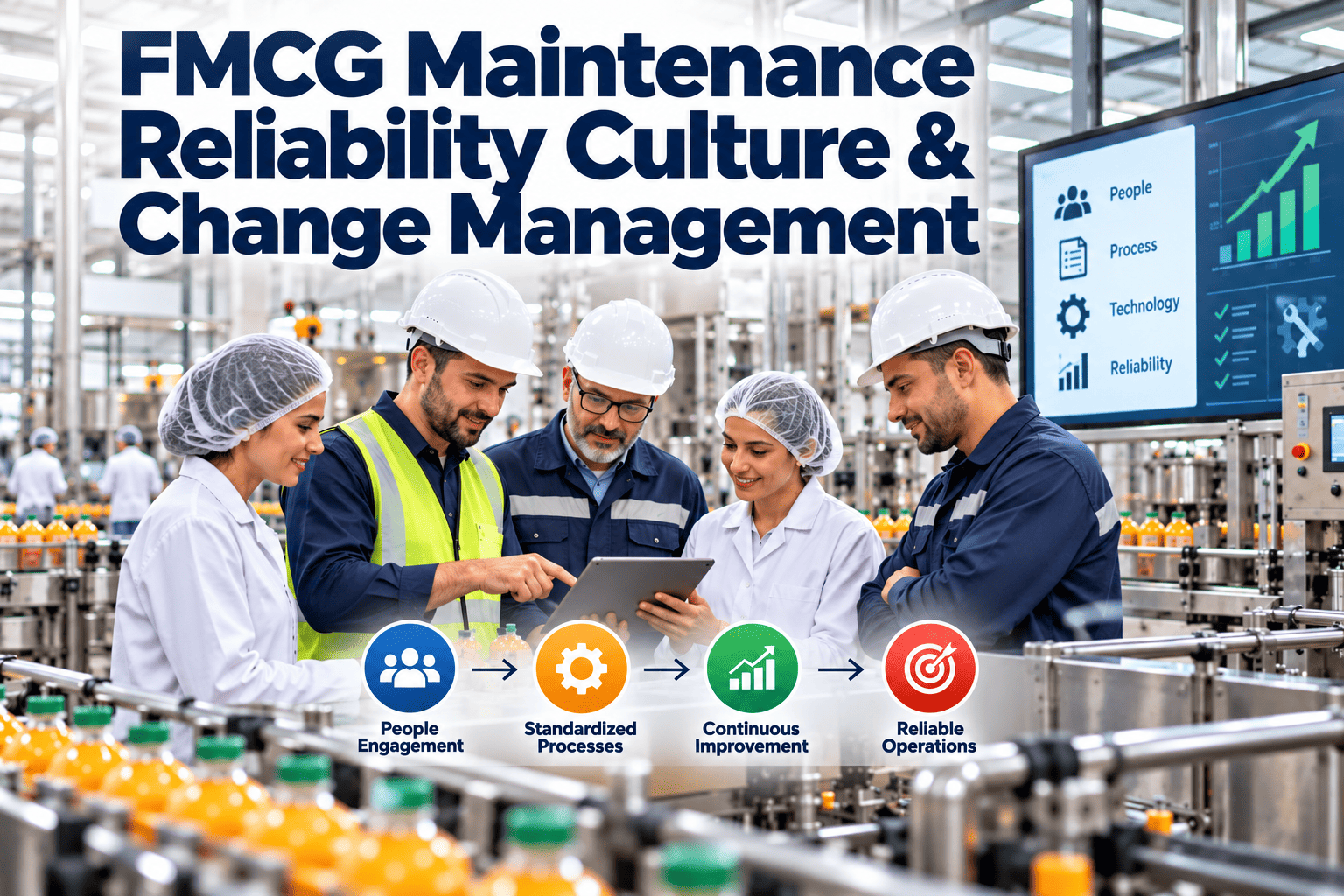
Most FMCG plants do not lack maintenance knowledge. They lack a shared belief that planned work is worth protecting when the line is under pressure. A new CMMS, a new PM schedule or a new reliability programme will only hold if supervisors, technicians and production leaders change how they behave on an ordinary Tuesday. This guide covers how to build a reliability culture in FMCG maintenance teams, from leadership alignment to technician buy-in, with practical support from Oxmaint maintenance management software.
Reliability Culture Is Built by Behaviour, Not by Software or Slogans
Move your plant from firefighting to planned, evidenced maintenance by aligning leaders, winning technicians and measuring the change honestly.
What a Weak Reliability Culture Looks Like
Culture shows up in small, repeated decisions. If several of the signs below sound familiar, the barrier is behavioural, not technical.
Why the FMCG environment makes this harder
- High-volume lines make every minute of downtime visible and every planned stop contested
- Frequent changeovers and short production windows compress maintenance time
- Shift patterns and contractors create handover gaps
- Audit pressure can reward paperwork before behaviour
- Ageing equipment mixed with new lines creates inconsistent standards
The Cost of Staying Reactive
Reactive cultures feel busy and productive, which makes them hard to leave. The hidden costs sit in places most dashboards do not look.
- Overtime and emergency call-outs
- Rush purchases of spares at premium cost
- Secondary damage from running to failure
- Technician fatigue and turnover
- Weak audit evidence and repeated findings
- Predictable stops that production can plan around
- Parts available when work is scheduled
- Fewer repeat failures through root cause work
- More stable teams with clearer priorities
- Records that exist because the work was recorded live
Leadership Alignment: The First Hard Conversation
Reliability culture cannot be delegated to the maintenance department. If plant leadership does not protect planned work, no technician will believe it matters.
| Leader | What they must visibly do | What undermines the change |
|---|---|---|
| Plant manager | Agree a minimum protected PM window and defend it in the production meeting | Overriding the schedule for volume without discussing risk |
| Production manager | Release lines on time for planned work and report equipment issues early | Treating maintenance as a service that interrupts output |
| Maintenance manager | Prioritise work consistently and show backlog and compliance openly | Accepting every urgent request without negotiation |
| Quality manager | Treat equipment condition as a food safety input, not a side issue | Raising maintenance issues only at audit time |
| Supervisors | Reinforce the process on the floor every shift | Bypassing the work order system for quick fixes |
Agreements worth making in writing
- The criteria that justify cancelling a planned task, and who can approve it
- How emergency work is raised, ranked and recorded
- Which indicators the leadership team reviews every month
- How production will be told in advance about planned stops
Technician Buy-In: Why People Resist and How to Respond
Technicians often resist new systems for sound reasons. They have seen initiatives start loudly and fade. Treat resistance as information.
Ways to involve technicians early
- Ask experienced technicians to review and improve PM task lists before launch
- Choose a pilot line with a willing team and learn from their feedback
- Recognise preventive finds publicly, with the same energy as breakdown fixes
- Provide training on the system in short, hands-on sessions during the shift
CMMS Adoption as a Change Programme
Software does not create culture, but it can make the desired behaviour easier and the undesired behaviour visible. Plan adoption as a change programme with clear stages.
Oxmaint helps teams manage preventive maintenance, work orders, inspections, scheduling and mobile workflows so the daily routine matches the culture you are trying to build. Start with a pilot line and expand as results appear.
Operators as Part of the Reliability Team
Operators see the equipment more hours than any technician. A reliability culture that ignores them wastes the best early warning system in the plant.
- Give operators simple, visual start-up and shift checks with clear thresholds for action
- Make it easy to report an abnormality, ideally from a phone or a line-side tag, with no blame
- Respond to reports quickly and tell the reporter what was done
- Train operators on basic cleaning, inspection and lubrication tasks where appropriate
- Recognise operators whose reports prevented a failure
Supervisors: The Make-or-Break Layer
Policies are interpreted by supervisors. If they treat the work order system as optional, technicians will too.
Root Cause Habits That Make Reliability Stick
Culture changes when people see problems solved at the source. A light, consistent root cause routine builds that belief faster than a heavy methodology.
Recognition, Incentives and What Gets Noticed
People repeat what is noticed and rewarded. Review what your plant actually celebrates and whether it matches the culture you want.
- Mention preventive finds and avoided failures in team meetings, not only dramatic repairs
- Include PM quality and record accuracy in performance conversations
- Avoid targets that reward closing work orders quickly regardless of quality
- Give technicians a voice in improving task lists and spares kits
- Share credit across maintenance, production and quality when results improve
Training and Skills: Building Capability Alongside Culture
Belief without skill leads to frustration. Pair behaviour change with practical training in the methods you are asking people to use.
- Condition checks and basic diagnostics
- Accurate, brief work order completion
- Hygiene clearance and food safety awareness
- Task list design and PM optimisation
- Backlog management and scheduling
- Using data to find repeat failures
- Reading reliability indicators
- Protecting planned work under pressure
- Coaching without blaming
Sustaining the Change After the Launch Energy Fades
Most programmes show early gains and then drift. Sustaining a culture means building the behaviour into routines that do not depend on one champion.
- Hold a short weekly reliability review with maintenance, production and quality in the same room
- Rotate the review lead, so ownership spreads beyond one person
- Include reliability measures in the monthly plant performance pack
- Refresh task lists and training annually using technician feedback
- Plan for turnover by documenting how the process works and why
Questions to Ask in a Culture Health Check
Use these questions in conversations, not only surveys. The answers show where belief and practice diverge.
- When did a planned task last get cancelled, and who decided?
- Can a technician say what happened to the last defect they reported?
- Do work orders get created before the work, or after?
- Would a technician feel safe reporting their own mistake?
- Do production and maintenance leaders describe priorities in the same way?
When Production and Maintenance Disagree
Conflict is normal in a plant under pressure. What matters is whether disagreements are settled by rules or by whoever shouts loudest.
- Agree a simple priority scale for work requests that both teams helped to write
- Use data on downtime causes and backlog age when discussing trade-offs
- Escalate unresolved conflicts to a named senior sponsor, with a decision deadline
- Review a recent disagreement monthly and adjust the rules if they did not work
Give Your Team a System That Rewards Planned Work
Make preventive maintenance visible, recorded in real time and reviewed with the same attention as production output.
A 90-Day Plan for Culture Change
Culture change needs early, visible wins. A 90-day plan builds credibility before asking for deeper change.
- Interview technicians, supervisors and operators
- Measure current PM compliance and repeat failures
- Agree protected PM windows with production
- Select a pilot line and a champion
- Run PMs through the CMMS on the pilot line
- Hold a short weekly review of findings
- Fix two or three recurring problems visibly
- Share early results with the whole team
- Update task lists using technician feedback
- Extend to the next line with trained peers
- Introduce root cause review for repeat failures
- Present results to plant leadership
Measuring Culture Change Without Fooling Yourself
Culture is hard to measure directly, so combine behaviour indicators with outcome indicators. Be wary of measures that can be gamed.
| Indicator | Type | What it tells you | Watch out for |
|---|---|---|---|
| PM completion on time | Behaviour | Whether planned work is protected | Tasks closed without being done |
| Work orders created before work | Behaviour | Whether the process is followed live | Orders raised after the event |
| Planned versus reactive ratio | Balance | Shift from firefighting to planning | Misclassification of urgent work |
| Repeat failures on the same asset | Outcome | Effectiveness of root cause work | Different wording for the same fault |
| Unplanned downtime on critical assets | Outcome | Reliability improvement | Reduced reporting rather than reduced failure |
| Technician survey scores | Sentiment | Trust in the process | Low response rates |
Pitfalls That Stall Reliability Programmes
Plants tend to stall in similar places. Spotting them early keeps momentum.
Connecting Culture to Food Safety and Audit Performance
Certification standards increasingly look at behaviour and consistency, not only procedures. Published commentary on BRCGS Issue 10 points toward stronger emphasis on food safety culture and consistent application. A strong reliability culture supports that expectation directly.
- Technicians complete hygiene clearance steps because the process makes it easy and expected
- Planned maintenance on food contact equipment is protected, not traded away for volume
- Findings are reported openly and followed through to closure
- Records are created during the work, so evidence reflects what actually happened
Frequently Asked Questions
Build a Maintenance Culture Your Team Believes In
Start with one line, one set of protected PMs and one honest review, and let the results make the case.


-in-fmcg-maintenance-small-changes,-big-impact.png)