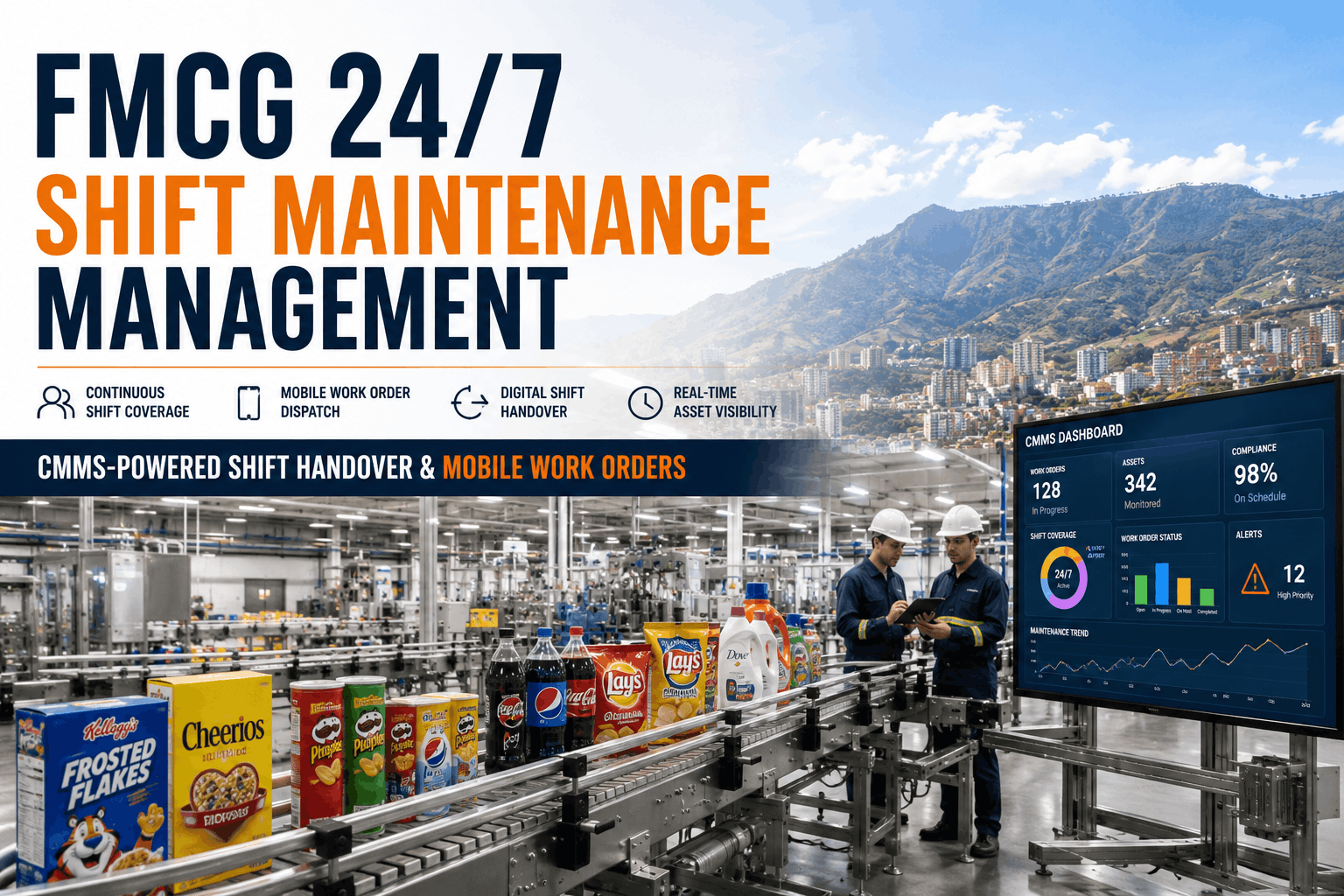
FMCG plants operating 24/7 continuous production manage maintenance across three or four shifts every day. Day shift hands off to evening shift at 6 PM; evening shift hands off to night shift at 2 AM; night shift hands off back to day shift at 6 AM. If a critical motor degrades during night shift, maintenance response must happen within hours to prevent catastrophic failure at 4 AM when the night shift technician is alone on the floor with no backup. If a conveyor splice shows signs of imminent failure during second shift, that information must flow to the on-call third-shift technician immediately. Traditional paper-based shift handovers fail this requirement: maintenance issues discovered by one shift are written in a notebook, that notebook sits in the maintenance office overnight, and the on-call technician doesn't learn about it until morning briefing. By then, eight hours have passed. The conveyor splice that could have been repaired during the 2 AM handover window is now catastrophic failure occurring at 5 AM with no technician response strategy. CMMS platforms built for continuous operations solve this by pushing shift-handover maintenance alerts directly to mobile devices, ensuring on-call technicians receive critical alerts in real time, enabling coordinated response across shift boundaries, and maintaining a continuous audit trail of what was discovered, when, by whom, and what action was taken. OxMaint's 24/7 shift maintenance module connects shift handovers to mobile alert systems, automates on-call scheduling, and ensures no critical maintenance issue is lost in handover transitions.
FMCG 24/7 Shift Maintenance Management & CMMS Guide: Continuous Operations Maintenance
24/7 shift maintenance management for FMCG plants: shift handover protocols, on-call technician systems, mobile work order dispatch, real-time alert routing to the technician currently on duty. Ensure critical maintenance issues discovered during any shift trigger immediate response to the on-call technician, not a notebook entry discovered 8 hours later. OxMaint's mobile-first architecture ensures maintenance alerts reach technicians in real time, shift handover checklists are documented digitally, on-call schedules are automated, and continuous operations never lose critical maintenance visibility.
The Shift Handover Maintenance Problem: How Continuous Operations Lose Critical Alerts
A beverage FMCG plant operates three shifts. Day shift (6 AM–2 PM), evening shift (2 PM–10 PM), and night shift (10 PM–6 AM). At 1:47 PM on Tuesday, during day shift, the Line 2 capping machine starts producing sub-optimal cap placement—caps are off-center by 2–3mm compared to specification. Day shift operator reports this to the maintenance technician, who visually inspects the capping head. The technician sees wear on the indexing cam, estimates replacement is needed within 24–48 hours, but the machine is still producing acceptable output (caps are off-center but still sealed). The technician makes a note: "Line 2 capping head indexing cam wear—replace during next planned maintenance window." That note goes into a maintenance logbook kept in the maintenance office. At 2 PM, day shift ends and evening shift begins. No formal handover occurs. The evening shift operator doesn't know about the capping head wear. At 4:30 PM, the wear accelerates. Caps start missing entirely—one in every 50 bottles runs uncapped. Evening shift operator calls maintenance. The same technician is unavailable (he's attending training). A different technician arrives at 5 PM, sees the urgent situation, calls for emergency cap machine parts (expedited shipping adds $800), and the machine runs degraded through the evening shift (producing defective cases that must be scrap-rebottled later, adding $2,100 cost). At 10 PM, evening shift ends. Night shift begins. Night shift supervisor doesn't see the maintenance logbook (it stays in the office). At midnight, the indexing cam finally fails completely. Line 2 goes down hard. The night shift technician on call receives a phone call from production: "Line 2 is down." He drives to the facility (30 minutes). By 1 AM, Line 2 has been down for 60 minutes. Emergency parts are ordered. The technician works through the night (6 hours emergency labor at premium rate). Line 2 restarts at 7 AM Wednesday morning—14 hours after initial discovery. Cost: $6,000 emergency parts + $1,200 overnight labor + $126,000 lost production (14 hours × 9,000 bottles/hour × $1.00 gross margin/bottle) = $133,200 total emergency cost. The indexing cam that could have been replaced proactively at $800 during a planned shutdown cost $133,200 in emergency response because the handover information was a logbook note that the night shift never saw. Schedule a consultation to see how mobile shift handover alerts could have prevented this scenario and saved $132,400.
Digital Shift Handover Checklist: What Real-Time Maintenance Visibility Looks Like
FMCG plants implementing OxMaint's shift handover module use a digital checklist that moves with the shifts. At shift change (every 6 or 8 hours depending on plant scheduling), the outgoing shift supervisor and incoming shift supervisor review a digital handover checklist on a tablet or mobile device. The checklist contains: equipment status summary (which machines are running, which are in maintenance, which are in standby), critical maintenance alerts from the previous shift (Line 2 capping head wear detected at 1:47 PM—repair scheduled for tonight), work orders in progress (conveyor bearing replacement scheduled for midnight—expected duration 2 hours, Line 1 will run at reduced speed during this window), equipment degradation warnings from IoT sensors (if applicable—motor current draw increasing on Line 3, schedule bearing inspection within 24 hours), parts on-hand status (emergency bearing kits in stock, standard caps in stock, expedited parts on order arriving Wednesday), and any abnormal occurrences from the previous shift (hydraulic pressure spike on palletizer at 11:30 AM—investigated by day shift, normal now, continue monitoring). Outgoing shift technician confirms completion of these items, incoming shift technician acknowledges and signs the digital checklist (timestamp creates audit trail). If critical issues exist, the incoming shift technician receives immediate mobile notifications. If on-call technician is needed, the system automatically pages or texts the on-call technician with priority level and equipment details. The entire handover takes 10–15 minutes and produces a digital audit trail. If an emergency occurs at 2 AM, all shifts can review the digital handover history and see exactly what was known about that equipment at each shift transition. Compliance auditors (for BRC, SQF, FSSC) can review handover records and confirm maintenance continuity across shifts. Production planners know exactly which equipment has maintenance underway and can adjust line speed or product allocation accordingly. This coordination eliminates the "lost in handover" scenario that plagues paper-based 24/7 operations.
On-Call Technician Scheduling & Mobile Alert Routing
24/7 FMCG plants typically maintain one or two on-call technicians per shift. An "on-call" technician is someone who is not on-site but is reachable within 30 minutes if an emergency occurs. Traditional on-call systems are manual: plant manager maintains a calendar showing which technician is on-call Monday through Friday nights, weekends, holidays. When an emergency happens, production calls the plant manager, who calls the on-call technician's phone, who then drives to the facility. OxMaint automates on-call scheduling and alert routing: the on-call rotation is configured in the CMMS (Monday-Friday nights: Tech A; weekends: Tech B; holidays: Tech C). When a critical alert fires (Line 2 capping machine emergency), the system automatically routes the alert to Tech A's mobile device with equipment details, priority level, and estimated response time. If Tech A doesn't acknowledge the alert within 5 minutes, the system escalates to Tech B and notifies the shift supervisor. All alert responses are timestamped and logged for auditing. At shift change, incoming shift supervisor can see "Tech A responded at 3:17 AM to Line 2 capping machine alert, bearing inspection requested." This documentation is critical for compliance audits (SQF, BRC, FSSC require documented maintenance continuity; real-time alert logs prove continuity). For FMCG plants, on-call alert routing eliminates the scenario where maintenance issues occur during night shift with no coordinated response because the on-call technician wasn't informed. Real-time alerts ensure immediate notification and response coordination.
FMCG 24/7 Shift Maintenance Management FAQ
"Our night shift technician used to call during his shift saying 'I didn't know about the motor issue—why wasn't I told?' OxMaint's mobile alerts changed that immediately. Now the on-call technician gets real-time alerts during all hours. Shift handover is documented, coordinated, and auditable. We've had zero 'lost in handover' maintenance issues since implementation. Night shift productivity is up because technicians know exactly what needs attention before they arrive."
— Priya Desai, Operations Manager, FMCG Continuous Production Facility, Tamil Nadu
Eliminate Shift Handover Gaps in 24/7 FMCG Operations
OxMaint's mobile shift maintenance module routes real-time alerts to on-call technicians within 5 minutes of discovery. Digital handover checklists document maintenance continuity across shift transitions. Automated on-call scheduling eliminates phone-call delays. Production planners see live maintenance status across all lines. Zero critical maintenance issues are lost between shifts. Deploy in 48 hours, see response time improvements immediately.