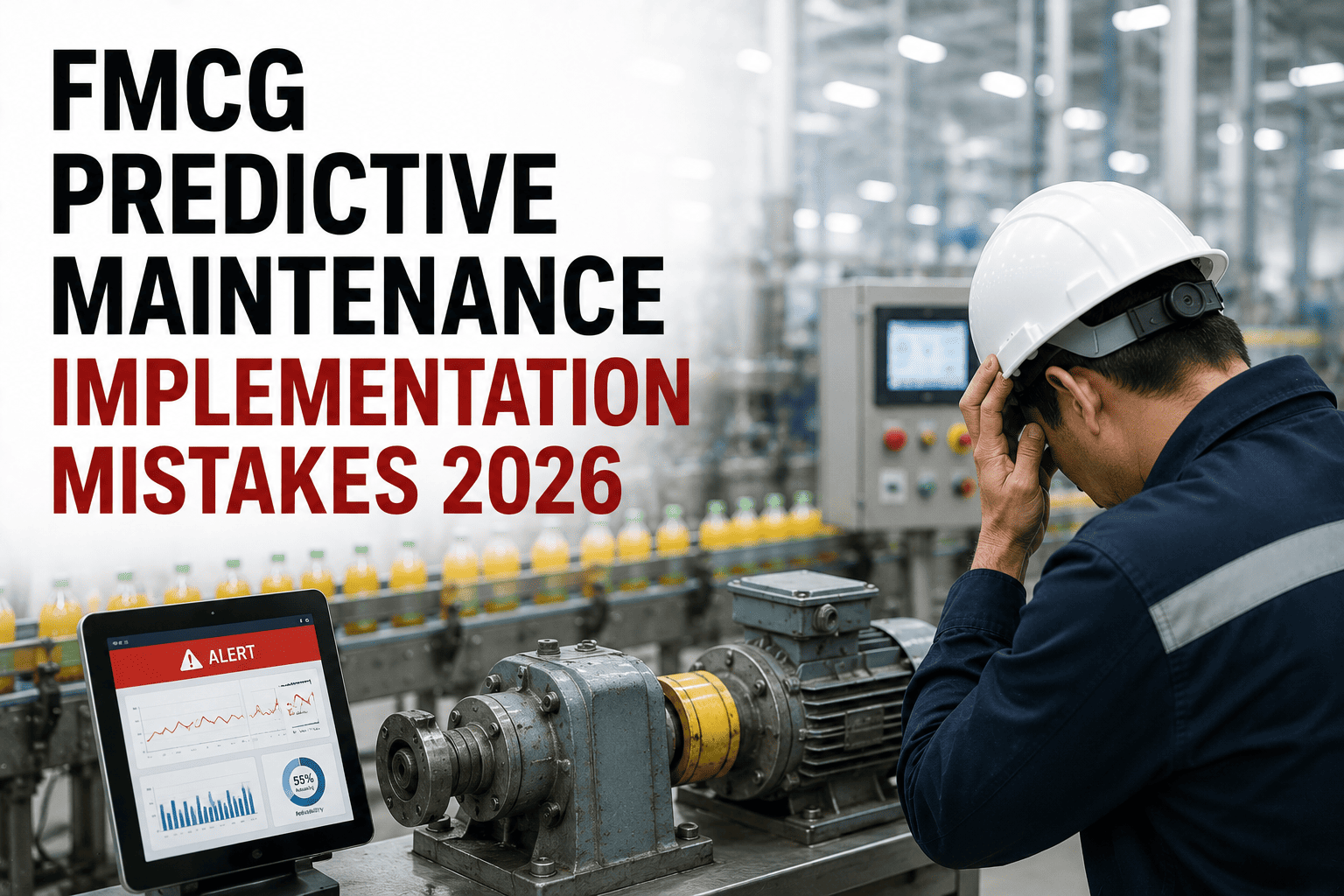
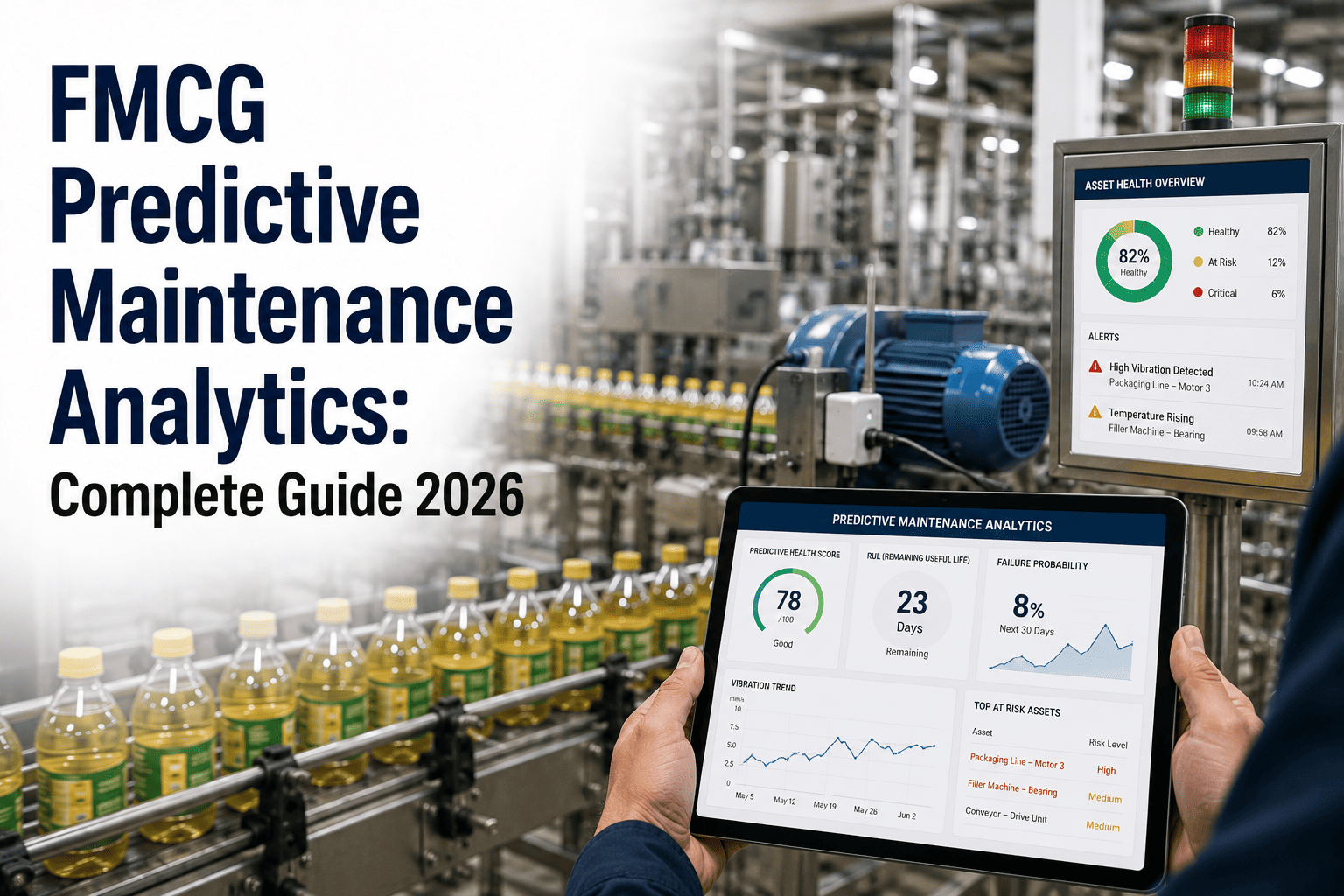
Most predictive maintenance programs don't fail with a dramatic collapse. They fail quietly, sensors reporting, dashboards updating, and nobody noticing that coverage stalled at a third of the plant and the models haven't been checked since go-live. The failure modes are well documented, which means they're also avoidable. Sign up to build a predictive maintenance program structured to avoid the mistakes that quietly stall most FMCG deployments.
What This 2026 Guide Covers
FMCG predictive maintenance implementations fail more often than they succeed, and the failure modes are well documented. This guide covers the common mistakes: wrong asset selection, poor data quality, lack of CMMS integration, and no reliability culture, plus the avoidance strategies that keep predictive investments on the value-delivery path.
<40%
Asset coverage where most stalled programs plateau
4
Failure modes that account for most stalled deployments
0
Model reviews many programs run after go-live
The Four Mistakes That Stall Most Programs
| Mistake |
Why It Derails The Program |
| Wrong asset selection |
Starting on low-impact or unpredictable assets makes early wins hard to find, and momentum stalls before coverage ever spreads |
| Poor data quality |
Gaps, mislabeled sensors, and inconsistent tagging quietly erode model accuracy long before anyone questions the alerts |
| Lack of CMMS integration |
Alerts that live in a separate dashboard from work orders get seen but not acted on, breaking the loop between signal and repair |
| No reliability culture |
Without technician buy-in and leadership follow-through, predictive alerts get treated as optional and adoption slowly fades |
Four Strategies That Keep A Program On Track
1
Coverage-Driven Asset Selection
Ranking assets by downtime cost and expanding coverage on a set schedule keeps the program from plateauing early
2
Data Quality Gates
Checking sensor tagging and data completeness before trusting a model's output catches quality issues before they compound
3
Closed-Loop CMMS Integration
Routing every confirmed alert straight into a work order closes the gap between a signal and an actual repair
4
Building A Reliability Culture
Technician training and visible leadership follow-through on alerts keeps predictive maintenance from becoming optional
Keep Your Predictive Program Out Of The Failure Statistics
OxMaint ties asset coverage, data quality checks, and closed-loop work orders together so alerts never stall in a separate dashboard. Sign up for a free trial to structure a predictive program built to avoid these mistakes, or book a demo to see how it maps to your plant.
What A CMMS Adds To Mistake Prevention
Coverage Tracking
Live visibility into what percentage of critical assets are actually monitored keeps expansion from quietly stalling
Data Quality Alerts
Gaps, dropouts, and mislabeled sensors get flagged automatically instead of silently degrading model accuracy
Model Performance Review Log
Scheduled model review dates stay tracked, so accuracy checks happen on a cycle instead of never after go-live
Adoption Metrics
Alert response times by technician and shift show exactly where reliability culture is taking hold and where it isn't
Predictive Maintenance Fails Quietly, Not Loudly
A stalled predictive program still shows dashboards, still generates occasional alerts, still looks active in a status meeting. The programs that actually deliver ROI are the ones tracking coverage, data quality, and model accuracy on a schedule, not the ones assuming the system is working because nothing has visibly broken.
Frequently Asked Questions
Q
What does insufficient asset coverage actually look like in practice?
It usually means a program launched strong on a handful of pilot assets and then never expanded further, leaving well below half the critical fleet monitored while the rest of the plant is still running on reactive or fixed-interval maintenance.
Q
Why does poor data quality kill a predictive program before anyone notices?
Sensor gaps and mislabeling degrade model accuracy gradually rather than all at once, so technicians start seeing more irrelevant alerts, lose trust in the system slowly, and stop responding long before anyone traces it back to the data.
Q
How often should predictive models actually be reviewed after go-live?
A quarterly review is a reasonable baseline for most FMCG applications, checking alert accuracy against actual outcomes so the model gets retrained before drift in product mix or line conditions quietly erodes its performance.
Don't Let Your Predictive Program Stall Quietly
OxMaint turns asset coverage, data quality, and model reviews into one tracked system instead of a dashboard nobody revisits. Sign up for a free trial to keep your predictive program on the value-delivery path, or book a demo to see it built around your plant.