
A bearing that costs $340 to replace during a planned window costs $18,000 when it fails catastrophically — pulling an entire FMCG line down for 6 hours, scrapping $42,000 of product, and triggering overtime across three shifts. Predictive maintenance using IoT sensors and AI gives FMCG plants 7–14 days of advance warning before failures occur. This is not theoretical — it is deployed, proven, and delivering 50–70% downtime reduction at plants running today. Start your free trial to deploy predictive maintenance on your critical assets. Book a demo to see AI failure predictions on real FMCG data.
The $18,000 Problem: What One Failure Really Costs
Most FMCG plants track repair cost but miss 80% of the true impact. Here is where the money actually goes when a critical asset fails without warning:
Notice that the direct repair — the number maintenance teams typically report — accounts for less than 10% of the total impact. The real damage is in lost production, scrapped in-process product, and cascade failures across interconnected equipment. A failed conveyor bearing does not just stop one conveyor — it starves the filler, backs up the labeler, and idles the case packer. FMCG lines are systems, not individual machines, and failures cascade through them at production speed.
This is why traditional maintenance KPIs — repair cost, MTTR, parts spend — understate the problem by 80%. And it is why predictive maintenance delivers ROI that seems too good to be true until you account for the full cost picture.
Reactive vs. Predictive: A Visual Comparison
Same bearing, same production line — two completely different outcomes depending on whether you have 14 days of warning or zero.
The difference is not better technicians or faster parts procurement — it is information. With 14 days of advance warning, the maintenance planner orders the $340 bearing through normal procurement (no expedite premium), schedules the replacement during the next planned changeover (zero production loss), assigns a technician during regular hours (no overtime), and the line never stops unexpectedly. The repair takes 45 minutes instead of 6 hours because there is no diagnosis, no waiting for parts, and no cascade damage to repair.
How It Works: 4-Stage Intelligence Pipeline
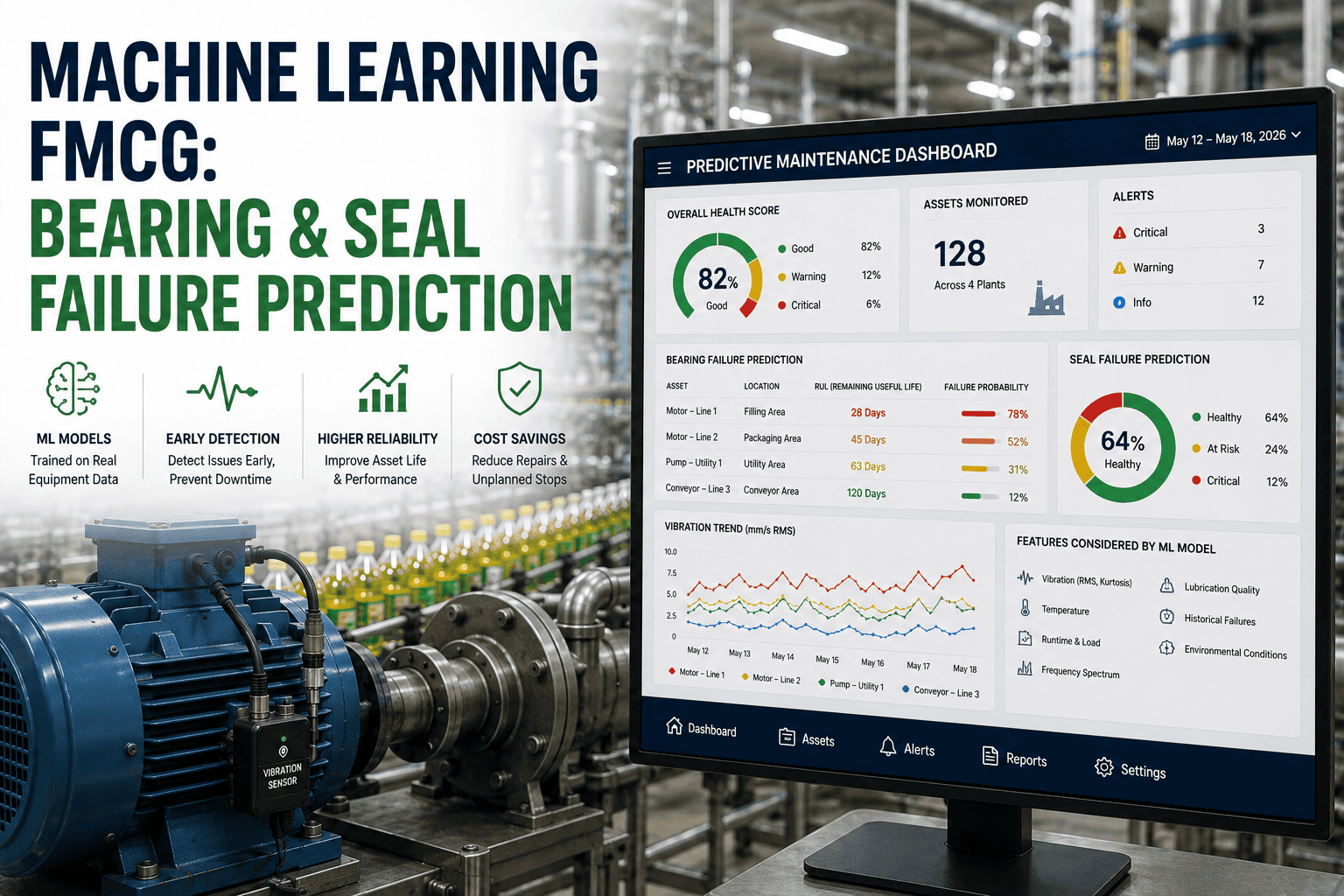
Predictive maintenance converts continuous sensor data into failure forecasts — here is the pipeline from raw signal to planned repair.
The critical difference between predictive maintenance and simple condition monitoring is Stage 3 — failure forecasting. Basic monitoring tells you something is wrong right now. Predictive analytics tells you that component X will fail in Y days with Z% confidence. That time window is what transforms maintenance from reactive firefighting into strategic planning. A 14-day warning window is enough to order parts at standard pricing, schedule the repair during a planned changeover, assign the right technician, and brief the production team — all without a single minute of unplanned downtime.
Prediction Windows by Equipment Type
Different FMCG assets give different amounts of advance warning. Here is how far ahead AI can predict failure for each critical asset category:
The prediction window depends on two factors: how gradually the failure mode develops and how sensitive the sensor is to early-stage degradation. Steam boilers degrade slowly through tube fouling and burner efficiency loss — giving 21–60 days of warning. Packaging seal systems degrade quickly when heating elements wear — giving only 3–10 days. This is why sensor selection must match the asset's dominant failure mode, not just stick a generic vibration sensor on everything.
For most FMCG plants, the sweet spot is instrumenting the 6 asset categories shown above. These account for 85% of unplanned downtime, and the sensor investment to cover them across a 5-line plant is $30,000–$50,000 — an amount that pays back multiple times with the first 2–3 prevented failures.
Three Strategies, One Winner
Here is how reactive, preventive, and predictive maintenance compare on the metrics that matter:
The critical insight is that preventive maintenance — while far better than reactive — still wastes money in two directions. It replaces components on calendar schedules rather than actual condition, meaning 25–30% of parts are changed prematurely (wasting parts cost and labor hours). Meanwhile, some components fail between PM intervals because their degradation pattern does not align with the fixed schedule. Predictive maintenance solves both problems by intervening based on actual equipment condition — not too early, not too late, but exactly when the data says intervention is needed.
The ROI at a Glance
Here is the annual math for a typical 5-line FMCG plant:
Even the most conservative scenario — where only half the predicted failures are actually prevented — delivers positive ROI within 6 months. The math is unambiguous: at $80K–$120K annual program cost, you need to prevent just 3–4 emergency events to break even. The average FMCG plant experiences 8–14 annually, and predictive maintenance prevents 50–70% of them. The question is not whether predictive maintenance pays off — it is how much capacity you are leaving on the table by waiting.
Real Catches: Disasters Prevented by Data
The pattern across hundreds of documented catches is consistent: the planned repair costs 5–15% of what the emergency repair would have cost. A $1,200 bearing replacement prevents a $274,000 shutdown. A $3,800 motor rewind prevents a $62,000 production loss. The sensor that detected each of these cost $150–$400 and will continue detecting failures for 3–5 years. These are not exceptional events — they are the normal, repeatable output of a properly deployed predictive maintenance program.
From Sensors to Predictions in 90 Days
Deploying predictive maintenance does not require replacing existing systems or instrumenting every asset on day one. Start with the 15–20% of assets that cause 60–70% of your emergency costs. Prove value fast. Expand with evidence.
The most important lesson from successful deployments: do not try to boil the ocean. Plants that attempt to instrument 200 assets on day one get overwhelmed by data, delay ROI, and lose team confidence. Plants that start with 15–25 sensors on their top failure-prone assets get their first validated catch within 4–8 weeks, generate immediate ROI documentation, and build the internal momentum that funds expansion. Every successful enterprise-wide predictive maintenance program started as a small pilot that proved itself fast.



-in-fmcg-a-step-by-step-guide-to-eliminating-recurring-failures.png)