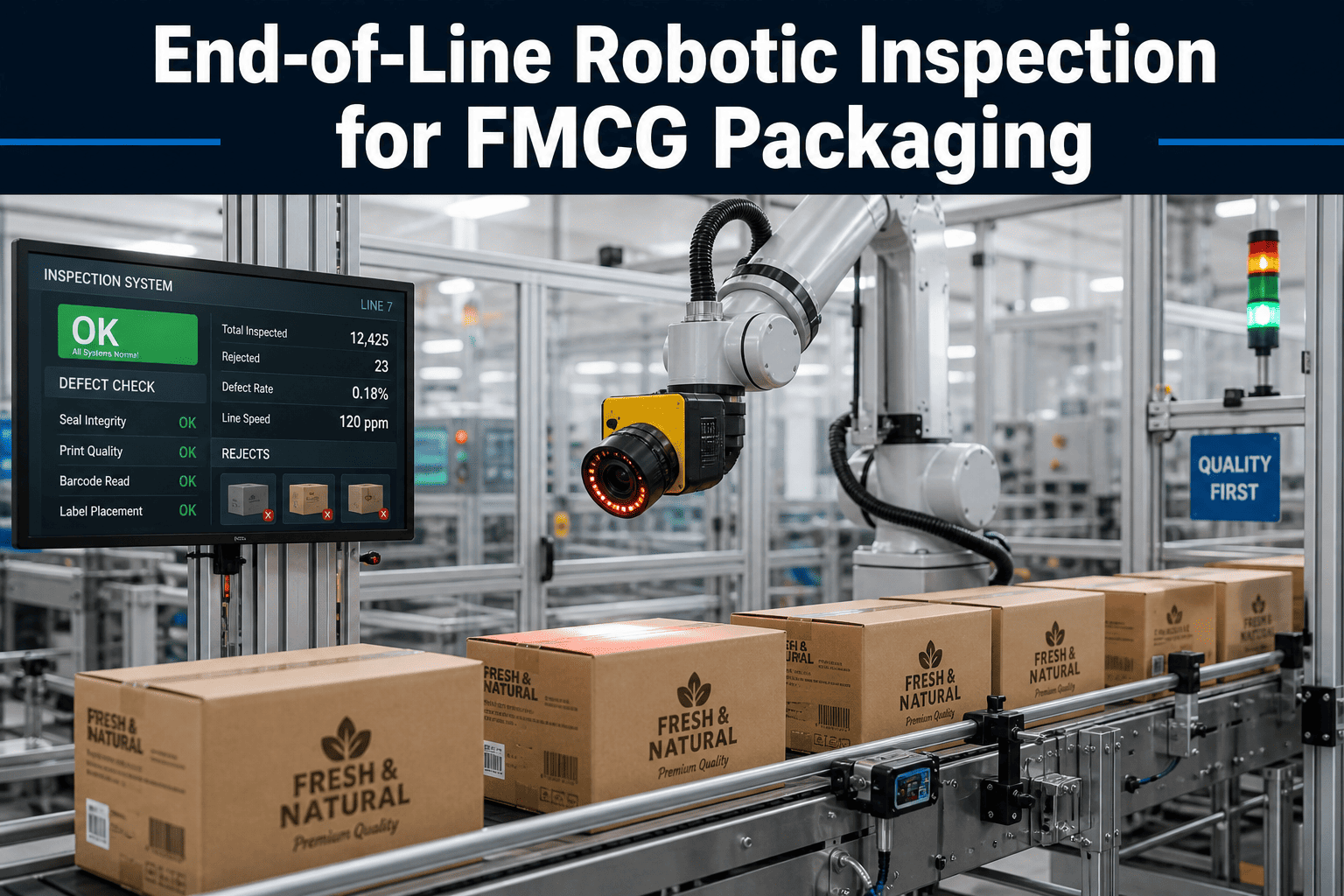
Label Inspection Robots for FMCG Packaging

By Oxmaint on February 13, 2026

label-inspection-robots-for-fmcg-packaging

At 2:47 AM on a Thursday in March, a high-speed labeling line at one of North America's largest household products manufacturers applied 14,000 units of incorrect regulatory text—a Spanish-language hazard warning printed on English-market bleach bottles. The AI vision inspection robot stationed downstream had been approving every unit. The reason: a firmware update three weeks earlier shifted the OCR reference library, and no one recalibrated the character recognition threshold. By the time a morning-shift QA technician caught the error visually, the pallets were staged for shipment. The recall cost $280,000. The retailer deducted an additional $65,000 in compliance penalties. The root cause wasn't the robot—it was the absence of a maintenance system that treated the vision camera as the mission-critical production asset it is. In FMCG packaging, label inspection robots are the last quality gate between your line and the consumer. When these systems drift, fail silently, or miss defects, the consequences cascade through your supply chain at production speed. The gap between deploying an AI vision system and maintaining it as a precision instrument represents the single largest unmanaged risk in modern packaging operations—talk to our team to learn how leading FMCG manufacturers are closing it.

The packaging inspection landscape is shifting: manufacturers are moving from periodic manual spot-checks toward continuous AI-powered label verification integrated directly into production workflows. Yet disconnected maintenance tools cost FMCG operations millions annually in undetected vision system degradation, missed recalibration windows, and preventable mislabeling events. A unified CMMS that treats every inspection robot as a managed asset—with automated work orders, calibration tracking, and performance analytics—transforms label quality from a reactive scramble into a documented standard of operational excellence. Start your free trial to see the platform in action.

78%
Of FMCG labeling defects are traceable to vision system drift or miscalibration
50%
Reduction in false-reject rates with scheduled vision system maintenance programs
$280K
Average cost of a single mislabeling recall event in consumer packaged goods

Achieve continuous label accuracy with AI vision maintenance intelligence

A modern label inspection architecture transforms packaging quality from a single-point camera check into a multi-layered verification ecosystem. Rather than trusting one vision station to catch every defect—print accuracy, barcode readability, regulatory compliance text, color fidelity, and placement alignment—integrated systems distribute inspection across specialized AI models, each maintained as an individual asset with its own calibration schedule, performance baseline, and degradation curve. When a system detects that its OCR confidence score has dropped below 98.5%, it doesn't just flag the reading—it auto-generates a recalibration work order before defective product reaches the end of line.

AI Label Inspection & Maintenance Ecosystem
CMMS PortalVision Asset Intelligence
OCR Verification
Regulatory Text, Ingredients, Lot Codes
Barcode & QR
1D/2D Readability, GS1 Compliance, Grading
Color & Print
Delta-E Measurement, Registration, Density
Placement & Skew
Label Position, Rotation, Wrinkle Detection
Seal & Tamper
Cap Presence, Shrink Band, Safety Seal
Camera Hardware
Lens, Lighting, Encoder, Trigger Timing

The critical insight driving AI vision maintenance is that inspection robots degrade predictably—and that degradation is detectable long before it causes a quality escape. When a camera's lighting uniformity drops 8% due to LED aging, false-reject rates climb before miss rates do. When a lens accumulates micro-contamination from packaging dust, edge detection sharpness degrades gradually across shifts. A CMMS that tracks these leading indicators converts them into scheduled maintenance actions, not emergency line stops—book a demo to see it in action.

Building a resilient inspection program — a maintenance priority playbook

Implementing a unified vision system maintenance program isn't about calibrating every camera on a fixed 90-day cycle—it's about risk-stratified prioritization. The following framework ranks vision system components by their impact on label compliance and consumer safety, then layers in automated diagnostics that transform raw performance telemetry into targeted maintenance actions. Under FDA 21 CFR Part 101 and CFIA labeling regulations, mislabeled consumer products carry strict liability—making inspection system uptime a regulatory compliance obligation, not just an operational preference.

Vision System Maintenance Priority Matrix
HIGHLabel Compliance ImpactLOW
CRITICAL PRIORITY
OCR / Regulatory Text VerificationAllergen Declaration AccuracyGS1 Barcode Grading ComplianceCountry-of-Origin Text Validation
Real-time Confidence Monitoring + Auto-WOs
HIGH PRIORITY
Color Fidelity (Delta-E) MeasurementLabel Placement & Skew DetectionPrint Registration AccuracyExpiration Date / Lot Code Readability
Shift-Start Verification + Weekly Calibration
MODERATE PRIORITY
Shrink Band / Tamper Seal PresenceCap Torque Verification CameraFill-Level Vision Check
Daily Trend Analysis + Scheduled PM
STANDARD MONITORING
Cosmetic Print Quality GradingPackage Orientation DetectionConveyor Tracking Encoder
Weekly Health Check + Quarterly Recalibration
LOWTechnical ComplexityHIGH

The Vision System Maintenance Framework

AI label inspection systems require layered maintenance intervals—from real-time confidence score monitoring to annual lens replacement cycles. Digital maintenance intelligence doesn't eliminate the need for vision system technicians; it ensures that when they intervene, they're focused on specific degradation patterns identified by data rather than performing blanket recalibrations. FMCG manufacturers report a 35% reduction in vision-related unplanned downtime and a 50% decrease in false-reject waste within the first year of structured maintenance—sign up to get started.

Vision System Diagnostic & Maintenance Framework

Real-Time
OCR confidence score monitoring (threshold: 98.5%)
Barcode grade tracking (minimum: ANSI C)
False-reject rate anomaly detection
Automated Watchdogs

Per Shift
Test target verification (golden sample pass/fail)
Lighting intensity measurement
Lens contamination visual check
Operator Checklist

Weekly
Camera alignment and focal distance verification
Encoder calibration (pixels-per-mm validation)
Trigger timing accuracy check
Reference image library version audit
Technician Work Order

Monthly
Full system calibration with certified test targets
LED array output measurement and replacement
AI model accuracy benchmarking vs. manual audit
Firmware and software version compliance
Field Validation + Certificate

Annual
Complete lens replacement cycle
Vision system hardware lifecycle review
AI model retraining with updated SKU library
Vendor performance evaluation and contract review
Strategic Capital Planning
Your Vision System Is Only as Good as Its Last Calibration
See how Oxmaint unifies your label inspection robots into a single maintenance intelligence platform with real-time confidence monitoring, automated work orders, and audit-ready calibration records.

Measuring what matters: KPIs for vision inspection operations

Vision system data without maintenance context is just noise. AI inspection robots generate terabytes of image data per shift, but packaging operations leaders need focused metrics that indicate system health, inspection reliability, and maintenance effectiveness. The following KPIs form the foundation of an effective label inspection maintenance program—schedule a demo to see how Oxmaint tracks them automatically.

Vision Inspection Operations Dashboard
All Systems: Operational
OCR ConfidenceTarget: ≥98.5%

99.1%
Average character recognition confidence across all active lines
False Reject RateTarget: <0.5%

0.3%
Good product incorrectly rejected — directly impacts OEE and waste
Barcode GradeMin: ANSI C

A-
Average GS1 barcode quality grade across all verified SKUs
Calibration ComplianceTarget: 100%

96%
Vision systems with current calibration certificates — 2 overdue
Miss Rate (Escapes)Target: 0

0
Defective labels reaching downstream — the ultimate quality metric
MTTR (Hours)Trend: Improving

2.8
Mean time to repair from vision alert to verified resolution

Expert perspective: the maintenance gap in AI-powered inspection

"

We invested $1.2 million in AI vision inspection across four packaging lines and assumed the technology would maintain itself. Within 18 months, our false-reject rate had climbed from 0.2% to 1.8%—costing us $400,000 annually in wasted good product—and our miss rate was creeping up because nobody was tracking camera lens degradation or lighting uniformity decay. The vision vendors sold us the cameras but not the maintenance framework. When we integrated everything into a CMMS with automated calibration scheduling and confidence-score monitoring, false rejects dropped back to 0.3%, our miss rate went to zero, and we recaptured 15% of our annual inspection maintenance budget by extending intervals on stable cameras and shortening them on drift-prone ones. The lesson: AI vision systems are precision instruments, not install-and-forget appliances.

— VP of Packaging Operations, National CPG Manufacturer
83%
Reduction in false-reject waste after structured maintenance
2.8hr
Mean time to repair — down from 12+ hours pre-CMMS
100%
Calibration compliance across all vision assets

The operational case for vision system maintenance extends far beyond preventing mislabeling recalls. Manufacturers that implement structured AI inspection maintenance protect brand equity, optimize line throughput by eliminating false-reject waste, and maintain the retailer trust that underpins their shelf placement. When a vision system fails silently, the cost isn't just the recall—it's the data gap in your quality record, the lost production during emergency recalibration, and the erosion of your ISO 9001 certification standing. Sign up for Oxmaint to build your vision maintenance program.

Conclusion: from installed cameras to managed quality assets

The label that ships with incorrect allergen text and the barcode that won't scan at the retailer's DC share a common root cause: a vision inspection system that was deployed as a capital purchase but never managed as a precision instrument. A unified CMMS doesn't replace vision system technicians—it equips them with predictive insight. When dashboards monitor OCR confidence, lighting uniformity, and calibration currency continuously, your inspection infrastructure becomes a self-diagnosing system that schedules its own maintenance before defects escape the line.

FMCG manufacturers that treat label inspection robots as managed assets achieve the trifecta of packaging quality: zero mislabeling escapes, minimal false-reject waste, and continuous audit readiness under ISO 9001, SQF, and retailer compliance standards. The technology exists. The ROI is proven—typically 10-15x the cost of the maintenance platform within the first year. The only question is whether your operation will continue to react to vision system failures or start predicting them to protect every label that carries your brand name.
Ready to Turn Your Vision Cameras Into Managed Quality Assets?
Discover how Oxmaint transforms label inspection robots from installed hardware into precision-maintained quality systems with real-time confidence monitoring, automated work orders, and audit-ready calibration records. Request a 15-minute operational walkthrough tailored to your packaging environment.

Frequently Asked Questions

What maintenance does an AI label inspection robot actually require?
AI vision inspection systems require layered maintenance at multiple intervals. Real-time monitoring tracks OCR confidence scores, barcode grading, and false-reject rates to detect degradation instantly. Per-shift checks verify golden-sample pass/fail accuracy and lighting intensity. Weekly maintenance covers camera alignment, encoder calibration (pixels-per-millimeter validation), trigger timing, and reference image library audits. Monthly work orders include full system calibration with certified test targets, LED array output measurement, and AI model accuracy benchmarking against manual audit results. Annually, lenses are replaced, hardware lifecycle is evaluated, and the AI model is retrained with the current SKU library. A CMMS automates all scheduling, escalation, and record-keeping for each interval.
How does CMMS software automate work orders for vision inspection systems?
The CMMS monitors vision system performance data in real time—OCR confidence, barcode grade, false-reject rate, and camera health metrics. When any parameter crosses a predefined threshold (e.g., OCR confidence drops below 98.5%), the system automatically generates a work order specifying the affected camera, the observed degradation, the required maintenance action, and the assigned technician. This eliminates the gap between detection and response. Work orders can also be triggered by calendar intervals (monthly calibration), cycle counts (every 500,000 inspections), or condition-based rules (lighting output below 90% of baseline). Every completed work order updates the asset's maintenance history, creating an audit-ready record for ISO 9001 Section 7.1.5 compliance.
What is the difference between false-reject rate and miss rate, and why do both matter?
False-reject rate measures good product incorrectly rejected by the vision system—this is a direct OEE and waste cost. Miss rate measures defective product that passes inspection undetected—this is a compliance and recall risk. Both metrics are symptoms of vision system health. A rising false-reject rate typically indicates early-stage degradation: the system is becoming overly sensitive due to lighting changes, lens contamination, or algorithm drift. If unaddressed, the same degradation eventually flips to increased misses as the system loses the ability to distinguish defects from normal variation. Tracking both metrics together in a CMMS provides a leading indicator of maintenance need long before a quality escape occurs.
Can we track third-party vision system vendor maintenance in the same platform?
Yes, and this is a best practice. Many FMCG manufacturers rely on vision system OEMs or integrators for annual calibrations and firmware updates. Oxmaint allows you to assign maintenance work orders to external vendors, require them to upload calibration certificates and test reports directly into the system, and track their response time and quality against SLAs. This creates a single source of truth where internal operator checks and external vendor calibrations share the same asset record—eliminating the gaps that occur when vendor service reports sit in email threads or filing cabinets rather than attached to the instrument's digital history.
How does vision system maintenance impact OEE in packaging operations?
Vision system health impacts all three OEE components. Availability suffers when an uncalibrated camera forces an unplanned line stop for emergency recalibration—typically 2-4 hours per event. Performance drops when operators reduce line speed because they don't trust the vision system's accuracy, or when false rejects force manual re-inspection of good product. Quality declines when defective labels escape inspection and generate rework, scrap, or recalls downstream. FMCG operations that implement structured vision maintenance consistently report 2-4 percentage points of OEE improvement in the first year, driven primarily by eliminating unplanned downtime and reducing false-reject waste by 50% or more. At $5,000-$15,000 per hour of lost production time on a high-speed packaging line, the ROI is typically realized within the first prevented incident.

Share This Story, Choose Your Platform!